Staff Augmentation vs Outsourcing in the UAE: Who Manages, Who Owns the Code, What You Sign
Staff augmentation vs outsourcing for UAE companies: who manages the people, who owns the code and accounts, what you sign, the risks and how to switch.
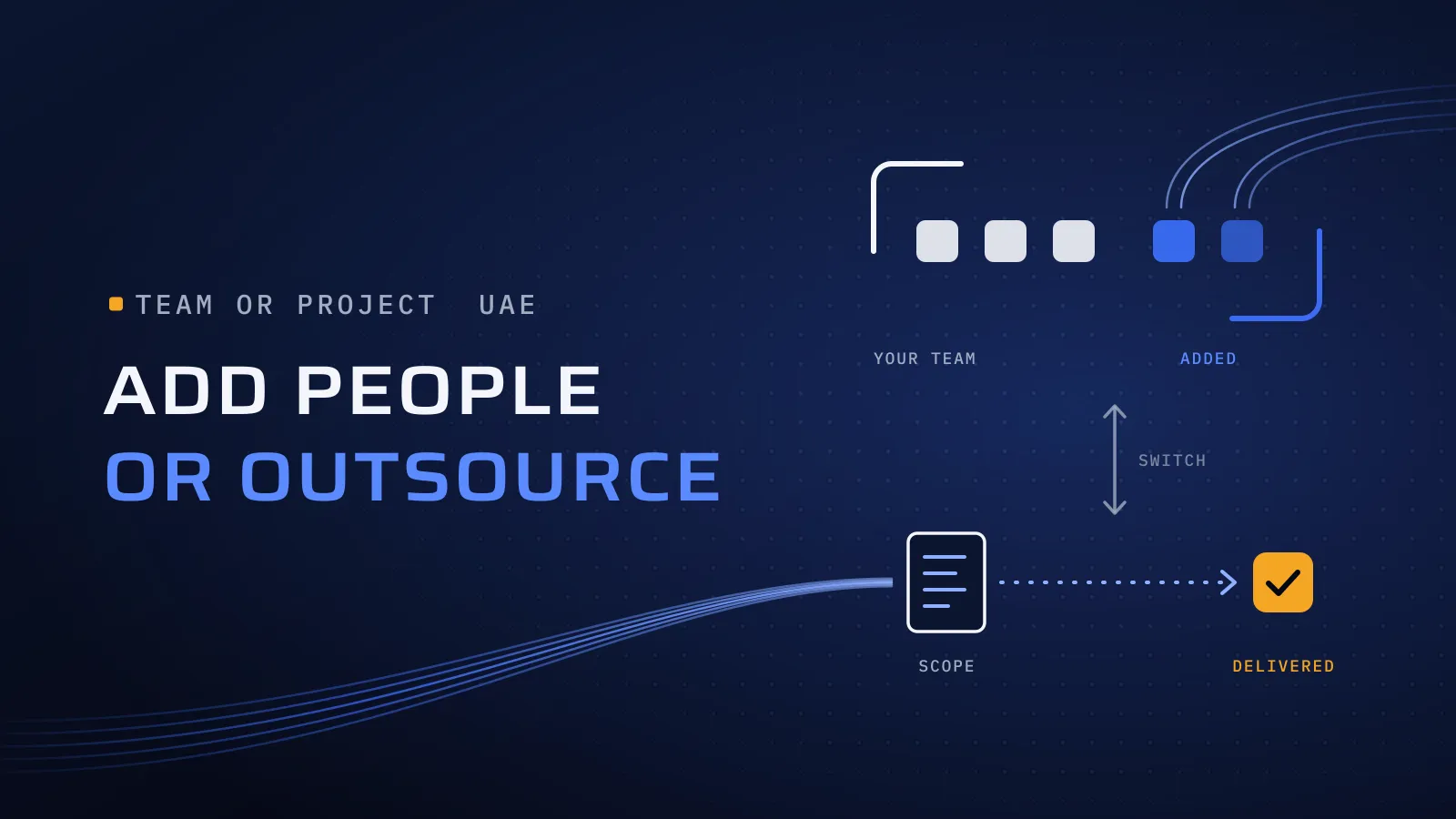
Staff augmentation vs outsourcing comes down to who runs the work. With staff augmentation, developers join your team and your lead directs them every day. With outsourcing, another company’s project manager runs the team until the agreed result is delivered and accepted. For a UAE company, the choice also decides whose accounts the code lives in, which days you share with the team and what you sign.
What is the difference between staff augmentation and outsourcing?
Quick answer: Staff augmentation adds people to your team: you choose them, direct their work and carry the delivery, while the provider handles their HR, payroll and replacements. Outsourcing hands over an outcome: the vendor manages its own team against a scope you sign off, and you accept the result. Augment when you have a lead and a moving backlog; outsource a clear scope when you don’t.
Have a lead and a backlog? See candidate profiles → Have a scope to hand over instead? Describe your project.
What the wrong model costs you
Augment without a lead, and the new developers wait for decisions while your most senior person turns into a dispatcher. Outsource a scope that changes every sprint, and each change becomes a change request and a later date. And if the repository or the app store listing sits in the vendor’s name, you learn what leaving costs on the day you want to leave.
Staff augmentation vs outsourcing, side by side
| Staff augmentation | Outsourcing (project delivery) | |
|---|---|---|
| What you buy | People, by role and seniority | A result: an agreed scope, delivered and accepted |
| Who directs the daily work | Your lead: priorities, stand-ups and code review | The vendor’s project manager; you approve the scope and accept each milestone |
| Who chooses the people | You interview the shortlist and decide | The vendor staffs its own team |
| Who carries the delivery risk | You: dates and quality follow your process | The vendor, against the scope and acceptance criteria |
| What you need on your side | Someone who sets priorities every day and reviews the work | One named decision-maker who answers questions and accepts each release |
| Where the work happens | Your tools, tracker and repositories | The vendor’s process, in repositories and accounts you should insist are yours |
| How you pay | A monthly fee per person | Per phase or milestone, or for the hours used |
You will also meet managed services in proposals: the vendor runs an ongoing function, such as support or maintenance, to agreed service levels. It suits a product after launch, not a build.
Who manages the people day to day?
With staff augmentation, you do. Your lead sets the priorities, runs the stand-up and reviews the code. The provider manages the employment: contracts, payroll, leave, performance reviews and replacements. If nobody on your side has time to direct developers every day, augmentation fails slowly, as tickets wait for answers.
With outsourcing, the vendor does. Its project manager runs the work and its tech lead reviews the code. You decide what is in scope, which trade-offs to accept and whether each release is done. Our guide to the product owner and product manager when you outsource sets out who decides what.
Who owns the code and the accounts?
Code in a repository you can open is not code you own. Whose name each account is in, and the contract’s IP clause, decide it. Check this list under either model.
| Asset | Whose name it should be in | Why it matters |
|---|---|---|
| Code repositories | Your company’s, with the vendor’s people added as named members | You keep the history, and access ends when you remove a person |
| Cloud accounts | Yours, billed to you | Production data and backups stay where you control them |
| Apple Developer and Google Play accounts | Yours | Moving a live app to another store account later is work you can avoid now |
| Domain and DNS | Yours | Whoever holds the domain holds your website and your email |
| Payment, SMS, maps and email services | Yours, with the keys in your own vault | A key from the vendor’s account stops working when that account does |
| Designs, tickets and documentation | Your design tool and your tracker | The next team, or your own, starts from them |
With staff augmentation this happens by default: people get named accounts in your tools. With outsourcing, some vendors start in their own repository and promise a handover at the end. Ask for your repository and accounts from the first commit, with the vendor as a member.
What do you sign for each model?
Both models use the same documents; what goes into them differs. Take this table to whoever reviews your contracts.
| Document | Staff augmentation | Outsourcing |
|---|---|---|
| NDA | Before any candidate sees your code or data | Before you share requirements, designs or data |
| Master agreement | Confidentiality, liability, payment and governing law | The same, plus any warranty on the delivered work |
| Statement of work | Per role: skills, seniority, start date, monthly fee, notice and replacement terms | The scope, deliverables, milestones, acceptance criteria and the change request process |
| IP clause | When the code and IP pass to you, and that it covers everything written for you | The same, plus what the vendor reuses from earlier work and the licence you get to it |
| Data terms | Which of your environments people may reach, with test data by default | The same, plus whether the vendor keeps copies of your data, where and for how long |
| Exit and handover | Notice terms, and access removed on the last day | What the handover includes: code, documentation, credentials, a walkthrough and any support after launch |
Holding a proposal already? Whether it offers people or a project, send it to us with anything confidential removed. We reply with the questions to ask and what we would change. Send us the proposal →
Where each model fits, and the risks
| Your situation | Fits better | Watch for |
|---|---|---|
| A tech lead, and a backlog bigger than the team | Staff augmentation | Your lead’s time: every new person needs onboarding and review |
| A skill you lack, such as Flutter, test automation or DevOps | Staff augmentation | Agree what the person leaves behind: tests, scripts and notes |
| No technical lead, and a defined MVP, portal or internal system | Outsourcing | Gaps in the scope: what isn’t written down isn’t in the price |
| A budget owner who approves a price per phase | Outsourcing, in phases | Change requests: agree how they are priced before the first one |
| A scope that changes every sprint | Staff augmentation | Without a fixed scope, the dates are yours to hold |
| A self-contained piece, such as a mobile app on your existing API | Outsourcing that piece | The API agreement between the two teams |
For a long-term product line with no time to hire, there is a third option: a dedicated team.
The risk in staff augmentation is that delivery stays with you: more people in a weak process make it weaker. The risk in outsourcing is distance: you see the work at reviews, and anything missing from the scope becomes a negotiation. Ask for a working build every iteration and acceptance criteria for every milestone, and compare firms with our checklist for choosing a software development company in Dubai.
The UAE side: the week, Arabic, data and VAT
- The week. Most UAE companies work Monday to Friday, and a team in Egypt works Sunday to Thursday, so you share four weekdays. With staff augmentation that shapes every stand-up and release; with outsourcing, book demos and acceptance on the shared days. The hours by season are in our guide to a development team in Egypt.
- Arabic. With staff augmentation, test Arabic in your interview for the roles that use it, as our guide to Arabic-speaking developers shows. With outsourcing, ask who reads your Arabic requirements and who tests the Arabic screens.
- Personal data. Augmented developers work inside your environment, under your access rules. An outsourcing vendor may build in its own, so ask whether it will hold copies of your data, and where. The UAE’s data protection laws include a federal law, separate DIFC and ADGM rules and a health data law; ask your legal adviser which apply to you.
- VAT. A VAT-registered supplier in the UAE adds VAT to its invoices. For services bought from abroad, a VAT-registered UAE company usually accounts for the VAT itself, under the reverse charge. Ask your accountant how each proposal will be invoiced, and compare them on the same basis.
How to switch between the models
What makes switching cheap is settled at the start: code and accounts in your name, tickets in your tracker, documentation written as you go, and handover terms in the first contract.
- From outsourcing to staff augmentation, often after launch, once you have a tech lead. Ask for a handover sprint: an architecture walkthrough, the deployment steps, open issues and every credential. Then add developers to the team your lead runs.
- From staff augmentation to outsourcing, often when your lead leaves or a piece of work is clear enough to fix. Turn the backlog into a written scope with acceptance criteria, and agree who now runs the team.
- Both at once. Augmented developers on your core product and one self-contained piece outsourced work well together. Name one person who owns the interface between them.
A checklist for choosing
| Question | If yes | If no |
|---|---|---|
| Can someone on your side set priorities and review code every day? | Staff augmentation can work | Outsource, or add CTO as a service before you augment |
| Can you write down today what “done” looks like? | Outsourcing can be priced and accepted | Augment, or start with product discovery |
| Will you still need these skills in three years? | Weigh hiring in-house for the core of it | Augment for the period, or outsource the piece |
| Is every repository and account in your company’s name? | Good, under either model | Fix that before anyone starts |
| Does the contract say how to switch, scale down and exit? | Sign | Ask for it first |
Send us a role brief or a scope. The roles, skills and hours you need, or what the project should do and who decides. We reply with how we would staff it and what we would ask first. See candidate profiles →
Not ready for a call? Ask for our company profile and we’ll send it to you.
How we work under either model
We offer both, so we have no reason to push you towards one.
Staff augmentation. We source candidates for your roles from the market, and from our core team where one fits, and screen each with a technical interview and a practical task. You interview the shortlist and choose who joins; HR, payroll and replacements stay with us. ButlerFM is facility management software, and our engineers joined ButlerFM’s own team. Talk to the team that worked on it: book a meeting.
Project delivery. Our core team runs the work: a project manager, CTO oversight, a tech lead, engineers and independent QA, with a build for you to review every iteration. Qargo is a car rental and ride-hailing platform we built for Qatar. Talk to the team that built it: book a meeting.
You sign with Flojics at Dubai Digital Park, Dubai Silicon Oasis. Our core team works from Egypt, Sunday to Thursday, Arabic-native and working in English. We also recruit roles beyond developers, as our guide to outsourcing to Egypt explains.
Pick the model first, then the people
Since 2014 we have worked with more than 100 clients across the UAE, Saudi Arabia, Qatar, Kuwait, the USA and Canada. Compare all four ways to work with us on our engagement models page, or see how staff augmentation in the UAE works. Augmenting? Vet the developers before anyone joins.
See candidate profiles → We ask about your goal, what you use today, your timing and who else should be involved. You leave with clear next steps. We reply by email first and set up a call only if you want one. Asking commits you to nothing, and we sign an NDA first if you ask.
Frequently asked questions
How is staff augmentation different from outsourcing?
With staff augmentation, people join your team: you choose them and direct their work, and the provider handles their HR, payroll and replacements. With outsourcing, a vendor delivers an agreed scope with its own team and project manager, and you accept the result. The first needs a lead on your side; the second needs a clear scope.
Which fits a company without a tech lead?
Usually outsourcing, because the vendor's project manager and tech lead run the work while you decide the scope and accept each release. If you want people inside your team anyway, add technical leadership first, such as CTO as a service, so someone can set priorities and review the code.
Who owns the code?
Keep the repositories and accounts in your company's name under either model, with the vendor's people added as members. Ownership of the code and IP is set by the contract. With us, it passes to you at the end of the contract term or project, once it is completed and paid.
Can we start with outsourcing and move to staff augmentation later?
Yes, often after launch, once you have a tech lead. Ask for a handover sprint covering the architecture, the deployment steps, open issues and every credential, then add developers to the team your lead runs. It costs least when the code and accounts were in your name from the start.
Is outsourcing the same as managed services?
No. Outsourcing a project delivers an agreed scope. Managed services run an ongoing function, such as support or maintenance, to agreed service levels, so you pay for the service rather than for people or a scope. It suits a product after launch, not a build.
Does VAT work differently for staff augmentation and outsourcing in the UAE?
No, it works the same way for both. A VAT-registered supplier in the UAE adds VAT to its invoices; for services bought from a supplier abroad, a VAT-registered UAE company usually accounts for the VAT itself under the reverse charge. Ask your accountant how each proposal will be invoiced, and compare them on the same basis.