Product Owner vs Product Manager When You Outsource Software: Who Decides What
Outsourcing software? You play the product manager, and the agency's product owner turns your goals into a backlog. See who decides what, and where a CTO fits.
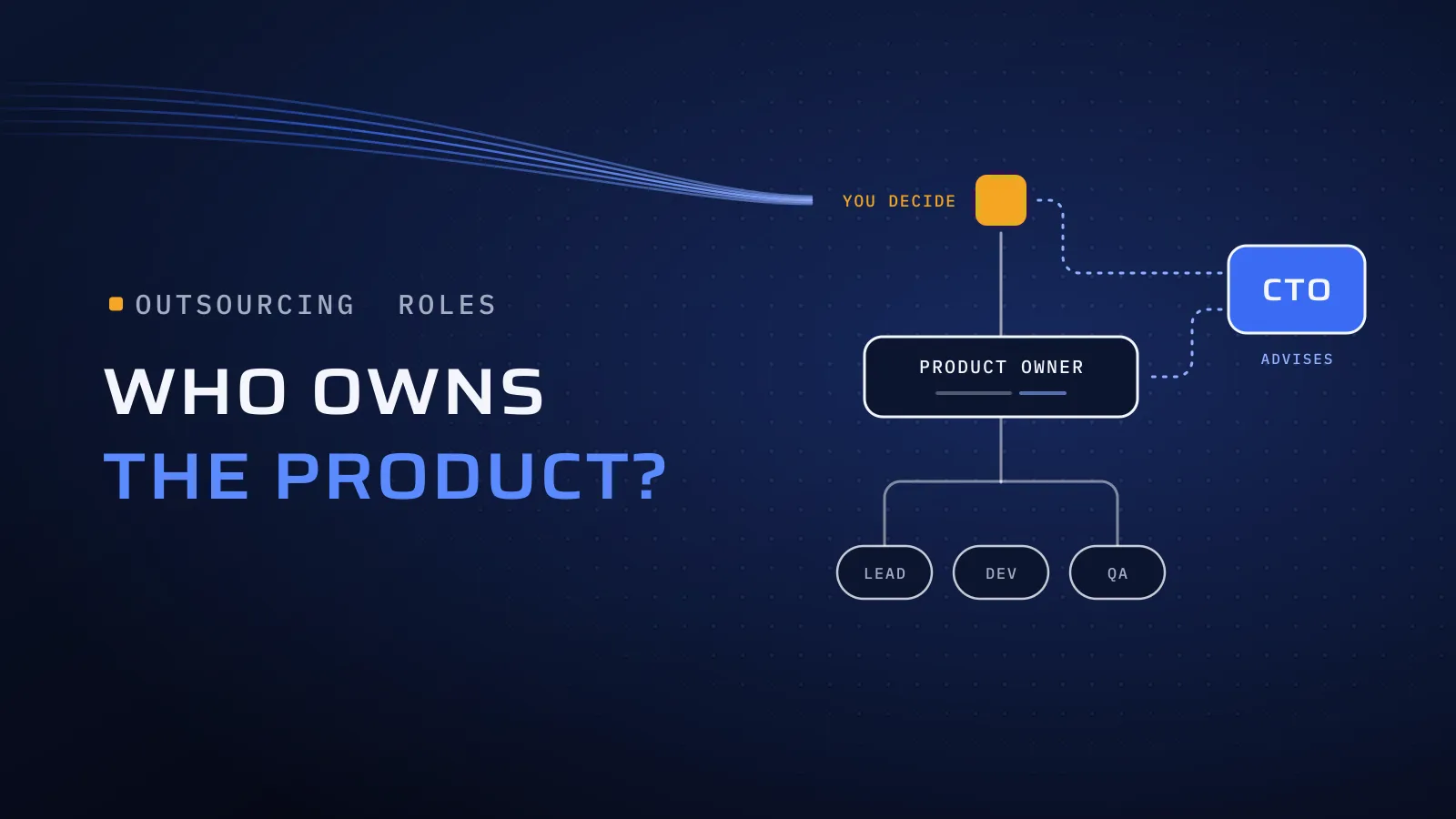
This guide is for founders and business owners about to hand their first software build to an outside team. When you outsource, you are the product manager, and the agency’s product owner turns your goals into work its team can build. Get that split wrong and you pay for features nobody approved, or wait on decisions nobody knew were theirs.
Who is the product owner when you outsource software?
Quick answer: In an outsourced build, the client plays the product manager: you set the goal, the budget and the launch date, and you decide which release you accept. The agency’s product owner sits between its software team and your stakeholders. They turn your goals into a ranked backlog with clear acceptance criteria, and bring every trade-off back to you. If you have no technical team, add CTO as a service as your advice layer on the technical calls. The final decisions stay with you.
Ask about CTO as a service → Or send us one question about your setup. We reply by email first and set up a call only if you want one.
What a blurred split costs you
When nobody has written down who decides what, the same problems show up:
- Two voices, one team. Your operations manager asks a developer for one thing, your sales lead for another, and both get built.
- “Done” means different things. Nobody wrote acceptance criteria, so the team calls a release finished and you can’t accept it.
- Decisions stuck in a queue. The team needs an answer, doesn’t know who gives it, and builds around the gap.
All three are cheap to fix before the build starts.
Product owner vs product manager: how the roles split with an agency
In a product company, both roles sit on one payroll. When you outsource, the line between them becomes the line between your company and the agency.
You are the product manager. You, or your product manager if you have one, own the why: who the product is for, what makes it worth switching to, the budget, the launch date and the results you expect. Competitor analysis for startups shows how to find that selling point before you brief anyone. You also give the final yes or no on each release, which is why Mountain Goat Software calls the client in contract development the true product owner: the client accepts or rejects what is built (Mountain Goat Software).
The agency’s product owner sits between the team and your stakeholders. They turn your goals into a backlog the developers can build: user stories, acceptance criteria that say what “done” means, and an order of work. They gather input from the people who will use or run the product, such as operations, finance, sales and a few real customers, settle the conflicts they can, and bring the rest to you with a recommendation. Your developers hear one set of priorities, not five.
The two roles pull in different directions on purpose. You push for what the business needs; the product owner protects a first release small enough to ship, and says no to extras for the reasons in KISS and YAGNI. MVP vs MMP vs MLP shows how that release grows in stages, and software product discovery is where the first backlog usually comes from.
What about a “fractional product owner” or “product owner as a service”? Usually a part-time product owner you contract separately, to sit between you and a vendor. On projects we deliver, the product owner comes with the team, next to the project manager, CTO oversight, the tech lead and independent QA.
Who decides what: a RACI table for an outsourced build
Use this table to agree the split in your first meeting with any vendor. D = decides, the final say. R = does the work and proposes. C = consulted before the decision. I = kept informed.
| Decision | You (founder or product manager) | Product Owner | Project Manager | CTO as a service | Tech Lead | Independent QA |
|---|---|---|---|---|---|---|
| Product goal, budget and launch date | D | C | C | C | I | I |
| What the first release includes, and what waits | D | R | C | C | C | C |
| The order of work for the next cycle | D | R | C | C | C | I |
| User stories and acceptance criteria | D | R | I | I | C | C |
| Architecture, stack and calls that are expensive to reverse | D | C | C | R | C | I |
| Dates, the plan, and the trade-off when a date is at risk | D | C | R | C | C | C |
| Code reviews and engineering standards | I | I | I | R | R | C |
| Testing each feature, edge cases included | I | C | I | I | C | R |
| Accepting a release | D | R | C | C | C | R |
What this means for you: you are the only D in the table. The team does the work and brings you options; you make every call that changes what you get, what it costs or when it lands. Code reviews and testing have no D: they are how the team keeps its promises, and you see their results at every review. That takes one named decision-maker, not a technical background.
Why the product owner and project manager are two people: how we run delivery. Why QA stays independent of the developers: quality assurance in software development.
Product owner vs CTO: what to build vs how to build it
The product owner owns what gets built and in what order. The CTO owns how it is built: the architecture, the stack, the data model and the integrations.
Take a request that sounds small, such as letting one customer account order for several branches. The product owner brings the business case and where it ranks. The CTO brings what it touches underneath, the way accounts, orders and permissions are structured, and what changing that costs now versus later. You see both views and decide. Without the CTO, the “small” request often becomes a shortcut every later feature must work around.
What changes when you have no technical team
If your company has a product lead but no CTO or IT lead, every technical proposal comes from the people who will build it, and nobody on your side can test it. You approve an architecture you can’t question, and an investor or a large client asks about it later.
That is where CTO as a service fits: the advice layer between your business and the build. With us, it means:
- Options in plain words. Each big technical call comes with the choices, what each means for you later, and a recommendation.
- A check on the build. Reviews of the architecture and the team’s work against the standards agreed at the start.
- A written decision log. Every call recorded with its reason, ready for an investor’s technical review or your first full-time CTO.
- Your side in technical meetings. The CTO sits with you at the reviews where technical calls are made.
The CTO recommends and you decide, as CTO as a service in Dubai sets out.
Not sure who should own what on your side? Tell us who leads the product, who will use it, and whether anyone technical is on board. We reply with the split of roles we would suggest. Ask about CTO as a service →
Want something to share with your partners first? Ask for our company profile and we’ll send it to you.
Which setup fits your company?
Most companies start in one of the first two rows and move down as they hire.
| Your side today | What you keep | What the agency brings | CTO as a service? |
|---|---|---|---|
| A founder with an idea, and no product or technical team | The goal, the budget and every final decision | Product owner, project manager, tech lead, developers and independent QA | Yes: it is your technical voice |
| A business with an operations or product lead, but no IT lead | One named decision-maker as product manager | The same delivery team | Yes, for the architecture, integrations and investor questions |
| A product manager and an IT lead or CTO of your own | Product direction and technical sign-off | A product owner who turns your product manager’s goals into a backlog, plus the build team | Optional, for big architecture calls |
| Your own product owner and engineers, short of hands | The backlog and the technical lead | Engineers who join your team through team extension | Usually not needed |
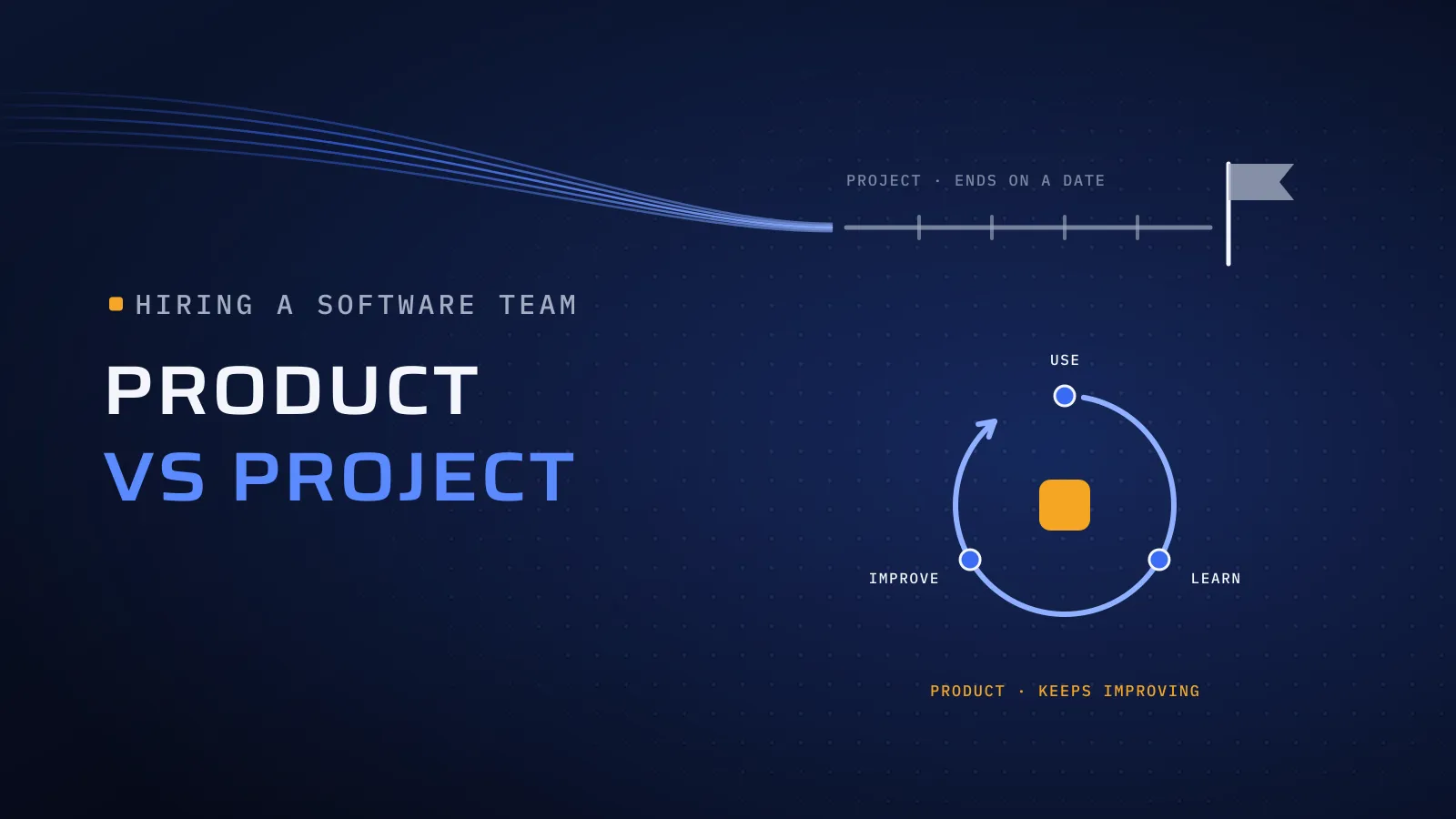
The four ways to work with us set out who runs the day-to-day work in each case. Also ask any vendor whether success means the delivery date or what users do after launch; product mindset vs project mindset lists the questions.
Your side’s checklist before the build starts
Whoever builds for you, settle these first:
- Name one decision-maker. The Scrum Guide calls the product owner “one person, not a committee” (Scrum Guide), and the same holds for whoever gives the final yes on your side. Partners, a board or a family council are consulted; one person signs off.
- List your stakeholders, and who breaks a tie. Operations, finance, sales, branch managers: the product owner hears them all and needs to know whose view wins.
- Agree what “done” means. Acceptance criteria for every feature, approved by you before the build, not argued over at release.
- Book the review at the end of every cycle. That is where you see working software and make the calls in the table.
- Decide the language of the work. In the GCC, the people who run a process often work in Arabic while the build team writes in English. Agree the language of the requirements, and have native Arabic readers accept the Arabic screens. Our core team are native Arabic speakers who work in English.
- Start outside approvals early. A payment gateway’s merchant account, UAE PASS access, app-store accounts in your company’s name: the product owner tracks them, but only your company can apply, and a late start moves the launch.
- Keep accounts and code in your name from the first day.
Where we have done this
Qargo is a car rental and ride-hailing platform in Qatar, and we led its technical direction and architecture. Talk to the team that built it: book a meeting.
ButlerFM is facility management software, and our engineers joined ButlerFM’s own team. Talk to the team that worked on it: book a meeting.
Settle who decides what before you sign
Since 2014 we have built software for more than 100 clients across the UAE, Saudi Arabia, Qatar, Kuwait, the USA and Canada. Our delivery teams are built around the roles in the table above.
Ask about CTO as a service → Tell us who leads your product today and what you plan to build, and you get back the split of roles we would suggest and the technical decisions to settle first. We reply by email first and set up a call only if you want one. Asking commits you to nothing, and we sign an NDA first if you ask.
Frequently asked questions
Who is the product owner when you outsource software development?
Day to day, the agency's product owner. They sit between the software team and your stakeholders, turn your goals into a ranked backlog with acceptance criteria, and bring every trade-off back to you. You keep the final say, because you decide which release you accept. In practice, the client plays the product manager and the agency provides the product owner.
What does the client's product manager do on an outsourced project?
They own the why: who the product is for, what makes it worth switching to, the budget, the launch date and the business results. They approve the scope, the order of work and each release. If you have no product manager, a founder or one named decision-maker plays the role.
What is a fractional product owner?
A part-time product owner you contract on their own, often to sit between your company and a software vendor. "Product owner as a service" usually means the same thing. On projects we deliver, the product owner is part of the team you get, together with the project manager, CTO oversight, the tech lead and independent QA.
What is the difference between a product owner and a CTO?
The product owner owns what gets built and in what order. The CTO owns how it is built: the architecture, the stack, the data model and the integrations. When a feature touches the structure underneath, you get both views on one page and decide.
We have no technical team. Do we need CTO as a service?
Usually, yes. Without anyone technical on your side, every technical proposal comes from the people who will build it, and nobody can question it for you. CTO as a service is the advice layer between your business and the build: options in plain words, reviews of the architecture and the team's work, and a written decision log.
Who makes the final decisions, us or the agency?
You do. The product owner, the project manager and the CTO prepare the options and recommend. You decide the goal, the scope, the order of work, the big technical calls and which release you accept. Code reviews and testing are how the team keeps its promises, and you see their results at every review.
How much of my time does this take?
One named decision-maker, a regular slot at the review at the end of each cycle, and quick answers when the product owner needs a decision. You don't need a technical background, because the options come to you in plain words.