How to Vet Dedicated Developers: A 12-Point Checklist Before Anyone Joins Your Team
How to vet dedicated developers from a vendor: a 12-point checklist for CTOs, from the technical task and code review to access, hours and replacements.
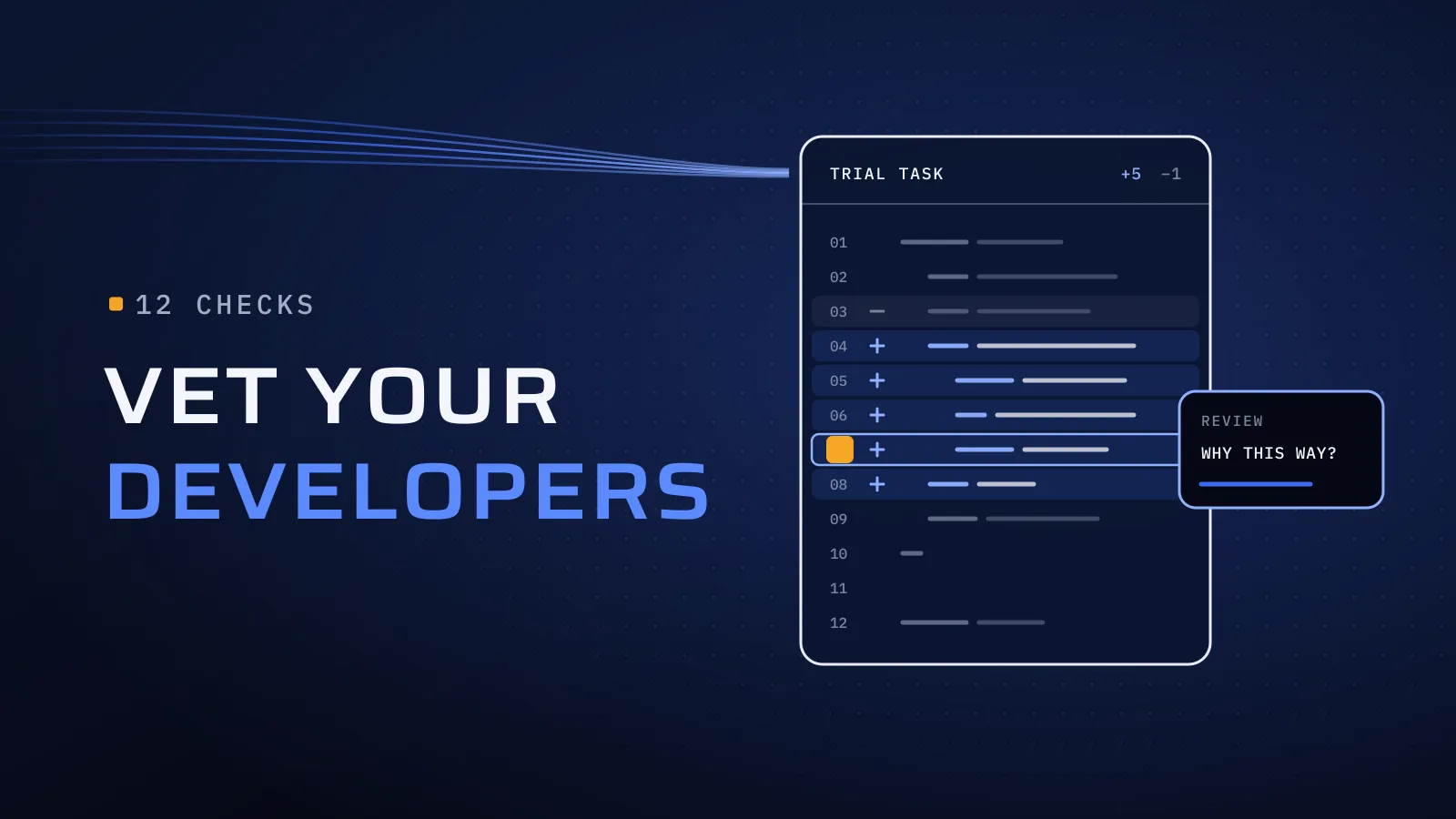
Knowing how to vet dedicated developers decides what a vendor’s shortlist does to your team: add capacity from the first sprint, or add review work for your seniors. A CV and a friendly call tell you little. A task from your own backlog, a review of code the candidate wrote and a clear set of working terms tell you most of what you need before anyone touches your repositories.
How do you vet dedicated developers from a vendor?
Quick answer: Vet the person and the terms. Set a technical task from your own work, review code the candidate wrote, and interview in the language the role works in. Then check the vendor’s side: the hours you share, how access is granted, who manages the developer, and how a replacement is found if the fit is wrong.
Know the roles you need? See developer profiles for your roles →
What a weak fit costs you
A developer who interviewed well but can’t work alone costs more than the fee. Your tech lead’s reviews turn into rewrites, questions wait for the next stand-up, and tickets come back reopened. It often takes two or three sprints to be sure, and by then you have paid for the seat, spent your lead’s time and are starting the search again. An afternoon of proper vetting per candidate costs far less than one of those sprints.
How to vet dedicated developers, step by step
- Write the brief as a scorecard. The stack and versions, the seniority, the hours the role must share with you, the language it works in and what good looks like after 30 days. Put Arabic only on the roles that use it; our guide to Arabic-speaking developers for hire shows how to mark it.
- Read the vendor’s notes before you meet anyone. Ask what was tested, who tested it and where the candidate was weaker. A shortlist without notes means you do the screening twice.
- Set a task from your own backlog. Small, close to a real ticket and in your stack. Judge the structure, the tests and the questions the candidate asks, not only whether it runs.
- Review code they wrote. Ask the candidate to explain their task, line by line, or a sample they are free to share: why it is built that way, what they would change and how they would test it. People who wrote the code explain it easily.
- Check the terms with the same care. Hours, access, management, replacements and exit are rows 7 to 12 of the checklist below. Settle them before the first day, not after the first problem.
The 12-point vetting checklist
Take this to your interviews and to the vendor call. Every row is something you can check before anyone joins.
| # | Check | What good looks like | Warning sign |
|---|---|---|---|
| 1 | Real work in your stack | Named projects in your stack and versions, with the candidate’s own part in each | A CV listing ten frameworks with no projects behind them |
| 2 | The vendor’s screening | A technical interview by a senior engineer and a practical test, with notes shared with you | “Our recruiters checked the CV” |
| 3 | Your interview, your decision | You interview every candidate and approve each person | People assigned to you without an interview |
| 4 | A technical task you set | A task from your own work, judged by your own engineers | Only the vendor’s generic test |
| 5 | A review of their own code | They explain their choices and what they would change | They can’t explain code they submitted |
| 6 | Communication in your working language | Clear written English in a ticket or pull-request description, spoken English in the interview, and Arabic where the role uses it | Fluent small talk, but no written sample |
| 7 | Overlap hours | A named window inside your day, with the stand-up time agreed in writing | “Flexible hours”, with no window |
| 8 | Security and access | An NDA before any access, named accounts in your tools, and only the access each task needs | Shared logins, or access before paperwork |
| 9 | Where the code lives | Your repositories from the first commit | The vendor’s repository, handed over “at the end” |
| 10 | Who manages them | Named: who sets daily priorities, and who handles HR, payroll and reviews | Nobody named, or everything relayed through a salesperson |
| 11 | Replacement terms | Written in your proposal: the vendor sources again and you interview the new candidates | “We’ll just swap someone in” |
| 12 | Reporting and exit | Monthly reporting, performance reviews and scale-down terms agreed up front | Hours logged, and nothing else |
How to read it: rows 1 to 6 test the person; rows 7 to 12 test the vendor. A strong candidate from a vendor that can’t answer rows 7 to 12 still puts your code and your calendar in someone else’s hands.
Bring the checklist to us. Send your role brief: the roles, stack, seniority and the hours you need to share. We reply with how we would source each role and what we would test before you meet anyone. See developer profiles for your roles →
Not ready for a call? Ask for our company profile and we’ll send it to you.
How our process answers the checklist
When you hire dedicated developers in Dubai through us, this is what each row gets.
- Rows 1 and 2. We source candidates for your roles from the market, and from our core team where one fits. Each is screened for real project experience in your stack, then has a technical interview with a senior Flojics engineer, a practical assessment relevant to the role and a team-fit interview on ownership, collaboration and remote-work habits. You get the profiles with our assessment notes.
- Rows 3 to 5. You interview every candidate, can set your own technical task and decide who joins. Nobody starts without your yes.
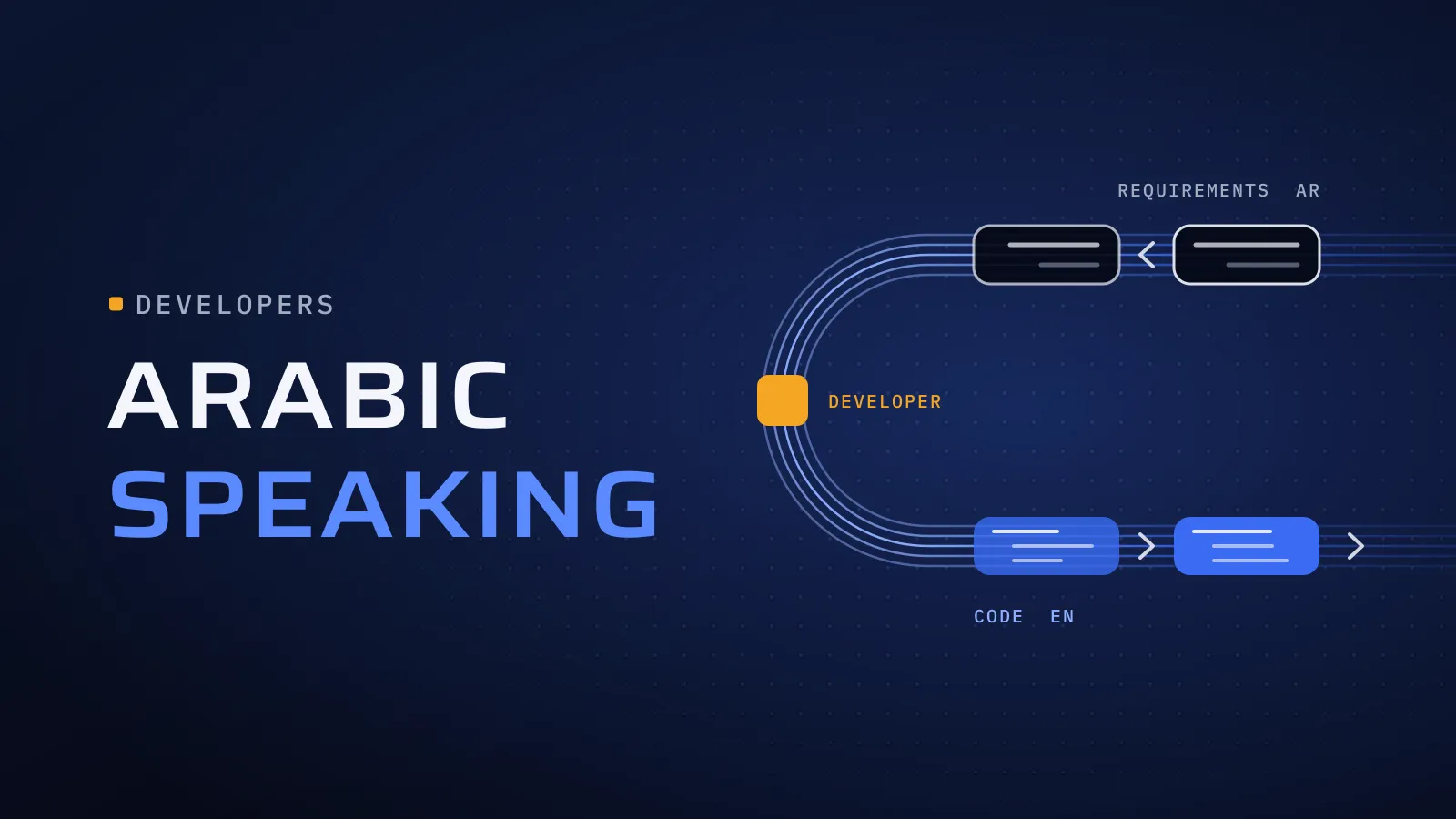
- Row 6. Our screening includes an English check, written and spoken, plus Arabic where your project needs it. Our core team are native Arabic speakers who work in English.
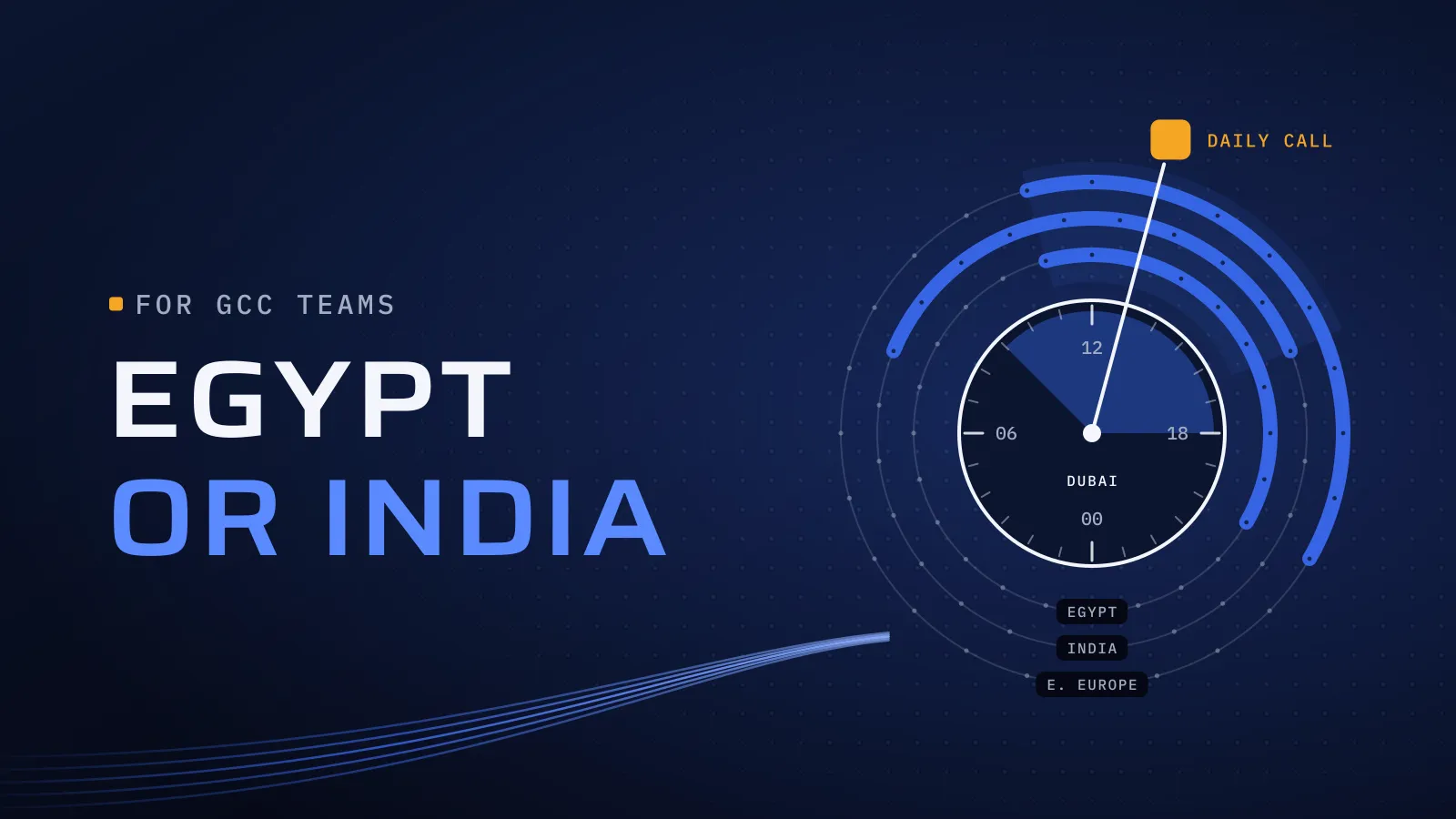
- Row 7. Our core team works from Alexandria, Sunday to Thursday, one to two hours behind UAE time. A Monday-to-Friday office shares four weekdays with us; teams in Saudi Arabia, Qatar and Kuwait share all five.
- Rows 8 and 9. The NDA, master agreement and statement of work come first. Then access to your tools, repositories and channels, and the code stays in your repositories.
- Row 10. On staff augmentation you manage the developer day to day: your stand-ups, tools and priorities. On a dedicated team you own the priorities and our delivery lead runs the team’s process. Either way, your account manager at Flojics handles contracts, HR, payroll and performance reviews.
- Rows 11 and 12. Replacements are our job: we source and shortlist again, and you interview the new candidates. You get monthly reporting and account manager check-ins, and you scale up or down on the terms in your proposal.
Proof: engineers inside a client’s own team
ButlerFM is facility management software for cleaning and maintenance businesses, and our engineers joined ButlerFM’s own team to fill its gaps. Talk to the team that worked on it: book a meeting.
Vetting doesn’t end on day one. On a dedicated team, two of our pillars keep checking the fit: CTO oversight, so senior technical leadership supervises the work and architecture calls never rest on one engineer, and transparent delivery, with clear milestones, reporting and communication, so you judge each person on the work delivered.
Vet the people, then the terms
Since 2014 we have worked with more than 100 clients across the UAE, Saudi Arabia, Qatar, Kuwait, the USA and Canada. Hiring for a team in Riyadh, Doha or Kuwait City? See staff augmentation for Saudi Arabia, Qatar and Kuwait, on your Sunday-to-Thursday week.
See developer profiles for your roles → We ask about your goal, what you use today, your timing and who else should be involved. You leave with clear next steps. The call commits you to nothing, and we sign an NDA first if you want one.
Frequently asked questions
Can we set our own technical task?
Yes. You interview every candidate on the shortlist, can set your own technical task and approve only the people you want. Our practical assessment comes first, so your task can test how the candidate fits your codebase rather than the basics.
How soon can a vetted developer start?
We agree the start date with you once you have chosen from the shortlist. Each person is sourced for your role, so the date follows the skills you need, and you can begin with one developer while the rest of the team is recruited.
What if a developer passes vetting but isn't right once they start?
Tell your account manager. Replacements are our job: we source and shortlist again, and you interview the new candidates as before. The code and documentation stay in your repositories, so nothing is lost while the new person settles in.
Do we vet a dedicated team differently from one developer?
Each person goes through the same checks, and you approve every one. For a team, also meet the delivery lead who will run its process, and agree the reporting before day one. You keep the priorities; we handle HR, payroll and replacements.
Who owns the code the developers write?
You do. It sits in your repositories from the first commit, and the code and IP pass to your company at the end of the contract term or project, once it is completed and paid.