How to Choose a Software Development Company in Dubai: A Weighted Scorecard
How to choose a software development company in Dubai: a weighted scorecard out of 100, four types of firm and when each fits, plus checks for app projects.
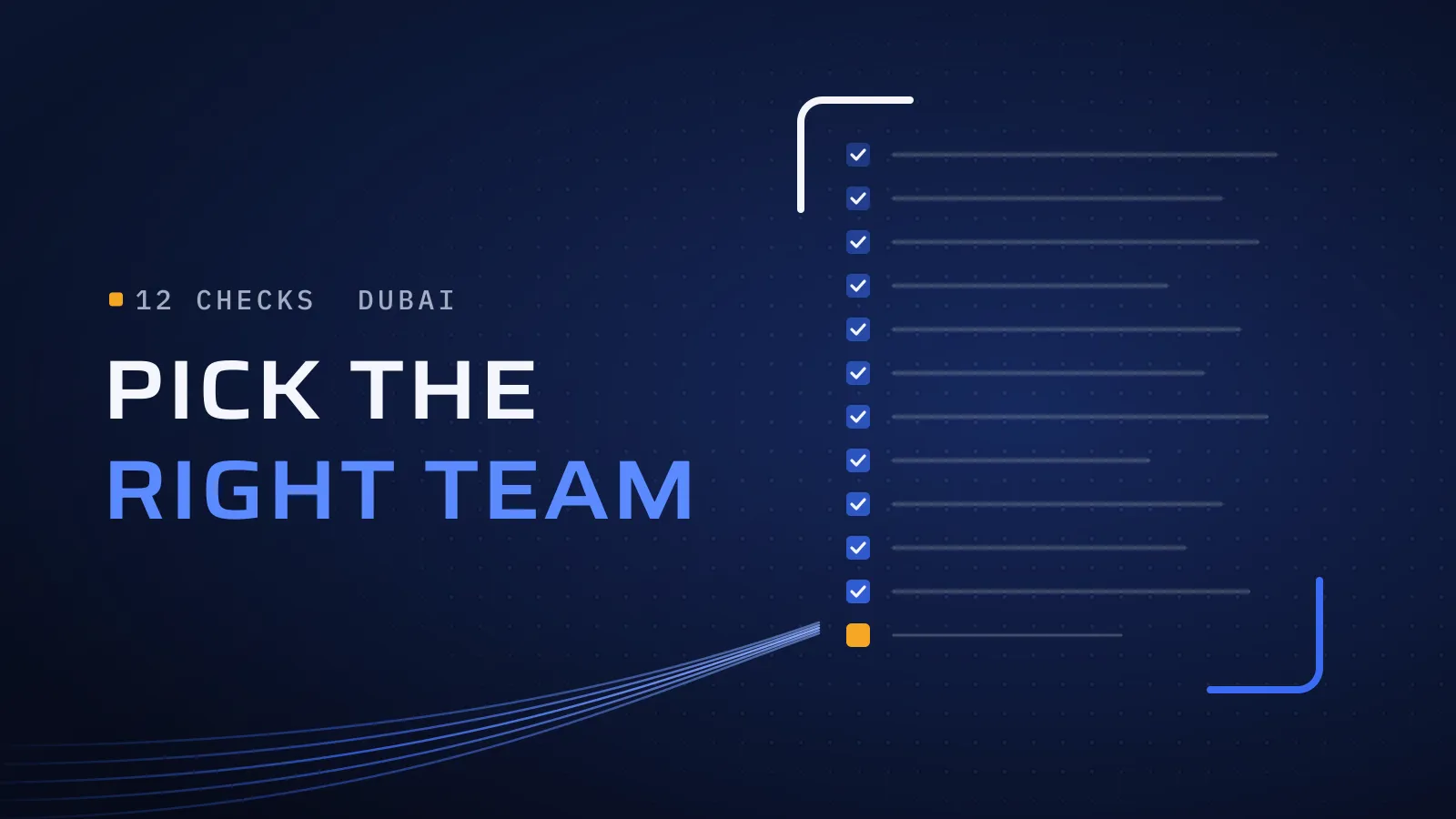
How to choose a software development company in Dubai comes down to one question: will this team ship something your users keep using, and leave you owning it? A weighted scorecard turns that into a number, so you compare firms on evidence you can check rather than on the slickest pitch.
How do you choose a software development company in Dubai?
Quick answer
Score each shortlisted firm from 1 to 5 on eight criteria, weight the scores and add them up to a total out of 100. Weight the evidence most: live products you can download, who actually builds yours, and written data and IP terms. As a rule of thumb, shortlist firms that score 70 or more, then call their references.
Adding us to your shortlist? Talk to us about your project →
What a wrong pick costs you
The first invoice is rarely the expensive part. The cost shows up later: a launch date that slips, a second team paid to learn or redo the code, and customers stuck on the old process for longer. Half a day spent scoring three firms properly is the cheapest insurance you’ll buy on the project.
How to run the comparison
- Write a one-page brief. The business problem, who will use the software, the must-haves for the first release, the systems it connects to (your ERP, payment gateway or UAE PASS), a budget range, a target date and who decides on your side. If you need a formal tender, our free software RFP template turns the same points into a Word document vendors answer section by section.
- Shortlist three to five firms. Use referrals and directory listings with verified client reviews.
- Score each firm after a call and a look at their live work, not from their website. Have two people on your side score separately, then compare.
- Ask the two highest scorers for a discovery step and a written proposal that names the team, what each phase delivers and the milestone dates, with assumptions, exclusions and VAT stated.
- Call two references each, then decide.
The scorecard
| Criterion | Weight | Scores 5 when | Scores 1 when |
|---|---|---|---|
| Portfolio with live store links | 20 | Apps and platforms you can download or log into, with the client named, close to yours in complexity | Only screenshots and mock-ups, with nothing you can open |
| Who actually builds it | 15 | Named people and roles, where each one sits, and any subcontracting disclosed | The team is “to be assigned”, or the people you meet only sell |
| Data and IP terms | 15 | Written terms for when the code and IP pass to you, an NDA before access, code and store accounts in your company’s name, data rules agreed before access | Vague on who owns the code, or the repository stays in their account |
| A discovery step | 10 | Hard questions before a price, and an estimate that shows the team, what each phase delivers, the assumptions and the exclusions | A fixed quote within a day, with no questions asked |
| UAE entity and office | 10 | A UAE trade licence, an office you can visit and a TRN on every tax invoice | A Dubai phone number, with the contract and invoices coming from abroad |
| Arabic and right-to-left (RTL) | 10 | Live Arabic interfaces with proper RTL layouts, and UAE PASS or local payment gateways where you need them | Arabic treated as translated text dropped into an English layout |
| Post-launch support | 10 | A warranty period, a support plan with response times, and yearly iOS and Android updates covered | Support “on request”, priced later |
| References you can call | 10 | Two or three clients with similar projects who take your call | No references, or only ones you can’t reach |
How to score: give each firm 1 to 5 on every row, multiply by the weight, add the eight results and divide by 5 for a total out of 100. If a row doesn’t apply, say your users don’t read Arabic, move its 10 points to discovery or support so the total stays at 100.
Which type of company fits your project
| Type | Fits when | The trade-off |
|---|---|---|
| A local firm with a UAE entity and its own team | You want one contract under UAE law, people you can meet, Arabic and local integrations, and the same team after launch | Fewer people than a global consultancy can put on site. Check that “local” includes the people who build |
| An offshore firm with a Dubai sales office | The scope is well defined, price drives the choice and you can manage work across time zones | The people you meet are not always the ones who build it. Check which entity signs and where each person sits |
| Freelancers and marketplaces | A small, well-defined task: a prototype, a landing page or a fix | One person holds the knowledge, with no QA or cover, and you manage the work and the handover |
| A global consultancy | A large, multi-country programme where change management and board reporting matter as much as the build | Higher fees and a longer start, and senior people often sell while others build |
Where we sit, and when we’re not the right fit. Flojics is the first type: a UAE company at Dubai Digital Park, Dubai Silicon Oasis, with offices in Dubai, Houston and Alexandria, and a core team of CTO, project managers, QA and engineers in Dubai and Egypt. We’re not the right fit if a ready-made product already solves most of your problem (buy it, and we’ll tell you so), if you need hundreds of people on site across several countries, or if what you need is hosting, hardware or networks rather than software.
Want an estimate to score against the others? Send us:
- the app or system type;
- the platforms: iOS, Android, web;
- the main features for the first release;
- whether you need Arabic;
- the systems it connects to.
We reply with a suggested first scope, the effort, the team and the price per phase, and the way of working that fits. Get an estimate for your project →
Buying for a larger organisation? Request the company profile for your procurement file, and we’ll send it to you.
Extra checks for a mobile app partner
If the project is an app, push harder on the portfolio and support rows:
- Use two of their apps for ten minutes each. If something feels awkward even though nothing is broken, your users will feel it too. Smooth UI and UX is what keeps an app installed.
- Ask how they learn about your users before design starts: interviews, a clickable prototype, a look at the apps your customers already use. The product has to revolve around the user.
- Check the whole team, not only developers: business analysis, UI/UX design, front-end and back-end development, and QA.
- Ask who publishes the app and handles the yearly iOS and Android updates. The store accounts should be in your company’s name.
Budgeting the build? Our guide to mobile app development cost in Dubai shows the phases, the team and what moves the effort.
How we answer the scorecard’s hardest rows
Two of the ways we work answer the scorecard’s hardest rows. CTO oversight: every project is supervised by senior technical leadership, so you know who makes the technical calls. Transparent delivery: clear milestones, reporting and communication, with working software to review before each milestone.
You can work with us in four ways: project delivery, staff augmentation (you choose developers from our shortlist), time and materials for small or changing scopes, or a dedicated team recruited for you. See how the four engagement models compare.
Spoiled is a home beauty services app we built, published on the App Store and Google Play, so you can download it and try it. Talk to the team that built it: book a meeting. More of our custom software development and app work is on our work page.
Score us with the rest
We have worked with more than 100 clients since 2014. Book a discovery call and put us through the scorecard. We ask about your goal, what you use today, your timing and who else should be involved. You leave with clear next steps. We reply by email first and set up a call only if you want one. Asking commits you to nothing, and we sign an NDA first if you ask.
Frequently asked questions
How much does custom software cost in Dubai?
It follows the effort: the roles on the team and how much each one has to build. A focused first release typically needs a delivery lead, a UI/UX designer, front-end and back-end developers and a QA engineer; a platform with many user roles and integrations needs more roles, working in parallel, for longer. Ask every firm for its team and what each phase delivers, so you compare quotes like for like. With us, you get the effort, the team and the price once we know your scope.
How long does it take to build custom software?
It follows the scope. A focused MVP is the quickest; a mid-sized business application takes longer; a complex platform with many user roles and integrations takes longest and needs more roles working in parallel. Releasing in phases puts working software in users' hands sooner. Ask each firm for a plan with dated milestones; with us, yours is agreed in your proposal.
Is a local Dubai company safer than an offshore team?
A UAE entity gives you a contract under UAE law and people in your time zone you can meet. What matters even more is who builds the product and whether you can try their past work. Many firms, ours included, pair a Dubai contract with engineers in a nearby time zone, so ask where each person sits and score the answer.
What questions should I ask a software development company before hiring it?
Ask who will build your product and where they sit, who reviews the architecture, whether QA is independent of the developers, how a change request is priced, how you will see progress, and which past projects you can try. For a Dubai contract, ask which UAE entity signs. Send us those questions too; we answer by email first.
Who owns the code?
Your company should, and the contract should say when. Ask when the code and IP pass to you, and for the repository and app store accounts to be in your company's name from day one. With us, the accounts can be yours from the start, and the code and IP pass to you at the end of the project, once the contract is completed and paid. An NDA comes first if you want one.
Is fixed price or time and materials better?
Fixed price per phase suits a clear scope, such as an MVP. Time and materials, billed by the hour, suits small or changing work, because you only pay for the hours used and can change priorities as you go. Many projects start with a discovery step and then run phase by phase, so you approve each cost before it starts.
What if the project goes wrong halfway?
Set it up so you never lose what you paid for. Each phase is accepted against agreed criteria, and the code, documentation and credentials stay in your accounts, so another team can pick the work up. Agree the handover steps in the contract, and the decision to change course stays yours.