Staff Augmentation vs Hiring In-House in the UAE: The Real Cost
Staff augmentation vs in-house hiring in the UAE: time to hire, recruitment, visas, notice, flexibility and management load compared, and when each fits.
Staff augmentation vs in-house hiring comes down to how long your roadmap waits for the person, and how much of the hiring, HR and risk you carry yourself. In Dubai, a new developer brings a search, interview rounds, a visa and often a notice period of up to three months before they write a line of code. An augmented developer joins your team on a date agreed in your proposal, and you still choose who joins and direct the work.
Staff augmentation vs in-house: what changes for you?
Quick answer
An in-house developer is your employee: you run the search, visa and HR, wait out a notice period and carry the costs beyond salary. With staff augmentation, the provider sources candidates, you choose who joins, and HR and replacements stay with the provider, for one monthly fee. Hire in-house for core roles; augment for capacity or missing skills.
Need developers on your roadmap this quarter? Plan your team →
What waiting for a hire costs you
A developer already working in the UAE usually serves a notice period of 30 to 90 days, as u.ae explains. Add the search, the interviews, the offer and visa processing, and a new hire can take months to start. Every one of those months is a release your customers don’t get, or a backlog your current team carries alone, while your leads spend their hours on CVs and interviews instead of the product.
Staff augmentation vs in-house hiring, side by side
| One developer | Hire in-house | Staff augmentation |
|---|---|---|
| Time to start | Search, interviews and offer, then a 30 to 90-day notice period and visa processing | A start date agreed in your proposal, after your interviews |
| Recruitment effort | Your team briefs an agency or writes the ad, screens CVs, runs every interview round and onboards | We source from the market and screen: a technical interview with a senior Flojics engineer and a practical task. You interview the shortlist and choose |
| Visas and HR admin | Yours: visa, work permit, Emirates ID, health insurance, payroll, leave and end-of-service records | Ours. HR and payroll sit with us |
| Scaling up or down | Each new role is a new hiring round; reducing the team means ending employment contracts, with notice and end-of-service pay | Add or reduce people as your roadmap changes, on the notice terms in your proposal |
| If someone leaves or doesn’t fit | You wait out their notice, or end the contract, then start a new search | We source a replacement and you interview again |
| Knowledge retention | Builds up in your company over the years, and leaves with whoever resigns | Code, tickets and documentation stay in your repositories and tracker, so a replacement picks up where the last person stopped |
| Management load | You manage the person and everything around them: reviews, leave, career growth and admin | You direct the daily work; our account manager handles HR, performance reviews and a monthly report |
| Who directs the work | You | You |
| Fits when | A core role you’ll need for years, close to the business, or work that has to happen on site | 6 to 18 months of extra capacity on a backlog you run, or a skill you lack, such as mobile or test automation |
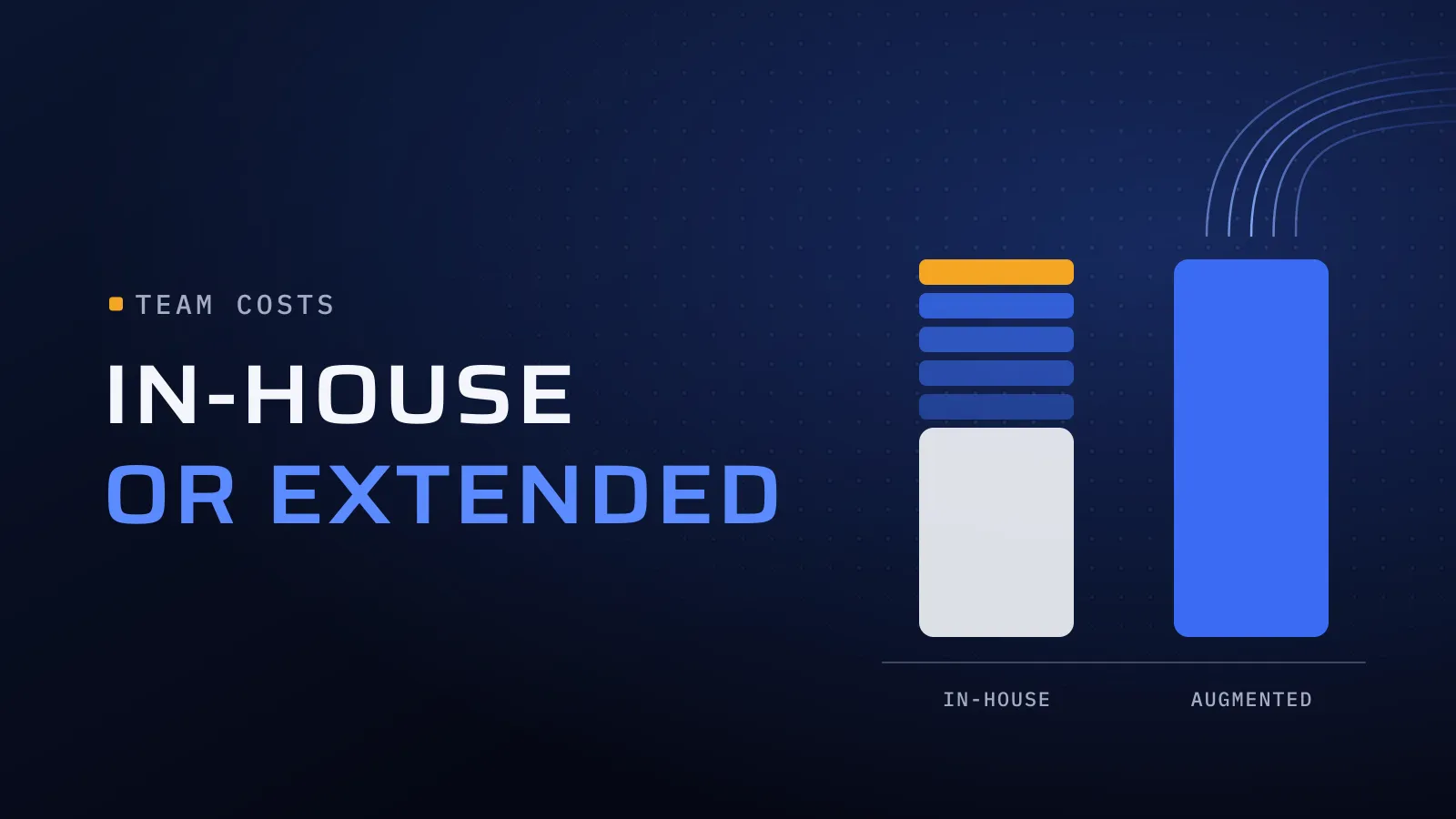
An employee also costs more than the salary. A UAE employer pays for recruitment or an agency, the visa and work permit, health insurance, end-of-service gratuity that grows with every year of service, a laptop and licences, and a desk. With staff augmentation, those sit with the provider, inside one monthly fee per developer.
Many companies end up with a mix: a small in-house core of product and tech leads, and augmented developers adding capacity around them.
Three questions that decide it
- Will you still need this role in three years? If yes, and it sits close to your customers or your strategy, hire in-house. If the need is tied to a backlog, a launch or a skill gap, augment.
- Who will run the hiring? If nobody on your team has weeks to screen, interview and handle HR, an in-house search will stall the work it was meant to speed up.
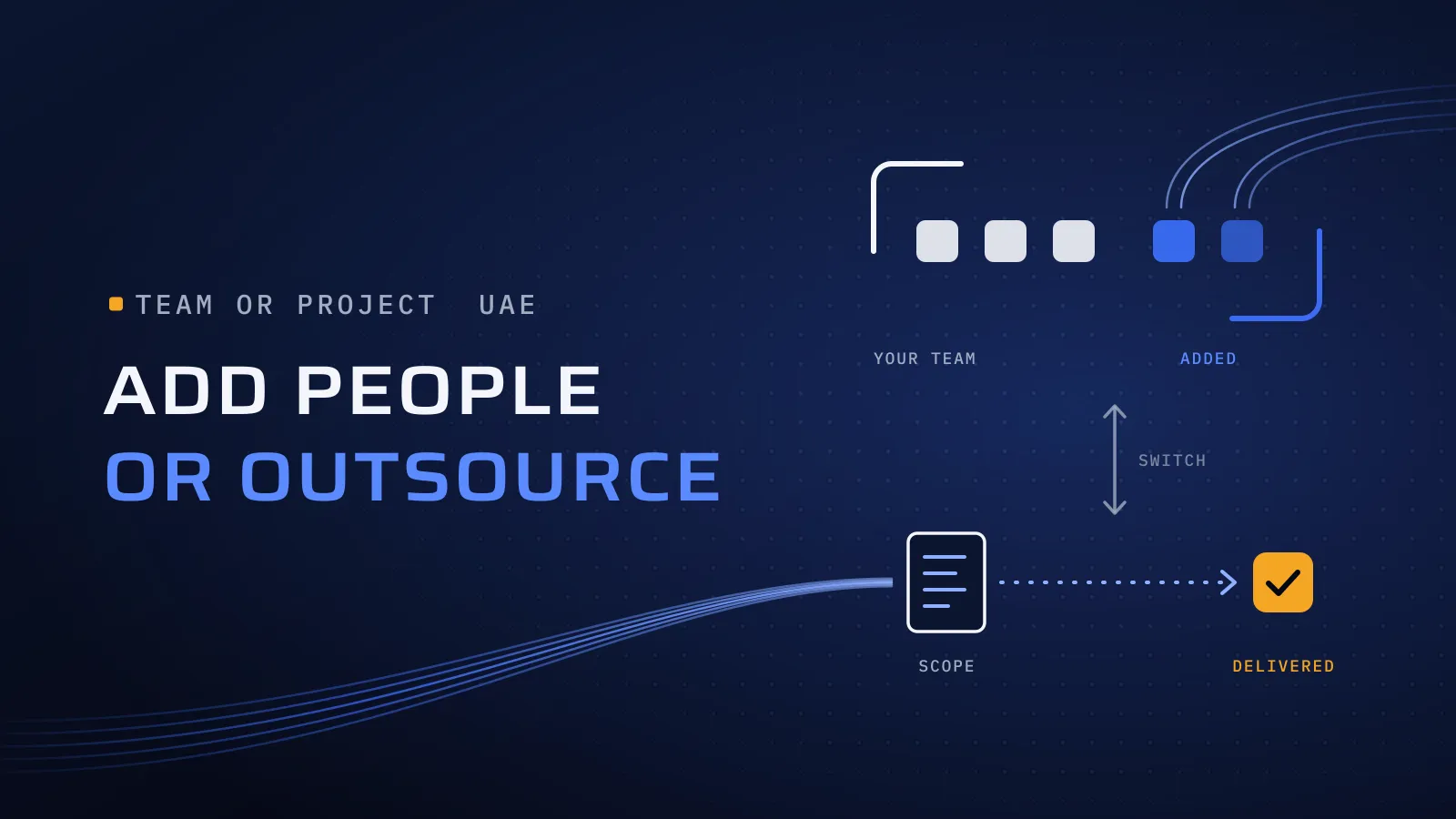
- Do you have a lead to direct the work? Staff augmentation needs someone on your side to set priorities every day. If you don’t, project delivery, set out below, fits better.
How staff augmentation works with us
- You brief us. The roles, skills, seniority, working hours and language your project needs.
- We source and screen. Candidates come from the market and from our core team where one fits. Each gets a technical interview with a senior Flojics engineer and a practical task.
- You choose who joins. You interview the shortlist, can set your own technical task and approve only the people you want.
- Contract, then access. NDA, master agreement and statement of work come first, then access to your tools.
- They work in your rituals. Your stand-ups, your tracker, your repositories. Scale up or down as your roadmap changes, on the notice terms in your proposal.
You pay one monthly fee per developer, agreed in your proposal. It moves with the role and seniority, the stack, how many people you add and how long you need them.
Our core team in Egypt is Arabic-native and works in English. Egypt is one hour behind Dubai in Egyptian summer time and two hours behind in winter. With a Monday-to-Friday week in Dubai and Sunday-to-Thursday in Egypt, you share four weekdays, with seven to eight hours of overlap a day when both offices work 9:00 to 18:00. The contract is run from our headquarters at Dubai Digital Park, Dubai Silicon Oasis.
Send us a role brief. List the roles, skills, seniority and hours you need. We reply with how we’d source the people and who you’d interview, and the start date goes into your proposal. Plan your team →
Not ready for a call yet? Ask for our company profile and we’ll send it to you.
When another way of working fits better
Staff augmentation is one of four ways to work with us:
- Time and materials suits small or changing scopes, such as a backlog of fixes, an integration or a code review. You buy hours from our core team and see where each one went.
- A dedicated team suits the long term. We recruit a team to your brief under a long-term contract, and our delivery lead runs its process.
- Project delivery suits a clear scope with no tech lead free to direct the work. We deliver it end to end, and our guide to choosing a software development company in Dubai covers how to compare firms for that.
You can compare all four on our engagement models page. Torn between adding people and handing the work over? Our guide to staff augmentation vs outsourcing sets out who manages, who owns the code and what you sign under each.
Plan your team with us
Beyond the people, we add transparent delivery: a monthly report, check-ins with your account manager and a performance review for each developer, so you always know what your fee is buying.
Since 2014 we have worked with more than 100 clients across the UAE, Saudi Arabia, Qatar, Kuwait, the USA and Canada. On ButlerFM, facility management software, our engineers joined ButlerFM’s own team. Talk to the team that worked on it: book a meeting.
See how staff augmentation in the UAE works with us, or plan your team with us. We ask about your goal, what you use today, your timing and who else should be involved. You leave with clear next steps. We reply by email first and set up a call only if you want one. Asking commits you to nothing, and we sign an NDA first if you ask.
Frequently asked questions
How long does it take to hire a developer in Dubai?
Usually months. You run the search and the interviews, make an offer, and then wait out the notice period, which is 30 to 90 days for someone already employed in the UAE, before visa processing starts. With staff augmentation, the start date is agreed in your proposal once you have interviewed the shortlist and chosen who joins.
Can we add a developer without sponsoring a visa?
Yes. With staff augmentation, HR and payroll sit with us and the developer works remotely, from our Alexandria office or wherever your brief sets. No visa, work permit or end-of-service obligation lands on your side. If the work has to happen on site in the UAE every day, an in-house hire usually fits better.
Do we stay in control of the work?
Yes. You interview every candidate, can set a technical task and decide who joins. Augmented developers work in your tracker, your repositories and your stand-ups, and your leads set the priorities. Our account manager checks in with you and sends a monthly report.
What if a developer is not the right fit?
Tell your account manager. HR and replacements sit with us: we source a replacement through the same shortlist and you interview again. The work stays in your repositories, so nothing is lost while the new person settles in.
Who owns the code, and how is our data handled?
Code lives in your own repositories from the first commit, and the code and IP pass to you at the end of the contract term or project, once it is completed and paid. We sign an NDA first if you want one. Each developer sees only what their tasks need.
What is the difference between staff augmentation and outsourcing?
With staff augmentation, developers join your team and you direct their work. With outsourcing, or project delivery, the vendor owns the result against an agreed scope. UAE companies with their own tech lead often augment; those without one usually outsource the project. We offer both, plus dedicated teams. Tell us who will lead the work; we reply by email first.
Is staff augmentation the same as a dedicated team?
No. Staff augmentation adds one or more developers to the team you already run. A dedicated team is recruited for you under a long-term contract, with our delivery lead running its process.