Staff Augmentation vs Managed Services: Which Fits Your Software Team in the UAE
Staff augmentation vs managed services for UAE companies: who directs the work, who answers when it breaks, what to check in the agreement and when to use both.
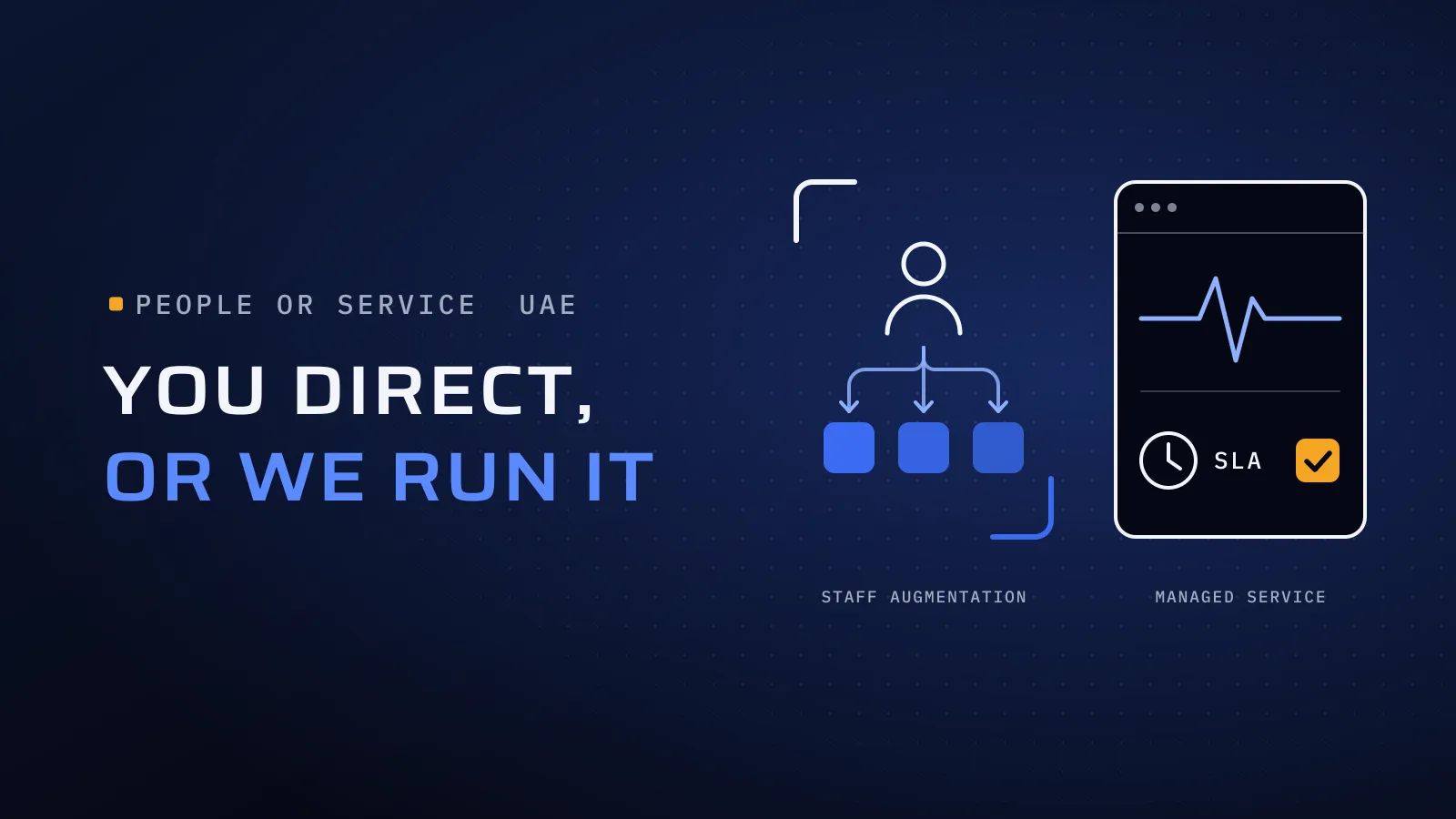
Staff augmentation vs managed services comes down to who answers for the result. With staff augmentation, developers join your team, your lead directs them and the outcome stays yours. With a managed service, a provider runs a defined, ongoing job, such as keeping your website, app or Odoo working, to terms written into the agreement, and answers for it.
What is the difference between staff augmentation and managed services?
Quick answer: Staff augmentation adds people to your team: you choose them and direct their work, and the provider handles their HR, payroll and replacements. A managed service hands over a job, not people: the provider runs an ongoing function, such as support or maintenance, to agreed service levels and answers when it goes wrong. Augment when the work is building and you have someone to lead it. Choose a managed service when the work is keeping something running. Many UAE companies use both.
Building, with a lead on your side? See developer profiles → Need something kept running instead? See what our website maintenance covers, or get a support plan for your Odoo (for UAE companies).
What does the wrong choice cost you?
Augment for upkeep, and a good developer spends the month on plugin updates and user questions while the roadmap waits. Your lead still gets the call when the site goes down, and when that developer leaves, nobody knows which backups were ever restored.
Buy a managed service for product work, and every new feature lands outside the agreement. The provider’s job is to keep things running, not to move your roadmap, so each request becomes a separate quote.
Staff augmentation vs managed services, side by side
| Staff augmentation | Managed services | |
|---|---|---|
| What you buy | People, by role and seniority | A defined job, such as support or maintenance, done to agreed terms |
| Who directs the work | Your lead: priorities, stand-ups and code review | The provider, against the list of jobs in the agreement |
| Who answers when it breaks | You: your lead sets the priority and carries the outcome | The provider, within the agreed response terms |
| What you need on your side | Someone who sets priorities every day and reviews the work | One contact who raises requests and approves changes before they go live |
| How work arrives | Your backlog, re-ranked as often as you like | Scheduled jobs and requests, within the scope the agreement sets |
| How you pay | A monthly fee per person | A fee for the service, set by what it covers |
| Fits | Building and changing a product | Keeping a live website, app or system working |
Who answers when something breaks?
With staff augmentation, you do. The developer you added fixes the bug, but your lead decides whether it comes before this sprint’s feature. Replacing a person who doesn’t fit is the provider’s job; the outage itself is yours.
With a managed service, the provider does, within the terms you signed. A good agreement says how a problem is reported, who answers, and how “the site is down” or “payroll has stopped” is handled differently from a request to change a report. You stop managing people and start managing an agreement, so it has to be specific.
What should a managed service agreement name?
A support agreement is worth what its rows say. Take this checklist to any provider, us included.
| Ask | Why it matters |
|---|---|
| Is each job listed by name, such as security updates, tested backups or the monthly WPS file? | A job that isn’t listed has no owner |
| Where do small changes end and new work begin? | Without that line, every request becomes a negotiation |
| What are the response terms for each level: down, broken, or a change? | “We’ll look into it” is not a term |
| Which days and hours are covered? | Check how a Friday or weekend problem is handled |
| Who checks the Arabic pages and bilingual documents after each change? | Updates break Arabic quietly: direction, fonts, invoices |
| What do you receive each month? | A report lets you see the work without managing it |
| Are the hosting, domain, repositories and admin logins in your company’s accounts? | Changing provider then means removing users, not moving accounts |
| How does it end, and what do you get on the way out? | Every credential, on a known date |
With staff augmentation you manage the people instead, so your questions are about the shortlist: see how to vet dedicated developers.
Which one fits your situation?
A managed service is the better choice more often than staffing vendors admit: for steady upkeep, when nobody on your side can direct developers, and when the rules around your system keep changing.
| Your situation | Fits better | Watch for |
|---|---|---|
| A product roadmap and a tech lead, with more work than people | Staff augmentation | Your lead’s time: each new person needs onboarding and code review |
| A skill your team lacks, such as Flutter, test automation or DevOps | Staff augmentation | Agree what the person leaves behind: tests, scripts and notes |
| A company website that brings in enquiries, and nobody checks it each month | Managed service: website maintenance | If the theme no longer gets updates, a redesign may need to come first |
| Odoo running your invoicing, VAT and WPS payroll in the UAE | Managed service: Odoo support | Custom and Apps Store modules must be in the agreement, not only standard Odoo |
| A live app that mostly needs fixes and updates for new iOS and Android versions | Managed service: an app support plan | Once requests turn into features, it is product work again |
| A live app plus a feature roadmap, and a lead to run it | Staff augmentation, with or without a support plan beside it | Name one person who decides what is a fix and what is a feature |
| No technical person in the company | A managed service for what runs; project delivery for anything new | Augmenting without a lead leaves developers waiting for decisions |
Not sure which parts of your work fit which model? Send us a short list: what you run today (website, app, Odoo), who looks after each one, and what your team is short of. We reply with which parts fit augmented developers, which fit a support agreement, and what we would ask first. Send us your list →
Can you use both at once?
Yes. Augmented developers build your product while a support agreement keeps the website and Odoo running. Two rules keep it clean:
- Name one owner for the boundary. Someone on your side decides whether a request is upkeep, which goes to the support provider, or a feature, which goes on your team’s backlog.
- Keep every account in your company’s name. Repositories, hosting, domain, store accounts and admin logins, with each provider added as users. Our guide to staff augmentation vs outsourcing lists each account to check.
The models also hand over to each other. After launch, a build often settles into upkeep that a support plan can carry. When the “small changes” keep turning into features, the work is a roadmap again, and needs people your lead directs.
Where do consulting, contractors and the other models fit?
| You may also be offered | What you buy | Who runs the work |
|---|---|---|
| Outsourcing (project delivery) | An agreed scope, delivered and accepted: see staff augmentation vs outsourcing | The vendor’s project manager |
| An in-house hire | An employee: see staff augmentation vs in-house hiring | You, including the search, visa and HR |
| Time and materials | Hours on the tasks you choose | Shared: you set the tasks, the provider logs the hours |
| A dedicated team | A team recruited for you, long term | Shared: you set priorities, the provider’s delivery lead runs the process |
| IT consulting | Advice and a plan | You carry it out, or buy the delivery separately |
| Independent contractors | Individuals you contract yourself | You, plus finding and replacing each person |
Our engagement models page compares the four ways to work with us side by side.
What changes for a company in the UAE?
- The week. Most UAE private companies work Monday to Friday, and a team in Egypt works Sunday to Thursday, so you share four weekdays. Augmenting? Plan stand-ups and releases on those days. Buying a service? Ask how a Friday or weekend problem is handled. Saudi Arabia, Qatar, Kuwait and Oman work Sunday to Thursday too, so developers for Gulf teams share all five days.
- Rules that change on dates you don’t set. VAT amendments, e-invoicing and WPS payroll all touch Odoo in the UAE. Under a support agreement, each change has a named owner; with augmented developers, your lead tracks them. Our guide to Odoo support in the UAE lists what the agreement should cover.
- Arabic. In a service agreement, write the Arabic checks in as a job. With staff augmentation, test Arabic in your interview for the roles that use it, as our guide to Arabic-speaking developers shows.
- Access to live systems. A managed service provider needs administrator access to production. Give named accounts, not shared logins, and remove them on the last day. The UAE’s data protection laws include a federal law and separate DIFC and ADGM rules; ask your legal adviser which apply to you.
How we work under each model
We offer both, so we can say plainly when the other one fits.
Staff augmentation. We source candidates for your roles from the market, and from our core team where one fits, and screen each with a technical interview and a practical task. You interview the shortlist and choose who joins. HR, payroll and replacements stay with us, with a monthly report and an account manager. On ButlerFM, facility management software, our engineers joined ButlerFM’s own team. Talk to the team that worked on it: book a meeting.
Managed services, under an ongoing support agreement. We run three today:
- Website maintenance for WordPress and custom sites: updates, backups with restore tests, form and checkout checks, content changes, Arabic checks after every update and a monthly report. Response times are written into your proposal as commitments.
- Odoo support, for companies in the UAE: custom and Apps Store modules, VAT and e-invoicing changes, the monthly WPS file, user help in English or Arabic, small changes and upgrade planning. Response terms are agreed in writing before support starts.
- App maintenance for apps we build, as part of our mobile app development: a support plan agreed with the project, covering bug fixes, updates for new iOS and Android versions and their libraries, and small changes. Our app maintenance cost guide lists what drives the running costs.
Independent QA checks each change before it goes live, so the person testing it did not make it.
You sign with Flojics at Dubai Digital Park, Dubai Silicon Oasis. Our core team works from Egypt, Sunday to Thursday, Arabic-native and working in English.
Start with the job, then pick the model
Since 2014 we have worked with more than 100 clients across the UAE, Saudi Arabia, Qatar, Kuwait, the USA and Canada. If the job is building, add people your lead directs, as our page on staff augmentation in the UAE explains. If the job is keeping something working, buy a service with terms you can hold the provider to.
Tell us what you need built and what you need kept running. For developers, the roles, skills and hours; for support, what you run and what keeps going wrong. See developer profiles → Running a website? Get an estimate for its maintenance. Running Odoo in the UAE? Get a support plan for your Odoo.
Not ready for a call? Ask for our company profile and we’ll send it to you.
We reply by email first and set up a call only if you want one. Asking commits you to nothing, and we sign an NDA first if you ask.
Frequently asked questions
What is the difference between staff augmentation and managed services?
Staff augmentation adds people to your team: you choose them and direct their work, and the provider handles their HR, payroll and replacements. A managed service hands over a job, such as support or maintenance: the provider runs it to agreed service levels and answers when it goes wrong. The first needs a lead on your side; the second needs a specific agreement.
When is a managed service the better choice?
When the work is keeping something running rather than building it: a company website, a live app that mostly needs fixes and updates for new iOS and Android versions, or Odoo in the UAE, where VAT, e-invoicing and WPS changes need an owner. It also fits when nobody on your side has time to direct developers every day.
Can we use staff augmentation and managed services together?
Yes. Augmented developers can build your product while a support agreement keeps your website and Odoo running. Name one person who decides whether a request is upkeep or a feature, and keep every account in your company's name, with each provider added as users.
What should a managed service agreement include?
Each job by name, where small changes end and new work begins, response terms for each level of problem, the days and hours covered, who checks the Arabic pages after each change, what you receive each month, and the accounts kept in your company's name. A job that isn't listed has no owner.
Which managed services does Flojics run?
Three, under an ongoing support agreement: website maintenance, Odoo support for companies in the UAE, and app maintenance for apps we build. If you want people inside your own team instead, that is staff augmentation.
Do your support team and augmented developers work the UAE week?
Our core team in Egypt works Sunday to Thursday, so it shares four weekdays with a Monday to Friday UAE office, and all five with companies in Saudi Arabia, Qatar, Kuwait and Oman. In any service agreement, check how a problem on a Friday or at the weekend is handled.