Real Estate Website Design in Dubai: What Brokers and Developers Need, and How to Choose Who Builds It
Real estate website design in Dubai: listings and portal feeds, leads into your CRM and WhatsApp, Arabic, DLD ad rules, and how to choose who builds it.
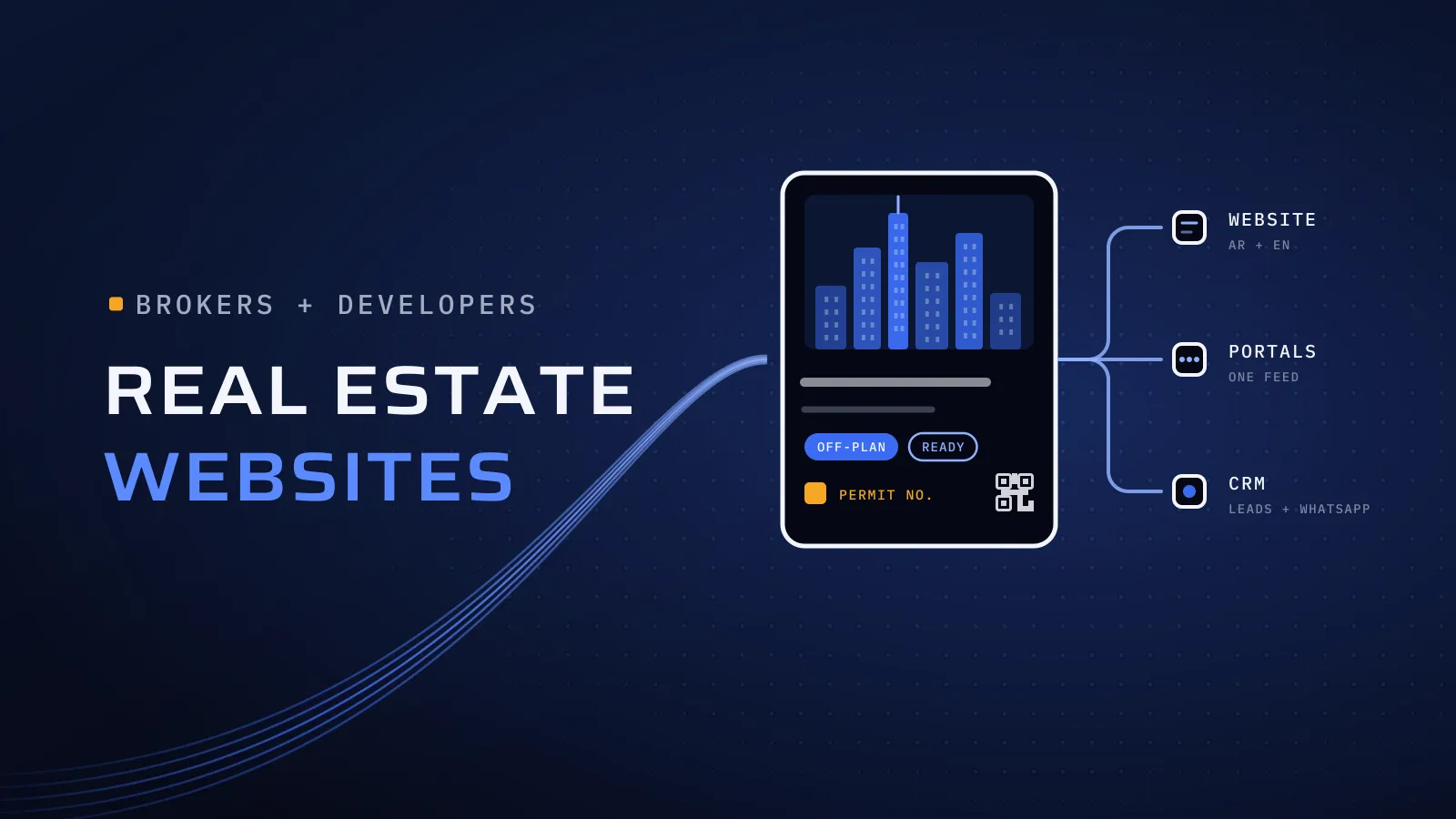
A real estate website in Dubai has three jobs: let buyers search your listings in English and Arabic, stay in step with Property Finder, Bayut and Dubizzle, and put every enquiry in front of the right agent while the buyer is still interested. Brokerages and developers need different sites for those jobs, and every listing also has to carry what Dubai’s advertising rules ask for. Choose who builds yours on those points, not on the look of a home page.
What does a real estate website in Dubai need?
Quick answer: Listings kept in one record that also feeds the portals. Search filters for off-plan and ready property, with a map. Every form, call and WhatsApp click landing in your CRM with the listing and the agent attached. Arabic designed right to left, with its own pages in Google. Photo galleries that stay fast on a phone. And the fields Dubai’s ad rules require, starting with the permit number. A developer adds project pages with the payment plan. Ask every company that quotes how it handles each one.
Planning the site? Get an estimate for your real estate website → or send us the proposal you received →
What a weak property website costs you
Buyers in Dubai often see the same apartment on two portals and on your site within the same hour. If your site still shows it after it was rented, or at a different price, they stop trusting the rest of your listings. If their enquiry lands in a shared inbox, the agent who answers first on a portal gets the viewing. None of this shows in a report; the enquiries simply go elsewhere. And because a listing is an advertisement in Dubai, a site with no place for the permit number leaves your marketing team patching it by hand.
Broker or developer: two different websites
| Brokerage website | Developer website | |
|---|---|---|
| Main job | Win enquiries across many listings, for sale and rent, and show the agents behind them | Sell one or a few projects, often off-plan, and register interest before and after launch |
| The pages that matter | Search results, the listing page, community pages, agent profiles | The project page, unit types and floor plans, the payment plan, construction updates |
| Where content comes from | Your CRM or listing system, which also feeds the portals | Your sales team and the project’s approved marketing material |
| Where enquiries go | To the listing’s agent, by form, call or WhatsApp | To the sales team or a broker partner, often after a brochure download |
| What changes often | Listings, prices and status, every day | Availability, payment plans and handover updates, by phase |
| What moves the scope | The number of listings, portal feeds, the CRM, languages | The number of projects, the unit inventory, languages, campaign pages |
How to read it: if you are both, say a developer with its own sales brokerage, plan one site with both sets of templates and one place where listings and projects are kept.
Listings and search: what buyers filter by
Buyers arrive with a short list of conditions. The filters should match how they think, in both languages:
- Buy or rent, then ready or off-plan. Off-plan buyers also filter by developer and handover date.
- Community and building, with a map view that shows results as pins and updates as the buyer moves the map.
- Property type, bedrooms, price range and size, with the size unit stated, square feet or square metres.
- Rental details: furnished or not, and how many cheques the landlord accepts.
Each listing page then needs the photos, a floor plan, the key facts, the agent with call and WhatsApp buttons, the permit details and similar listings. Community pages, one for each area you sell in, give Google something lasting to rank, since single listings come and go.
Portal feeds: one listing record, everywhere
Your website and the portals should show the same listing because they read the same record. Typing a unit into the CRM, then into each portal, then into the website is where stale listings and mismatched prices start.
The portals publish their own routes in. Property Finder runs a developer network with APIs that let real estate CRMs and software partners manage listings and leads. Bayut’s help centre describes an XML feed that syncs listings in bulk from a broker’s CRM to Bayut and dubizzle. What your account can do, and the fields each portal asks for, is agreed with that portal, so ask your account manager before the build starts.
| Where your listings live today | Your website reads from | Watch for |
|---|---|---|
| A real estate CRM that already feeds the portals | The same CRM, through its feed or API | What the CRM exposes: photos, permit fields, the agent, the status |
| Spreadsheets, or each portal’s own tools | A listing database built with the site, which then feeds the portals | Portal access, the field lists, and who keeps each listing current |
| Typed separately in each place | Fix this first | Stale and mismatched listings, whatever the design |
Enquiries should travel back the same way. Both portals describe ways to pass their enquiries to a CRM, so a buyer who asks on a portal and later on your site becomes one contact with one history, not two.
Dubai’s advertising rules, built into the site
In Dubai, a property listing is an advertisement. RERA, the regulatory arm of Dubai Land Department (DLD), sets what an ad must carry, and its circular on ads names real estate platforms and social media among the channels. A good website makes the rules hard to miss: a field for each item, shown on the page, and a listing that can’t go live without them.
| The rule, as DLD and RERA publish it | What the website does |
|---|---|
| Every property ad needs a RERA permit, issued through the Trakheesi system, and the permit number must appear on the ad | A permit-number field on every listing, shown on the listing page. No permit, no publish |
| The ad must include the name of the real estate company | The company name on every listing and project template |
| Off-plan ads must show the developer’s name, the project name and number, its location and the approved escrow account number | Required fields on every project page and off-plan listing |
| The advertiser answers for the content, which must not include anything the permit did not approve | Listing details come from the same record the permit was issued for |
| DLD issues a Madmoun QR code with each ad permit, so buyers can check the ad, and requires companies to show it on their ads | A place for the QR code on every listing, at a size that still scans |
| Brokers may use only phone numbers registered in the Real Estate Brokers Registry for marketing and customer contact | Call and WhatsApp buttons use each agent’s registered number |
| Ads with promotions, such as free extras, discounts or fee waivers, need a promotional campaign permit | Campaign landing pages carry their own permit |
| Portals must take down listings that are no longer available, or mark them sold | Your site does the same: sold or rented units leave search or show their status |
Sources: RERA’s Circular 2-2022 on real estate ads, Circular 3-2022 for portals, Circular 01-2023 on registered phone numbers, its Real Estate Brokerage Practice Guide and DLD’s Madmoun announcement, checked on 29 October 2026. Rules change, so confirm the current conditions with DLD before launch. The permit is yours to request; the site makes sure it shows.
What this means for you: ask every company that quotes to show you where the permit number, the company name and the off-plan fields sit in its listing template. If the answer is “your team can type it into the description”, it will be missing on the day it matters.
Leads: into your CRM, with the listing attached
- Every form, call button and WhatsApp click records the listing reference, the agent, the language and where the visitor came from: a portal, Google or a campaign.
- The enquiry reaches the right person: the listing’s agent, or the sales team for a project, with a fallback rule when nobody picks it up. Every path is tested before launch.
- WhatsApp opens with a message that names the listing, so the agent knows which unit the buyer means. Many buyers in the Gulf prefer it to a form, so count each click as a lead.
- Forms stay short: a name, a phone number and one question. On a project page, a brochure or payment plan download behind a short form is a fair exchange.
An honest note on build or buy: many real estate CRMs include a website module. For a small brokerage that mainly needs its listings online, that can cover most of the job. A designed site pays off when your brand has to stand apart, when you sell developer projects, when Arabic matters, or when you want community pages that rank in Google. Still choosing the CRM itself? Our custom CRM guide compares buying one, extending it and building your own.
Planning a real estate website? Tell us whether you are a brokerage, a developer or both, how many listings or projects you carry, the portals and CRM you use and the languages you need. We reply with the templates, the integrations, the team and the price. Get an estimate for your real estate website →
Not ready for a call? Ask for our company profile and we’ll send it to you.
Arabic and English, and found in both
- Design every template in Arabic from the first draft, right to left: the gallery arrows, map controls, filter panel and price line all mirror. Building names often stay in English inside Arabic text, so test those mixed lines.
- Choose your digits once. Many UAE sites use Western digits on Arabic pages for prices, sizes and phone numbers. Whatever you choose, use it everywhere.
- Give each language its own address, such as /ar/, with the versions linked to each other (hreflang) so Google shows the right one.
- Write Arabic titles and descriptions for Arabic searches, such as «شقق للبيع في دبي», rather than translating the English ones.
- Add only languages your sales team can answer in. Some Dubai brokerages add Russian or Chinese for overseas buyers, and each needs the same care.
Our guide to Arabic localization covers the right-to-left details.
Speed with hundreds of photos
A listing page carries more photos than almost any other page, and most buyers open it on a phone. Speed comes from how the site handles images, not from showing fewer:
- Agents upload originals; the site makes the smaller sizes and modern formats, WebP or AVIF, on its own.
- The first photo loads first, and the rest load as the buyer swipes. Videos and 360° tours load on tap.
- Every image has a fixed frame, so the page doesn’t jump while it loads.
- Test on a mid-range Android phone on mobile data, and track Google’s Core Web Vitals, not just a desktop score.
Agent profiles and developer project pages
Agent profiles. One page for each agent: photo, languages, the areas they cover, their active listings, and their registered phone and WhatsApp. It is also a page Google can show when someone searches the agent’s name. When an agent leaves, their listings move to a colleague and their page redirects rather than breaking.
Developer project pages. Each project needs an overview, the location, unit types with floor plans, the handover status and the off-plan details from the rules above. Show the payment plan as a table of stages, such as on booking, during construction and on handover, with the share due at each, exactly as the approved plan states it. Keep the plan as data, not an image, so one change updates the page, the Arabic version and the brochure. Once buyers sign, the payment plan, construction updates and handover often move into an app; our guide to real estate app development in Dubai covers what developers build for owners and tenants after the sale.
How to choose who builds it
| Ask | A good answer | A warning sign |
|---|---|---|
| Show us a bilingual site you built, in Arabic, on a phone | Templates that mirror properly, with real Arabic copy | Arabic added at the end, or machine-translated |
| Where will our listings live, and how will they reach the portals? | One record that feeds the site and the portals, tested with your accounts | “You’ll add them on the website too” |
| Where do the permit number, company name and off-plan fields sit? | Required fields in the listing and project templates | “Type them into the description” |
| What happens when a unit is sold or rented? | It leaves search, or shows its status, everywhere at once | No clear answer |
| Where does a WhatsApp click or a form go? | Into your CRM with the listing and the agent, tested before launch | An email to a shared inbox |
| How fast is a listing page with all its photos on a phone? | They test it on a mid-range phone and show you | “It’s fast on our office Wi-Fi” |
| What can our team change without a developer? | Listings, agents, projects, payment plans, community pages | Every change is a ticket |
| Who owns the domain, the code and the listing data? | Your company, in writing | The agency’s own accounts |
Replacing a site that already ranks? Our guide to website redesign in Dubai shows how a redirect map keeps your Google traffic. Our website design cost guide covers what sets the price, and our scorecard for choosing a software company in Dubai helps you compare the shortlist. Once the site is live, our website maintenance guide covers the monthly care that keeps it safe and fast.
Already holding a proposal? Send it to us with anything confidential removed. We reply with the questions to ask and what we would change before you sign. Send us the proposal →
Where Flojics fits
Our designers and engineers work as one team. As a website design company in Dubai, we design each template in Arabic and English from the first draft. The system behind the site, such as a listing database, portal feeds or CRM routing, is custom web development, built by the same team. Quality built into every step: CTO oversight, independent QA before each release and a dated plan in FloPlan, our own delivery software.
Two websites we built, with parts a property site also needs: Abdulhameed Aljasmi Advocates is a law firm whose multilingual website presents its legal team and practice areas. Talk to the team that built it: book a meeting. DannionCE is an engineering and architecture firm whose website showcases its project portfolio. Talk to the team that built it: book a meeting.
Send us your listings, portals and CRM
Since 2014 we have worked with more than 100 clients across the UAE, Saudi Arabia, Qatar, Kuwait, the USA and Canada. Our headquarters is at Dubai Digital Park, and our core team works from Egypt. They are native Arabic speakers, so your Arabic pages are checked by people who read them the way your buyers do. Tell us whether you are a brokerage, a developer or both, how many listings or projects you carry, the portals and CRM you use and the languages you need.
Get an estimate for your real estate website → or send us the proposal you received → We ask about your goal, what you use today, your timing and who else should be involved. You leave with clear next steps. We reply by email first and set up a call only if you want one. Asking commits you to nothing, and we sign an NDA first if you ask.
Frequently asked questions
How much does a real estate website cost in Dubai?
It depends more on what the site connects to than on its page count. The main drivers are where your listings come from and how they reach the portals, the CRM and WhatsApp routing, the number of languages, developer project pages with payment plans, and how many templates the design needs. Send us your listing count, portals, CRM and languages, and we reply with the team, the integrations and the price.
Can our website show the same listings as Property Finder and Bayut?
Yes, but the listings should flow from one place to all of them, not from the portals to your site. Keep them in your CRM or in a listing database built with the site, and feed the portals from it. Property Finder offers APIs to software partners, and Bayut's help centre describes an XML feed from a broker's CRM to Bayut and dubizzle. What your account allows is agreed with each portal.
Do listings on our own website need a DLD permit number?
RERA's Circular 2-2022 applies to companies that market property through any advertising channel, including real estate platforms and social media, and requires the permit number on the ad. Treat each listing on your site as an ad: show its permit number and your company name, and for off-plan, the project and escrow details. Confirm the current conditions with DLD before launch.
What is the difference between a broker website and a developer website?
A brokerage site lives on search: many listings for sale and rent, community pages and agent profiles, kept in step with the portals. A developer site sells a few projects: project pages, unit types, floor plans, payment plans and construction updates, with enquiries going to the sales team. A developer with its own brokerage needs both sets of templates.
Should a real estate website in Dubai be in Arabic?
If your buyers, sellers or landlords include Arabic speakers, yes, designed right to left from the first template rather than translated at the end. Give the Arabic pages their own addresses, and titles written for Arabic searches, so Google can show them to people who search in Arabic.
Can WhatsApp enquiries go into our CRM?
Yes. The WhatsApp button opens a chat that already names the listing, and the click is recorded in your CRM with the listing, the agent and the source. Use each agent's number from the Real Estate Brokers Registry, because RERA allows brokers to use only registered numbers for marketing and customer contact.
Who owns the website and the listing data?
Your company should. Keep the domain, hosting, CRM and portal accounts in its name, and the listing data in a system you can export. With us, the code passes to you at the end of the project, once it is completed and paid.