Custom CRM Development in Dubai: Buy a CRM, Extend It or Build Your Own?
Custom CRM development in Dubai: when to buy a CRM, extend one or build your own, with an Arabic and WhatsApp checklist and questions to ask before you sign.
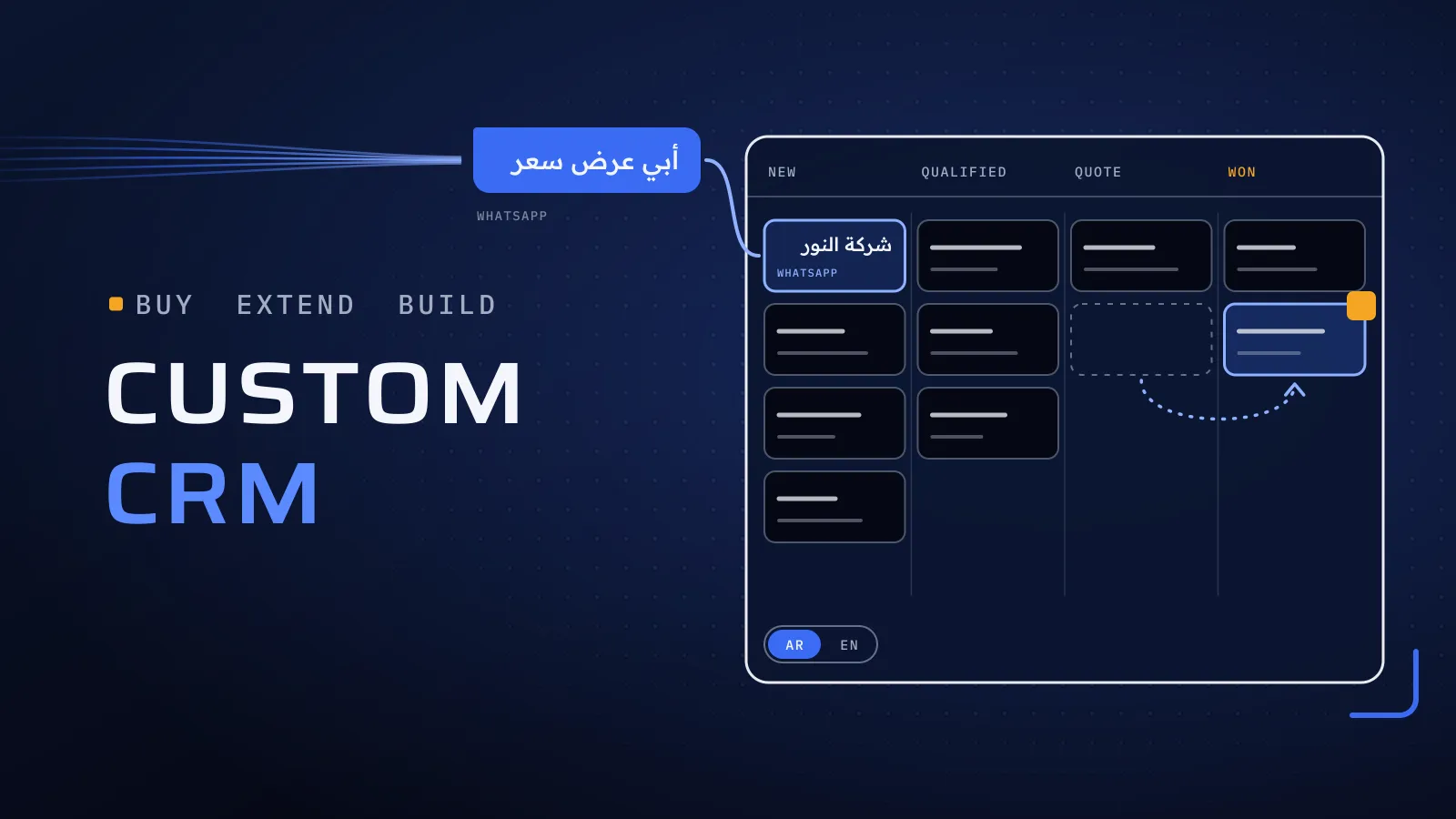
Custom CRM development in Dubai makes sense when your sales process is part of what you sell, or when a ready CRM keeps sending your team back to WhatsApp and Excel. For most companies, the right first move is a ready CRM, or one extended with the screens and connections it lacks. Build your own when your process, your Arabic data or your integrations don’t fit any product.
Should you buy a CRM, extend one or build your own?
Quick answer: Buy a ready CRM when your sales follow the usual path (lead, meeting, quote, deal) and your team can adapt to the product. Extend it with custom modules and connections when it fits most of the work but misses a few steps, an Arabic need or a system it must talk to. Build your own when the process is how you compete, when many occasional users would each need a paid licence, or when the CRM has to live inside your own platform. Whichever you choose, test it with your own Arabic customer records and WhatsApp enquiries before you sign.
Planning a CRM? Tell us how a lead moves through your company today → or send us the CRM proposal you received →
What a CRM that doesn’t fit costs you
The cost never appears as a line in the budget. A buyer writes on WhatsApp to a salesperson’s own phone, and when that salesperson leaves, the conversation leaves too. The same company is saved three times, as شركة النور, as Al Noor and as Alnoor LLC, so nobody sees its full history. Quotes are built in Excel because the CRM can’t price the way you sell, and the pipeline report is a sheet someone fills in on Thursday night. A CRM your team doesn’t update is a monthly bill with a login.
Buy, extend or build: the decision table
| Buy a ready CRM | Extend a ready CRM | Build your own CRM | |
|---|---|---|---|
| What it means | Subscribe to a product such as Salesforce, HubSpot, Zoho CRM, Microsoft Dynamics 365 or Odoo CRM, and configure it | Keep the product, and add custom modules, screens and connections to your other systems | Software written around your process, owned by your company |
| Fits when | Your sales follow the usual path and the team can adapt its habits | The product covers most of the work but misses a step, a report or a connection | The process is how you compete, the CRM sits inside your own platform or portal, or no product fits without heavy workarounds |
| What you pay for | Licences per user, setup and training | Licences, plus building and keeping up each extension | The build, then hosting in your own cloud account and support, with no per-user licence |
| Arabic | Depends on the product: test your own Arabic records in the trial | As the product, plus Arabic in your own screens and documents | Designed in from the first screen |
| The vendor’s add-on or a ready connector | A connector built to your rules | Built in, to your rules | |
| The catch | You follow the product’s way of working, and fees grow with every user | Each product upgrade has to be tested against your extensions | More work before the first release, and a team to keep improving it |
| Who changes it next year | Your admin, within the product’s limits | Your admin, plus developers for the extensions | Developers, yours or ours |
How to read it: most companies should start in the first two columns. Building pays off when the right-hand column describes your business, not when one report is missing.
For UAE companies whose sales, invoicing or stock already run on Odoo, Odoo CRM shares the same customers and products. Its One App Free plan gives one app, such as CRM, to unlimited users on Odoo Online, and adding apps moves you to a plan priced per user (Odoo pricing, checked 29 October 2026). How far Odoo’s own Arabic goes is covered in our guide to Odoo in Arabic.
Six questions that decide it
- Do your sales follow the usual path? Lead, first call, meeting, quote, deal. If yes, a ready CRM fits. If a deal passes through steps no product has, such as a credit check, a site survey or a partner’s approval, lean towards extending or building.
- Who needs a login, and how often? Per-user licences suit a sales team that works in the CRM all day. They weigh more when brokers, agents, partners or field staff each need a few screens a week. Count both groups before you compare.
- Do your customers write to you in Arabic, on WhatsApp? Then the Arabic and WhatsApp checks below matter more than any feature list.
- What must it talk to? Your ERP or accounting system, the website forms, a call centre, a customer portal, the property portals. Each connection is a piece of work in every column, so count them.
- Is the customer data what you sell? For a broker, a trading platform or a membership business, the client records and their history are the business. Then where the data lives, how it exports and who sets the rules weigh more.
- Who will change it next year? If nobody on your side will own the setup, a simpler ready CRM beats a powerful one. If the CRM will change with every new product line, plan for developers from the start.
How to read it: the usual path and few connections point to buying. A product that fits with two or three gaps points to extending. When questions 1, 2 and 5 all point away from a product, price a build that starts with one workflow.
What should an Arabic CRM do?
Arabic on a product’s language list can mean translated menus and little else. An Arabic-first CRM handles Arabic in the records and the documents too. Test these with your own data, in the trial or the demo:
- Search that forgives spelling. أحمد and احمد, ة and ه, ى and ي: a search for one should find the other, and “Al Noor” should find النور when both names are on the record.
- Two names per contact and company. An Arabic name and an English name, both searchable, with a choice of which one appears on documents.
- Phone numbers in one format. +971, 00971 and 05x numbers saved as one number, with Arabic digits typed on a phone stored the same way, so a WhatsApp chat finds its contact and duplicates stop piling up.
- Screens that stay right to left. Lists, forms, a line that mixes Arabic and English, and a phone number inside an Arabic sentence.
- Arabic documents. Quotes and proposals in Arabic and English, laid out right to left, in your brand’s fonts.
- Arabic templates and reports. Email and WhatsApp templates in both languages, and reports your Arabic-speaking managers read without a translation.
What this means for you: if a product passes these checks with your own records, buy it. If it fails one or two, an extension usually covers the gap. If it fails search and names, it fails at the core of a CRM, and a build is worth pricing.
A WhatsApp inbox inside the CRM
Many Gulf buyers send their first enquiry on WhatsApp, not through a form. A CRM that can’t hold those chats leaves the most important conversations on personal phones. Set up five things:
- A company number on the WhatsApp Business Platform. A CRM connects through Meta’s platform, not the WhatsApp Business app on one person’s phone. The number and the account stay in your company’s name.
- One shared inbox, with an owner for each chat. Each chat opens on the contact’s record, goes to a salesperson, and stays with the company when that person leaves.
- Chats tied to deals. The quote sent, the voice note received and the “yes” in the chat show on the deal, not only on a phone.
- Templates for follow-ups. A customer’s message opens a 24-hour customer service window. Inside it your team replies freely; after it, only with template messages, and Meta charges per delivered message by category (Meta). Prepare Arabic and English templates for quotes, reminders and payment follow-ups.
- Rules for who sees what. Managers see every chat, salespeople see their own, and nobody deletes history.
If you also want an assistant that answers common questions before a person takes over, see our guide to an AI chatbot for business in the UAE.
Send us how a lead moves today. Where enquiries arrive (WhatsApp, the website, calls, portals), who follows up, how a quote is made and what the CRM must connect to. A screenshot of your pipeline sheet with the figures hidden is enough. We reply with the route we would take, buy, extend or build, and what a first release would cover. Plan your CRM with us → Already holding a CRM proposal? Send it to us →
Not ready for a call? Ask for our company profile and we’ll send it to you.
Real estate CRM in Dubai: what changes
Property sales add needs of their own:
- Listings and leads in one place. The CRM holds each unit, sends it to the property portals and takes portal enquiries back with the listing and the agent attached. What your account can use is agreed with each portal.
- Lead rules for agents. Leads shared by area, language or turn, with a time limit before an unanswered lead moves to the next agent.
- For developers: units, payment plans and brokers. Off-plan inventory by building and floor, reservations, payment plan milestones, and the broker partners who bring buyers.
A brokerage that mainly lists resale and rental units is usually well served by a CRM made for brokers, extended where it falls short. A developer selling off-plan through broker partners is where a build, or a deep extension, is more often worth it. Our guide to real estate website design in Dubai covers how the website sends each enquiry to the right agent.
If you build: what the first release covers
A custom CRM should start small and be in daily use early. A first release that covers one sales path well beats a full system nobody opens.
| Phase | What it delivers |
|---|---|
| Discovery | How a lead moves today, the fields that matter, the roles, the connections, and the decision to buy, extend or build |
| First release | Contacts and companies in Arabic and English, the pipeline for one sales team, the WhatsApp inbox or your main enquiry channel, one connection (often the website forms or the ERP) and the reports managers read each week |
| Data move | Contacts from Excel or the old CRM, cleaned first: duplicates merged, phone numbers in one format, an owner on each record. A sample moves first and the sales team checks it |
| Next releases | Quotes and approvals, more teams, a mobile app for field sales, more connections and automation |
The team: a product owner who owns the requirements and priorities with your sales lead, a project manager who owns the dates, a technical lead for the architecture and connections, the developers, and independent QA. QA tests every path in Arabic and English, including the WhatsApp chat that arrives at night with no one assigned.
What drives the cost of a custom CRM
We don’t publish a price list. Your price is agreed in your proposal, and it follows six drivers:
- Roles and permissions. One sales team is simpler than sales, managers, partners and customer service each seeing different records.
- Channels. WhatsApp, email, calls, website forms and portals, each one connected and tested.
- Connections. Your ERP or accounting system, payment links, the website and a call centre.
- Arabic. Bilingual records, search, documents and templates, tested right to left.
- The data you bring. Clean lists move quickly; years of duplicates need cleaning first.
- Mobile and offline. Sales staff who visit customers need an app, not just a browser.
On the buy side, add the licence for every user, every month, for as long as you run it. Compare the routes over several years, not on the first invoice.
Questions to ask before you sign
Ask every CRM vendor, partner or developer the same questions, in writing:
| Question | Why it matters |
|---|---|
| Can we run the trial or demo with our own Arabic records and WhatsApp chats? | Search and names fail on real data, not on demo data |
| Whose name are the WhatsApp number and the Meta account in? | Yours, so the chats stay when a vendor or an employee goes |
| How do we export all our data, including chat history and files? | The customer data is the asset; check the format before you need it |
| What happens to our extensions when the product upgrades? | Someone has to test them, and fix them, each time |
| Who owns the code of anything built for us? | Your company should |
| Which connections are in the price, and which are extra? | Missing connections are where budgets grow |
| Who can change a pipeline stage or a field next year without a developer? | It decides what the CRM costs to run |
Where Flojics fits
Through custom software development in Dubai, we build custom CRMs, and the extensions and connections that make a ready CRM fit: WhatsApp inboxes, Arabic and English records and documents, and links to your ERP, website and portals. For UAE companies whose business runs on Odoo, we implement Odoo CRM as part of Odoo ERP. If your reps sell on the road, FloSales, our own field sales app, covers orders, customer visits and collections, synced with the back office.
Our core team are native Arabic speakers, so Arabic search, names and documents are checked by people who read them, and independent QA tests every path before each release.
iBankMarkets is a forex brokerage for which we delivered a CRM, alongside MetaTrader 4 integration, trial accounts and an online trading system. Talk to the team that built it: book a meeting.
Tell us how your sales run today
Since 2014 we have worked with more than 100 clients across the UAE, Saudi Arabia, Qatar, Kuwait, the USA and Canada. Our headquarters is at Dubai Digital Park, and our core team works from Egypt. Tell us where your enquiries arrive, who follows them up and what the CRM must connect to. If a ready CRM does the job, we will say so.
Plan your CRM with us → or send us the CRM proposal you received → We ask about your goal, what you use today, your timing and who else should be involved. You leave with clear next steps. We reply by email first and set up a call only if you want one. Asking commits you to nothing, and we sign an NDA first if you ask.
Frequently asked questions
How much does custom CRM development cost in Dubai?
We don't publish a price list, because the cost follows your sales process: the roles and permissions, the channels such as WhatsApp, the systems it connects to, Arabic records and documents, the data you bring and whether field staff need a mobile app. Your price is agreed in your proposal. On the buy side, compare per-user licences over several years, not the first invoice.
Should we buy a CRM or build our own?
Buy when your sales follow the usual path of lead, meeting, quote and deal, and your team can adapt to a product. Extend a ready CRM when it covers most of the work but misses a step, a report or a connection. Build when the process is how you compete, when many occasional users would each need a paid licence, or when the CRM must live inside your own platform.
What should an Arabic CRM do?
More than translate the menus. It should find أحمد when someone types احمد, keep an Arabic and an English name on each contact, store every phone number in one format, keep screens right to left, and produce quotes and WhatsApp templates in both languages. Test these with your own records during the trial.
Can WhatsApp be connected to a CRM?
Yes, through Meta's WhatsApp Business Platform with a number in your company's name, not the WhatsApp Business app on a salesperson's phone. Each chat then opens on the contact's record and stays with the company when a salesperson leaves. Outside the 24-hour window after a customer's last message, only template messages can be sent.
Can Odoo CRM work for a UAE company?
Yes, especially when sales, invoicing or stock already run on Odoo, because the CRM then shares the same customers and products. Odoo's One App Free plan gives one app, such as CRM, to unlimited users on Odoo Online, and more apps move you to a per-user plan. We implement Odoo for companies in the UAE.
Can we move our contacts from Excel or our current CRM?
Yes, once they are clean: duplicates merged, phone numbers in one format and an owner on each record. A sample moves first and your sales team checks it, then the rest follows. Chat history and files need their own check, because not every system exports them.