Law Firm Website Design in Dubai: What a UAE Law Firm Website Needs, and Who Should Build It
Law firm website design in Dubai: Arabic and English, practice-area pages, lawyer profiles, safe enquiry forms, the UAE rules on promotion and who builds it.
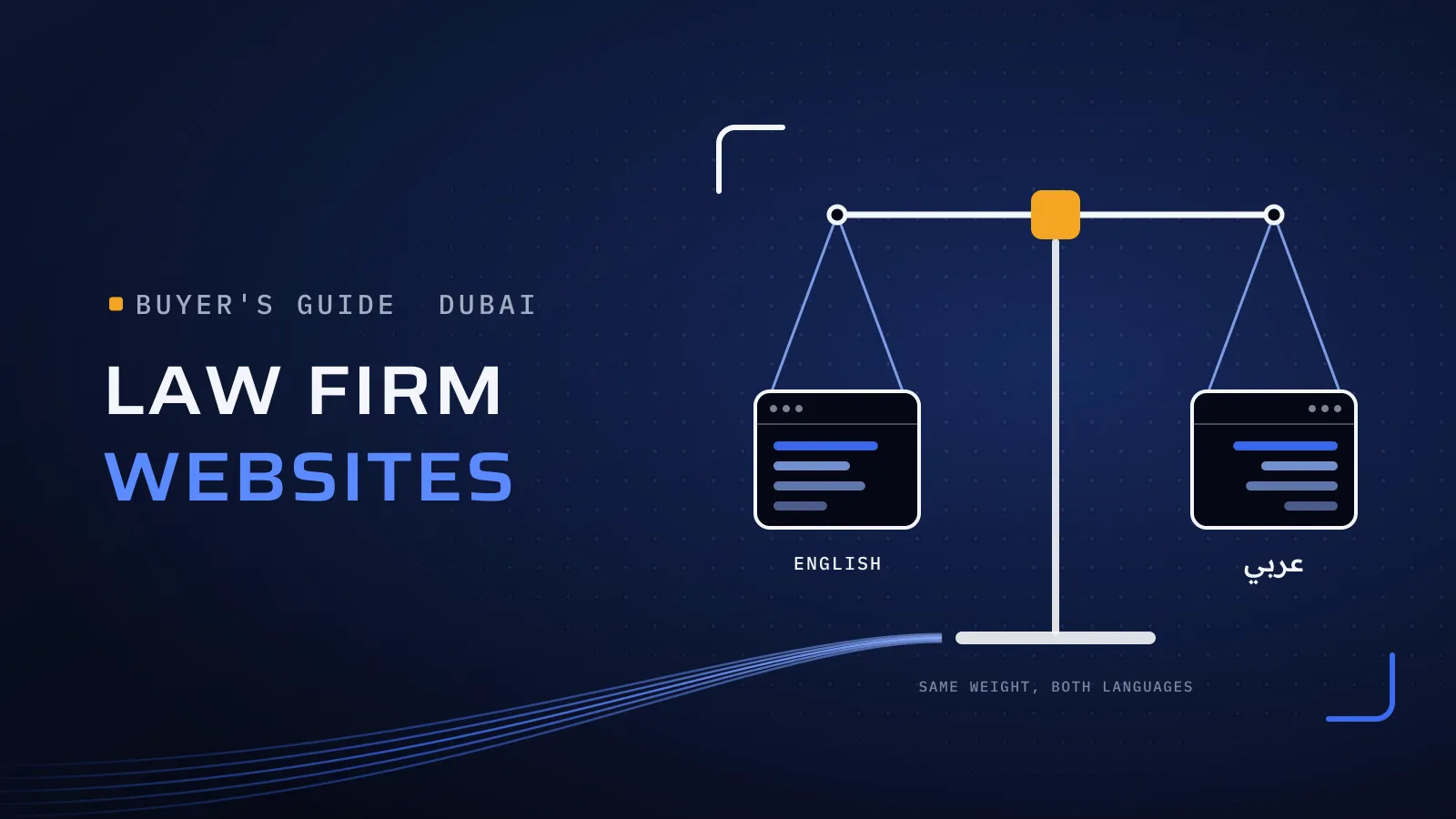
A law firm website in Dubai has two jobs. It shows a client, in Arabic or English, that you handle their kind of matter, and it takes their first enquiry without putting anything confidential at risk. Most firm websites manage the first job; the forms, the booking and what the site may say under the UAE’s rules for lawyers are where the choice of builder shows.
What does a law firm website in Dubai need?
Quick answer: Arabic and English pages written for each reader, with the legal Arabic checked by a native speaker and approved by your lawyers. One page per practice area and a profile for each lawyer. A short enquiry form that never asks for documents or the facts of a matter, and booking that confirms after your conflict check. Every claim checked against the UAE rules on how lawyers promote themselves. Then speed on a phone, clear trust signals, and articles that answer what your clients search for. Choose a builder who asks about your intake before your colours.
Know what your firm needs? Plan your firm’s website with us → or send us the proposal you received →
What a weak website costs a law firm
A client with an unpaid salary, a rent dispute or a company to set up checks two or three firms on a phone before calling any of them. Machine-translated Arabic, one page listing twenty practice areas, or a form that lands in an inbox nobody watches loses that client, and nobody tells you they left. A careless site costs in a second way. A form that invites documents, or a claim the rules don’t allow, becomes the firm’s problem, not the developer’s.
The checklist: what a UAE law firm website needs
| Part | What it must do | Check before launch |
|---|---|---|
| Arabic and English | Each language written for its reader, Arabic laid out right to left, each at its own address | Every template in both languages, on a phone |
| Practice-area pages | One page per area: who it serves, the matters you handle, the lawyers, the next step | No page is a bare list of services |
| Lawyer profiles | Title, qualifications, languages, practice areas, a real photo, a contact route | Each title matches the person’s registration, in both languages |
| Enquiry form | Few fields, routed by practice area, with a notice not to send confidential details | A test enquiry reaches the right person, in both languages |
| Consultation booking | Practice area, language, office or video, a real slot | The firm confirms only after its conflict check |
| Rules on promotion | Every claim is one the firm can support | A partner signs off the copy in both languages |
| Data protection | A privacy notice that matches what the forms and tools collect | You know who can read enquiries and when they are deleted |
| Speed and trust | Fast on mobile data; licence, offices and people easy to find | Tested on a mid-range phone, not on office Wi-Fi |
| Content for search | Pages and articles that each language’s searchers can find | Search Console and analytics live on launch day |
How to read it: the first three rows win the client’s trust, the next four protect the firm, and the last two bring clients to the site. A proposal that covers only the first three prices a brochure, not a law firm website.
Arabic and English, written for lawyers
Many of your clients will read the site in Arabic first, and many only in English. A literal translation of English legal copy reads stiffly in Arabic and often picks the wrong term, so each language gets its own copy.
- Two checks on legal Arabic. A native Arabic writer checks the language; one of your own Arabic-speaking lawyers approves the terms.
- Titles first. The federal law regulates advocacy and legal consultancy as two professions, so «محامٍ» (advocate) and «مستشار قانوني» (legal consultant) are not interchangeable. Each profile carries the title its holder is registered under.
- Right to left, properly. The layout mirrors, phone numbers and dates stay readable, and form fields accept Arabic names.
- Its own address for each language, such as
/ar/, paired with its translation, so Google shows Arabic searchers the Arabic page.
A third language follows the same rules. Plan it in the first design; added after launch, it reopens every template.
Practice-area pages and lawyer profiles
A practice-area page answers one question: can this firm handle my matter? Give each area its own page: who it serves (individuals, companies or both), the matters you take on, the lawyers who lead the work and one next step. A single “Services” page with twenty headings answers nobody.
A lawyer profile carries the name in Arabic and Latin script, the registered title, qualifications, experience, languages, practice areas, a real photo and the lawyer’s articles, with enquiries routed through the firm. Under the UAE rules below, a lawyer’s printed materials and the firm’s sign may show only academic qualifications, professional experience and the level of court the lawyer may appear before. Ask your regulator whether website profiles should follow the same limit.
Enquiry forms: what to ask, and what never to collect
A contact form is the first place a client might hand you something confidential. Design it so they can’t, until a lawyer has spoken to them.
| Ask on the public form | Leave for the lawyer’s first call or a secure portal |
|---|---|
| Name, phone or WhatsApp, email | Contracts, court papers, screenshots or any file upload |
| Preferred language and time to call | Emirates ID, passport or visa numbers |
| Practice area, from a short list | The full facts of the matter |
| Individual or company, and the emirate or country | Health, criminal record or family details |
| The other party’s name, only if your conflict check needs it first | Bank or card details, outside a payment page |
| One or two lines on the subject | Anything the client wouldn’t put in an email to a stranger |
- Say it on the form. A line above the message box asks the client not to send confidential details or documents. Many firms add that an enquiry doesn’t make the sender a client; your firm writes that wording.
- Keep the message out of email. The notification carries the name, the practice area and a link. The message stays in your CRM or a protected inbox that only named people can read.
- Route by practice area, so an employment enquiry doesn’t wait in the corporate team’s inbox.
- Move documents to a portal. Once the client is engaged, files go through a secure client portal behind a login, not email attachments.
The data protection basics
The UAE has a federal personal data protection law, Federal Decree-Law No. 45 of 2021, and the DIFC has its own, DIFC Law No. 5 of 2020, as the UAE government portal lists. Which rules apply to your firm is a question for your own counsel. Under any of them, the website’s part is the same: a privacy notice in both languages that matches what the site really collects, including analytics, chat and booking tools; only the fields the first call needs; a known place for every enquiry, with named readers and a deletion date; and marketing consent kept apart from the enquiry.
Booking a consultation online
- Let the client choose the practice area, the language, an office visit or a video call, and a slot from the lawyers’ real calendars.
- Book in two steps. The client requests a slot; the firm confirms after its conflict check. A client you can’t act for shouldn’t receive an instant confirmation.
- Show Dubai time, and the client’s own time when they book from abroad.
- Take payment, if the first consultation is paid, on the payment gateway’s own page, and say what happens if the firm declines after the conflict check.
- Confirm in the client’s language, by email or WhatsApp, with no case details in the message.
- Decide who answers WhatsApp. Many UAE clients would rather send a WhatsApp message than fill in a form. Agree who replies, and what may be discussed there before a lawyer has spoken to the client.
What the UAE rules say about promoting a law firm
These are the rules we could check on official sources. They are not legal advice, and your firm stays responsible for what its website says.
- A website is a permitted channel. Cabinet Resolution No. 8 of 2025, the executive regulations of the federal law on the advocacy and legal consultancy professions, lists a website for the lawyer or the firm among the permitted means of self-promotion, with the office sign, the letterhead and the firm’s own social media channels (Article 35, published by the Ministry of Justice).
- The limits are in Article 34 of the same resolution. A lawyer may not promote themselves in a way that conflicts with the traditions, dignity and prestige of the profession, seek work through intermediaries, or hint at influence or connections. Nor may they publish or imply false, misleading or fabricated information, on social media or by any other means. The same article sets the limit on titles described above.
- Breaches are disciplinary matters. In Circular No. 1 of 2024, the Government of Dubai Legal Affairs Department reminded Dubai firms that Federal Decree-Law No. 34 of 2022 (Article 45) bars an advocate from promoting themselves against the ethics of the profession or through intermediaries, and that a breach leads to disciplinary action.
What this means for your website: every claim is one the firm can support, nothing hints at connections, and any arrangement that pays a third party to bring you clients is cleared with your regulator first. The texts above don’t deal with testimonials, client names, case results, rankings or fees one by one. Before you publish any of them, ask your licensing authority: the Ministry of Justice, the Legal Affairs Department for firms licensed in Dubai, or the DIFC or ADGM authorities for firms there. Get each client’s written consent first.
Planning your firm’s site? Send us your practice areas, the languages you need and where enquiries go today. We reply with the pages, the intake form and the booking flow we would build, and the effort, team and price behind them. Plan your firm’s website with us →
Not ready for a call? Ask for our company profile and we’ll send it to you.
Speed and trust signals
Most clients open a law firm’s site on a phone, from a search or a link sent on WhatsApp. Keep the first screen light: no autoplay video, compressed images, and Arabic fonts loaded only in the weights you use. Test on a mid-range phone on mobile data, the way your clients see it.
Trust signals that help without testing any rule: the firm’s licence details and licensing authority in the footer; office addresses with a map and hours that match your Google Business Profile; real photos of your lawyers and offices; qualifications and languages in every profile; articles with a named author and a date; and a privacy notice, with a secure (HTTPS) connection on every page.
Content that brings clients from search
- One page per practice area, in each language. Arabic searchers phrase things their own way, so write the Arabic page for their words instead of translating the English heading.
- Articles that answer real questions, written or reviewed by a named lawyer, dated, and updated when the law changes.
- No near-copies. Twenty pages for twenty Dubai districts with the same text help nobody, Google included.
- A Google Business Profile for each office, with the same name, address and phone as the site, and structured data that gives search engines the same details.
Replacing an old site? Keep the addresses that bring enquiries and redirect the rest; our guide to website redesign in Dubai covers the redirect map.
How to choose who builds your law firm website
Send every candidate the same questions. The answers show who has thought about a law firm and who is quoting a brochure.
| Ask them | A good answer | A warning sign |
|---|---|---|
| Show us a law firm or professional-services site you built in Arabic | A live site you can open in both languages on your phone | Screenshots only, or English only |
| Who writes and reviews the Arabic? | Native Arabic writers, with legal terms approved by your lawyers | Machine translation, or “you’ll send us the Arabic” |
| What does the enquiry form collect, and where does it go? | The minimum, no uploads, a named place and named readers | An upload box and the general inbox |
| How do you handle the rules on promotion? | Your firm approves every claim, and they flag what to check with the regulator | Testimonials, rankings and bold promises suggested with no word on the rules |
| Who can edit the pages? | Your team edits practice pages and articles in both languages | Every change needs the developer |
| Who owns the domain, hosting, CMS and analytics? | Your firm, from day one, with the builder invited as a user | The agency’s own accounts |
| What happens after launch? | Updates, backups and security fixes in writing, with a named contact | Nothing agreed |
The price follows the templates, the languages, who writes the copy, the forms, booking and the CMS. Our guide to website design cost in Dubai shows how each one moves it, and our weighted scorecard for choosing a software company in Dubai turns the answers above into a score. For the last question, our website maintenance guide lists what monthly care should cover.
Already holding a proposal? Send it to us with anything confidential removed. We reply with the questions to ask and what we would change before you sign. Send us the proposal →
Where Flojics fits
As a website design company in Dubai, we design and build law firm websites in Arabic and English, with the enquiry forms and booking behind them. When a firm needs more than a website, such as a client portal, we build that too; our page on software for law firms and legal services sets out what we build for firms.
Abdulhameed Aljasmi Advocates & Legal Consultants is a law firm with offices in Dubai and Cairo; we designed its multilingual website, which presents the firm’s vision, legal team and practice areas. Talk to the team that built it: book a meeting.
Two of the ways we work fit a law firm. UI/UX focus: each template is designed around the client’s next step, in every language the site carries. Independent QA: the forms, both languages and the booking flow are tested by someone who did not build them. Our core team are native Arabic speakers who work in English, so your Arabic pages are written and reviewed in Arabic, and your lawyers approve the legal terms and every claim.
Send us your practice areas
Since 2014 we have worked with more than 100 clients across the UAE, Saudi Arabia, Qatar, Kuwait, the USA and Canada. Our headquarters is at Dubai Digital Park in Dubai Silicon Oasis, and our core team works from Egypt. Send us your practice areas, your languages and a line on how enquiries reach your lawyers today, or the link to your current site.
Plan your firm’s website with us → or send us the proposal you received → We ask about your goal, what you use today, your timing and who else should be involved. You leave with clear next steps. We reply by email first and set up a call only if you want one. Asking commits you to nothing, and we sign an NDA first if you ask.
Frequently asked questions
What should a law firm website in the UAE include?
Arabic and English pages written for each reader, one page per practice area, a profile for each lawyer, a short enquiry form that asks for no documents, consultation booking that confirms after your conflict check, and a privacy notice that matches what the site collects. It should be fast on a phone, and every claim on it should be one the firm can support.
Can a law firm in Dubai advertise on its website?
Yes, within limits. Cabinet Resolution No. 8 of 2025 lists a website for the lawyer or the firm among the permitted means of self-promotion (Article 35). Article 34 rules out promotion that conflicts with the profession's traditions and dignity, solicitation through intermediaries, hints of influence or connections, and false or misleading information. Ask your licensing authority before publishing testimonials, client names, case results or rankings.
Should our law firm website be in Arabic and English?
For most UAE firms, yes. Write each language for its reader instead of translating word for word, give each language its own address so Google shows the right one, and have a native Arabic writer check the language while your own lawyers approve the legal terms, starting with each lawyer's title.
What should a law firm's contact form not ask for?
Documents, Emirates ID or passport numbers, the full facts of the matter, health or criminal record details, and bank details. Ask for contact details, language, practice area and a line on the subject, add a notice not to send confidential details, and move documents to a secure portal once the client is engaged.
How much does a law firm website cost in Dubai?
It follows what the site has to do: the page templates, the languages, who writes and reviews the copy, the forms and where they send enquiries, booking and payments, the CMS your team edits, and care after launch. Send us your practice areas and languages, and we reply with the effort, the team and the price.
Can clients book and pay for a first consultation online?
Yes. Let them choose the practice area, the language and an office or video slot from your lawyers' calendars, then confirm after your conflict check. A paid consultation goes through the payment gateway's own page, with a clear line on what happens if the firm can't take the matter.