WordPress or a Custom-Built Website for a Dubai Business: How to Decide
WordPress vs custom website for a Dubai business: what each does well, Arabic and English, integrations, security, upkeep and who maintains it, in one table.
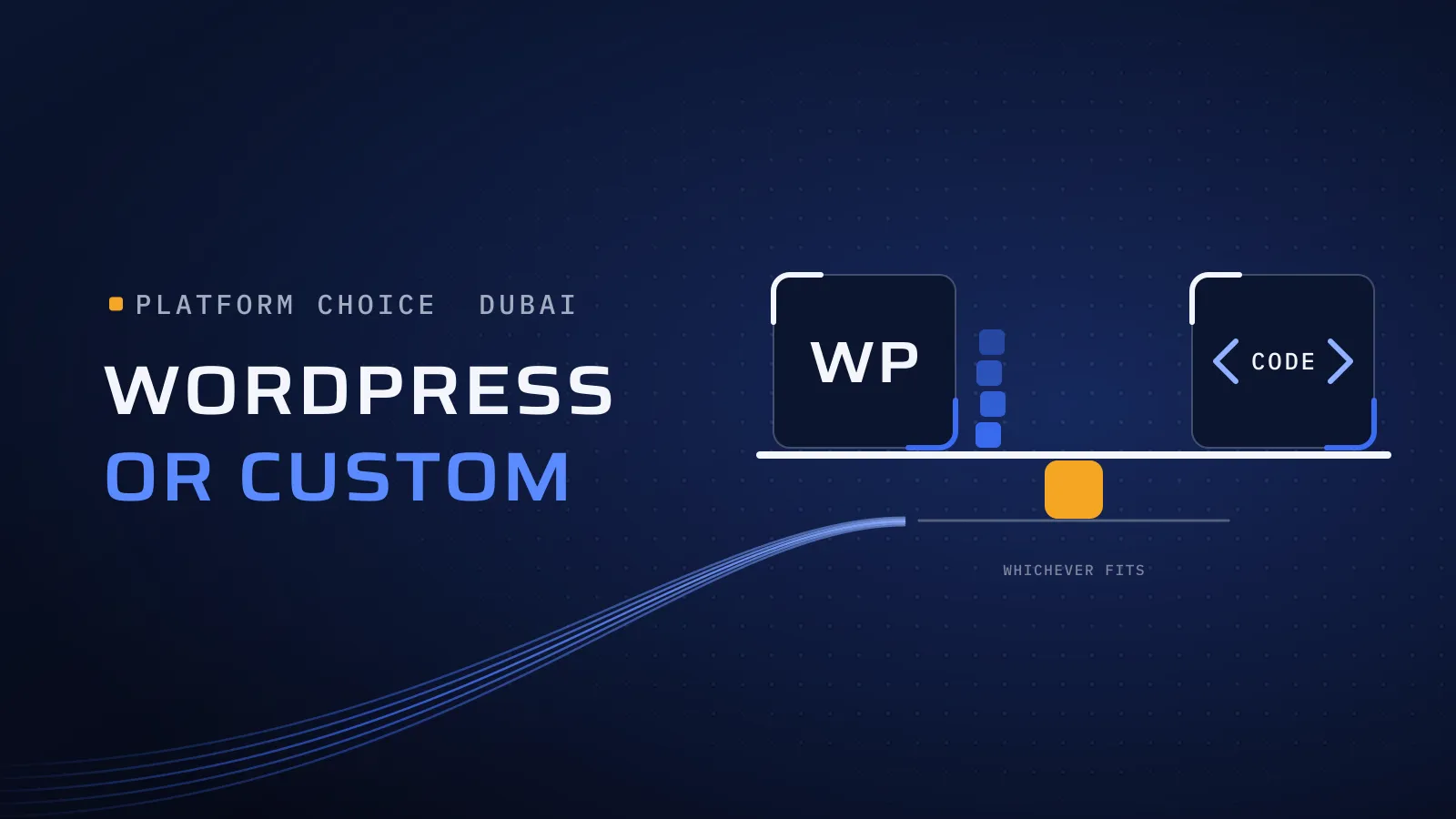
Choosing between WordPress and a custom-built website comes down to three questions more than to technology: who edits the site, what it must connect to, and who looks after it once it is live. WordPress fits a company website your own team updates. Custom code fits a website that is really software, with logins, portals or live data from your own systems. We build on both, and this is the checklist we use to choose.
Which should a Dubai business choose: WordPress or a custom website?
Quick answer: Choose WordPress when the site is mainly pages, services, news and enquiry forms, your marketing team edits it often, and the features you need exist as well-kept plugins. Choose a custom build when the site needs accounts, bookings, a portal, your pricing rules or two-way links to your CRM or ERP, or when you want few third-party parts to patch. Many sites sit in between: WordPress with one custom feature, or a headless setup. Arabic and English work on both, if planned from the first design.
Choosing a platform for a new site? Book a free website consultation → or send us the proposal you received → and we reply with the questions to ask and what we would change.
What the wrong choice costs you
The mistake runs both ways. A WordPress site asked to act as a portal becomes a stack of plugins from different authors doing the job of software, and one update breaks another. A custom site built for a simple brochure has the opposite problem: every new page or Arabic correction waits for a developer, so marketing stops publishing. Either way, the site is rebuilt sooner than planned.
What WordPress does well, and where it strains
What it does well:
- Editing. Your team adds pages, news, projects and services in an editor they learn without a developer.
- Choice. Themes and plugins cover common needs: forms, galleries, events, and a shop through WooCommerce.
- People. Many developers know it, so you are not tied to one supplier.
Where it strains:
- Plugins multiply. Each one is another author’s code to update. WordPress’s own security guide tells site owners to keep plugins updated and to delete any plugin they don’t use.
- Two languages added late. WordPress’s documentation says it “does not support a bilingual or multilingual blog out-of-the-box”. Arabic and English need a multilingual plugin, such as WPML or Polylang, or a separate installation per language, plus a theme that handles right to left. Both work when chosen early and tested in Arabic on a phone.
- The site becomes an application. Accounts, approvals or two-way sync with your ERP can be built inside WordPress, but then you are writing custom software that must also survive every WordPress update.
When a custom-built website pays off
A custom build means developers write the site in a framework, such as Laravel, or as a static site: pages built in advance as files, with no database behind them. You get exactly what you specify, and you own more code to look after. It pays off when:
- Integrations carry the business. Leads reach your CRM with the page they came from, prices and stock come from your ERP, payments settle in dirhams through your gateway, or customers sign in with UAE PASS.
- Customers or suppliers log in. Portals, bookings and dashboards are software, tested as one system, not as plugins that happen to work together.
- Speed matters on every page. You decide what loads. WordPress can be fast too, with a lean theme, few plugins and good hosting; slow ones often carry a heavy page builder and many plugins.
- You want a smaller security surface. Fewer third-party parts and, on a static site, no admin login on the public site. But a framework nobody patches is as risky as a plugin nobody updates.
- Arabic and English must stay in step. Each page and its twin can be built into the site’s structure, and the site can refuse to publish a page missing its other version.
- The site will grow into a product: a web app, or a mobile app on the same back end.
What custom costs you: any change beyond what your editor allows goes through a developer, and only people who know your framework can maintain it.
The decision table
Answer each row, then take the table to whoever signs off the site.
| Question | Lean to WordPress if | Lean to custom if |
|---|---|---|
| Who edits the site, and how often? | Your marketing team, weekly, without a developer | Mostly new features, or developers edit it |
| What does the site do? | Presents services and news, and collects enquiries | Logs people in, takes bookings or prices quotes |
| What must it connect to? | Email, analytics and a CRM through a maintained plugin | Your ERP, CRM, gateway or government services, in both directions |
| Arabic and English | Your team translates pages in a multilingual plugin | Both languages must stay in step, with rules the site enforces |
| The features you need | Exist as plugins with active updates | Don’t exist, or only by combining several plugins |
| Third-party parts | A short plugin list, each with someone who updates it | As few as possible, with the framework patched on a schedule |
| Who maintains it later | Any WordPress team, given the logins, backups and licences | A team that knows the framework, given the repository and deploy notes |
How to read it: if most answers sit in one column, that is your platform. If they split, read the middle options below. And if WordPress covers what you need, start there; we say so, even when it means we build less.
The middle options: WordPress with custom parts, or headless
WordPress with custom parts. Your own theme, plus one custom plugin for the feature no plugin does well: a quote calculator, a link to your CRM, a members’ area. Your team keeps the editor, and only the custom part needs a developer. Ask for the custom code in its own plugin, in a code repository, so a theme change can’t remove it.
Headless. WordPress, or another CMS, holds the content, and a separate front end built in code shows it. WordPress’s REST API lets you bring content into “completely separate applications”, such as a website and a mobile app sharing the same content. Editors keep a familiar admin; developers control the speed and the pages. The trade-off: two things to host and maintain, and plugins that change the public pages no longer apply.
What it takes to build and run: roles and tasks
The cost of a WordPress website in Dubai, or of a custom one, follows the people and the work, not the platform’s name. A build involves a project manager, a UI/UX designer for each page template in both languages, developers for the theme and plugins or the custom code, an independent QA engineer, and a technical lead at CTO level when the site connects to your CRM, ERP or gateway.
What makes it bigger: more page templates, both languages at launch, more editing power for your team, each integration, logins and custom features. Our guide to website design cost in Dubai explains each driver and what to ask every quote.
After launch, the work becomes recurring tasks:
| Task | On WordPress | On a custom site | Who owns it |
|---|---|---|---|
| Content | Your team, in the editor | A CMS, or a developer if there is none | Your marketing lead |
| Updates | The core, the theme and every plugin | The framework, its packages and the server | A developer, tested on a copy first |
| Security patches | As each plugin’s author releases them | As the framework and packages release them | A developer, then a check of the site |
| Licences | Premium plugins and themes, on each supplier’s terms | Any paid service you add | Your company’s accounts |
| Hosting and backups | Hosting and a full backup with restore tests | Hosting, the code repository and backups | Your company’s accounts |
| Checks after each change | Forms, both languages, the shop if there is one | The same, plus each integration | QA or your maintenance provider |
The running effort grows with each plugin, each integration and each move to a newer PHP or framework version. Our website maintenance checklist lists what monthly care should cover, and our website maintenance services cover both kinds of site.
Who can maintain it later?
- On WordPress, the pool of developers is large. The risks are a premium plugin licensed to the agency’s account, a page builder only one person understands, and admin access held by the agency alone. Keep the admin login, the hosting, a recent full backup and every licence key in your company’s name.
- On a custom site, fewer people know your exact code, so the handover matters more. Ask for a common framework, the code in a repository your company owns, written build and deploy steps, and notes on each integration. Then ask: could another team run this from what you hand over?
Hiring a WordPress website development company in Dubai: what to ask
Whether a Dubai company proposes WordPress or custom code, ask in writing:
- Why this platform for our site, and what would make you recommend the other one?
- Which theme or page builder, and which plugins? Which are paid, and in whose name?
- How are Arabic and English handled: which plugin, which right-to-left theme, and does each language get its own addresses?
- Where does any custom code live, and who else could maintain it?
- Who updates and patches the site after launch, and who checks it afterwards?
- What do we hold on launch day: logins, hosting, repository, backups and licences?
- Replacing an old site: who builds the redirect map for its URLs?
Holding a website proposal? Send it to us with anything confidential removed. We reply with the questions to ask about the platform, the plugins and Arabic, and what we would change before you sign. Send us the proposal you received → Starting from scratch? Book a free website consultation →
Not ready for a call? Ask for our company profile and we’ll send it to you.
Our own site: from WordPress to custom
We rebuilt flojics.com from WordPress as a custom static site, in English and Arabic. Every old URL kept its address or got one permanent redirect to its closest new page, and we checked them with a script. Our guide to website redesign in Dubai shows the method.
Custom suited us because the people who edit our site are developers, and every English page and its Arabic version change together. A company whose marketing team publishes every week, with no developer on hand, is often better served by WordPress. We build that too: TheEffectArt is an antiques platform whose WordPress website we redesigned to show each piece. Talk to the team that built it: book a meeting.
Send us your page list, or the proposal you were given
We are a website design company in Dubai that builds on WordPress and on custom code; when the site is really a portal or a business system, it becomes a custom software development project. Native Arabic speakers on our core team check the Arabic screens, independent QA tests both languages and every form, and we don’t sell hosting, so it stays in your company’s accounts. Since 2014 we have worked with more than 100 clients across the UAE, Saudi Arabia, Qatar, Kuwait, the USA and Canada, from our headquarters at Dubai Digital Park in Dubai Silicon Oasis, with our delivery team in Egypt.
Send us your page list, your languages, who will edit the site and what it must connect to. We reply with the platform we would choose and why, and the phases, team and price.
Book a free website consultation → or send us the proposal you received → We reply by email first and set up a call only if you want one. Asking commits you to nothing.
Frequently asked questions
WordPress or a custom website: which is better for a Dubai business?
Neither in general. WordPress fits a company website your team edits often, where the features you need exist as well-kept plugins. A custom build fits a site that logs people in, takes bookings, prices quotes or exchanges data with your CRM or ERP. Many sites sit in between: WordPress with one custom feature, or a headless setup. Decide by who edits the site, what it connects to and who maintains it.
How much does a WordPress website cost in Dubai?
It follows the people and the work, not the platform's name: a project manager, a designer for each page template in English and Arabic, developers, independent QA, and a technical lead when the site connects to your CRM, ERP or gateway. More templates, both languages at launch, more editing power for your team, integrations and custom features make it bigger. Send us your page list and we reply with the platform we would choose, and the phases, team and price.
Can WordPress handle Arabic and English?
Yes, with planning. WordPress's own documentation says it does not support a bilingual or multilingual site out of the box, so Arabic and English need a multilingual plugin, such as WPML or Polylang, or a separate installation per language, plus a theme that handles right to left. Choose both early, give each language its own addresses, and check every template in Arabic on a phone.
Is a custom website more secure than WordPress?
It can have a smaller attack surface: fewer third-party parts and, on a static site, no admin login on the public site. But it is only as safe as its upkeep: a framework nobody patches is as risky as a plugin nobody updates. On WordPress, keep every plugin updated and delete the ones you don't use, as WordPress's own security guide advises.
What is a headless website, and when does it make sense?
WordPress or another CMS holds the content, and a separate front end built in code shows it, reading the content through an API. Editors keep a familiar admin, and developers control the speed and the pages. The trade-off is two things to host and maintain, so it pays when a website and a mobile app share the same content.
Can we move from WordPress to a custom site and keep our Google traffic?
Plan the move around a redirect map: every old URL keeps its address or gets one permanent redirect to its closest new page, and each one is tested. We did this when we rebuilt flojics.com from WordPress as a custom static site in English and Arabic, and checked the old URLs with a script.
Who can maintain the website if we change provider?
On WordPress, many developers can, if your company holds the admin login, the hosting, a recent full backup and every plugin licence. On a custom site, fewer people know your exact code, so ask for a common framework, the code in a repository your company owns, written build and deploy steps, and notes on each integration.