Website Redesign in Dubai: When to Redesign, What to Keep, and How to Keep Your Google Traffic
Website redesign in Dubai: when it pays, what to keep, fix or drop, and how a redirect map keeps your Google traffic when old URLs change.
A website redesign in Dubai should bring you more enquiries than the site it replaces. Done carelessly, it does the opposite: the new site looks better, but the pages Google sent buyers to for years now show errors, a form stops reaching sales, and enquiries fall away before anyone checks why.
When is a website redesign in Dubai worth it?
Quick answer: Redesign when the site holds the business back: slow or awkward on a phone, broken or missing Arabic, pages your team can’t edit without a developer, or copy that no longer matches what you sell. Keep the content and addresses that bring enquiries, fix what blocks them, and redirect every old URL to its closest new page.
Know what’s wrong with your site? Plan your redesign with us →
Not every problem needs a redesign. Outdated copy or a few slow pages can be fixed on the site you have. A redesign pays when the problem is the structure: the page templates, the navigation, the Arabic layout or a CMS your team avoids.
What an old site, or a careless redesign, costs you
Buyers in the UAE check your website before they answer a proposal or call your sales line. A site that is slow on a phone, shows broken Arabic or describes last year’s services loses those enquiries, and nobody tells you they left. A rushed redesign costs in a different way. Search engines and other websites have been sending people to your old addresses for years. Change those addresses without redirects and the visits land on error pages, and the place those pages held in Google’s results goes with them.
What to keep, what to fix, what to drop
Go through the current site with whoever owns marketing and sales before any design starts. Every row needs an answer.
| What you have | Keep it when | Change it when | Check before launch |
|---|---|---|---|
| Page addresses (URLs) | The page has visits, links from other sites or enquiries | The address is unclear, or the page is merged into another | Every old URL opens a live page or redirects to one |
| Pages that bring enquiries | The topic still sells | The layout, speed or call to action holds them back | The facts and main phrases survive the rewrite |
| Pages nobody visits | They support a page that sells | They are out of date or repeat another page | Each one redirects to the closest page you keep |
| Forms and the CRM link | Enquiries reach the right person today | They land in an inbox nobody reads | A test enquiry from every form reaches sales, in both languages |
| The Arabic version | It was designed right-to-left, with real Arabic copy | It is machine-translated or breaks on a phone | Every template, in both languages, on a phone |
| The CMS | Your team edits pages without help | Every change needs a developer, or plugins are out of date | Your team publishes a test page on its own |
| Analytics and Search Console | Always: their history is how you compare before and after | Forms and calls aren’t tracked | Both run on the new site from launch day |
| Domain, hosting and logins | They sit in your company’s name | They sit with a former agency or a former employee | Your company holds every login before work starts |
How to read it: the first two rows decide whether the redesign keeps your traffic, and the last row decides whether you can start at all. Settle the logins first.
How a website redesign runs, step by step
- List everything the old site has. Every URL from its sitemap, Search Console and analytics, every form and where it sends, every account and who holds it. This list becomes the redirect map.
- Sort it with the table above, with marketing and sales in the room. Plan the new page list around what sells, not around the old menu.
- Design the templates. If your buyers read Arabic, each page type is designed in Arabic and English from the first draft. Our guide to website design cost in Dubai shows how templates, languages and the CMS set the price, and our Arabic localization guide covers the right-to-left details.
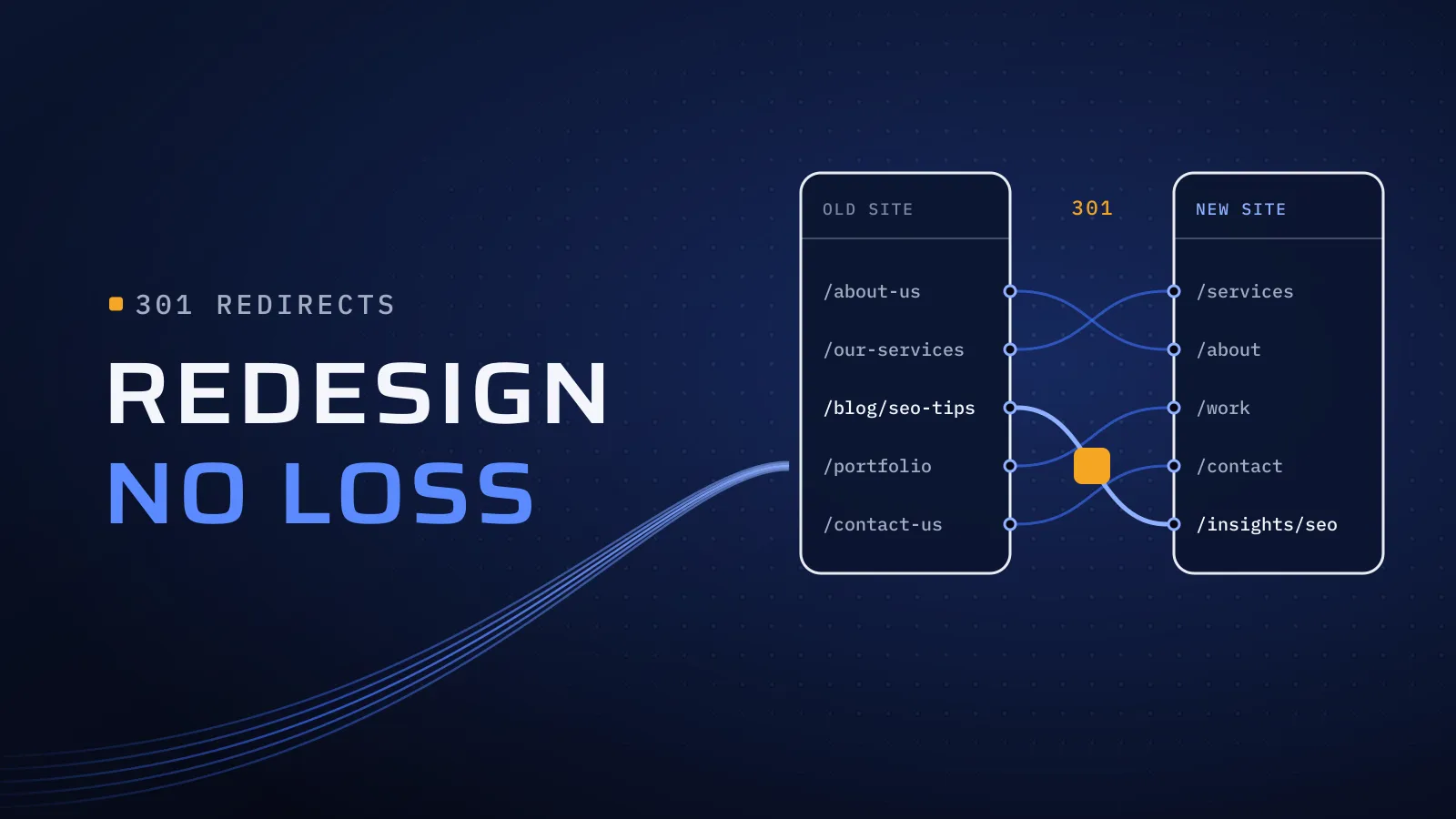
- Build, and map every old URL to one new page. Each old address gets one permanent (301) redirect to its closest new page, and content moves across with its facts intact.
- Test, switch and watch. Every redirect, form and template is tested before the switch. After launch, check Search Console for errors and confirm that enquiries keep arriving.
Planning a redesign? Send us your current site’s address and what has to change. We reply with what we would keep, what we would rebuild and how your old URLs would move. Plan your redesign with us →
Not ready for a call? Ask for our company profile and we’ll send it to you.
How to keep your Google traffic through a redesign
Keeping your traffic is part of building the new site properly, like a contact form that reaches sales. It is not a marketing extra. Google’s guide to site moves with URL changes sets out the rules, and four of them matter most in a redesign:
- Map every old URL to a new one. A sheet with two columns, old address and new address, is the map. Google calls this mapping important.
- Use permanent redirects. A 301 tells browsers and search engines that the page has moved for good.
- Don’t send everything to the home page. Google warns that many old URLs redirected to one unrelated page can confuse visitors and may be treated as a soft 404: an error page in disguise. Send each one to its closest match.
- Keep the redirects. Google advises keeping them as long as possible, and generally at least a year.
Google also says to expect temporary movement in rankings during a move. What you control is the map: complete, tested and live on switch day.
What this means for you: before you approve a redesign quote, ask who builds the redirect map, how every old URL is tested and who checks Search Console in the weeks after launch. If the answer is “we’ll redirect the main pages”, the rest of your addresses are left to chance.
We did it on our own site first
We rebuilt our own website, flojics.com, from WordPress, and held it to the same rules. We listed every URL the old site had published. Each one either kept its address or got one permanent redirect to its closest new page, with no chains and no blanket redirects to the home page, and we checked every old URL’s redirect with a script.
TheEffectArt is a WordPress website redesign for an antiques platform. Talk to the team that built it: book a meeting.
Two of the ways we work fit a redesign. UI/UX focus: user experience is considered from the beginning, so the new templates start from what buyers came to the old site to do. Independent QA: a dedicated testing and quality assurance process, so the forms, both languages and the redirect map are checked by someone who did not build them. As a website design company in Dubai, we design and build the new site, and the redirect map is part of that build.
Send us the site you have today
Since 2014 we have built websites and software for more than 100 clients across the UAE, Saudi Arabia, Qatar, Kuwait, the USA and Canada, from our headquarters at Dubai Digital Park in Dubai Silicon Oasis and our offices in Houston and Alexandria. Send us your site’s address and a line on what has to change. Your price is agreed in your proposal; it follows the templates, the languages, the content that moves and the size of the redirect map.
Plan your redesign with us → We ask about your goal, what you use today, your timing and who else should be involved. You leave with clear next steps. The call commits you to nothing, and we sign an NDA first if you want one.
Frequently asked questions
What does a website redesign cost?
It follows the same drivers as a new site: page templates, Arabic and English, the CMS, forms and CRM links, and who writes the copy. A redesign adds two of its own: how much existing content moves across, and how many old URLs need a redirect. Your price is agreed in your proposal, with each driver set out.
How long does a website redesign take?
It follows the number of templates, the languages and how much copy is rewritten. Waiting for copy and sign-offs is a common cause of delay, so your proposal sets dates for both, alongside the design and build. Your launch date is agreed in your proposal, with the redirect testing planned before it rather than after.
Will we lose our Google rankings when we redesign?
Google says to expect some temporary movement during any move to new URLs. The avoidable losses come from old addresses that no longer lead anywhere. Give every old URL a permanent redirect to its closest new page, keep the facts on the pages that bring visits, and watch Search Console after launch, and the new site builds on what the old one earned.
Should we move off WordPress when we redesign?
Not by default. If your team edits it easily and it is kept updated, a redesign can stay on it. Move when the platform itself is the problem: plugins nobody updates, an editor your team avoids, or pages that stay slow whatever you fix. Either way, the redirect map and the checks are the same.
Who owns the new website and its code?
Your company should. Keep the domain, hosting, CMS, analytics and Search Console in company accounts. With us, the code passes to you at the end of the project, once it is completed and paid.