Website Design Cost in Dubai: What Moves the Price, and What a Business Website Needs
Website design cost in Dubai explained: why quotes differ, the seven things that set the price, template vs custom design, and what to ask each quote.
Website design cost in Dubai is hard to compare because no two quotes price the same website. One agency quotes a few pages on a ready-made theme; another quotes a designed, bilingual site your team can edit, with enquiries landing in your CRM. Choose on the total alone and you can pay twice: once for the cheap site, and again for the rebuild when it can’t take Arabic, new pages or the leads your sales team needs.
What does website design cost in Dubai, and why do quotes differ?
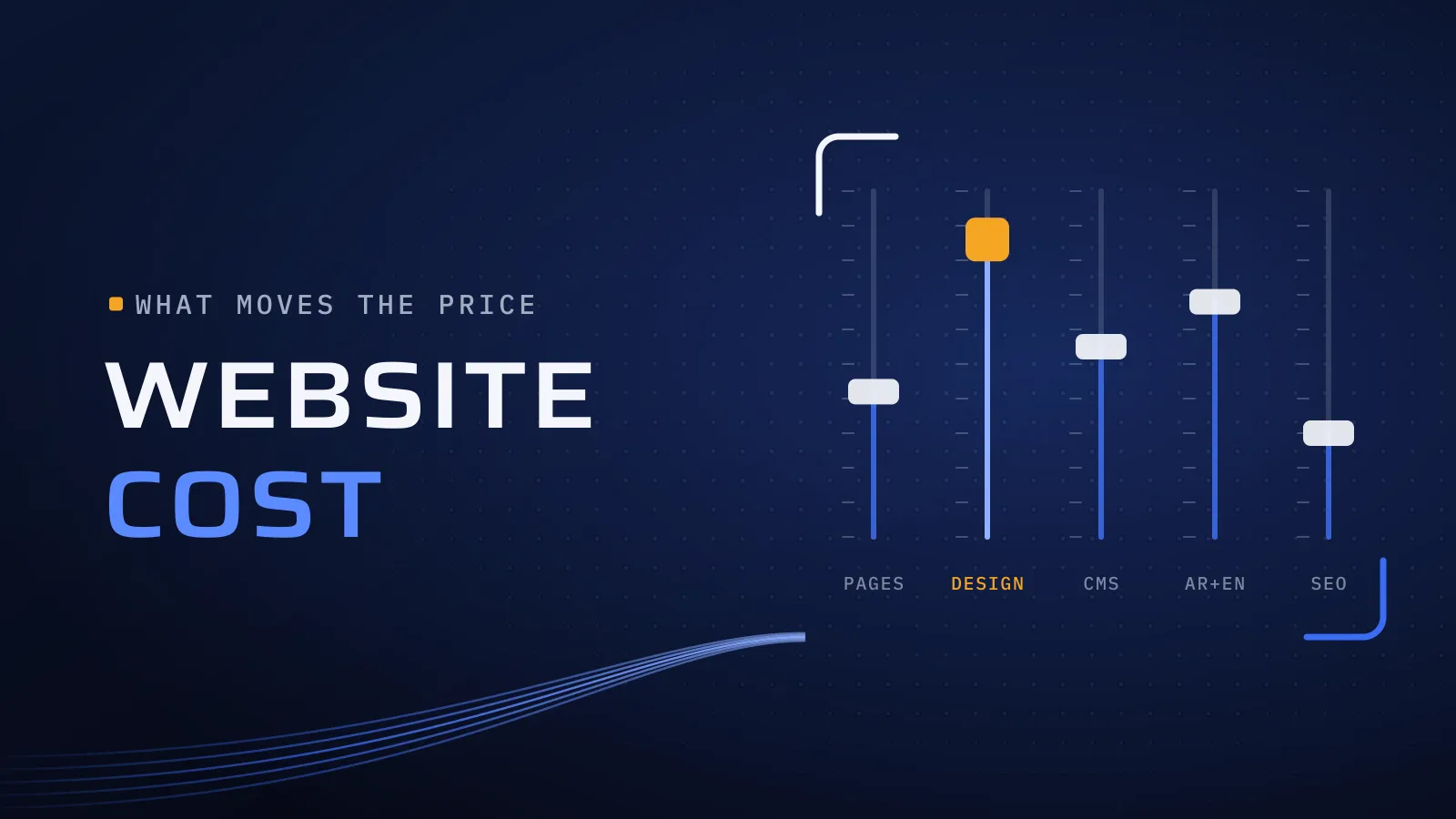
Quick answer: Website design cost in Dubai follows seven drivers: how many page templates the site needs, Arabic and English, the CMS, forms and CRM links, e-commerce, who supplies copy and photos, and hosting and care after launch. Quotes differ because each assumes a different mix. Write down your answer to each, send the same list to every agency, and the quotes become comparable.
Get a quote for your website →
What a weak website costs you
Buyers check your website before they reply to a proposal or call your sales line. A site that is slow on a phone, shows broken Arabic or hides its contact form loses those enquiries quietly, because nobody tells you they left. A site that can’t grow costs you a second time: when you need new services, a second language or a lead form that reaches sales, it gets rebuilt, and you pay again for design, content and setup.
The seven things that move the price
1. Page templates, not pages. A template is a page layout: home, service, case study, article, contact. A 40-page site built from five templates can cost less than a 15-page site where every page is designed differently. Count the templates you need first, then the pages that reuse them.
2. Arabic and English. A second language adds a right-to-left layout for every template, Arabic fonts, a language switch and copy in both languages kept in step. Planned from the first design, it is part of each template; added later, every page is reopened. Our guide to Arabic app localization explains what right-to-left design involves.
3. The CMS. The content management system is where your team edits the site without a developer. Ask exactly what your team can change on its own: text, images, new pages, new sections. A site where marketing can publish a new service page itself costs more to set up and less to run.
4. Forms and CRM. A form that sends an email is simple. Forms that route by service, block spam, record where the visitor came from and create a lead in your CRM need more setup and testing, and they decide whether an enquiry reaches sales the same day or sits in an inbox.
5. E-commerce. Selling online adds a catalogue, cart, checkout, a payment gateway, delivery options and VAT invoices. That turns a website into a store, so price it as its own project; our e-commerce website cost guide compares Shopify, WooCommerce and a custom store on what moves that quote. Our guide to e-commerce apps and websites in Dubai covers what a store needs at launch, and our B2C e-commerce solutions in Dubai show how we build one.
6. Copy and photos. Who writes the text, in which languages, and who supplies the photos? A quote that assumes you provide approved copy and images is cheaper on paper, and the launch then waits for them. Copywriting, translation and a photo shoot are real line items, so ask whether each is in or out.
7. Hosting and care after launch. Hosting, the domain, paid plugins or fonts, security updates, backups and small changes. Some quotes include a first year; others leave all of it out. Ask for each as a separate line, with who pays which provider. Our guide to website maintenance in Dubai lists the ten jobs that monthly care should cover.
What this means for you: before you ask for quotes, write one page with your answer to each of the seven: the templates you need, the languages, what your team must edit, where enquiries go, whether you sell online, who supplies copy and photos, and who looks after the site once it is live. Send that same page to every agency. Quotes built on one brief can be compared; quotes built on guesses can’t. Running a formal tender? Our free website and software RFP template in Word gives every agency the same document to answer.
Template or custom design?
The second big gap between quotes is how the site is designed. Take this to whoever signs off the budget:
| Option | A ready-made template | Your own design on a proven CMS | A fully custom build |
|---|---|---|---|
| Fits | A small brochure site that has to go live soon | Most company sites: designed for your offer, edited by your team | A site that is really a web app, with accounts, bookings, calculators or portals |
| You get | A quick start at the lowest build cost | Templates made for your services and buyers, on an editor your team can learn | Exactly the features and flows you need |
| You trade off | A look shared with other sites, and limits when you add features or Arabic | More design time before the build | The highest build cost, and a developer for most changes |
| Check before you sign | The theme’s right-to-left version, on a phone | Every template, in both languages | Who maintains it, and what your team can edit |
What every business website needs, whatever the budget
Whichever column you choose, these are not extras:
- Fast on a phone, with buttons and forms that are easy to tap.
- Arabic done properly, if your buyers read it: right-to-left layout, real Arabic fonts, no machine-translated headings.
- Readable by search engines. The site should be built so search engines can read it: real text rather than text inside images, clear headings and a page for each service.
- A clear next step on every page, with a short form or a phone number that works when tapped.
- Analytics from launch, so you know which pages bring enquiries.
- Room to grow, so new pages and sections don’t need a rebuild.
Some sectors add needs of their own, such as listings and portal feeds on real estate websites, or enquiry forms that collect nothing confidential on law firm websites.
Questions to ask each quote
Put every quote you receive through the same questions. The answers show what each price includes.
| Ask | Why it matters |
|---|---|
| How many page templates are included, and which ones? | Templates drive design and build time; pages that reuse them cost little. |
| Is Arabic designed for every template, or translated at the end? | Right-to-left added late means reopening every page. |
| What can our team edit without a developer? | It decides what every future change costs you. |
| Where do form submissions go, and who tests them? | An enquiry that lands nowhere is a lost lead. |
| Who writes the copy and supplies the photos, in both languages? | If it is on you, the quote is lower and the launch waits for your content. |
| How is the site built for speed and for search engines? | It should load fast on a phone and be readable by search engines from day one. |
| What happens after launch, and what does the first year cost? | Hosting, licences, updates and backups recur every year. |
| Who owns the domain, the hosting account and the code? | Your company should, so you can change agency without starting again. |
Have quotes that don’t line up? Send us your page list and the languages you need, or the brief you sent other agencies. We’ll say which of the seven drivers explains the gap and what we would include. Get a quote for your website →
Comparing agencies with your team first? Ask for our company profile and we’ll send it to you.
Send us your page list
Since 2014 we have worked with more than 100 clients across the UAE, Saudi Arabia, Qatar, Kuwait, the USA and Canada. We are headquartered at Dubai Digital Park in Dubai Silicon Oasis and have offices in Houston and Alexandria. Abdulhameed Aljasmi Advocates & Legal Consultants is a law firm whose multilingual website we designed. Talk to the team that built it: book a meeting.
Two of the ways we work keep a website quote honest. UI/UX focus: user experience is considered from the beginning, so each template is designed around the visitor’s next step, in every language the site carries. Product thinking: we solve business problems, not only deliver features, so the site is scoped around the enquiries it has to win rather than a page count. As a website design company in Dubai, our designers and engineers work together from the start, so each layout is practical to build and fast to load.
Send us your one-page brief, even half finished, or the site you have today. Your price is agreed in your proposal, with each of the seven drivers set out so you can see what it includes.
Get a quote for your website → We ask about your goal, what you use today, your timing and who else should be involved. You leave with clear next steps. We reply by email first and set up a call only if you want one. Asking commits you to nothing, and we sign an NDA first if you ask.
Frequently asked questions
Why do website quotes in Dubai differ so much?
Because each quote prices a different website. One counts a few pages on a ready-made theme with your text pasted in; another counts designed templates in two languages, a CMS your team can edit, forms that feed your CRM and care after launch. Put every quote into the same list of seven drivers, and the gap usually explains itself.
Template or custom design: which should we choose?
A template suits a small brochure site that has to go live soon on a tight budget, as long as its Arabic version works properly on a phone. Custom design pays when the site has to explain a complex offer or stand apart from competitors. Many companies take the middle route: their own design, built on a proven CMS their team can edit.
Does an Arabic version add much to the cost?
It adds work in three places: a right-to-left layout for every template, Arabic fonts checked on every screen size, and copy written or translated in Arabic and kept in step with the English. Planned from the first design, it is part of each template. Added to a finished site, every page is reopened, which is the expensive way to do it.
What does a website cost after launch?
Three lines recur every year: hosting and the domain renewal, any paid plugins, fonts or CMS licences, and care, meaning security updates, backups, fixes and small changes. Ask each quote to list them separately and say who pays which provider, so the first year's cost is clear before you sign.
Who owns the website and its code?
Your company should. Register the domain and the hosting account in your company's name and get admin access to the CMS and analytics at launch. With us, the code and IP pass to you at the end of the project, once it is completed and paid.