Website Maintenance Services in Dubai: What Monthly Care Covers and How to Choose a Provider
Website maintenance services in Dubai: the ten jobs monthly care should cover, what to put in the agreement, and what to recover if your developer disappears.
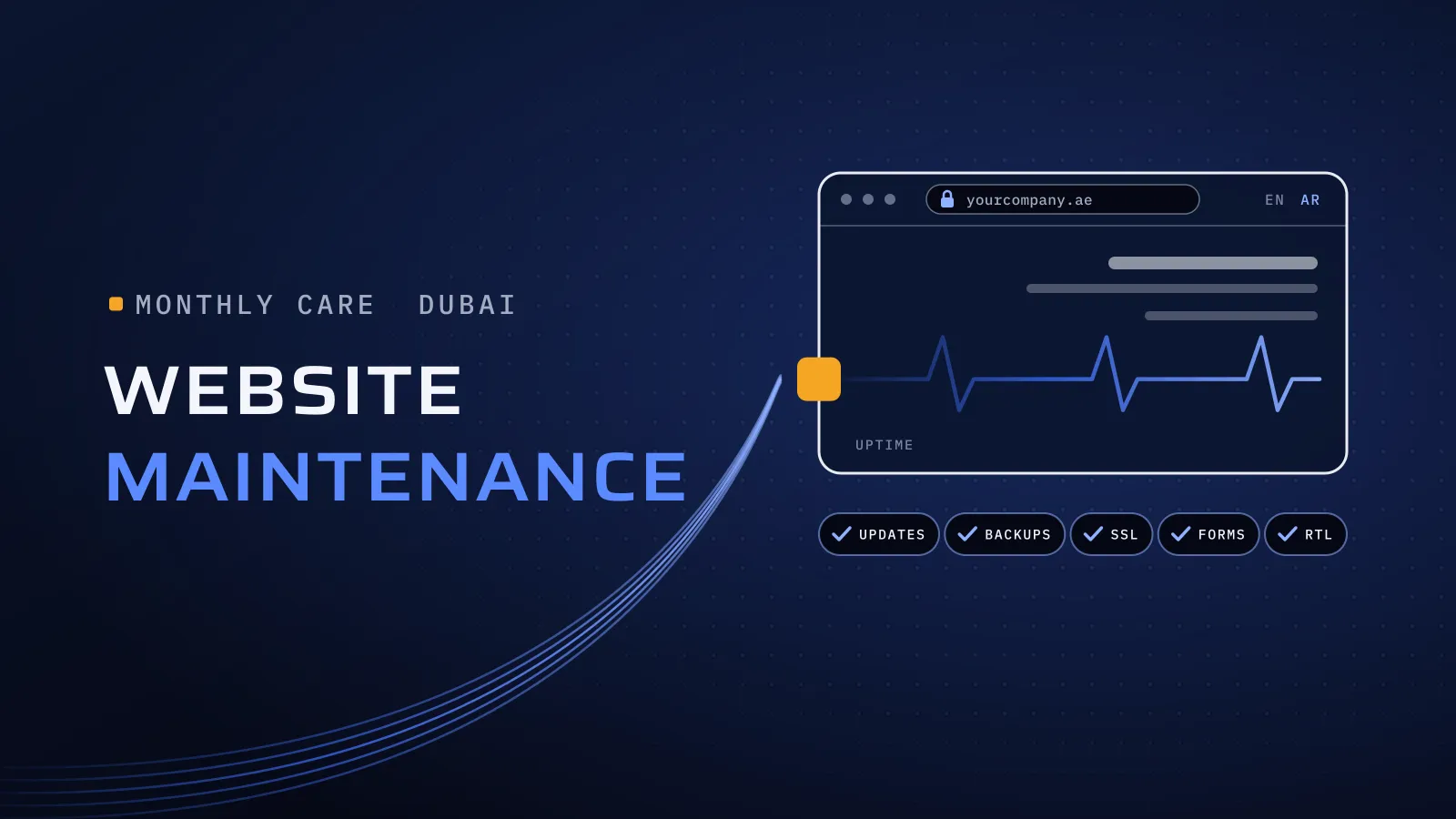
Website maintenance in Dubai is the routine work that keeps a company site safe, fast and sending enquiries to sales: updates, backups, monitoring, renewals and a check after every change. Buy it by what gets checked and who holds the keys, not by the hours in a package.
What do website maintenance services in Dubai cover?
Quick answer: Ten jobs: security patches, plugin and CMS updates, backups with restore tests, uptime monitoring, speed and Core Web Vitals, content updates, SSL and domain renewals, form and lead tracking checks, Arabic right-to-left checks after updates, and a monthly report. Choose a provider that tests the site after every update, writes response times into the agreement as commitments, and keeps your hosting, domain and admin logins in your company’s name.
Holding a maintenance quote? Send us the proposal you received → or plan a new website with us →
What a website without care costs you
Nobody announces that a website has stopped working. A plugin update stops the contact form sending, and the sales inbox goes quiet. The SSL certificate lapses, and browsers warn visitors away. A theme update breaks the right-to-left layout, and Arabic-speaking buyers leave. The domain renewal notice goes to a former employee’s email. Each one costs enquiries before anyone notices, and each fix is small when someone is checking.
The monthly website care checklist
Use this table to brief a provider or check a quote. The last column matters most: a job you never see in a report may not be happening.
| Job | What it covers | When | Ask to see |
|---|---|---|---|
| Security updates and patches | Security fixes for the CMS, theme, plugins, server software and PHP version | When a fix is released, after a fresh backup | The list of what was patched, with version numbers |
| Plugin and CMS updates | WordPress core, themes and plugins; on a custom site, the framework and its packages | On a staging copy first, then live | What was updated, and what was held back and why |
| Backups and restore tests | Files and database, kept away from the server | Backups on a schedule; restores tested regularly | The date of the last successful restore test |
| Uptime monitoring | Outside checks of key pages, with alerts to a named person | All the time | The uptime record, with a note on each outage |
| Speed and Core Web Vitals | Loading, responsiveness and visual stability, measured on real visits | In every report, and after any big change | Search Console’s Core Web Vitals report, not one lab score |
| Content updates | Text, images, new pages and news, in both languages | On request, within the agreed scope | What changed, and who approved it |
| SSL and domain renewals | The certificate, the domain and any paid licences | Before each expiry, with auto-renew on | Every expiry date, and whose name each one is in |
| Forms and lead tracking | A test enquiry from every form, reaching the sales inbox or CRM, and recorded in analytics | After every update | The test enquiries, and where each one landed |
| Arabic and right-to-left checks | Layout direction, Arabic fonts, mirrored icons, mixed Arabic and English text, forms typed in Arabic | After every update or theme change | Phone screenshots of the main Arabic templates |
| Reporting | One page: updates, incidents, renewals due, speed and test enquiries | Each month | The report itself, sent without asking |
How to read it: the first rows keep the site safe and online; the forms and Arabic rows keep it bringing in work. Check that a quote covers both.
Three checks that keep the site earning
Forms and lead tracking. An update can break a form silently: the message seems to send, then never arrives. After every update, send a test enquiry from each form, in English and in Arabic, and confirm it reached the right person, the CRM and your analytics. Test the WhatsApp button and the phone link too; many Gulf buyers use them instead of the form.
Arabic after every update. Arabic pages break in ways an English-only check misses: a theme update resets the text direction, a new font drops Arabic letters, an arrow points the wrong way. Open the main templates in Arabic on a phone after each update. Our guide to Arabic localization and right-to-left design lists what to look for.
Restore tests. A backup is proven only once it has been restored. Have a recent one restored to a staging copy from time to time, before the day you need it.
Two dates make this more urgent in 2026:
- SSL certificates renew more often. Since 15 March 2026, a new public SSL certificate is valid for at most 200 days, falling to 100 days in March 2027 and 47 days in March 2029 (CA/Browser Forum). Renewal has to be automatic and monitored.
- Old PHP versions stop getting security fixes. WordPress and Laravel run on PHP. PHP 8.2 gets security fixes only until 31 December 2026, and older versions already get none (php.net). Ask which version your hosting runs, and test the move on a staging copy.
WordPress or custom: what changes in maintenance
| WordPress | Custom site (for example Laravel, or a static site) | |
|---|---|---|
| What needs updating | The core, the theme and every plugin, each from a different author | The framework, its packages and the server |
| Where the risk sits | Plugins that are abandoned or rarely updated: remove what you don’t use | Packages left behind, and an old framework version |
| What you must hold | The admin login, the hosting, a full backup and premium plugin licences | The code repository, the server, and the build and deploy steps written down |
On a custom site, the provider needs developers who know the framework; for Laravel, our guide to Laravel upgrades in the UAE covers the support dates.
What to put in a website maintenance agreement
An agreement should read like a checklist, not a promise. Put these rows in writing before the first month.
| Clause | What to write |
|---|---|
| Scope | The ten jobs above, by name, and where content updates end and new work begins |
| Response times | A response time per level, as a commitment: site down, form or checkout broken, content change. Say when the clock runs, in Dubai time, and on which days |
| Hosting, domain and logins | In your company’s name and accounts. The provider is invited as a user and never holds the only admin login |
| Backups | Where they are kept, who can restore them, and how often a restore is tested |
| Changes | Updates tested on a staging copy first, approved changes only, and a way back if an update fails |
| Reports | What the monthly report contains, and who receives it |
| Third-party costs | Hosting, licences, paid plugins and fonts: who pays which supplier |
| Exit | Notice, and what comes back to you: access, the latest backup, the code and setup notes |
What this means for you: if a quote says “monthly maintenance” with no list behind it, ask for the list, and ask for the response times as written commitments before you sign.
Holding a maintenance quote? Send it to us with anything confidential removed. We reply with the questions to ask the provider and what we would change before you sign. Send us the proposal → Planning a new website instead? Plan your website with us →
Not ready for a call? Ask for our company profile and we’ll send it to you.
When the old developer disappears: the handover checklist
A freelancer moves on, an agency closes, or the one employee who knew the site leaves. Collect access in this order; each step makes the next one easier.
- The domain. Log in to the registrar and check the registrant: your company, with a company email address that isn’t one person’s.
- DNS. Where it is managed (the registrar, the host or a service such as Cloudflare), with a login. Your email depends on it too.
- Hosting. The account, its billing and the server or file access, in your company’s name.
- The CMS. An administrator account of your own. Remove any admin account nobody can name.
- Code and content. A full copy of the files and the database: on WordPress, the theme and any custom plugins; on a custom site, the code repository.
- Licences. Premium plugins, themes and fonts, moved to a company account so updates keep coming.
- Forms and email. Where each form sends, the email sending service, the CRM connection and the spam-protection keys.
- Analytics and Search Console. A company account as owner of Google Analytics, Search Console and Tag Manager.
- Other connections. Payments, maps, chat and WhatsApp widgets, and their keys.
Then change every password and remove the old access on the same day. If the developer no longer answers, the registrar and the host can help the account holder recover access, which is why those accounts belong in your company’s name.
Maintenance or redesign?
Maintenance keeps a sound site in good order; it can’t fix a weak foundation. Plan a redesign when you see these signs:
- the theme or page builder no longer gets updates;
- updates keep breaking the Arabic pages, or the layout on phones;
- your team can’t change a page without a developer;
- pages stay slow on a phone whatever gets fixed;
- the structure and copy no longer match what you sell.
Our guide to website redesign in Dubai covers what to keep and how to keep your Google traffic.
How to choose a website maintenance company in Dubai
Ask every provider the same six questions, in writing. They work for a website maintenance agency, a freelancer or your own IT team.
- What do you test after every update, and can we see a sample monthly report?
- When did you last restore a backup for a client site, and what did you check afterwards?
- Who receives the downtime alert, and when, in Dubai time?
- How do you check the Arabic pages after an update, and who on your team reads Arabic?
- Whose name will the hosting, the domain and the licences be in?
- If we stop working together, what do you hand back, and how?
Our guide to website design cost in Dubai shows where care after launch sits in a first-year budget.
Where Flojics fits
As a website design company in Dubai, we design and build company websites in Arabic and English, and web apps and portals through custom web development. After launch, we support the sites we build with updates, improvements and A/B testing; your proposal sets out what the support covers and its response times. We don’t sell hosting, so your hosting and domain stay in your company’s accounts, with us invited as users.
Independent QA: a dedicated testing and quality assurance process, so the forms, both languages and each update are checked by someone who did not make the change. Our core team are native Arabic speakers, so the Arabic pages are checked by people who read them.
Abdulhameed Aljasmi Advocates & Legal Consultants is a law firm whose multilingual website we designed. Talk to the team that built it: book a meeting. DannionCE is an engineering and architecture firm whose website showcases its project portfolio. Talk to the team that built it: book a meeting.
Send us the quote, or the site you’re planning
Since 2014 we have worked with more than 100 clients across the UAE, Saudi Arabia, Qatar, Kuwait, the USA and Canada. Our headquarters is at Dubai Digital Park, and our core team works from Egypt. Send us the maintenance proposal you were given, or a few lines on the website you are planning.
Send us the proposal you received → or plan your website with us → We ask about your goal, what you use today, your timing and who else should be involved. You leave with clear next steps. We reply by email first and set up a call only if you want one. Asking commits you to nothing, and we sign an NDA first if you ask.
Frequently asked questions
How much does website maintenance cost in Dubai?
It follows the site, not the package name: the CMS and how many plugins it runs, Arabic and English, the forms and connections, how much content changes, and the response times you need. Compare quotes on the ten jobs in the checklist and on their response times, not on the monthly fee alone. Holding a quote? Send it to us, and we reply with the questions to ask.
What should a website maintenance plan include?
Security updates, plugin and CMS updates, backups with restore tests, uptime monitoring, speed and Core Web Vitals, content updates, SSL and domain renewals, form and lead tracking checks, Arabic right-to-left checks after updates, and a monthly report that shows each of them.
Does a website that rarely changes still need maintenance?
Yes. Security fixes, certificate and domain renewals, PHP versions and backups don't wait for new content. Since March 2026, a new SSL certificate lasts at most 200 days, and PHP 8.2 stops receiving security fixes at the end of 2026. A quiet site still needs its updates, checks and renewals.
Who should own the hosting, domain and admin logins?
Your company. Keep the domain, hosting, CMS, analytics and Search Console in company accounts, under a company email address, and invite the provider as a user. Then changing provider means changing users, not recovering accounts.
What should I do if my web developer disappears?
Recover access in this order: the domain, DNS, hosting, a CMS admin account of your own, a full copy of the files and database, licences, forms and email, analytics and Search Console, then other connections. Change every password and remove the old access on the same day.
Should we maintain our website or redesign it?
Maintain it while the foundation is sound. Redesign when the theme no longer gets updates, updates keep breaking the Arabic pages, your team can't edit a page without a developer, or pages stay slow on phones whatever gets fixed.