E-commerce Website Cost in Dubai: Shopify or a Custom Store, and What Moves the Quote
E-commerce website cost in Dubai: Shopify, WooCommerce or custom, compared on UAE payments, cash on delivery, VAT and ERP sync, and what moves a quote.
E-commerce website cost in Dubai depends less on the platform’s name than on what happens after a customer presses Pay: a gateway that settles in dirhams, a cash order refused at the door, the courier label, the VAT invoice, and a stock count that drops everywhere at once. Price those, and Shopify, WooCommerce and a custom store become easy to compare.
How much does an e-commerce website cost in Dubai?
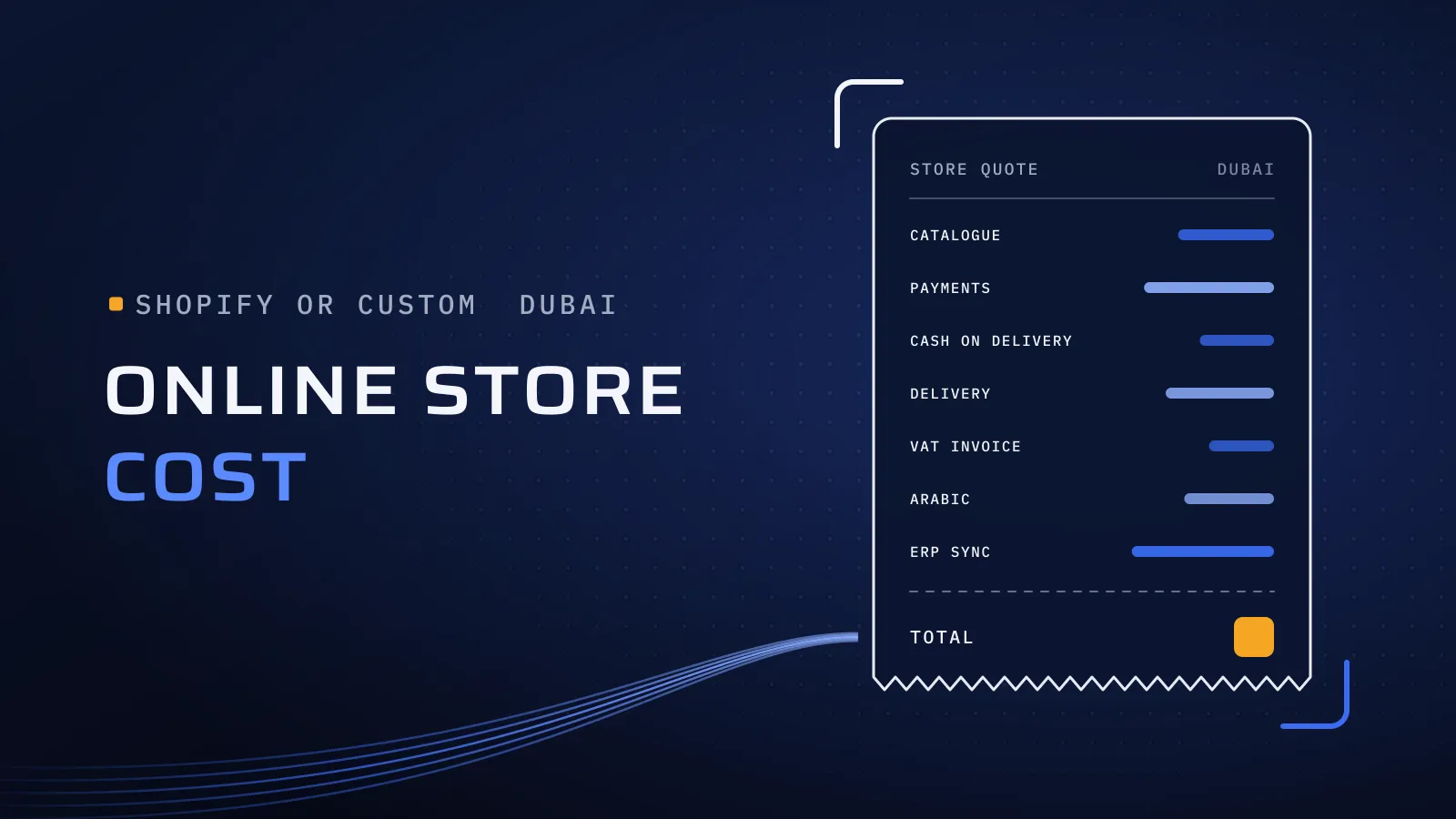
Quick answer: The cost follows seven things only a store has: the catalogue, the payment methods, delivery and returns, VAT invoices, Arabic and English, connections to your ERP and marketplaces, and rules only your business has, such as trade prices. Shopify is the quicker start when your selling fits its checkout and apps. WooCommerce suits a business that already runs WordPress. A custom store pays when your pricing, checkout or stock rules don’t fit a template. Write one page answering all seven, send it to every agency, and the quotes become comparable.
Holding a store quote? Send us the proposal you received → or get the phases, team and price for your store →
Why two store quotes can’t be compared
One agency prices a theme with your products loaded and a payment button. Another prices a store connected to your gateway, your courier and your stock, with an invoice your accountant accepts. In a demo the two look alike; the difference shows in the first month of orders. A cash order is refused and nobody records it. An item sells on Noon after the website sold the last one. The order confirmation isn’t a valid tax invoice. Each one becomes a refund, a phone call or a fix by hand, and the cheaper quote turns into the more expensive store.
Shopify, WooCommerce or a custom store: the UAE decision table
Take this to whoever runs sales and finance. We checked the third-party facts on each provider’s own pages on 29 October 2026.
| Shopify | WooCommerce (on WordPress) | Custom store | |
|---|---|---|---|
| Fits when | Your catalogue, cart and checkout are standard, and you want to start soon | You already run WordPress, or want the shop and your content in one site you host | Your pricing, checkout or stock rules don’t fit a template, or a website and an app share one back end |
| Cards, Apple Pay and Google Pay | Shopify Payments, for businesses located in the UAE whose category is supported; any other gateway adds Shopify’s third-party fee | A UAE gateway’s WooCommerce plugin; check that it is kept up to date | Your gateway’s API, chosen for dirham settlement and the methods you need |
| Cash on delivery | A manual payment method; Shopify charges no third-party fee on it | Built into the free core plugin, and can be limited to the shipping methods you choose | Your own rules: confirm before dispatch, cap the order value, limit it by area |
| What you pay suppliers | The plan, paid apps and card fees | Hosting in your company’s name, paid extensions and gateway fees; the core plugin is free | Hosting and gateway fees; no platform subscription |
| Arabic, right to left | Storefront translation is on every plan; check the theme and the checkout in Arabic on a phone | A translation plugin and a theme that handles right to left; check both | Designed in both languages from the first screen |
| VAT invoice | Check that the invoice template or app prints every required field | Check the invoice plugin the same way | Built into the order flow |
| Trade buyers (B2B) | B2B on every plan from Basic; the features and catalogue limits depend on the plan | Extensions for trade prices; check credit terms and approvals | Price lists, credit terms and approvals the way you run them |
| Stock in your ERP | Through an app or a connector | Through a plugin or the WooCommerce API | Built in, once you decide which system owns stock, prices and customers |
| What you keep if you leave | Your account and an export of your data; the theme and apps only run on Shopify | The code, the database and the hosting | The code and the data, as agreed in your contract |
Sources: Shopify’s pages on where Shopify Payments is available, payment methods in the UAE, manual payments, B2B and UAE pricing; WooCommerce’s plugin page and cash on delivery guide.
How to read it: every “check” is a place where a Shopify or WooCommerce quote can grow later, through apps, plugins and workarounds. If your trade prices or stock rules don’t fit the B2B and ERP rows, price a custom store, or Odoo in the UAE, before you commit to a platform you would have to work around. And if Shopify covers how you sell, start there; we say so, even though it means we build less.
What moves the quote: seven drivers only a store has
Use the middle column as your store brief. The last column shows what makes each part bigger.
| Driver | What to write in your brief | What makes it bigger |
|---|---|---|
| Catalogue | How many products and variants (size, colour, pack), who loads them, and in which languages | Thousands of variants, a supplier feed, made-to-order options such as engraving or sizes to measure |
| Payments | Cards, Apple Pay and Google Pay, pay-later, cash on delivery, and how refunds work | Each extra method, deposits or split payments, saved cards for repeat orders, partial refunds |
| Delivery and returns | Your courier, the emirates and areas you deliver to, delivery slots, and how a return starts | Several couriers, same-day slots, your own drivers, click and collect from branches, the cash each courier collects matched to its orders |
| VAT and invoices | Whether you are VAT-registered, and whether companies buy from you | Full tax invoices for trade buyers, credit notes for partial refunds, e-invoicing for sales to companies |
| Arabic and English | Which pages, product data, emails and SMS are in Arabic | Arabic search and filters, product data kept in step in two languages |
| Your systems | What runs stock, accounts and customers today, and the marketplaces you sell on | Two-way sync, several warehouses or branches, Noon and Amazon on one stock count |
| Rules only you have | Trade price lists, subscriptions, bookings sold with products, other sellers on your platform | Each one moves the store toward a custom build |
Other sellers on your platform turn a store into a marketplace, which is its own project: see marketplace app development.
What this means for you: fill in the middle column before you ask anyone for a price. A quote built on your brief can be compared with the next one; a quote built on the agency’s guesses can’t.
Payments, cash on delivery and VAT: the UAE rows in detail
Payments. Choose a gateway that settles in dirhams to your UAE bank account, takes cards, Apple Pay and Google Pay, and has a maintained plugin or API for your platform. Shopify Payments is offered to businesses located in the UAE, with Apple Pay, Google Pay and Shop Pay at checkout. If you use another gateway on Shopify, Shopify charges its third-party transaction fee on each order, in addition to the gateway’s own fee.
Cash on delivery. If your shoppers ask for it, offer it with controls: confirm each cash order before dispatch, set a maximum order value, and match the cash each courier collects to its orders. Refusals by area then show you where to tighten the rules.
VAT. Once you are VAT-registered, the prices you publish must include VAT. The exceptions include sales to other VAT-registered businesses, where a price may be shown without VAT if it clearly says so (VAT Executive Regulation, Article 27). Registration is mandatory above AED 375,000 of taxable supplies and imports in 12 months (Federal Tax Authority). A shopper who isn’t VAT-registered can receive a simplified tax invoice: the words “Tax Invoice”, your name, address and TRN, the date, what was sold, and the total with the VAT in AED. A VAT-registered company buying for more than AED 10,000 needs a full tax invoice with its own TRN (Article 59 of the same regulation). Test one of each before launch.
E-invoicing for trade buyers. Sales to shoppers stay outside the UAE e-invoicing system until the Minister decides otherwise; sales to companies don’t (Ministerial Decision No. 244 of 2025). From 2027, invoices to companies travel as structured data through an Accredited Service Provider; our guide to UAE e-invoicing in 2027 has the dates. If your store sells to trade buyers, decide early where those invoices are issued: in the store, or in your ERP.
Who builds a store, and what each phase delivers
We show cost as people and phases, because that is what a price is made of. A store needs:
- a product owner, who decides what launches first and what waits;
- a UI/UX designer, for the product, cart and checkout screens in both languages;
- developers: theme and plugin work on Shopify or WooCommerce, or front-end and back-end developers on a custom store;
- an independent QA engineer, who tests on real phones and doesn’t write the code;
- a CTO-level lead on the architecture, when the store connects to an ERP, a courier and a gateway.
The phases:
- Discovery. One order mapped from browse to return, including a refused cash order and a refund, and a decision on which system owns stock, prices and customers. You get a written scope and a dated plan.
- Design in both languages. Product, cart and checkout screens you try on your own phone and approve before the build.
- Build and connect. The store and its admin, then the gateway, the courier and your ERP.
- Independent QA. Both languages on real phones, an item selling out mid-checkout, a partial refund, and an invoice checked field by field.
- Launch and grow. Conversion, repeat orders and cash refusals show what comes next: an app, loyalty or a new market.
What makes a project bigger is in the drivers table above.
Tell us what you sell, how your customers pay and what runs your stock. We reply with the platform we would choose, what a first release covers, and the phases, team and price. Get the phases, team and price for your store → Already holding a quote? Send us the proposal you received →
Not ready for a call? Ask for our company profile and we’ll send it to you.
What a store costs to run after launch
Budget for these on every platform, and ask each quote to list them separately, with who pays which supplier:
- the platform plan (Shopify) or the hosting (WooCommerce and custom), in your company’s name;
- paid apps, plugins, themes and fonts;
- the gateway’s fee on each order, and the courier’s fee on each shipment;
- care: security updates, backups, fixes and small changes. Our guide to website maintenance in Dubai lists what it should cover.
Shopify publishes its UAE prices. As shown on Shopify’s UAE pricing page on 29 October 2026:
| Shopify plan | Plan price a month | Online card rate with Shopify Payments | Fee when you use another gateway |
|---|---|---|---|
| Basic | USD 24 paid yearly, USD 32 paid monthly | 2.9% + AED 1.00 | 2% |
| Grow | USD 69 paid yearly, USD 92 paid monthly | 2.8% + AED 1.00 | 1% |
| Advanced | USD 299 paid yearly, USD 399 paid monthly | 2.7% + AED 1.00 | 0.6% |
| Plus | From USD 2,300 | 2.5% + AED 1.00 | 0.2% |
Amex and international cards cost more on every plan. Prices change, so check the page before you sign. WooCommerce’s core plugin is free; its paid extensions, your hosting and your gateway are priced by their own suppliers. These are suppliers’ fees, not ours: our price for building your store is agreed in your proposal.
How to compare two store quotes
Ask every agency the same six questions, in writing:
- Which payment methods are included, and is a refund tested on each one?
- Which courier is connected, and what happens to a cash order refused at the door?
- Who loads the products, how many, and in which languages?
- Which apps, plugins or licences does the quote assume, and who pays for them each month?
- Does the invoice print every field the FTA requires, and are invoices to trade buyers covered?
- Whose name are the store, hosting, gateway and courier accounts in, and what do you keep if you change provider?
A quote that can’t answer these is pricing a smaller store than the one you need. Our guide to website design cost in Dubai runs the same check for a company website, and e-commerce app or website first? helps if you are also weighing an app.
Where Flojics fits
We build online stores and the systems behind them as B2C e-commerce solutions in Dubai, on WordPress or on custom code, whichever fits how you sell. If Shopify covers it, we tell you so. In the UAE we also implement Odoo: if Odoo already runs your stock and accounts, its own e-commerce app may be enough for a simple web store, and we tell you when it is; otherwise a custom storefront connects to Odoo, so stock, prices, orders and invoices stay in one place. We have connected Odoo to Noon and Amazon; our guide to Odoo integration with Noon and Amazon covers what syncs. Outside the UAE, we connect the store to the ERP you already run.
We don’t sell hosting, so your store’s hosting, domain and gateway stay in your company’s accounts, with us invited as users. Independent QA checks payments, both languages and every release, and our core team are native Arabic speakers, so the Arabic checkout is checked by people who read it.
Mowein is a marketplace app where home-based sellers upload their items through a web app and customers pay by Visa or Apple Pay. Talk to the team that built it: book a meeting. TheEffectArt is an antiques platform whose WordPress website we redesigned to show each piece. Talk to the team that built it: book a meeting.
Send us your store quote, or the store you’re planning
Since 2014 we have worked with more than 100 clients across the UAE, Saudi Arabia, Qatar, Kuwait, the USA and Canada. Our headquarters is at Dubai Digital Park, and our core team works from Egypt. Send us the store proposal you were given, or your one-page brief.
Send us the proposal you received → or get the phases, team and price for your store → We ask about your goal, what you use today, your timing and who else should be involved. You leave with clear next steps. We reply by email first and set up a call only if you want one. Asking commits you to nothing, and we sign an NDA first if you ask.
Frequently asked questions
How much does an e-commerce website cost in Dubai?
It follows the store, not the platform's name: the catalogue, the payment methods, delivery and returns, VAT invoices, Arabic and English, the ERP and marketplace connections, and rules only your business has. Write your answer to each on one page, send it to every agency and compare the quotes line by line. Send us that page and we reply with the effort, the team and the price for your store; send us a quote you hold and we reply with the questions to ask.
Is Shopify available in the UAE?
Yes. Businesses located in the UAE can take cards, Apple Pay, Google Pay and Shop Pay through Shopify Payments, if their business category is supported. Another gateway also works, with Shopify's third-party transaction fee on each order: 2% on Basic, 1% on Grow, 0.6% on Advanced and 0.2% on Plus, as Shopify's UAE pricing page showed on 29 October 2026.
Shopify or a custom store: which should we choose?
Shopify, when your catalogue, cart and checkout are standard and you want to start soon. A custom store, when trade price lists, bookings, other sellers, an app on the same back end or stock rules in your ERP don't fit a template. WooCommerce suits a business that already runs WordPress. The decision table in this guide compares all three on UAE payments, cash on delivery, VAT invoices, Arabic and ERP sync.
Which payment gateway should a UAE online store use?
One that settles in dirhams to your UAE bank account, takes cards, Apple Pay and Google Pay, and has a maintained plugin or API for your platform. Add pay-later if your customers ask for it, and run cash on delivery as its own method, with order confirmation and a maximum order value. On Shopify, Shopify Payments avoids the third-party transaction fee.
Do online store prices in the UAE have to include VAT?
Yes, once you are VAT-registered: published prices include VAT, apart from a few cases such as sales to VAT-registered businesses, where a price can be shown without VAT if that is clearly stated. A shopper can receive a simplified tax invoice with the words Tax Invoice, your name, address and TRN, the date, what was sold, and the total and VAT in AED. Registration is mandatory above AED 375,000 of taxable supplies and imports in 12 months.
Can the store keep stock in sync with our ERP or Odoo?
Yes. Decide which system owns stock, prices and customers, and the store, your branches and any marketplace listings work from one count. In the UAE we implement Odoo: if it already runs your stock, its own e-commerce app may cover a simple web store; otherwise a custom storefront connects to it. Outside the UAE, we connect the store to the ERP you run.
What does an online store cost to run after launch?
The platform plan or the hosting, paid apps or plugins, the gateway's fee on each order, courier fees, and care: updates, backups and fixes. Ask each quote to list them separately, with who pays which supplier. We don't sell hosting, so it stays in your company's name.