Odoo vs ERPNext in the UAE: Two Open-Source ERPs Compared on VAT, Hosting and Support
Odoo vs ERPNext UAE: what each free edition covers, VAT201, Corporate Tax, e-invoicing, Arabic, Frappe Cloud vs Odoo hosting, UAE support and licences.
Odoo vs ERPNext in the UAE is a choice between two open-source ERPs written in Python. Both run UAE VAT, stock, purchasing and accounts, and both can be hosted by their makers or on your own servers. The differences show up later: what the free edition leaves out, where your data sits, and how many people in the UAE can support the system when your implementer is busy. Choose on the licence line alone and you meet those gaps at your first Corporate Tax return or your first upgrade.
We implement Odoo, not ERPNext, so read this as an Odoo implementer’s comparison. Every ERPNext fact comes from Frappe’s own pages, checked on 27 October 2026, and one section says plainly when ERPNext fits better.
Odoo vs ERPNext for a UAE company: which fits?
Quick answer: ERPNext fits a company that wants every module under an open-source licence, the UAE VAT 201 report included, data in Frappe Cloud’s UAE region or on its own servers, and Python developers to own it. Odoo fits when you want WPS payroll, a Corporate Tax report and a wide choice of UAE implementers, and accept a per-user subscription for them.
Weighing both? Tell us which processes and reports matter most, and we’ll say where Odoo fits and where ERPNext would serve you better.
What the free edition covers in each
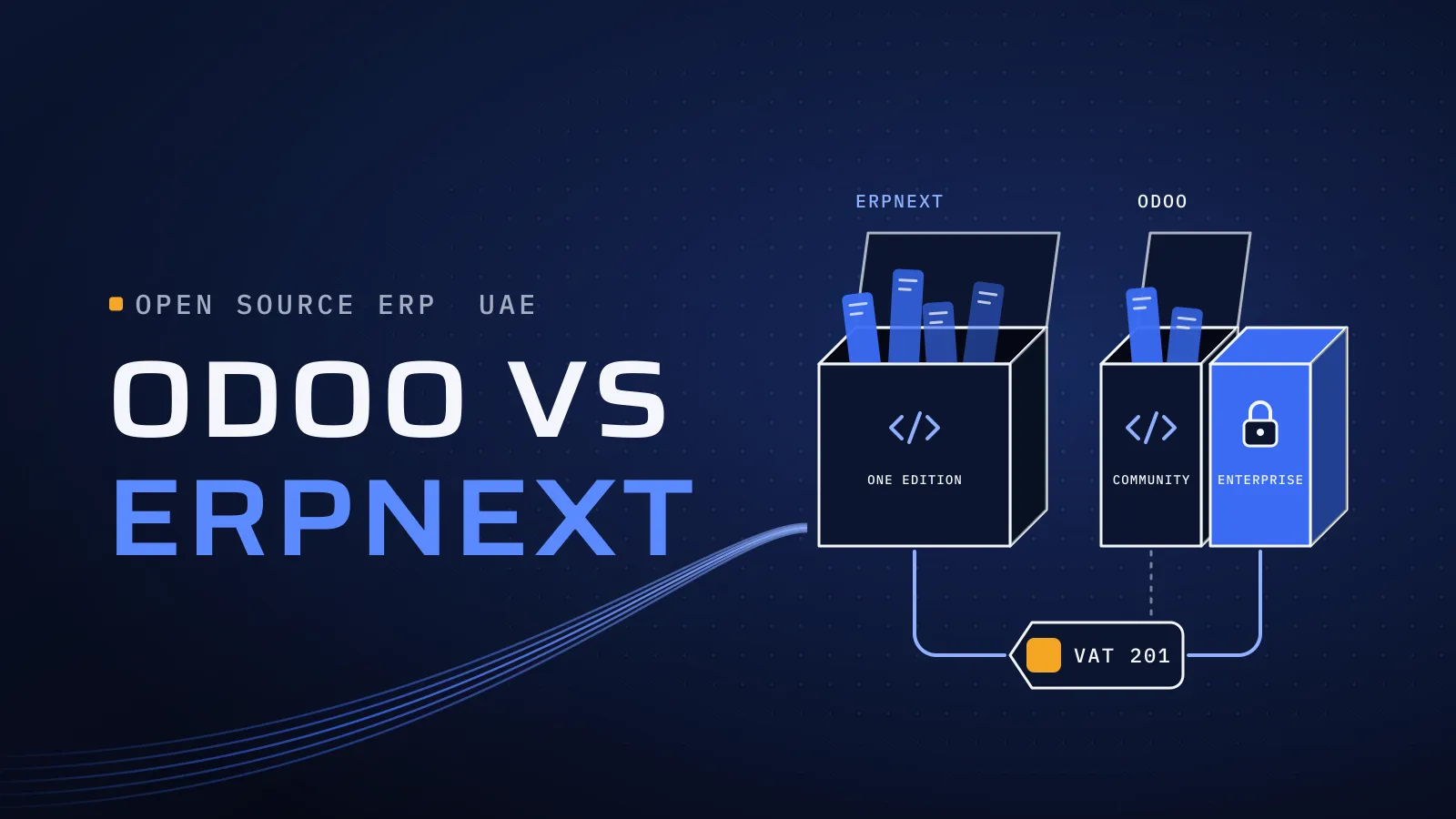
“Open source” means different things here. ERPNext is open source in full. Odoo is open core: a free Community edition, plus an Enterprise edition sold per user as the Standard and Custom plans. Here is what that means for a UAE finance team.
| ERPNext | Odoo Community | Odoo Enterprise | |
|---|---|---|---|
| Licence | GNU GPL v3, every module | GNU LGPL v3 | Odoo’s subscription licence, per user |
| UAE chart of accounts and VAT taxes | Yes | Yes | Yes |
| VAT201 report | Yes, the UAE VAT 201 report | Not included | Yes |
| Corporate Tax report | Not yet | Not included | Yes, from the accounts you tag |
| Payroll | Frappe HR, a separate free app; no UAE WPS file in Frappe’s documentation | Not included | Payroll app with UAE WPS files |
| Version upgrades | You or your implementer | You or your implementer | Included for standard apps; custom code by your implementer |
So the fair comparison for a UAE finance team is ERPNext against Odoo Enterprise. Odoo Community suits a team ready to add the UAE reports and payroll itself, from community modules or its own code.
What this means for you: a free licence moves cost; it doesn’t remove it. With ERPNext you pay for hosting, implementation and the UAE pieces you build. With Odoo Enterprise you also pay per user, and the VAT201 and Corporate Tax reports, payroll and version upgrades come with it.
UAE VAT, Corporate Tax and e-invoicing
- VAT. ERPNext’s UAE VAT 201 report depends on three settings: the emirate on the company address and each sales invoice, the zero-rated and exempt flags on items, and every VAT account listed in UAE VAT Settings. Reverse charge and tourist refunds are fields on invoices. Odoo’s VAT201 report follows the FTA’s format, and you export it and enter the figures in EmaraTax; our Odoo VAT and Corporate Tax guide covers the setup. In both, test the return on a quarter you’ve already filed.
- Corporate Tax. Odoo’s Corporate Tax report reads the accounts you tag for exempt income, disallowed expenses and deductions. ERPNext has no equivalent yet: Frappe’s UAE page says it is working with local partners on Corporate Tax and e-invoicing compliance, without dates. Until then, the adjustments stay in your tax adviser’s file.
- E-invoicing. Neither Frappe nor Odoo is on the Ministry of Finance list of accredited service providers, so both connect to the ASP you appoint. Odoo has connectors today and a native ClearTax integration announced in September 2026, with no date; our Odoo ASP integration guide compares the routes. For ERPNext, ask each provider on your shortlist for a working ERPNext connector, or plan one built in Python on Frappe’s API.
What waiting costs you
The e-invoicing dates don’t wait for an ERP decision. Businesses with revenue of AED 50 million or more appoint an ASP by 30 October 2026 and go live on 1 January 2027; smaller ones appoint by 31 March 2027 and go live on 1 July 2027, as our UAE e-invoicing 2027 guide sets out. Choose the ERP first and you build the connector once. Choose late and you build it in the old system, then again in the new one.
Arabic on screen and on paper
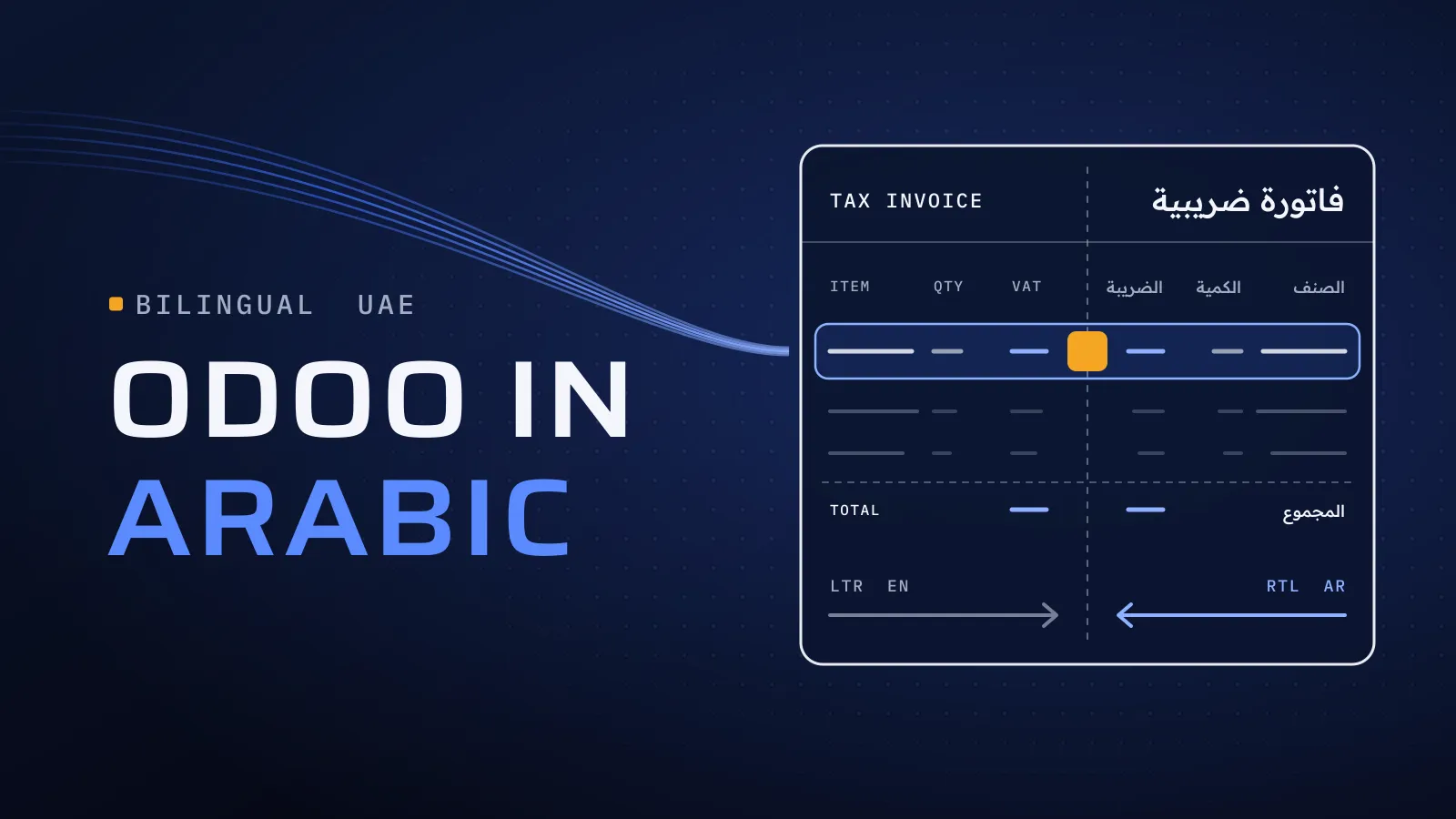
Both switch their screens to Arabic, right to left, when a user picks the language. ERPNext’s Arabic comes from translations its community keeps, and Frappe’s UAE page points to a Marketplace app for an Arabic screen font. In Odoo, Arabic can also be the second language on tax invoices; in ERPNext, a bilingual tax invoice is a print format your implementer designs. Ask both sides to print your own bilingual invoice, and let a few warehouse and sales staff try the screens they use most.
Hosting: who runs the servers
We don’t sell hosting, so we have no stake in which one you pick.
| Option | For | Who runs it | Custom code | UAE data |
|---|---|---|---|---|
| Frappe Cloud | ERPNext | Frappe | Custom apps on a private bench group | UAE and Bahrain among its server regions |
| Odoo Online | Odoo | Odoo | Studio on the Custom plan; no custom modules | No UAE region; the Middle East one runs in India and Saudi Arabia |
| Odoo.sh | Odoo, Custom plan | Odoo’s platform; your implementer manages the code | Yes | Odoo’s own hosting regions |
| Your own server or a UAE cloud | Both | You or your IT provider | Yes | Yes |
On your own server, either product is yours to patch, back up and upgrade. If a customer, regulator or contract requires UAE data, settle hosting before you choose the product.
Customising in Python
Both run on Python, so one pool of developers can read both, but changes are made differently.
- ERPNext sits on the Frappe Framework. Custom fields, form layouts, scripts and simple reports can be made in the browser and are stored in the database; bigger changes go into a custom app. On Frappe Cloud, custom apps need a private bench group.
- Odoo changes through Studio on the Custom plan, or through Python modules with XML views and JavaScript components. Modules run on Odoo.sh or your own server, not on Odoo Online.
In both, every change is retested at each major upgrade, so change the process first and write code last. Our guide to hiring an Odoo developer in Dubai lists the skills to test, and our Odoo upgrade guide shows what custom code adds at upgrade time.
Who can support it in the UAE
On 27 October 2026, Odoo’s partner directory listed 122 partners in the UAE and Frappe’s listed 9. A listing doesn’t prove UAE tax work for either, but the size of the pool matters when you want a second quote, a new implementer or extra hands at year-end. Frappe’s Product Warranty fixes bugs in its apps and, its pricing page notes, doesn’t include functional support; Odoo’s Enterprise subscription includes support for its standard apps. Your own setup is supported by your implementer in both, so ask each one to show a VAT return they set up and who answers after go-live.
When ERPNext fits better
- You want no per-user licence, and every module, the UAE VAT 201 report included, under an open-source licence.
- Your data must stay in the UAE on a vendor-run cloud. Frappe Cloud lists a UAE region; Odoo Online doesn’t.
- A Python team will own the system, and can build the Corporate Tax worksheet and WPS file you’d otherwise get in Odoo Enterprise.
- Many people log in for small tasks, and a per-user price would charge for each of them.
- ERPNext already runs well for you, with trained users and an implementer you trust. E-invoicing alone isn’t a reason to move.
In these cases, choose or keep ERPNext, and talk to a Frappe partner. We implement Odoo only.
Six questions to settle it
| Question | If yes, lean to |
|---|---|
| Should WPS salary files come from the same system as the accounts? | Odoo |
| Do you want the Corporate Tax report inside the ERP? | Odoo |
| Must data stay in the UAE without servers of your own? | ERPNext on Frappe Cloud |
| Will an in-house Python team own changes and upgrades? | ERPNext |
| Do you want many UAE implementers to choose from? | Odoo |
| Is avoiding a per-user licence the deciding factor? | ERPNext |
Weigh the answers rather than count them: one hard rule, such as UAE data or WPS from the ERP, can settle it alone.
Answered the six? Send us your answers, your companies and users by role, what you’d customise and your e-invoicing date. We reply with where Odoo fits, what stays a gap and where ERPNext would serve you better. Check Odoo against ERPNext for your company →
Not ready for a call? Ask for our company profile and we’ll send it to you.
Licences and running costs
- ERPNext has no licence fee. Frappe Cloud charges for hosting by compute, not by user: on 27 October 2026 its pricing page started shared sites at US$5 a month and dedicated servers at US$40 a month. Self-hosting costs your servers plus the time to patch, back up and upgrade them.
- Odoo charges per user. On 27 October 2026, Odoo’s pricing page showed Standard at US$13.50 and Custom at US$25.50 per user per month, billed yearly, for the first 12 months, then US$16.90 and US$32.00. Odoo Online is included; Odoo.sh is billed separately. Our Odoo licence calculator works it out in dirhams for your users.
- Both need implementation, data migration, the ASP subscription and connector, support, and custom code retested at each upgrade. Our Odoo implementation cost guide lists what drives that work, and our price is agreed in your proposal.
Moving from ERPNext to Odoo
The move is an export and import of records, not a file conversion. Move the chart of accounts, customers and suppliers with TRNs, items, warehouses, open invoices and bills, stock at cost and opening balances. Keep the history in ERPNext, read-only, for as long as the FTA requires. Custom fields and apps don’t convert: rebuild each job in Odoo’s configuration first and a module last. Switch at the start of a VAT period after two rehearsals, as our Tally to Odoo migration guide sets out.
Who runs your Odoo rollout
We implement Odoo for UAE companies from Dubai Digital Park. Our Odoo team leads the rollout, from mapping your processes to the first VAT return filed from Odoo. Python is one of our core stacks, so custom modules are written and reviewed by engineers who know the language under both products. Since 2014 we have delivered software for more than 100 clients, and our core team are native Arabic speakers who work in English. Every rollout runs with:
- CTO oversight on hosting, company structure and what to customise, before anything is built.
- Independent QA that tests the VAT201 return, the WPS file and the bilingual invoice before each release.
- A dated plan in FloPlan, our own delivery software, so you see each phase before it starts.
Our Odoo clients stay under NDA. Outside Odoo, we also build custom ERP: Al-Mawared ERP is a web-based ERP for exchange companies across the MENA region. Talk to the team that built it: book a meeting.
Bring your processes and your hosting rule
Tell us your companies, users by role, where your data must live, what you’d customise and your e-invoicing date. Implementation, data migration, VAT and Corporate Tax setup, WPS payroll and the ASP connection are part of our Odoo implementation services in the UAE. If ERPNext fits better, we tell you.
Check Odoo against ERPNext for your company → We ask about your goal, what you use today, your timing and who else should be involved. You leave with clear next steps. We reply by email first and set up a call only if you want one. Asking commits you to nothing, and we sign an NDA first if you ask.
Frappe’s ERPNext UAE documentation, UAE page, Frappe Cloud pricing and server pages and partner directory; Odoo’s pricing, licence and privacy pages, UAE localisation documentation and partner directory; and the Ministry of Finance provider list checked on 27 October 2026.
Comparing other systems? Read Odoo vs Zoho, Odoo vs SAP Business One, Odoo vs Business Central, Odoo vs QuickBooks and Odoo vs NetSuite for the UAE.
Frequently asked questions
Is ERPNext really free for a UAE company?
The software is. ERPNext is licensed under GNU GPL v3, and every module, the UAE VAT 201 report included, comes without a licence fee. You still pay for hosting, implementation, support and anything built for you. On 27 October 2026, Frappe Cloud's pricing page started shared sites at US$5 a month and dedicated servers at US$40.
Is Odoo Community enough for UAE VAT?
Odoo Community has the UAE chart of accounts and VAT taxes. The VAT201 and Corporate Tax reports, and the Payroll app, come with Odoo Enterprise, sold as the Standard and Custom plans. So compare ERPNext with Odoo Enterprise, or plan to add the UAE reports to Community with community modules or your own code.
Can ERPNext produce the UAE WPS salary file?
Frappe HR, the free HR and payroll app that runs beside ERPNext, handles salary structures and payroll runs, but Frappe's documentation, checked on 27 October 2026, describes no UAE WPS salary file. Ask your implementer how the file is produced and test it with your bank. Odoo's Payroll app produces UAE WPS files and works out end-of-service gratuity.
Which one keeps our data in the UAE?
Frappe Cloud lists UAE and Bahrain among its server regions, and Frappe's UAE page offers hosting in its UAE data centres. Odoo Online has no UAE region: its Middle East region runs in India and Saudi Arabia, with backups in Europe and Canada. To keep Odoo data in the UAE, run it on a server in the country, on the Custom plan.
Are Odoo or ERPNext accredited e-invoicing providers in the UAE?
No. Neither Frappe nor Odoo was on the Ministry of Finance list of accredited providers on 27 October 2026, so both connect to the provider you appoint. Odoo has connectors and a native ClearTax integration announced in September 2026, without a date. For ERPNext, ask providers for a working connector, or plan one built on Frappe's API.
Is it easier to find Odoo or ERPNext support in the UAE?
On 27 October 2026, Odoo's partner directory listed 122 partners in the UAE and Frappe's listed 9. A listing doesn't prove UAE tax experience, so ask any implementer to show a VAT return they set up, and who answers support after go-live.