UAE E-Invoicing 2027: Deadlines, ASP Rules and ERP Readiness
UAE e-invoicing requirements 2027: who is in scope, ASP and go-live deadlines, PINT AE, penalties, an ERP readiness checklist and Odoo set-up steps.
The UAE e-invoicing requirements for 2027 change how every B2B and B2G invoice leaves your business: from 1 January 2027 for companies with revenue of AED 50 million or more, and from 1 July 2027 for smaller ones, invoices must travel as structured data through an Accredited Service Provider (ASP), not as PDFs (Ministerial Decision No. 66 of 2026, Ministerial Decision No. 244 of 2025). The large-business date to appoint an ASP, 30 October 2026, has now passed: if that is you and you have no provider yet, appoint one now. In the 1 July 2027 group, your date to appoint one is 31 March 2027. Either way, get your ERP ready in time and invoicing carries on as normal; leave it late and invoices bounce, customers wait to pay and penalties can follow.
What are the UAE e-invoicing requirements for 2027?
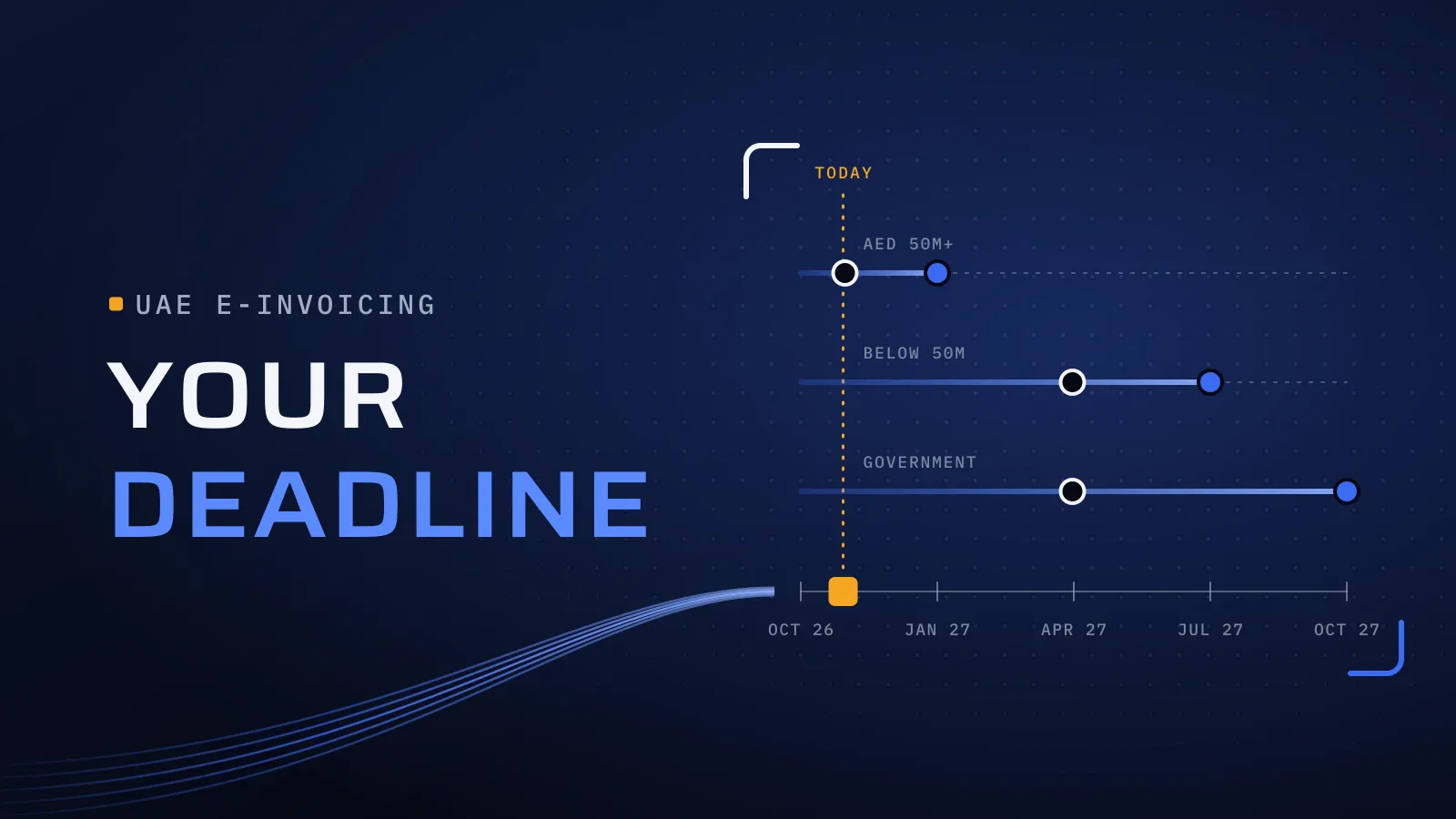
From 1 January 2027, businesses with revenue of AED 50 million or more must send B2B and B2G invoices and credit notes as structured PINT AE data through an Accredited Service Provider. Their date to appoint one, 30 October 2026, has passed, so a business still without a provider should appoint it now. Businesses below AED 50 million appoint an ASP by 31 March 2027 and start on 1 July 2027; government entities start on 1 October 2027. B2C stays out.
Running Odoo? Get your Odoo ready for e-invoicing with us.
An ASP contract on its own is not enough. Your customer and supplier records, tax codes and invoice formats have to pass the ASP’s checks before your go-live date, and testing takes time. Run the ERP work alongside choosing a provider, and go-live becomes a normal month-end.
Who the UAE e-invoicing mandate covers
The mandate rests on Ministerial Decisions No. 243 and 244 of 2025 and their later amendments, all listed on the Ministry of Finance e-invoicing page. The same page defines an eInvoice as structured invoice data that is exchanged electronically and reported to the Federal Tax Authority (FTA). A PDF, a Word file, an image, a scan or an email does not count, however correct it looks as a tax invoice.
The system applies to every business transaction made in the UAE, apart from exclusions. B2C transactions stay outside it until the Minister decides otherwise (Ministerial Decision No. 244 of 2025). The excluded transactions, as amended by Ministerial Decision No. 197 of 2026 from 1 October 2026, are:
- government entities acting in a sovereign capacity that do not compete with the private sector
- international passenger transport by airlines with e-tickets, and the ancillary passenger services they bill with an Electronic Miscellaneous Document
- international goods transport by air under an airway bill, for 24 months from the effective date
- VAT-exempt or zero-rated financial services
- transactions between members of the same VAT tax group, for 24 months from 1 January 2027
Excluded businesses can still join voluntarily. The rule that is easiest to miss is on the receiving side. Both the issuer and the recipient of an e-invoice or e-credit note must appoint an ASP (Ministerial Decision No. 243 of 2025), so a business that mostly buys still needs one.
The 2027 timeline, group by group
| Group | Appoint an ASP by | Mandatory from | Source |
|---|---|---|---|
| Pilot (Taxpayer Working Group) | Not applicable | 1 July 2026 | MD 244 of 2025 |
| Voluntary adopters | Not applicable | Any time from 1 July 2026 | MD 244 of 2025 |
| Revenue of AED 50 million or more | 30 October 2026 (passed) | 1 January 2027 | MD 66 of 2026 |
| Revenue below AED 50 million | 31 March 2027 | 1 July 2027 | MD 244 of 2025 |
| Government entities | 31 March 2027 | 1 October 2027 | MD 244 of 2025 |
The large-business appointment date has already moved once. Ministerial Decision No. 244 of 2025 set 31 July 2026; Ministerial Decision No. 66 of 2026 replaced it with 30 October 2026 and kept the 1 January 2027 go-live. Revenue for the AED 50 million test is the gross income in your most recent accounting period, based on your financial statements, so work from your latest accounts, not forecasts. Not sure which row is yours? Our UAE e-invoicing deadline checker asks five questions and gives your appointment and go-live dates.
In the AED 50 million group and still without an ASP after 30 October 2026? Your go-live is still 1 January 2027, and Cabinet Decision No. 173 of 2026 counts not appointing an ASP among the violations it fines, so act now. Pick a provider from the Ministry’s list of accredited service providers, sign for sending and receiving together, and start onboarding. Run the Odoo data and connector work at the same time, not after. Already holding a provider’s or connector’s quote? Send us the proposal you received, with anything confidential removed, and we’ll tell you what it covers for Odoo and what it leaves out.
In the 1 July 2027 group (revenue below AED 50 million)? Your date to appoint an ASP is 31 March 2027. Use the time before it for the work no provider does for you: complete customer and supplier records (TRNs and addresses), map your tax codes to the UAE rules, and name who fixes rejected invoices. Then compare providers on sending and receiving together, so the one you appoint can start testing with data that is already clean.
How the five-corner Peppol model and PINT AE work
The Ministry calls the model Decentralised Continuous Transaction Control and Exchange (DCTCE). The MoF e-invoicing page describes five corners:
- The supplier sends the invoice data in PINT AE format to its ASP.
- The supplier’s ASP validates the data, converts it to the UAE XML format and reports a Tax Data Document to the FTA.
- The buyer’s ASP validates the invoice and sends back a Message Level Status.
- The buyer receives the invoice in its own system.
- The FTA receives the tax data reported by the supplier’s ASP.
PINT AE is the UAE’s national version of the Peppol international invoice specification, as KPMG explains. The FTA published its mandatory field requirements on 23 February 2026. KPMG counts 51 mandatory fields for an electronic tax invoice, with an adapted list for commercial (non-tax) invoices. On the network, each business is identified by its Tax Identification Number (TIN), the first 10 digits of its corporate tax registration number, under the UAE scheme code 0235. Businesses that are not registered for corporate tax still need to register with the FTA to get a TIN.
What an Accredited Service Provider does
An ASP sits at corners 2 and 3. It checks each invoice against the PINT AE rules, delivers it to the buyer’s ASP over Peppol, reports the tax data to the FTA and returns status messages to you. You choose and contract your ASP yourself.
There are 80 accredited providers on the Ministry’s list of accredited ASPs (checked 29 October 2026). Ministerial Decision No. 168 of 2026, in force from 1 October 2026, ended the separate pre-approval stage and gave providers holding only pre-approval 30 days to meet the full requirements, so every name on the list is now a fully accredited provider.
Penalties under Cabinet Decision No. 173 of 2026
Cabinet Decision No. 173 of 2026 sets the e-invoicing penalties. It was issued on 6 October 2026 and repeals the earlier Cabinet Decision No. 106 of 2025; the Ministry’s e-invoicing guidelines (V2.0, 26 October 2026) refer to it too. Its table covers four violations: not implementing e-invoicing as Ministerial Decision No. 244 of 2025 requires, including not appointing an ASP (or, for a recipient, not keeping up its obligations once live); not issuing and sending an e-invoice through the system; the same for an e-credit note; and not telling your ASP about changes to the data registered with the FTA. The fines run per month of non-compliance, per document or per day of delay, each with a cap, so read the amounts in the decision itself. Voluntary e-invoicing is outside the decision, and the guidelines say e-invoicing penalties don’t apply to e-invoices issued voluntarily before your mandatory date.
Whatever the amounts, two working deadlines decide whether you are on time. An e-invoice or e-credit note must be issued and sent within 14 business days of the transaction, or within the VAT Law’s invoicing timeline if you are VAT-registered (MD 197 of 2026). A change to your FTA-registered data must reach your ASP within 5 business days of the FTA confirming it (MD 243 of 2025). From 1 October 2026, MD 197 of 2026 also repealed the duty to report a system failure, so that deadline, and the penalty that went with it, no longer applies.
Missed deadlines almost always come from one of three gaps: invoices that fail validation, a connection that breaks without anyone noticing, and registration changes nobody passes on. Clean data, tests with your ASP and a named owner close all three. That is the work in the steps and the checklist below.
Is your Odoo ready for PINT AE? We prepare your Odoo data, tax setup and invoice formats, then set up and test the connection to the accredited service provider you choose.
Get your Odoo ready for e-invoicing → · Not ready for a call? Ask for our company profile and we’ll send it to you.
How do you set up Odoo for UAE e-invoicing in 2027?
As of October 2026, Odoo has no built-in UAE PINT AE module, so you need three things: clean data in Odoo, an accredited service provider, and a connector that turns posted invoices into PINT AE data and writes the ASP’s status back to each invoice. Then test with your ASP before your go-live date.
- Clean your master data. TRN, TIN, legal name and address for every B2B and B2G customer and supplier, with duplicates merged.
- Map tax codes and invoice types to PINT AE: standard-rated, zero-rated, exempt, reverse charge and out of scope, plus flags such as free zone and deemed supply.
- Choose your ASP and connector together. Check the provider is in the accredited table and has a tested connector for your Odoo version and hosting. Odoo Online cannot run custom or Odoo Apps Store modules, so a connector module needs Odoo.sh or on-premise hosting.
- Test end to end with your ASP: a normal invoice, a credit note, a rejected invoice and an inbound supplier invoice.
- Go live with a named owner for rejections, registration changes and a fallback when the connection breaks.
We checked Odoo’s own material on 21 October 2026. The UAE localisation documentation for Odoo 20 lists three UAE modules (l10n_ae, l10n_ae_reports and l10n_ae_pos), none of them for PINT AE, and the Odoo 20 release notes list no UAE PINT AE feature. Third-party UAE connectors are listed on the Odoo Apps store; ask to see yours working against your ASP’s test environment, on your Odoo version, before you sign. Budget the connector and data clean-up inside the project; our Odoo implementation cost guide has the market figures.
ERP readiness checklist
Most e-invoicing problems start in the ERP, well before an invoice reaches the ASP. Work through this list with finance and IT in the same room.
| Area | What to check | Why it matters |
|---|---|---|
| Customer and supplier master data | TRN, TIN, legal name and address for every B2B and B2G partner, with duplicates merged | The TIN is the Peppol participant ID (KPMG), and bad data fails validation |
| Tax codes | Standard-rated, zero-rated, exempt, reverse-charge and out-of-scope codes mapped to PINT AE tax categories | A wrong category fails the ASP’s validation |
| Invoice types | Tax invoices, commercial invoices, self-billed invoices and flags such as free zone, margin scheme and deemed supply | The FTA field list covers these cases (KPMG) |
| Credit notes | Every credit note references the original invoice and goes through the ASP | A late e-credit note counts like a late invoice: the same 14-business-day window applies |
| Products and units | Item descriptions, codes and units of measure are consistent | Line items are part of the structured data |
| Your ASP | On the accredited list; a tested connector for your ERP version; how rejections come back; inbound invoices into payables; what it archives; pricing per invoice, month or legal entity | You contract the ASP yourself, so settle these before you sign |
| Connector | Posted invoices sent automatically, status messages written back to each invoice, retries after errors | Finance needs to see rejections inside the ERP |
| Inbound invoices | Supplier e-invoices from your ASP land in accounts payable | Recipients must appoint an ASP too |
| Testing | End-to-end tests with your ASP on real scenarios, including rejections and credit notes | Voluntary use has been open since 1 July 2026, so you can test early |
| Named owner | One person who handles rejections, tells the ASP about registration changes and runs the fallback when something breaks | Invoices are due within 14 business days, and registration changes within 5 |
| Archive | E-invoices, credit notes and associated data kept for the Tax Procedures Law period, ready to produce to the FTA | Required by MD 197 of 2026 |
We handle it for you
We implement Odoo for UAE businesses. For e-invoicing, we prepare your Odoo data, tax setup and invoice formats, then set up and test the connection to the accredited service provider you choose. We are not an ASP, so you contract your provider directly, and we work alongside it through testing and go-live. Transparent delivery means you always know which rows of the checklist are done, which are in test and which are left.
Our Odoo client projects are under NDA, so we don’t name them here. We have also built ERP software from scratch: Al-Mawared ERP is a web-based ERP for exchange companies across the MENA region. Talk to the team that built it: book a meeting.
You keep your eye on the business; we handle the Odoo side for you. See our ERP and Odoo implementation services, or read our Odoo implementation guide for the UAE if you are still choosing a system.
Get your Odoo ready for e-invoicing → We ask about your goal, what you use today, your timing and who else should be involved. You leave with clear next steps. We reply by email first and set up a call only if you want one. Asking commits you to nothing, and we sign an NDA first if you ask.
Dates and rules checked on 21 October 2026 against the Ministry of Finance decisions linked above; the dates, penalties and the system-failure rule rechecked on 31 October 2026, and the ASP list on 29 October 2026.
Frequently asked questions
When does e-invoicing become mandatory in the UAE?
Businesses with revenue of AED 50 million or more go live on 1 January 2027; their deadline to appoint an Accredited Service Provider was 30 October 2026, and any still without one should appoint it now. Businesses below AED 50 million appoint one by 31 March 2027 and go live on 1 July 2027, and government entities go live on 1 October 2027. Each group has a fixed date, so you can plan the ERP work back from yours.
Do we need an Accredited Service Provider if we mostly buy?
Yes. The issuer and the recipient of an e-invoice must each appoint an ASP, because invoices travel from the supplier's ASP to the buyer's ASP over the Peppol network. Ask providers to quote for sending and receiving together, so one contract covers both directions.
Is a PDF invoice sent by email still acceptable?
Not for in-scope B2B and B2G transactions once your date arrives. The Ministry of Finance says PDFs, Word files, images, scans and emails are not eInvoices. The good news is that Odoo already holds invoices as structured records, so the work is making that data complete and sending it through your ASP.
What are the penalties for missing the UAE e-invoicing deadline?
They are now set by Cabinet Decision No. 173 of 2026, issued on 6 October 2026, which repealed Cabinet Decision No. 106 of 2025. It sets administrative fines for not implementing e-invoicing on time (including not appointing an ASP), for not issuing and sending an e-invoice or e-credit note through the system, and for not telling your ASP about changes to your FTA-registered data; the amounts are in the decision on the Ministry of Finance e-invoicing page. They don't apply to e-invoices issued voluntarily before your date. Clean data, a tested connection and a named owner are what keep you clear of them.
Does Odoo support PINT AE natively?
Not when we checked in October 2026. Odoo 20's UAE localisation has no PINT AE module, and Odoo is not on the Ministry of Finance list of accredited ASPs, so Odoo users connect to an accredited ASP through a connector. We prepare your Odoo data, tax setup and invoice formats, then set up and test the connection to the accredited service provider you choose.
How much does e-invoicing readiness cost?
Expect three lines: your ASP's subscription, which each provider quotes (the Ministry's list has no prices), any connector licence, and the Odoo work on data, tax setup and invoice formats, which is agreed in your proposal. Our Odoo implementation cost guide gives sourced market figures, so you can check any quote against them.