UAE E-Invoicing Deadline Checker: Your ASP and Go-Live Dates
Check your UAE e-invoicing deadline in five questions: when to appoint an Accredited Service Provider, when to go live, and whether your date has passed.
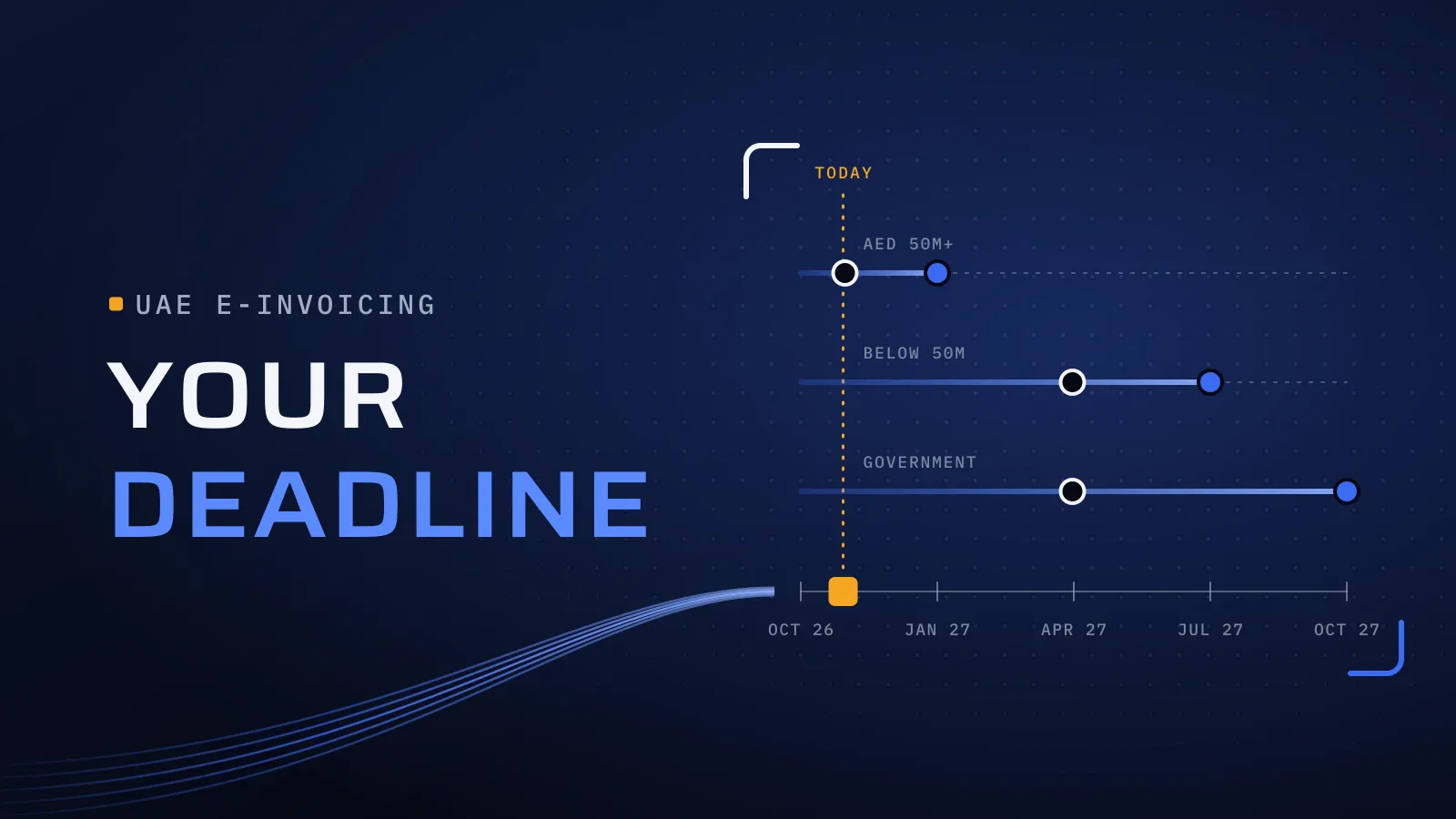
Your UAE e-invoicing deadline depends on one figure: your revenue. Businesses with revenue of AED 50 million or more must appoint an Accredited Service Provider (ASP) by 30 October 2026 and go live by 1 January 2027. Smaller businesses appoint one by 31 March 2027 and go live by 1 July 2027, and government entities have their own dates. Answer five questions in the deadline checker at the end of this page to see your dates, whether either has passed, and what to do first.
When is my UAE e-invoicing deadline?
Quick answer: Revenue of AED 50 million or more: appoint an ASP by 30 October 2026, go live by 1 January 2027. Below AED 50 million: appoint by 31 March 2027, go live by 1 July 2027. Government entities: appoint by 31 March 2027, go live by 1 October 2027. When we checked the Ministry of Finance on 29 October 2026, no further extension had been announced.
| Who | Appoint an ASP by | Go live by |
|---|---|---|
| Revenue of AED 50 million or more | 30 October 2026 | 1 January 2027 |
| Revenue below AED 50 million | 31 March 2027 | 1 July 2027 |
| Government entities | 31 March 2027 | 1 October 2027 |
The dates come from Ministerial Decision No. 244 of 2025, Article 5, as amended by Ministerial Decision No. 66 of 2026. The same three rows appear in the Ministry’s UAE Electronic Invoicing Guidelines, version 2.0, dated 26 October 2026.
Revenue means the gross income of your most recent accounting period, taken from your financial statements, or from other documents the FTA accepts if you don’t have statements. Use your latest figure, not this year’s forecast. Government entities follow their own row whatever their revenue.
Running Odoo? Get your Odoo ready for e-invoicing. Already holding an ASP or connector quote? Send us the quote you received, and we reply with the questions to ask before you sign.
Has the UAE e-invoicing deadline been extended?
Once. Ministerial Decision No. 66 of 2026 moved the large-business ASP date from 31 July 2026 to 30 October 2026 and kept go-live on 1 January 2027. The smaller-business and government dates have not moved. Since May, the official sources have repeated the dates rather than changed them:
- At its awareness event in Ras Al Khaimah, the Ministry said the mandatory Phase One date “remains unchanged”.
- The Federal Tax Authority’s news of 29 September 2026 gave both business rows and urged businesses not to leave it to the last minute.
- The guidelines dated 26 October 2026 still show 30 October 2026 and 1 January 2027.
Plan on the dates in the table, and check the Ministry of Finance e-invoicing page before you rely on any date, ours included.
What did change in October 2026 is the detail around the dates. Ministerial Decision No. 197 of 2026, in force from 1 October 2026, gives transactions between members of the same VAT group 24 months from 1 January 2027 before e-invoicing applies to them, and sets the issuing window at 14 business days from the transaction. VAT-registered issuers follow the VAT Law’s invoicing timeline. A separate decision ended the pre-approval stage for providers, so the Ministry’s list of accredited ASPs now names accredited providers only: 80 of them when we checked on 29 October 2026.
What UAE e-invoicing is
An e-invoice is invoice data in a structured format that software can read. It travels from the supplier’s ASP to the buyer’s ASP over the Peppol network, and the tax data is reported to the FTA. The Ministry calls this a five-corner model: supplier, supplier’s ASP, buyer’s ASP, buyer and FTA. A PDF, a Word file, an image, a scan or an email is not an e-invoice, however correct it looks.
Who is in scope, according to the guidelines and Ministerial Decision No. 243 of 2025:
- Every business that invoices companies or government in the UAE, VAT registered or not. A business with no tax registration registers with the FTA to get a Tax Identification Number (TIN). For everyone else, the TIN is the first 10 digits of the TRN.
- Buyers as well as sellers. You appoint one ASP for both sending and receiving, so a company that mostly buys still needs one.
- Not consumer sales. Sales to people who aren’t in business are outside e-invoicing, and a business that only sells to consumers is outside it until the Minister decides otherwise.
- Not some transactions: government work done in a sovereign capacity that doesn’t compete with the private sector, airline passenger tickets and their ancillary services, international air cargo for 24 months, VAT-exempt or zero-rated financial services, and VAT-group transactions for 24 months from 1 January 2027.
What to prepare before your date
The Ministry’s guidelines end with a readiness checklist. This is the order we would work through it, for a business that invoices from an ERP or accounting software:
| Step | What it means | Who owns it |
|---|---|---|
| 1. Confirm your phase | Revenue from your latest financial statements | Finance |
| 2. Choose one ASP | From the Ministry’s list, for sending and receiving | Finance and IT |
| 3. Sign, then onboard | Your EmaraTax account admin picks the ASP under the E-Invoicing tile | Finance |
| 4. Have your TIN | First 10 digits of your TRN, or register with the FTA | Finance |
| 5. Fix the data | Customer TRNs, legal names, addresses and tax codes; every credit note linked to its invoice | Finance, with your ERP team |
| 6. Connect your system | Invoices go out and supplier invoices come in through the ASP | Your ERP team or software vendor |
| 7. Test with the ASP | A normal invoice, a credit note, a rejection fixed and resent, an inbound supplier invoice | Finance and the ASP |
| 8. Go live with an owner | One person fixes rejected invoices and tells the ASP about registration changes | Finance |
The data in step 5 must match the Ministry’s mandatory field requirements. For step 2, the Ministry’s short guide on choosing an ASP (version 1.1, 28 October 2026) asks about each provider’s history, product ownership, integration, security, support levels, pricing and scalability. Steps 5 to 7 take the longest, so start them while you are still choosing the provider.
If your date has passed
If your revenue is AED 50 million or more and you had no ASP by 30 October 2026, appoint one from the Ministry’s list now, sign and start onboarding. Your go-live date is still 1 January 2027, so the system work matters more than the contract date.
On penalties, the Ministry’s October 2026 programme overview lists Cabinet Decision No. 173 of 2026 and marks the earlier Cabinet Decision No. 106 of 2025 as repealed. We didn’t find the text of Decision No. 173 on the Ministry’s e-invoicing page, so we don’t quote amounts here: check the Ministry of Finance page for the ones that apply to you. The guidelines say e-invoicing penalties don’t apply to e-invoices issued voluntarily before your mandatory date.
If you run Odoo
Odoo is not on the Ministry’s list of accredited providers (we checked on 29 October 2026), so Odoo reaches your ASP through a connector. What a connector must do, and what your Odoo plan and hosting allow, is in our guide on connecting Odoo to your ASP. The scope rules and an ERP readiness checklist are in UAE e-invoicing 2027, and the tax setup every e-invoice depends on is in Odoo VAT and Corporate Tax setup.
Still invoicing from Tally, QuickBooks or spreadsheets? Your date doesn’t wait for a new system. Compare the routes in moving from Tally to Odoo, and check your company is ready with the ERP readiness check.
How we help
We implement Odoo for UAE businesses from Dubai Digital Park, with our core engineering team in Egypt. We are not an ASP and don’t sell any provider’s subscription: you sign with the ASP you choose, and we prepare Odoo’s data, tax setup and invoice formats, set up the connector and test it with your ASP. We also support Odoo set up by another company, so you don’t start again.
Outside Odoo, we have built finance software from scratch. Al-Mawared ERP is a web-based ERP we built for exchange companies across the MENA region. Talk to the team that built it: book a meeting.
Tell us your Odoo version, where it is hosted, how many legal entities send invoices and your date. Our Odoo implementation services in the UAE cover the rest of the work around the connection. Get your Odoo ready for e-invoicing → We reply by email first and set up a call only if you want one.
Dates checked against the Ministry of Finance’s e-invoicing page, its decisions and guidelines, and the Federal Tax Authority’s news on 29 October 2026.
Frequently asked questions
Has the UAE e-invoicing deadline been extended again?
Not when we checked the Ministry of Finance on 29 October 2026. The only change so far moved the ASP date for businesses with revenue of AED 50 million or more from 31 July to 30 October 2026, and kept go-live on 1 January 2027 (Ministerial Decision No. 66 of 2026). The Ministry's guidelines dated 26 October 2026 still show those dates.
Which revenue figure decides my e-invoicing phase?
The gross income of your most recent accounting period, from your financial statements, or from other documents the FTA accepts if you have none (Ministerial Decision No. 244 of 2025). Use your latest figure, not a forecast. AED 50 million or more puts you in the first phase; below that, you appoint an ASP by 31 March 2027 and go live by 1 July 2027.
Do we need e-invoicing if we are not VAT registered?
Yes, if you invoice companies or government bodies. The Ministry's guidelines say e-invoicing applies regardless of VAT registration status. If you have no tax registration at all, register with the FTA through EmaraTax to get a Tax Identification Number (TIN), which your ASP needs.
We only sell to consumers. Do we need an ASP?
Not for now. Sales to people who aren't in business are outside e-invoicing, and a business that only sells to consumers is not subject to it until the Minister of Finance decides otherwise (Ministerial Decision No. 244 of 2025, Article 5). One invoice to a company or a government body changes that.
What should we do if our ASP deadline has passed?
Appoint an ASP from the Ministry's list now, sign, and start onboarding through EmaraTax. Your go-live date has not moved. The Ministry's October 2026 materials list Cabinet Decision No. 173 of 2026 for e-invoicing penalties; check the Ministry of Finance page for the amounts that apply.
Is Flojics an Accredited Service Provider?
No. We implement Odoo in the UAE and connect it to the accredited provider you choose. You sign with the ASP directly; we prepare Odoo's data, tax setup and invoice formats, set up the connector and test it with your ASP before go-live.