Is Your Company Ready for an ERP? A 10-Question ERP Readiness Assessment for UAE Businesses
An ERP readiness assessment for UAE companies: check your structure, approvals, processes, people, data and tax in 10 questions, and see what to fix first.
An ERP readiness assessment answers a question most UAE companies skip: is the company itself ready, not just the software? Odoo can be set up to match almost any business, but it can’t decide who approves a discount, which of three customer records is the right one, or who signs off go-live. Companies that settle these things before the project get a system their people use. Those that don’t make the same decisions anyway, in the middle of the rollout, while the clock runs.
Is your company ready for an ERP?
Quick answer: Your company is ready for an ERP when each department has a named owner, approval rules are written down, the main processes are documented, one decision-maker and a project lead are named, each department has a key user with time for the project, and your customer, product and accounting data is clean. You don’t need all of it on day one.
Want a second opinion? Book your free ERP readiness consultation → Or take the 10-question self-check at the end of this article first.
This article assumes you have already decided you need an ERP. If you haven’t, start with the signs you’ve outgrown spreadsheets and come back.
What starting before you’re ready costs
An ERP project runs on decisions. When the decisions haven’t been made, every workshop turns into a debate between departments, configuration waits for answers, and the data migration is repeated each time someone finds another version of the customer list. People learn the new system on demo data, go live on half-cleaned records and quietly go back to their spreadsheets.
The calendar adds pressure. UAE businesses with revenue of AED 50 million or more go live with e-invoicing on 1 January 2027. Smaller ones must appoint an accredited service provider by 31 March 2027 and go live on 1 July 2027 (Ministry of Finance e-invoicing page). A company that starts its ERP late, and unprepared, makes its hardest decisions under a legal deadline.
Structure: an organisation chart with named owners
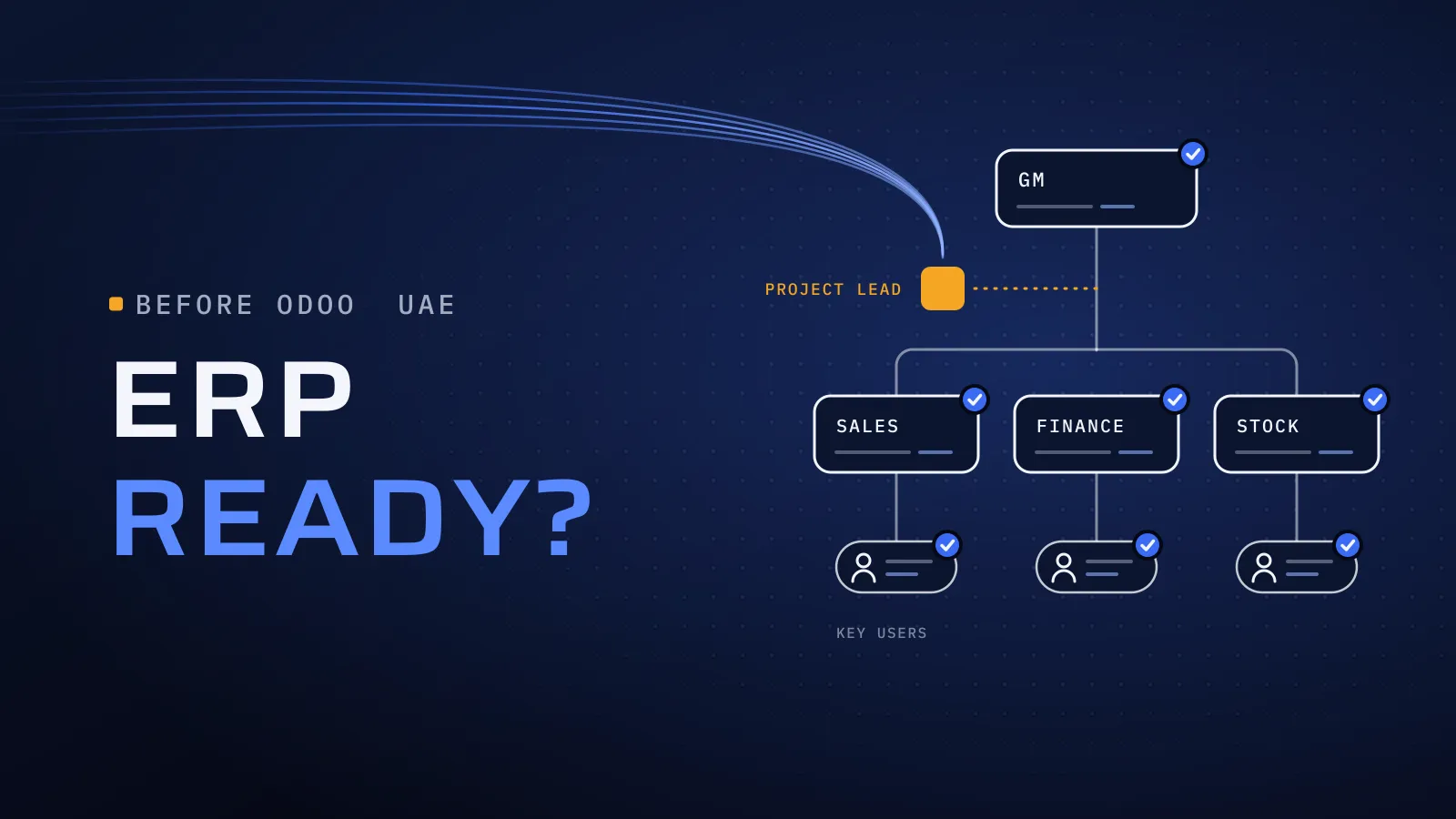
An ERP copies your organisation. User access, approval routes, reports by department or branch, and who receives which alert all come from the organisation chart. If the chart only exists in the general manager’s head, the system will be built on guesses.
Draw it before you start:
- One box per department: sales, purchasing, stock, finance, HR, and any branch, warehouse or legal entity.
- A name in every box. The owner decides how their part of the system works and answers for it after go-live.
- Who reports to whom, including people who cover two roles, which is common in UAE SMEs.
In Odoo, your companies, branches, departments, employees and access rights are set up from this chart, so it saves time from the first session.
Approval rules: who approves what
Most UAE companies have approval rules. Few have written them down. The rule lives on WhatsApp: “anything big, ask me first”. An ERP needs the rule written as a role and a limit, so it can route each document to the right person.
| Decision | Who approves | What to write down |
|---|---|---|
| Purchase orders | Department owner, then finance above a set amount | The amount, and who stands in when they are away |
| Discounts on quotations | Sales manager, then the general manager above a set percentage | The percentage, and whether it changes by customer or product |
| Supplier payments | Finance manager, with a second signatory above a set amount | Payment days, and who releases the bank transfer |
| Customer credit limits | Finance | Who can raise a limit, and what happens when a customer is over it |
| Expense claims | Line manager | The categories, and which receipts are needed |
You set the amounts. Odoo’s Purchase app has a built-in second approval above an amount you choose, and other approvals are set up as rules on the documents they apply to.
Processes: written down, even a page each
You don’t need a process manual. You need one page for each main flow, showing the steps, who does each one and which document it produces:
- Quote to cash: quotation, order, delivery, invoice, payment.
- Purchase to payment: request, purchase order, receipt, supplier bill, payment.
- Stock: receiving, transfers between locations, counts and write-offs.
- Month-end: what finance closes, in what order and with which reports.
Where branches do the same job differently, decide which way wins before configuration starts. Discovery maps the detail with you; the pages make sure it starts from your process, not from the software’s defaults.
People: one decision-maker, a project lead and key users
People are the part of readiness that can’t wait for the rollout.
- One decision-maker. One person settles disagreements between departments, approves the scope and signs off go-live. A steering group can set direction, but one person decides. Our Odoo implementation guide for the UAE explains why decision speed matters more than technical complexity.
- A project lead. Someone on your side runs the project day to day: gathers answers, books sessions, chases data. They don’t need to come from IT; they need to know how the company works.
- Key users, with time set aside. One person per department who knows the work, tests the system with real cases and trains colleagues. Their manager agrees to free part of their week during design, testing and training. A key user who is never free is a name on a list, not a key user.
Not sure where you stand? Take the 10-question check below, or send us a few lines about your company: your departments, branches and what you run today. We review your structure, roles, processes and data, and tell you whether you are ready for Odoo and what to fix first. It’s free and without obligation, for companies in the UAE.
Book your free ERP readiness consultation →
Not ready for a call? Ask for our company profile and we’ll send it to you.
Data: customers, products and the chart of accounts
Clean master data is the difference between a go-live and a clean-up project. Three lists matter most:
- Customers and suppliers: one record each, without duplicates, with the TRN, the emirate in the address (Odoo reads it to pick the VAT tax), payment terms and a contact for invoices.
- Products: one code per item, a unit of measure, a category, a price and a cost; barcodes if you scan; and a counted quantity if you hold stock.
- Chart of accounts: agreed with your accountant, with last month’s bank, customer and supplier balances reconciled, so the opening balances in the new system can be trusted.
Your team owns the clean-up, because only they know which record is right. We give you import templates and check the data in trial migrations. If you are moving from Tally, our Tally to Odoo migration guide lists what moves and what stays behind.
Tax: VAT, Corporate Tax and your e-invoicing date
Three tax questions belong in a readiness check, because a mistake here reaches your returns:
- VAT: are your TRN, the tax codes (standard, zero-rated, exempt, reverse charge) and the emirate on each customer correct today?
- Corporate Tax: can your accountant build the return from your accounts, or does it come from a side spreadsheet?
- E-invoicing: do you know your dates, and who your accredited service provider will be?
Our Odoo VAT and Corporate Tax guide covers the setup, and our guide to UAE e-invoicing in 2027 sets out who must be ready, and by when.
Not ready yet? What to fix first, and what can wait
No company scores ten out of ten on every point, and you don’t need to. The rule of thumb: people and decisions before you start; data and detail during the rollout, as long as someone owns each gap.
| Gap | Fix before you start | Can be finished during the rollout |
|---|---|---|
| No decision-maker or project lead | Name them before you sign anything | Nothing; this one can’t wait |
| Department owners | A name in each box | The full chart with every employee |
| Approval rules | The main limits for purchases, discounts and payments | Fine-tuning once people use the system |
| Processes | One page for each main flow | The detailed steps, mapped in discovery |
| Key users | Named, with their manager’s agreement | Their training, during testing |
| Customer and supplier records | The obvious duplicates removed | Missing TRNs and emirates, filled in with our templates |
| Product list | One code per item | Categories, barcodes and price lists |
| Chart of accounts | Agreed with your accountant | The Corporate Tax mapping, during configuration |
| E-invoicing | Your dates known and your provider chosen | The Odoo connection to the provider, set up and tested |
If the middle column is done, you are ready to start, even with gaps in the last one. If it isn’t, a few internal decisions will save you more than any consultant can.
Your free ERP readiness consultation
We implement Odoo for companies in the UAE, and our Odoo team leads each rollout. Before any proposal, we offer a free, no-obligation ERP readiness consultation: we review your structure, roles, processes and data, and tell you whether you are ready for Odoo and what to fix first. If you aren’t ready yet, we say so, with the list.
Quality is built into every step: CTO oversight of the structure and the migration plan, independent QA before each release, and a dated plan in FloPlan, our own delivery software. Flojics Technology has worked with more than 100 clients since 2014. Al-Mawared ERP is a web-based ERP we built for exchange companies across the MENA region. Talk to the team that built it: book a meeting.
Comparing systems or budgets too? Read Odoo vs Zoho for UAE companies, and our Odoo implementation cost guide with Odoo’s licence calculator. Our Odoo implementation services in the UAE page sets out what a rollout includes.
Take the self-check below; your score and gaps go straight into the request. Book your free ERP readiness consultation → We reply by email first and set up a call only if you want one. Asking commits you to nothing, and we sign an NDA first if you ask.
Is your company ready for an ERP? 10 questions
Answer for your company as it runs today, not as it should run. Say yes only when the whole line is true now. Your score and gaps go into the consultation request, ready to edit.
Does every department have a named owner?
An organisation chart shows one person responsible for sales, purchasing, stock, finance and HR, and who they report to.
Are your approval rules written down?
Everyone knows who approves purchases, discounts and payments, up to what limit, and who stands in when they are away.
Are your main processes documented?
Quote to cash, purchase to payment and stock movements are written down, even as one page each.
Is there one decision-maker for the project?
One person has the final say on scope and priorities, settles disagreements between departments and signs off go-live.
Have you named a project lead?
Someone on your side will run the project day to day: gather answers, book sessions and chase data.
Does each department have a key user with time set aside?
One person per department will test, train colleagues and answer questions, and their manager has agreed to free part of their week.
Are your customer and supplier records clean?
One list each, without duplicates, with TRNs, emirates, addresses and payment terms filled in.
Is there one product list that everyone uses?
Each item has one code, a unit of measure and a price and, if you hold stock, a counted quantity.
Is your chart of accounts agreed, and do the balances reconcile?
Your accountant agrees with the chart of accounts, and last month’s bank, customer and supplier balances reconcile.
Are VAT and Corporate Tax set up correctly, and do you know your e-invoicing date?
TRNs and tax codes are right, your accounts can feed the Corporate Tax return, and you know your 2027 e-invoicing dates.
Count your yes answers. 9 or 10: ready to start. 6 to 8: nearly ready, so fix the gaps in the first phase. 5 or fewer: fix the gaps first. A no on question 4 or 5 holds the project back, whatever the score.
Book your free ERP readiness consultationYour result
0 of 10 answered
0/10
Answer all ten to see your result.
Questions 4 and 5 come first. Without one decision-maker and a project lead, a rollout stalls however clean the data is.
What to fix
Free and without obligation, for companies in the UAE. Opens the contact form with your score and gaps in the message, ready to edit. We reply by email first and set up a call only if you want one.
Frequently asked questions
What is an ERP readiness assessment?
It checks whether your company, not the software, is ready for an ERP project. It looks at your structure (an owner for each department and written approval rules), your processes, the people who will run the project and your data. The result is a list of gaps to fix before you start, and of what can wait for the rollout.
Does our company need to be fully ready before we start?
No. People and decisions must be in place first: one decision-maker, a project lead, an owner for each department and key users with time for the project. Detailed process steps, data clean-up and the Corporate Tax mapping can be finished during the rollout, as long as someone on your side owns each one.
Who should be our decision-maker and project lead?
The decision-maker is usually the general manager or the finance head: someone who can settle disagreements between departments and sign off go-live. The project lead runs the project day to day and doesn't need to come from IT. A good one knows how the company works and can get answers from every department.
How much time do key users need to give?
Enough to join the sessions for their area, test with your real data and train their colleagues. Their manager should agree to free part of their week during design, testing and training. The dates are set in your project plan, so their workload can be planned around them.
Is the ERP readiness consultation really free?
Yes. It is free and without obligation, for companies in the UAE. Send us your self-check score or a few lines about your company. We review your structure, roles, processes and data, and tell you whether you are ready for Odoo and what to fix first. We reply by email first and set up a call only if you want one.
Do we need clean data before we talk to an Odoo implementer?
No. Knowing where your data stands is enough to start. Your team owns the clean-up, because only they know which customer record is the right one. Our Odoo team gives you import templates, checks the data in trial migrations and shows what still needs fixing before go-live.