MVP vs MMP vs MLP: What Each Release Proves, and Which One to Build First
MVP vs MMP vs MLP for founders: what each release proves, an example, customer feedback by sector, AI for validation, and if accounting software can be an MVP.
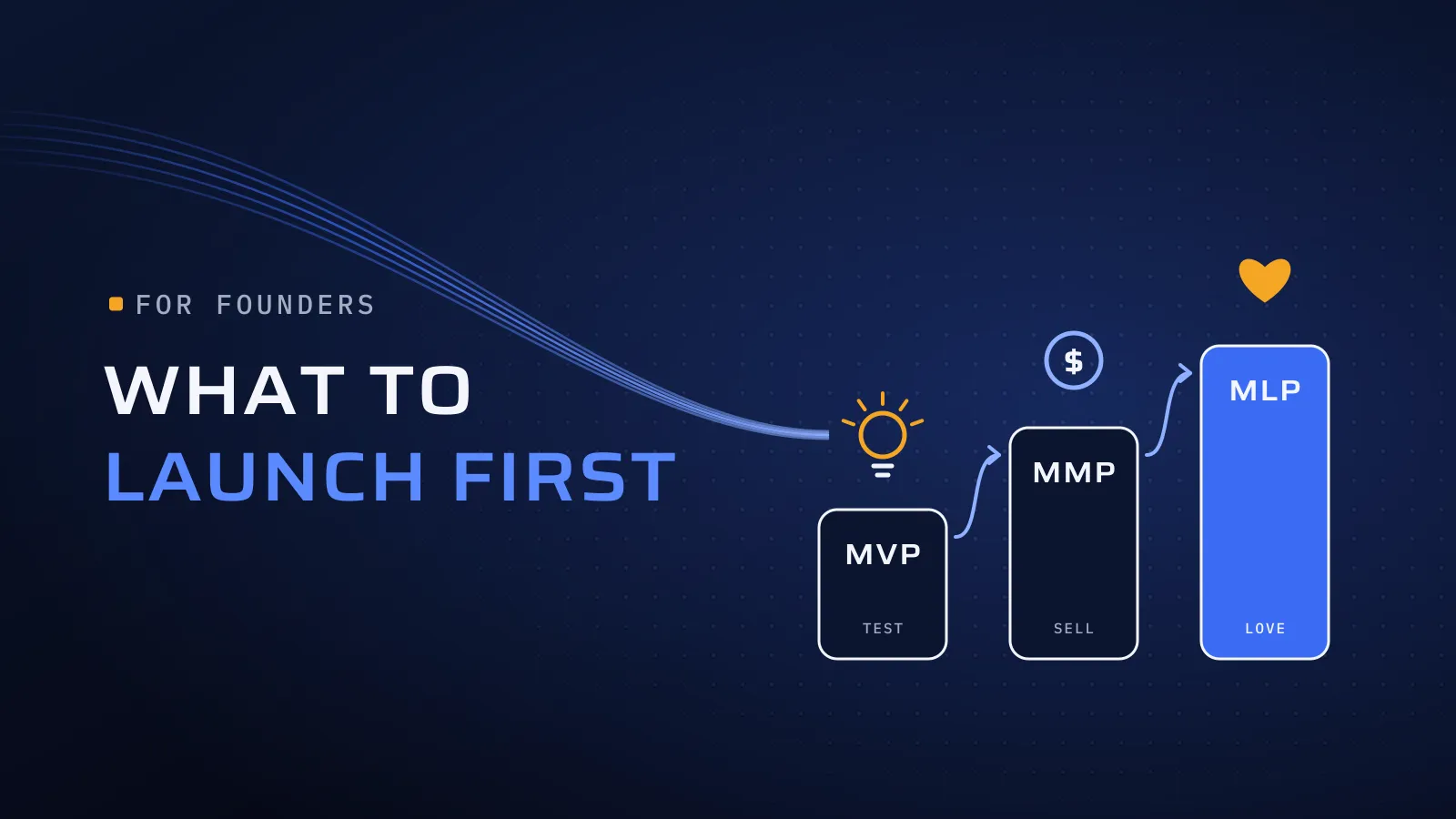
This guide is for startup founders and business owners who are about to build something new. MVP, MMP and MLP are three releases that answer three different questions. A minimum viable product (MVP) tests the idea: does anyone have this problem badly enough to act? A minimum marketable product (MMP) tests the business: will strangers pay? A minimum lovable product (MLP) tests loyalty: will people choose you over what they use today? Build them in that order, and each release spends money only on the question in front of you.
What is the difference between an MVP, an MMP and an MLP?
Quick answer: Picture three boxes joined by arrows. MVP, a light bulb: the smallest thing that proves the idea, often not even software. MMP, a dollar sign: the smallest release a stranger will pay for. MLP, a heart: the smallest release people would pick over the alternatives, because one part of it is clearly better. The MVP is for learning, the MMP for earning, the MLP for keeping.
Planning your first release? Ask about CTO as a service →
Mixing them up costs runway: an MVP polished before anyone has said yes, or an MLP that beautifully answers the wrong question.
MVP vs MMP vs MLP: the comparison table
| MVP (the idea) | MMP (it sells) | MLP (people love it) | |
|---|---|---|---|
| The question it answers | Is the problem real, and will people act on it? | Will strangers pay, on terms that work for you? | Will they choose you over the alternatives? |
| What it must have | The core job, even if done by hand behind the scenes | The core job, payment or invoicing, support, security and your market’s legal basics | One part clearly better than what they use now |
| What can be missing | Polish, automation, most settings | Anything a first buyer won’t ask about | Breadth: it is still small, just loved in one place |
| The signal that it worked | People use it again without being chased | Strangers pay, and renew or reorder | Users return unprompted and bring others |
| The common mistake | Polishing before anyone has said yes | Selling before you know which feature people value | Adding delight everywhere instead of in one place |
The MLP idea comes from Brian de Haaff, co-founder of Aha!, who argued in a 2013 article that a first product should aim to be loved, not merely tolerated, and later wrote the book Lovability. Some guides put the MLP before the MMP; in a crowded market that can be right, as the table below shows. The MVP always comes first.
One idea through all three boxes: an example
Take a padel court booking app in Dubai.
- MVP. A booking page for a few clubs, each slot confirmed by hand over WhatsApp. The question: will players book through you instead of calling the club?
- MMP. An app with live slots, card payment, the clubs’ cancellation rules, a panel for each club, receipts, and Arabic and English. The question: will players pay through it, and will clubs accept your terms?
- MLP. The same app with one thing players tell friends about, such as finding a fourth player in one tap. The question: do they come back, and bring the other three?
The core job and its data model never changed, which is why the foundations stay in every release. For the team and phases behind a first release, see MVP development cost in Dubai.
Which one should you build first?
| Where you are today | Build this | Why |
|---|---|---|
| An idea, and no evidence anyone needs it | An MVP, often run by hand or with a no-code tool | The cheapest way to learn |
| Early users keep using the MVP and ask when they can pay | An MMP | The question is now commercial |
| Buyers already pay for alternatives in a crowded category | An MMP with one lovable part | Nobody switches for “the same, but newer” |
| The product moves money, holds health records or calculates tax | A closed pilot to learn, then an MMP that is correct from day one | You can cut scope, never correctness |
| You are replacing a spreadsheet inside your own company | One process, end to end, for one team | The risk is adoption, not demand |
A clickable prototype counts as an MVP only if it answers the demand question, such as people trying to book through it. Screens that only show the design are a different test.
What this means for you: name your box before you ask anyone for a quote. The lovable part usually hides in what competitors’ users complain about; competitor analysis for startups shows how to find it, and product principles keep it from spreading into everything.
Does customer feedback work in every sector?
Yes, but the method changes, and so does what misleads you.
| Sector | Feedback that works | What misleads you |
|---|---|---|
| Consumer apps | Watching people use a prototype; what they do in their second week; store reviews of similar apps | Friends and family; launch-day downloads; “I would definitely use this” |
| Marketplaces | Talking to each side separately; how fast the supply side answers; repeat orders | Sign-ups on one side only; demand you paid to create |
| B2B SaaS | The last time they did the job and what it cost; a pilot with a named owner on their side | Praise in a demo; a manager’s yes when the users weren’t in the room |
| Internal enterprise tools | Sitting with the people who do the work; whether they still open the old spreadsheet | The sponsor’s opinion; usage that is mandatory anyway |
| Regulated: finance | The compliance officer and the auditor, early; a closed pilot, in a sandbox if needed | Early users’ enthusiasm, which says nothing about the regulator’s answer |
| Regulated: health | Clinicians inside a real workflow; patients reached through the provider | A doctor’s interest outside working hours |
In the Gulf, two habits matter. Many first conversations happen on WhatsApp, so use it for research: ask for a voice note about the last time the problem happened, in Arabic or English. And where business runs on relationships, people are kind to founders: a polite “looks great” is not a yes. In B2B, the person who signs is rarely the person who uses the system every day. Talk to both.
For health products, decide where the pilot’s data lives before the first patient record: Federal Law No. 2 of 2019 (Article 13) bars storing or processing health data from UAE health services outside the country, unless the health authorities allow it.
Not sure which box you are in? Tell us in a few lines where your product is today:
- the idea, and who pays for it;
- what customers have told you so far;
- the box you think you are building;
- whether it moves money, holds health data or calculates tax.
We say what technical leadership you need now and what can wait. Ask about CTO as a service →
Only one question? Ask it. Or ask for our company profile to share with your co-founders first.
Can accounting software be an MVP?
Yes, but you cut scope, never correctness. If an invoice shows the wrong VAT, your customer’s tax return is wrong, and no “beta” label fixes that. In the UAE, the bar is concrete:
- VAT. The standard rate is 5%, alongside zero-rated and exempt supplies and the reverse charge. Registration is mandatory above AED 375,000 of taxable supplies and imports in 12 months, and voluntary above AED 187,500 (Federal Tax Authority).
- E-invoicing. In-scope B2B and B2G invoices must travel as structured data through an Accredited Service Provider (ASP). Businesses with revenue of AED 50 million or more appoint one by 30 October 2026 and go live on 1 January 2027; smaller businesses appoint by 31 March 2027 and go live on 1 July 2027; government entities go live on 1 October 2027. B2C stays out for now. See our guide to UAE e-invoicing in 2027.
So an accounting product that issues B2B tax invoices in 2027 must produce data an ASP accepts, from its first version.
What you can cut:
- The segment. One kind of customer, such as service companies that hold no stock, with one legal entity and one currency.
- The workflow. Quote, invoice, payment reminder and export to the accountant, instead of a full ledger, payroll and inventory.
- The ledger itself. Many finance products start as a layer beside the accounting system a company already runs. For UAE companies we implement Odoo, which can be that system.
What you never cut: correct VAT on every line, including zero-rated, exempt and reverse-charge cases; invoice numbering, and credit notes that reference the original; an audit trail nobody can edit; tested rounding; and records kept for the period tax law requires. That is KISS and YAGNI applied honestly: leave out the features you don’t need yet, never the rules you need today.
The cheapest accounting MVP may not be software at all: an accountant serves a few clients from spreadsheets while you watch where the time goes, with no tax risk.
Regulated product? UAE sandboxes exist for testing
The UAE government portal lists the country’s regulatory sandboxes. They include the DFSA Innovation Testing Licence in the DIFC, for new financial products, services and business models; the ADGM RegLab in Abu Dhabi, for fintech without the full set of requirements at the outset; the Central Bank’s sandbox for the insurance sector; and the federal Regulations Lab (RegLab), which grants temporary licences for projects using future technologies, such as AI, where no law yet covers them.
Entry rules differ by regulator. A sandbox limits who you serve while you test; it doesn’t lower the bar for correct numbers.
Can AI speed up validation?
Yes, in four places:
- Research synthesis. Sorting interview notes and competitor reviews, in Arabic and English, into themes. You still read the quotes behind each one.
- Prototypes. Clickable screens sooner, so users react to something real.
- Test data. Realistic invoices, Arabic names and awkward VAT cases to test against, without touching real customers’ records.
- Code. Engineers draft code and tests faster and review every line; AI-assisted software development explains how.
Where it doesn’t help: AI can tell you whether an idea hangs together. It can’t tell you whether your buyer will pay, because it has never met them. “Synthetic users” answer with what sounds plausible, which is polite feedback at scale. Use AI to prepare for customer conversations and to make sense of them, not to replace them. Which customer data may go into which AI tool is agreed with each client before work starts.
Who decides what goes into each box?
When you outsource, someone has to hold the line between the boxes: what is in, what waits and what must be right from day one. With no technical co-founder, that is the advice layer CTO as a service provides: the CTO recommends and explains the trade-offs, and you decide. Day to day, the product owner turns your customers’ feedback into a ranked backlog; product owner vs product manager when you outsource sets out who does what.
Qargo is a car rental and ride-hailing platform in Qatar whose technical direction and architecture we led. Talk to the team that built it: book a meeting.
ButlerFM is facility management software for cleaning businesses. Talk to the team that worked on it: book a meeting.
Talk to us about your first release
Since 2014 we have built software for more than 100 clients across the UAE, Saudi Arabia, Qatar, Kuwait, the USA and Canada. Our headquarters is at Dubai Digital Park in Dubai Silicon Oasis, with offices in Houston and Alexandria.
Ask about CTO as a service → Tell us the idea and which box you think you are in. We say what technical leadership you need now and what can wait. We reply by email first and set up a call only if you want one. Asking commits you to nothing, and we sign an NDA first if you ask.
Frequently asked questions
What is the difference between an MVP, an MMP and an MLP?
They answer three different questions. An MVP (minimum viable product) tests whether the problem is real and whether people will act on it. An MMP (minimum marketable product) tests whether strangers will pay. An MLP (minimum lovable product) tests whether people choose you over what they use today and come back. In short: the MVP is for learning, the MMP for earning and the MLP for keeping.
Does the MLP come before or after the MMP?
We build in the order MVP, MMP, MLP. In a crowded market, where buyers already pay for something similar, your first paid release may need one lovable part, or nobody switches. Either way, the MVP comes first.
Is a prototype the same as an MVP?
Only when it answers the demand question, for example when people try to book or order through it. Screens that only show the design are a prototype: useful, but a different test.
Can accounting software be an MVP?
Yes, but you cut scope, never correctness. Start with one segment and one workflow, or sit beside an existing ledger instead of replacing it. VAT on every line, credit notes, an audit trail and, from 2027, invoice data an Accredited Service Provider accepts must be right in version one.
Can AI validate a startup idea?
It can test whether an idea hangs together and sort what customers have told you. It can't tell you whether your buyer will pay, because it has never met them. Use AI to prepare for customer conversations and to make sense of them afterwards, not to replace them.
How do I collect customer feedback for a B2B product?
Ask about the last time they did the job and what it cost them, run a pilot with a named owner on their side, and talk to both the person who signs and the people who will use it. Praise in a demo, and a manager's yes when the users weren't in the room, both mislead.
Who decides what goes into the MVP when we outsource the build?
You do. With CTO as a service, a senior technical lead recommends what belongs in each release, what can wait and what must be right from the first version, and explains the trade-offs. The product owner turns your customers' feedback into a ranked backlog. The final call stays with you.