Product Principles Examples: The Few Rules That Decide What Your Product Never Builds
Product principles examples from Basecamp, Linear, Intercom and Gusto, a fill-in template for founders, and how written principles settle scope arguments.
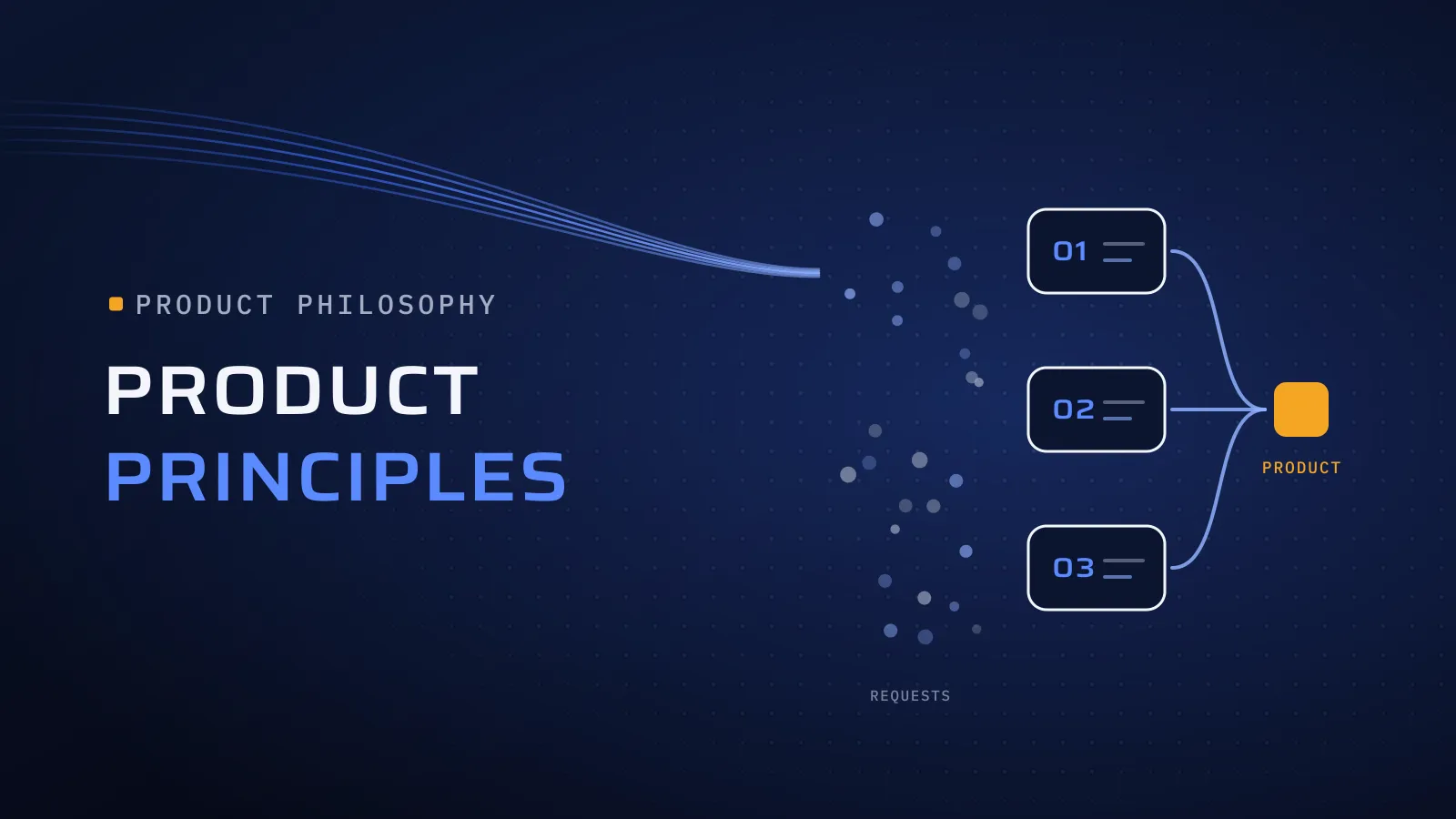
This guide is for founders and business owners about to start a software product with a team or software company they hire. A small product can’t beat a bigger one on features. It wins by being clearly better at one job for one kind of customer, and product principles are the few written rules that keep it there: what you build, and what you never build.
What are product principles? Examples in one minute
Quick answer: Product principles are three to five short rules that tell your team which option to pick when two good options compete. Published examples include Intercom’s “opinionated by default, flexible under the hood”, Linear’s “simple first, then powerful” and GOV.UK’s “do less”. A good principle rules something out. Write yours before the build, with whoever leads the technology.
What building without principles costs you
Without written principles, every feature request is judged on its own, and each one sounds reasonable: a settings page for one large customer, a report an investor asked for, a second app for a partner. The loudest voice decides, or the developer with the strongest preference. Scope grows, the launch moves, and the product slowly turns into a smaller copy of the market leader, with less money behind it. Principles don’t block good ideas. They make each idea earn its place against the one job your product exists to do.
Principles, vision, philosophy and design principles: what’s the difference?
These words get mixed up in pitch decks. Each one answers a different question:
| The question it answers | The shape of an example | |
|---|---|---|
| Vision | Where is the product going? | “Every small clinic in the UAE takes bookings online” |
| Product philosophy | What do we believe about good software? | “Software should make the common choice for the user” |
| Product principles | Which option wins when two good ones compete? | “Defaults first; a setting only when many customers ask” |
| Design principles | How do screens look and behave? | “One main action per screen” |
| Engineering principles | How is it built and changed? | “Proven technology, even over new” |
| Company values | How do we treat people? | “Say early what we don’t know” |
A product philosophy is the belief. Principles turn that belief into rules a team can apply in an ordinary planning meeting. Design principles sit underneath them and guide the UI/UX design work.
Product principles examples from companies that publish theirs
The words in quotes are each company’s own; the right-hand column is our reading of what the principle keeps out.
| Company | The principle, in their words | What it keeps out |
|---|---|---|
| Basecamp (37signals) | “Start With No” | Building a request the first time someone asks. The first answer is “not now”, and a request that keeps coming back gets a closer look. |
| Basecamp (37signals) | “fixed time, variable scope” | Letting the work grow until it fits the estimate. The time is set first, and the scope is shaped to fit it. |
| Linear | “Simple first, then powerful” | A first screen full of options. Power arrives as the customer grows. |
| Intercom | “Opinionated by default, flexible under the hood” | A blank configuration screen. Defaults and templates come first; customisation sits behind them. |
| Gusto | “No Product Dead Ends” | A flow the customer can’t finish without calling support. |
| GOV.UK | “Do less” | Building what someone else already provides well. |
Two things stand out. Each principle is short enough to say out loud in a meeting. And each one costs something: Intercom’s own post on its principle describes a data feature that was first too flexible for customers to adopt, so the team added opinionated defaults. A principle that never costs you a feature is a slogan.
What does “opinionated software” mean?
Opinionated software picks one good way to do a job and makes it the default, instead of asking every customer to configure their own. The idea goes back to 37signals’ book Getting Real, whose chapter “Make Opinionated Software” argues that good software takes sides rather than trying to please everyone. In a Figma interview, Linear’s co-founder describes designing for “one really good way of doing things”. Gusto lists “Be opinionated” among its five product principles.
For a startup, being opinionated is usually right: one segment and one workflow, done well. It isn’t right everywhere:
- Where customers truly differ, such as approval chains inside large companies, keep a strong default and add configuration only where the business really varies.
- Where the rule is the law, such as UAE VAT or e-invoicing, there is no opinion to hold. The product follows the rule from the first release.
- Where language is part of the job. If your customers are in the Gulf, “Arabic and English from the first release” is a principle, not a feature for later. Our guide to Arabic app development shows what adding it afterwards involves.
How to write your product principles: a fill-in template
- Start from the customer and the job. If you haven’t yet, read what your competitors’ users complain about. Your principles should protect the thing you will do better.
- List the arguments you know are coming. Settings or defaults? Web or app first? One customer type or several? Launch sooner, or launch more complete?
- Write each one as “X, even over Y”. The “even over” part names what you give up. If nobody would ever argue for the opposite, it isn’t a principle: “easy to use” fails; “book without an account, even over collecting more data” passes.
- Attach one decision to each. Name a real feature it lets in or keeps out. If you can’t, drop the principle.
- Keep three to five, and review them after launch. Change a principle when evidence from real users says so, not when one request is loud.
Copy this and fill it in:
For [customer] who need to [job], our product is the one that [what you do better].
- We choose [X], even over [Y]. It keeps out: [a feature or request].
- We choose [X], even over [Y]. It keeps out: [a feature or request].
- We choose [X], even over [Y]. It keeps out: [a feature or request].
Not now: [one to three things you won’t build yet].
We revisit these when: [the signal, such as the same request from several paying customers].
A worked example, for an imaginary booking app for small clinics in the UAE:
- A patient books without creating an account, even over collecting more data.
- Arabic and English from the first release, even over a longer feature list.
- Clinic staff run the day from a phone, even over a full desktop dashboard.
- We connect to what clinics already use, even over replacing it.
Not now: medical records, in-app chat with doctors, a loyalty scheme.
How principles settle scope arguments with your team or vendor
This is where principles pay for themselves. Most scope arguments between a founder and a software company are two good ideas competing, with no rule to choose between them. Written principles turn the argument into a quick check.
| The argument | Without a principle | With a principle |
|---|---|---|
| A large prospect wants a custom feature before signing | You build it, and now maintain two versions of the product | “One product for every customer”: offer the closest existing workflow, or log the request under “not now” |
| “Add a setting so each customer can choose” | Every new option multiplies the cases to test | “Defaults first”: ship one good default, and add the setting when the same request keeps coming back |
| The launch date is slipping | The date moves, then moves again | “Fixed date, flexible scope”: cut features to keep the date, and never cut correctness (what never to cut) |
| A rare case needs its own admin screen | A screen used a few times a year gets built, tested and maintained | “Manual first for rare cases”: your team handles it by hand until it repeats |
| A developer wants to move to a newer framework | The roadmap stalls while the code changes | “Proven technology, even over new”: a rewrite needs a customer reason |
| An advisor asks for an AI feature | It joins the roadmap because it sounds current | “Every feature serves the core job”: it waits under “not now” until it does |
Put every change request through four questions: which principle does it serve, which does it break, what leaves the release to make room, and who decides? On our projects, the CTO recommends, the product owner reorders the backlog, and you make the call. The principles make that call quick, and the reason gets written down.
What this means for you: before you sign with any software company, give them your principles together with the brief. A vendor that pushes back on a principle early is useful to you. A vendor that agrees to every request will let the scope grow until the launch date moves.
Got a feature list that keeps growing? Tell us where your product is today and the customer you’re building for. We say what technical leadership you need now and what can wait. Ask about CTO as a service →
Not ready to talk yet? Ask for our company profile and we’ll send it to you.
Why setting principles is part of a CTO’s job
Many product choices are technical commitments in disguise. A settings page multiplies what has to be tested. A custom version for one customer splits the code. “Works offline” changes the architecture. That is why principles belong with whoever leads the technology, working with the founder, rather than with the developer who happens to be building that week.
As part of CTO as a service, we draft the principles with you before the build, use them to review scope with your developers or ours, and keep a written log of each decision and the principle behind it. You keep the final say. The same thinking shapes how you choose a first release in MVP vs MMP vs MLP, and how a good team says no in KISS and YAGNI for founders. If you’re weighing a fixed project against a product that keeps improving, read product mindset vs project mindset.
Qargo is a car rental and ride-hailing platform in Qatar, and we led its technical direction and architecture. Talk to the team that built it: book a meeting.
Write your principles before the first line of code
Since 2014 we have built software for more than 100 clients across the UAE, Saudi Arabia, Qatar, Kuwait, the USA and Canada. We are a software development company in Dubai, headquartered at Dubai Digital Park in Dubai Silicon Oasis, and the four ways to work with us show who runs the day-to-day work in each case.
Ask about CTO as a service → Tell us where your product is today and what you want it to be best at. We say what technical leadership you need now and what can wait. We reply by email first and set up a call only if you want one. Asking commits you to nothing, and we sign an NDA first if you ask.
Frequently asked questions
What are product principles?
Three to five short rules that tell your team which option to pick when two good options compete. They sit between the vision, which says where the product is going, and the design principles, which say how screens behave. A good principle rules something out, so it costs you a feature now and then.
What are some examples of product principles?
Companies that publish theirs include Basecamp ("Start With No"), Linear ("Simple first, then powerful"), Intercom ("Opinionated by default, flexible under the hood"), Gusto ("No Product Dead Ends") and the UK government's digital service ("Do less"). Each one keeps a certain kind of feature or request out of the product.
What does opinionated software mean?
Software that picks one good way to do a job and makes it the default, instead of asking every customer to configure their own. The idea goes back to 37signals' book Getting Real. For a startup it is usually right: one segment and one workflow, done well. Where customers truly differ, keep a strong default and add configuration only where the business really varies.
What is a product philosophy, with an example?
It is the belief about good software that sits behind your principles. 37signals believes software should take sides rather than try to please everyone; one of the principles that follows is "Start With No", where the first answer to a feature request is "not now".
How many product principles should a startup have?
Three to five. Fewer, and they don't settle enough arguments; more, and nobody remembers them in a meeting. Attach one real decision to each, and drop any principle that never keeps a feature out.
Who should write the product principles: the founder or the software company?
You own them, because they describe your customer and your business. Whoever leads the technology should draft them with you, because many product choices are technical commitments. With CTO as a service, the CTO drafts and applies them, the product owner uses them to order the backlog, and you make the final call.
How do principles help when you work with a software vendor?
They turn scope arguments into a short check: which principle the request serves, which it breaks, what leaves the release to make room, and who decides. Give your principles to the vendor with the brief, so the arguments happen early, in writing, instead of after the launch date moves.