AI-Assisted Software Development: Faster Delivery, Same Quality and Control
AI-assisted software development that ships faster with the same reviews, tests and control: how our engineers use AI, and what stays with people.
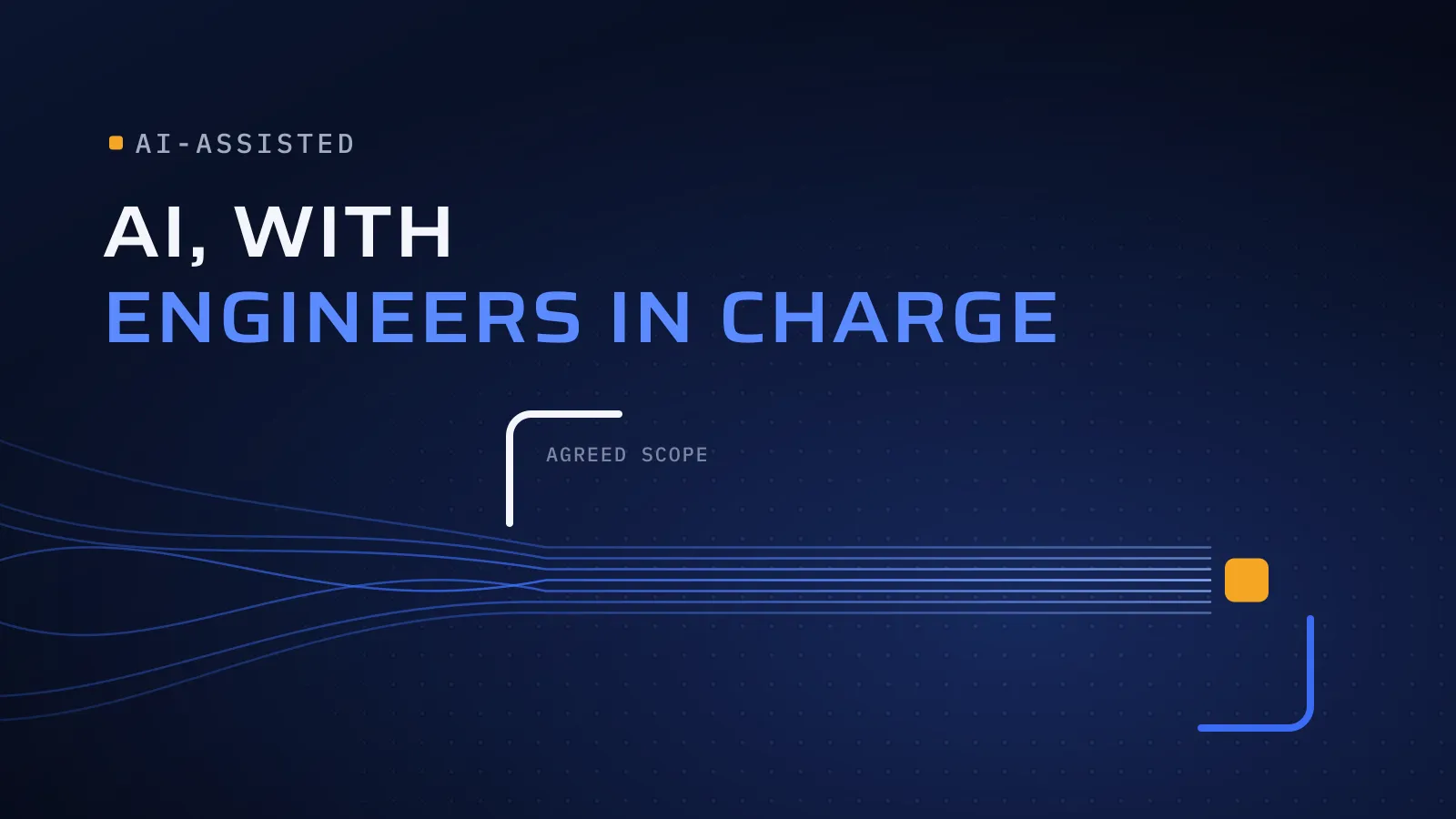
AI-assisted software development should get your product to users faster without lowering the bar: the same reviews, the same tests, and you still decide the scope. That is how our engineers use it. AI drafts code, tests and documentation faster, and engineers review, test and own everything that ships.
What does AI-assisted development mean for your project?
Our engineers use AI tools to draft code, tests and documentation faster, then review, test and own everything that ships. You get the same quality checks and the same control over scope, with first drafts that take less time. Architecture, security-sensitive logic and unclear requirements stay with senior engineers and your Product Owner.
Wondering where AI fits your project? Talk to us about AI in your project →
Speed without rules is the expensive kind. Left unchecked, AI tools produce features nobody asked for and code nobody fully understands, and you pay for both later in rework and maintenance. With the right limits, you keep the speed and the bill stays where you agreed it.
How we use AI without losing quality or control
- A written spec first. Each task starts with a description and acceptance criteria agreed with your Product Owner, including what is out of scope.
- AI drafts, the engineer shapes. AI helps most where the task is clear and the result is easy to check: screens, forms, API clients, first unit tests from the acceptance criteria, documentation and data-migration mapping. The engineer reads every line.
- Every change is reviewed. A second engineer, usually the Technical Lead, reviews each change. If the author can’t explain a line, it doesn’t merge.
- Independent QA tests what ships. The acceptance criteria become tests, and our QA role owns the test plan, as quality assurance in software development explains. Code that no criterion asks for is removed in review.
- Extra ideas go to your backlog. When AI suggests something useful that nobody asked for, it goes to your Product Owner to decide, not into the code. Your scope stays yours.
What stays with people. Architecture decisions, because the data model and the integrations are hard to undo and depend on your budget and growth plans. Security-sensitive logic, such as sign-in, permissions, payments and anything that touches personal data. And unclear requirements, where AI fills the gaps with guesses that look reasonable. The fix there is a conversation with your Product Owner, which is what software product discovery is for.
Google’s 2025 DORA report on AI-assisted software development calls AI an amplifier: it magnifies the strengths of high-performing organisations and the problems of struggling ones. For you, that means a partner’s process matters more than its tools.
AI-first, AI-assisted or a dedicated team: which fits each part of your project?
These are the three ways we build, as on our home page, and most projects mix them. Use the table to agree, at the start, which applies to which part of the work.
| AI-first | AI-assisted | Dedicated team | |
|---|---|---|---|
| What it is | Products built around AI | Faster delivery, engineers in charge | People on the hard problems |
| Fits | New products and features | Every build | Complex challenges |
| Typical work | Assistants, document reading, smart search, automated workflows | Code, tests, documentation, data migrations | Legacy systems, heavy integrations, scale and security |
| Choose it when | AI does the job your users pay for and removes work they do by hand | Always: it is how our engineers work | The hard part is knowledge AI tools don’t have |
| What you get | A product that takes manual work off your users | Ordinary software, with first drafts that take less time | A senior team working the problem end to end, inside your tools and schedule |
If AI belongs inside your product, our AI and automation team designs it around the workflow it serves, and AI agents for enterprises covers agents that take on defined tasks in a large company. When the hard part is an old system or many integrations, team extension puts senior engineers on it, inside your own team.
Want AI inside your product, not only in how it is built?
Send us the process or the idea in a few lines. We reply with where AI would save real work, where plain code is the better tool, and what a first version could cover.
Find where AI fits your product → · Not ready for a call? Ask for our company profile and we’ll send it to you.
What you can check on your own project
You don’t have to take our word for any of this. On every project we run, the practice leaves a trail you can see:
- Before work starts: the list of AI tools agreed with you, what they may see, and what stays out of them.
- On every task: a written spec with acceptance criteria your Product Owner agreed.
- On every change: a named author and a named reviewer, with nothing merged that the author can’t explain.
- At every cycle’s end: working software to click through, tested by QA against those criteria.
AI drafts; a person decides what ships. Two of our principles keep that true on your project:
- CTO oversight. Every project is supervised by senior technical leadership, who decide where AI helps and where it stays out.
- Independent QA. A dedicated testing and quality assurance process checks what ships, whatever drafted it.
Your code goes only into the AI tools agreed with you before work starts, and production personal data and secrets stay out of them. We design for UAE PDPL, Saudi PDPL and PIPEDA, and agree data rules with you before access.
Since 2014 we have delivered software for more than 100 clients in the UAE, Saudi Arabia, Qatar, Kuwait, the USA and Canada, from our headquarters at Dubai Digital Park in Dubai Silicon Oasis and our offices in Houston and Alexandria.
Want to see where AI would speed up your project? Talk to us about AI in your project. We ask about your goal, what you use today, your timing and who else should be involved. You leave with clear next steps. The call commits you to nothing, and we sign an NDA first if you want one.
Frequently asked questions
Does AI-assisted development make my project cheaper?
It shortens parts of the work, such as first drafts of code, tests and documentation. Review, testing and the hard design decisions still take engineers' time, so we price on scope, agreed in your proposal, not on a promised speed-up. What you pay for is software that has been reviewed and tested.
Will we launch sooner?
First drafts take less time, so features reach review and testing sooner. Review and testing take as long as they need, by design. Your dates sit in a dated release plan, and you see working software at the end of every cycle, so you can watch the progress for yourself.
Who is accountable for code that AI drafted?
A named engineer, exactly as for any other code. They read every line, a second engineer reviews the change and independent QA tests it. If the author can't explain a line, it doesn't merge, so nothing ships that nobody understands.
Which AI tools see our code, and who owns what they draft?
Only the tools agreed with you before work starts, and production personal data and secrets stay out of them. AI-assisted work passes to you on the same terms as the rest of the code we write for you: at the end of the project, once the contract is completed and paid, as written in your agreement. We design for UAE PDPL, Saudi PDPL and PIPEDA, and agree data rules with you before access.
What if AI gets something wrong?
It sometimes does, confidently, so we plan for it. Every change is reviewed and tested, each new dependency and its licence is checked by hand, and AI features in a product are tested on real examples, with a person reviewing the high-stakes cases. Wrong output is caught in review, not by your users.
Should my product itself be AI-first?
Only if AI does the job your users pay for and removes work they now do by hand, such as reading documents, answering from your content or smart search. If the product works just as well without AI, it doesn't need to be AI-first, and we will tell you so.