MVP Development Cost in Dubai: What to Build First, and What It Costs
MVP development cost in Dubai and the UAE: four scope tiers, what moves the price, how long a first release takes, what to cut, and a worksheet for your team.
MVP development cost in Dubai is set less by a rate card than by what goes into the first release. Keep it to the one job your users need done, and you launch sooner, on a budget you control, with real usage to show investors; put the whole wish list in, and the runway is spent before anyone has used the product.
How much does an MVP cost in Dubai?
Quick answer: By UAE market figures, a simple MVP built by a professional team costs about AED 40,000 to 110,000 (USD 11,000 to 30,000) and takes about 2 to 3 months. Two user groups, money moving between them or sensitive data push it higher. Your price is agreed in your proposal after discovery, and it follows your scope.
Know the one job your MVP must do? Talk to us about your MVP →
What a bigger first release costs you
Waiting for the full product means paying for every feature before a single user has told you which one matters. Each extra month of building spends runway with no revenue, no feedback and no usage number to show investors. A smaller first release turns the budget into evidence sooner, and that evidence makes the next spend easier to justify and to aim.
Which MVP are you building? Four scope tiers
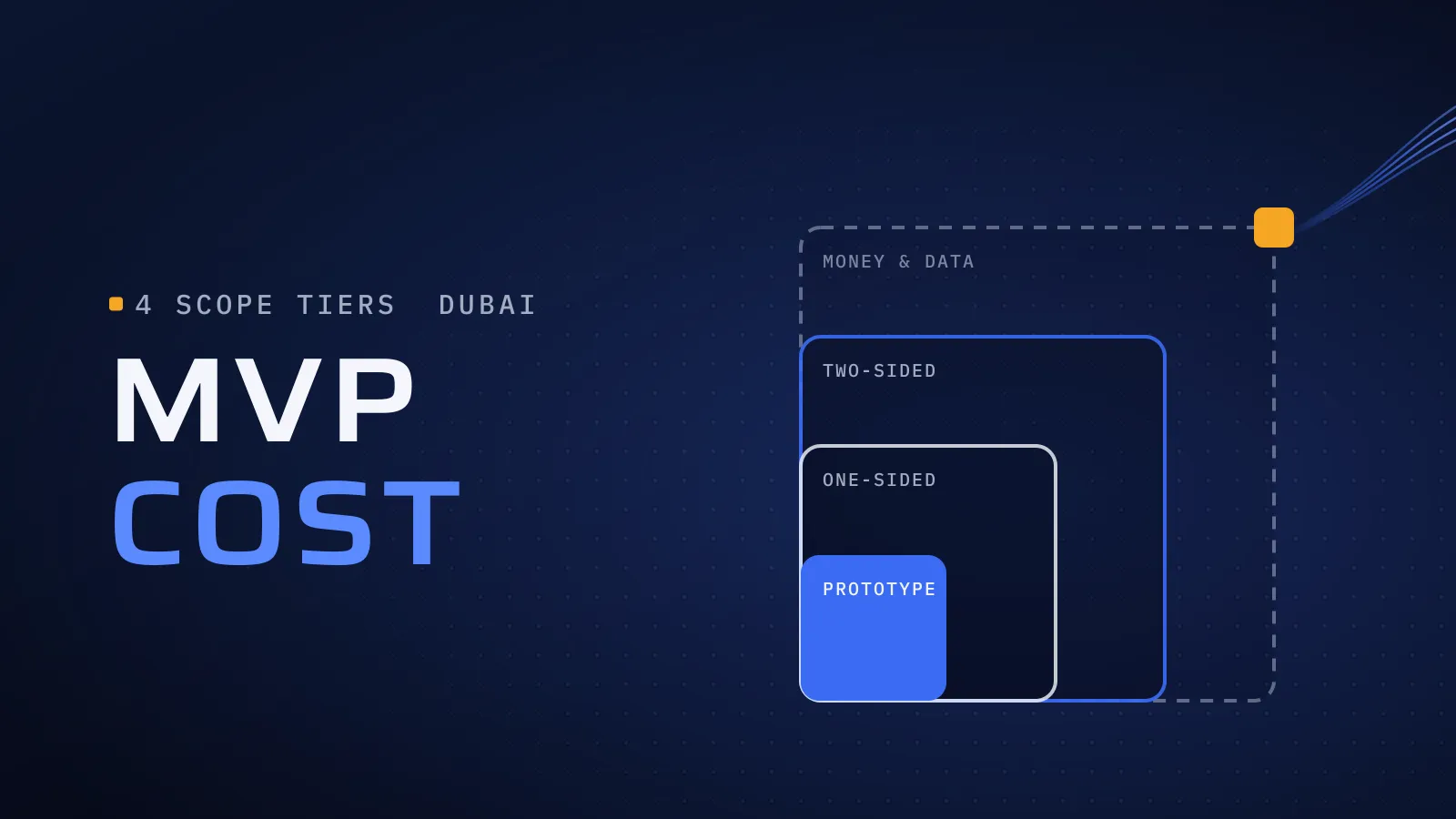
Find your tier before you compare quotes: two quotes for different tiers aren’t comparable, however similar the idea sounds.
- A clickable prototype. Designed screens of the main journey with no code behind them, to test the idea with users and investors. It costs a fraction of a build, takes weeks, and usually becomes the build’s first step anyway.
- A one-sided MVP. One user group, one core journey, one codebase and a simple admin panel your team uses to run everything else. A salon that takes bookings in an app while staff manage the slots from the panel is a typical example. This is the simple band in our app cost guide.
- A two-sided MVP. Two user groups who need each other, such as customers and providers, usually with money passing between them. Each side has its own screens, rules and tests, and neither works without the other, so this tier typically reaches the guide’s medium band.
- Money or sensitive data at the core. Wallets, payouts, health records or ID checks, added to tier 2 or 3. Security reviews, penetration testing and the payment provider’s own checks add time and cost, so plan for them in the first estimate, not at launch.
What moves an MVP’s price
Screens and platforms are covered in the cost guide. For a first release, four drivers matter most:
- How settled the scope is. A fixed price has to carry every open question, so an unsettled scope costs more as a fixed quote than in time and materials. Settle the must-haves, then fix the price; or keep the scope open and pay for the time.
- Money between users. Taking a payment is one integration. Holding, splitting or paying out money adds rules, records and tests on every path, so it moves the price more than most screens do.
- What you are willing to do by hand. An admin panel where your team approves providers, matches orders or issues refunds replaces features you would otherwise build. Manual work at a few transactions a day is cheap; automate it once the volume makes it expensive.
- Who builds it. An in-house team means salaries before the first line of code.
That last driver is worth pricing. The Hays GCC Salary Guide 2025 puts a full-stack or mobile app developer in the UAE at AED 25,000 to 40,000 a month, a UI/UX developer at AED 20,000 to 30,000 and a QA/test analyst at AED 15,000 to 25,000. These are market figures for the total fixed monthly package as of Q4 2024, not our prices. A four-person MVP team is about AED 85,000 to 135,000 a month before recruitment, visas and the months it takes to hire, which the real cost of hiring in Dubai itemises. That team makes sense once the product is proven; before then, a defined project means you pay for the agreed release, not a payroll that runs on after it ships. No technical co-founder? CTO as a service covers the architecture decisions part-time.
How to build an MVP in Dubai, step by step
- Name the one job and the number that proves it. Who your first users are, what they do today and the one or two numbers you will read every week after launch. Our guide to software product discovery shows how to pick the features worth building first.
- Sort every feature with the worksheet below. Must-have, later or never for v1. The must-have column is your scope, and your scope is your price.
- Choose how to work. For a defined MVP, project delivery with a fixed scope per phase, so you know each phase’s price before it starts. If the scope is still moving, time and materials lets you pay for the work done and change course as users respond. Our four ways to work set out the options side by side.
- Build in short cycles you can try. The core journey is designed and clicked through first, then built, with a working version to try at the end of each cycle and testing alongside.
- Launch small, then measure. Release to a first group of users, read your numbers each week and let them decide what moves up from the later column.
The MVP scope worksheet
Fill this in with your co-founders or product lead. Every feature on your list goes into exactly one column.
| Area | Must-have for v1 | Later | Never for v1 |
|---|---|---|---|
| The core journey | Every step of the one job, start to finish, for each user group it needs | Shortcuts for repeat users | A second core journey |
| Sign-up and login | Phone or email sign-up | Social login; UAE PASS, unless the job needs a verified identity | Your own identity system |
| Platforms | One codebase: cross-platform for iOS and Android, or web if the job happens at a desk | The second platform, if you started with one | Separate native apps with no device feature that needs them |
| Payments | One gateway, if users pay in the app | Saved cards, wallets, splits and payouts, unless moving money is the core job | Your own payment processing |
| Admin and operations | A simple panel for users, content and the core job’s records | Roles, approvals and automated workflows | A separate back-office app for each team |
| Languages | The language most first users prefer, in a layout ready for right-to-left | Full Arabic and English content | Languages for markets you haven’t entered |
| Integrations | Only what the core job cannot run without | ERP, CRM or accounting sync | Links to systems you don’t use yet |
| Extras | None | Chat, ratings, loyalty and referrals, once users ask for them | Features copied from a competitor “just in case” |
| Measurement | Tracking on each step of the core journey | Dashboards and cohort reports | Reports nobody has asked to read |
| Foundations | Tests, security, access rules, backups and a data model built for the full product | Nothing here waits | Nothing here is ever cut |
How to read it: every must-have has to serve the core journey or the foundations. Anything that doesn’t is not a must-have yet: move it to “Later” and give it a reason to come back, such as a number it should improve.
Filled in the worksheet, or stuck on one row? Send us your must-have column and your launch date. We reply with the tier we see, what we would move to “later” and whether a fixed scope or time and materials fits. Talk to us about your MVP →
Sharing this with co-founders or investors first? Ask for our company profile and we’ll send it to you.
How long does an MVP take?
By the same UAE market figures, a simple MVP takes about 2 to 3 months from discovery to launch, and a two-sided one longer. Three things stretch the timeline more than the code does:
- Decisions waiting on you. Designs and scope need sign-off. A weekly slot with the person who decides keeps the build moving.
- Launch paperwork. Enrolling in the Apple Developer Program as a company needs a D-U-N-S number, and a payment gateway checks your business documents, such as your trade licence, before it approves a merchant account. Start both in week one, in your company’s name, so they are ready before the build is.
- Scope added mid-build. Every new must-have moves the date. Fix the launch date and let the must-have list flex: whatever doesn’t fit goes to the later column.
Your dates are agreed in your proposal, with a release plan you can share with your investors.
What to cut first, and what never to cut
When the must-have column is still too long, cut in this order:
- The second platform. One cross-platform codebase covers iOS and Android; if the job happens at a desk, a web app alone can do it.
- Design polish. Standard components now, animations later. The core journey still gets careful design, because users judge the product by it.
- Automation you can do by hand. Approvals, matching and reports run from the admin panel until the volume says otherwise.
- Extras around the core. A WhatsApp button stands in for in-app chat; loyalty, referrals and ratings wait for users who ask.
The foundations row never makes this list. Tests, security and a data model built for the full product cost little at the start and a lot to add later, and they let release two build on release one instead of replacing it.
Two sides, one journey: Zidly
Zidly is a QR code tipping and donations app we built for Kuwait. Customers scan a code at the location and choose who the money goes to: one employee, a whole team or a community case. We built both sides: the customer flow for scanning a code and sending money, and the app where workers and beneficiaries receive and manage their tips and donations.
In this article’s terms, that is a two-sided product with money moving between the sides, and its core journey fits in three words: scan, choose, receive. On a worksheet for a similar product, both sides of that journey are must-haves, because a tip nobody can receive is not a product. Ideas that build on it, such as loyalty or referrals, are what the later column protects: valuable, but dependent on a journey that already works. Talk to the team that built it: book a meeting.
Two of the ways we work keep an MVP’s budget honest. Product thinking: we solve business problems, not only deliver features, so every must-have serves the core journey. Scalable architecture: built for long-term growth, so we cut features, not foundations. Our mobile app development page shows more of our app work.
Bring your idea and your launch date
Since 2014 we have built software for more than 100 clients across the UAE, Saudi Arabia, Qatar, Kuwait, the USA and Canada, from our headquarters at Dubai Digital Park in Dubai Silicon Oasis and our offices in Houston and Alexandria. Bring the worksheet, even half filled in, and your launch date.
Talk to us about your MVP → We ask about your goal, what you use today, your timing and who else should be involved. You leave with clear next steps. The call commits you to nothing, and we sign an NDA first if you want one.
Frequently asked questions
How is the price of an MVP set?
By the scope of the first release: how many user groups it serves, which platforms it runs on, whether money moves through it and what it connects to. We settle that scope with you in discovery, and your price is agreed in your proposal after discovery, phase by phase. You see the cost of each phase before you commit to it.
How long does it take to build an MVP in Dubai?
By UAE market figures, a simple MVP takes about 2 to 3 months from discovery to launch, and two-sided products take longer. Your dates are agreed in your proposal. Fixing the launch date and letting the must-have list flex is the surest way to hold it, because anything that doesn't fit moves to the next release instead of moving the date.
Fixed price or time and materials: which suits an MVP?
A fixed scope per phase, as project delivery, once discovery has settled the must-haves. Time and materials when the scope is still moving, for example while you test with early users and expect to change direction. Many founders use both: a fixed first release, then time and materials for the changes their users ask for.
Who owns the MVP's code, accounts and data?
You do. The code and IP pass to you at the end of the project, once it is completed and paid, and the App Store, Google Play and payment accounts can be in your company's name from the start. We sign an NDA first if you want one.
What if the MVP doesn't get the response we hoped for?
Then you have learned it on the smallest budget, which is what an MVP is for. The numbers agreed before launch show which part users skipped, and your later list holds the next thing to test. Because the foundations were built for the full product, the next release changes the product rather than replacing it.