How to Hire App Developers in Dubai: Company, Team or Freelancer
How to hire app developers in Dubai: an app company, developers added to your team, or freelancers. Who manages, who owns the code, what to sign and test.
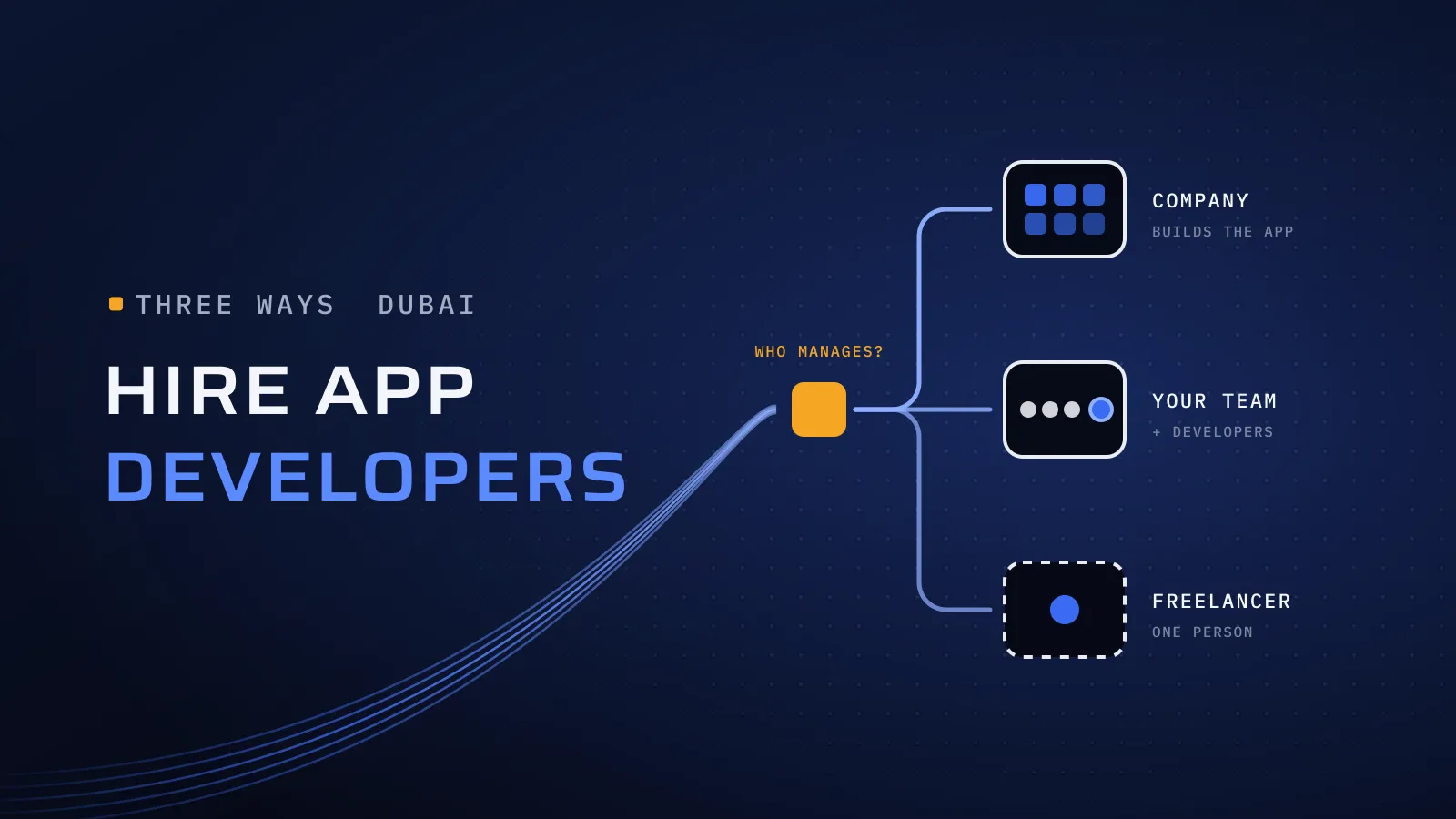
To hire app developers in Dubai, choose the route before the people: an app development company that builds the whole app, developers added to your own team, or freelancers. Each route puts the management, the code and the store accounts in different hands, and the wrong choice usually shows months later, when a release slips or an account can’t be moved.
How do you hire app developers in Dubai?
Quick answer: Start with who will manage the work. If nobody on your side can own the backlog and review code, hire an app development company to build the app. If you have a product owner or a tech lead, add developers to your own team. Keep freelancers for small, well-defined pieces. On every route, keep the code and the App Store and Google Play accounts in your company’s name, and test each developer on a task from your own app.
Know your route? Get an estimate for your app → or add app developers to your team →
What hiring the wrong way costs you
Most app hiring problems are route problems, not people problems. Hire one freelancer to build a whole platform, and you become its project manager, tester and release manager, or those jobs wait until launch. Add developers to a team with nobody to set priorities, and they wait for decisions. Hand a company a vague brief, and it prices its own reading of it. Each mistake costs a release or two before anyone names it. Match the route to who on your side can lead the work, then vet the people on your own app.
Three ways to hire app developers, side by side
| App development company | Developers added to your team (staff augmentation) | Freelancers | |
|---|---|---|---|
| What you get | A whole team: design, mobile and back-end developers, QA and a delivery lead | One or more developers in your stand-ups, tracker and repositories | One person, or a few you coordinate yourself |
| Who manages the work | The company’s delivery lead runs the plan; you decide the scope and accept each release | You: your product owner or tech lead sets the daily priorities. The provider handles HR, payroll and replacements | You, directly, for each person |
| What you need on your side | Someone who makes product decisions and tests releases | Someone who owns the backlog and reviews code | Someone who writes the tasks, reviews the code and runs the releases |
| How you vet | Their live apps, the people who will work on yours and their written answers | You interview every candidate and set a task from your app | References, code they wrote and a paid trial task |
| If someone leaves | The company replaces them inside its team | The provider sources again, and you interview the new candidates | You start a new search |
| What drives the cost | The app’s scope: user roles, platforms, integrations, Arabic | The level and number of developers, the stack and how long you need them | Their rate and hours, plus the design, QA and management you add |
| Fits when | A new app or a big release, and no tech lead free to run it | A live app or a roadmap you already run, short of hands or a skill | A small, well-defined piece: a prototype, one integration, a fix |
How to read it: start from the row “What you need on your side”. If you can’t fill it, the route doesn’t fit, however good the people are. Hiring an employee is a fourth route; our comparison of staff augmentation vs in-house hiring in the UAE covers the visa, the notice period and the costs beyond salary.
Route 1: an app development company builds it
You bring the goal and the decisions; the company brings every role and owns the delivery. It fits a new app or a rebuild when nobody on your side has time to run developers day to day. You still own the product decisions, quick answers to the team’s questions and the acceptance of each release on a real phone. Many companies start here and move to their own or added developers after launch, which works when the code and accounts are already in their name.
Vet the company, not the sales call. Download two of its live apps and switch one to Arabic, ask who will build yours and where each person sits, and ask for a quote that lists its phases, roles and assumptions. Our comparison of mobile app development companies in the UAE has ten questions to send every firm, and the weighted scorecard for choosing a software company in Dubai turns the answers into a score.
Already holding a quote? Send us the proposal you received, with anything confidential removed. We reply with the questions to ask and what we would change. Send us the quote →
Route 2: add app developers to your own team
Staff augmentation suits a company that already runs an app or a roadmap and is short of hands or a skill: a second Flutter developer, an iOS specialist for one native feature, a back-end developer for the admin panel. The developers work in your tools, on your priorities, and the provider carries the hiring, HR, payroll and replacements.
The condition is a person on your side who owns the backlog and reviews code. Without one, added developers wait for decisions, and a company project fits better.
Through our staff augmentation in Dubai, we source app developers for your roles from the market and screen them first; you interview each one, can set your own task and decide who joins. Our 12-point vetting checklist covers what to check in the people and in the provider, and for Flutter roles, our guide to hiring Flutter developers in Dubai sets out the levels and the test.
Route 3: freelancers
A freelancer fits work you can describe on one page and check yourself: a clickable prototype, one integration, a bug list on an app you already run, or extra hands for a short spell. The risk grows with the job. One person can’t design, build the app and the back end, test on real phones and handle store reviews at once, and if they fall ill or take another offer, the work stops.
Three habits keep it safe:
- Pay for a small trial task first, taken from your own app, before any larger milestone.
- Keep everything in your company’s name: the repository, the cloud account and both store accounts. Never let a freelancer publish your app from a personal account.
- Pay per accepted milestone, against a written list of what each one delivers.
If the freelancer works from the UAE, ask under which freelance permit or licence they invoice you. We don’t supply freelancers; if one fits your job, the checklists below still apply.
Leaning towards a route? For a build, send the app type, the platforms, the main features and whether you need Arabic; we reply with the effort, the team and the price. For developers, send the roles, the level and the hours you need to share; we source candidates, and you interview and choose. Get an estimate for your app → or add app developers to your team →
Not ready for a call? Ask for our company profile and we’ll send it to you.
Before day one: the ownership checklist
Settle these before anyone writes code. Each row is easy on day one and hard after launch.
| Check | Company | Your team, augmented | Freelancer |
|---|---|---|---|
| NDA | Before you share the idea | Before any access | Before you share the idea |
| Contract | Scope, phases, acceptance and support after launch | Master agreement and statement of work: roles, notice and replacements | Milestones and what each one delivers |
| Code and designs | Pass to your company under the contract: check when | Written in your repositories from the first commit | A signed IP assignment covering code, designs and assets |
| Repositories | In your company’s account, or moved there at handover | Yours from day one | Yours from day one |
| App Store and Google Play | Your company’s developer accounts, with the vendor invited as a user | Yours, with each developer invited in the role they need | Yours, never the freelancer’s personal account |
| D-U-N-S number | Your company’s, requested first | Same | Same |
| Cloud, domain, maps and payment gateway | In your company’s name, with the vendor as a user | Same | Same |
| On exit | Build and release steps written down, all access handed over | Access removed the same day; the code is already yours | Final code, credentials and access handed over |
How to test app developers: a checklist by role
A CV lists frameworks; a short task on your own app shows how someone works. Give every candidate for a role the same task, judge the structure, the tests and the questions they ask, and run the Arabic check on every role.
| Role | Set this task | Ask this | Arabic check | Warning sign |
|---|---|---|---|---|
| Flutter | The level-based task in our Flutter hiring guide | How they would add your payment gateway if its Flutter package fell behind | The screen mirrors when the language changes inside the app | Every screen in one file, and no tests |
| React Native | One screen in TypeScript that lists data from your API, with error states and a component test | How they upgraded React Native on a live app, and what broke. Since 0.82 every app runs on the New Architecture, so an older app’s upgrade is real work | React Native sets the direction at start-up: how would they handle your language button? | Doesn’t know which React Native version their last app ran |
| iOS (Swift) | One SwiftUI screen, or UIKit if your app uses it, with an async API call and an XCTest unit test | Signing, TestFlight, and an App Store rejection they fixed | Leading and trailing instead of left and right; back arrows flip, your logo doesn’t | Never shipped to the App Store themselves |
| Android (Kotlin) | One Jetpack Compose screen with a ViewModel, an API call and a unit test | How they test on low-cost Android phones, and how they keep up with Google Play’s yearly target API level | Start and end instead of left and right, mirrored icons, Arabic typed into forms | Tested on one flagship emulator only |
| Back end (API and admin panel) | One API endpoint in your stack with login, validation and a test, plus a note on how the app calls it | How old app versions keep working after an API change, and who confirms a payment: the gateway’s webhook to the server, not the app | Search that matches Arabic spelling variants; Arabic and English fields in the admin panel | Breaking API changes with no versioning |
How to read it: the task shows skill, the question shows experience, and the Arabic check shows whether the app will hold up in this market. A strong candidate passes all three without being walked through them.
UAE checks to add for every app hire
| Check | What to ask the developer or the vendor | Why it matters here |
|---|---|---|
| Arabic and right to left | An app they built in Arabic, and your task screen in both languages | Arabic planned from the first screen is far less work than Arabic added after launch. Speaking Arabic is a separate skill, set out in our guide to Arabic-speaking developers |
| UAE PASS | A UAE PASS login they built against the staging environment, and what UAE PASS’s own assessment asked for | UAE PASS approves each service provider before it goes live (UAE PASS onboarding), so experience saves a round of fixes. Our UAE PASS integration guide lists what that assessment covers |
| Payment gateways | A UAE gateway they integrated, card authentication (3-D Secure), Apple Pay and Google Pay, and failed payments | Payments are where an app loses money quietly, so every failure path needs a test |
| Working week | The days and hours they work, in Dubai time | Teams in Egypt and Saudi Arabia work Sunday to Thursday, so a Monday-to-Friday office in Dubai shares four weekdays with them. Agree the shared window and the stand-up time in writing |
| Store accounts | Have they published from a company account and answered a store rejection? | Apple and Google ask an organisation for a D-U-N-S number, and Google warns that getting one can take up to 30 days. Request it before the first sprint |
How much does it cost to hire an app developer?
There is no single figure, because each route bills for something different.
- A company prices the app: the roles it needs and what each one builds. User roles, payments, Arabic, integrations such as UAE PASS or your ERP, and native or cross-platform move it most. Our mobile app development cost guide shows the team behind each type of app and what to send for an estimate. Asking several companies to bid? Our free app and software RFP template gives each of them the same brief to price.
- Added developers are priced per developer, usually as one monthly fee. The level, the stack, how many people you add and how long you keep them move it. HR, payroll and replacements sit inside the fee.
- A freelancer bills for time. The hidden cost is the work nobody else covers: design, the back end, testing on real phones, store submissions and your own hours spent managing.
Compare routes on the whole job, not the headline rate. A lower rate that leaves you running QA and releases yourself can cost more by launch.
Where Flojics fits
We work on the first two routes. As a mobile app development company in Dubai, we build in Flutter, React Native and native Swift and Kotlin, with the back end and the admin panel. Quality built into every step: CTO oversight, independent QA before each release and a dated plan in FloPlan, our own delivery software. For team extension, we source app developers for your roles, and you choose who joins.
Qargo is a car rental and ride-hailing platform in Qatar. Talk to the team that built it: book a meeting. On ButlerFM, facility management software, our engineers joined ButlerFM’s own team. Talk to the team that worked on it: book a meeting.
Choose the route, then the people
Since 2014 we have worked with more than 100 clients across the UAE, Saudi Arabia, Qatar, Kuwait, the USA and Canada. Our headquarters is at Dubai Digital Park, and our core team works from Egypt. Bring the route you’re leaning towards and what your app must do.
Get an estimate for your app → or add app developers to your team → We ask about your goal, what you use today, your timing and who else should be involved. You leave with clear next steps. We reply by email first and set up a call only if you want one. Asking commits you to nothing, and we sign an NDA first if you ask.
Frequently asked questions
How much does it cost to hire an app developer in Dubai?
It depends on the route, because each one bills for something different. A company prices the app: the roles it needs and what each builds, moved most by user roles, payments, Arabic and integrations. Developers added to your team are priced per developer, by level, stack and how long you need them. A freelancer bills for time, and you add the design, testing and management they don't cover. Send us your app or your roles for an estimate.
Should I hire a freelancer or an app development company?
Use a freelancer for a piece you can describe on one page and check yourself, such as a prototype, one integration or a bug list. For a whole app, with a back end, an admin panel, testing on real phones and store releases, a company brings every role and runs the delivery, so you don't end up as the project manager.
Who should own the App Store and Google Play accounts?
Your company. Open both developer accounts in the company's name, with its D-U-N-S number, and invite the vendor or the developers as users with the role each one needs. An app published from a freelancer's personal account stays in that account until it is transferred, and a transfer needs their cooperation.
Who owns the code?
You should, and the contract should say when. Added developers write the code in your repositories from the first commit. On a project with us, the code and designs pass to you at the end of the project, once it is completed and paid. With a freelancer, get a signed IP assignment before the first milestone.
What should I test when I hire a mobile app developer?
A short task from your own app in their framework, one screen in Arabic and English, and questions about releases: signing, store review and a rejection they fixed. Add a back-end task if the role touches your API. Judge how they structure the work and the questions they ask, not only whether it runs.
Can we start with a company and move to our own developers later?
Yes, if the code, the repositories and the store accounts are in your company's name from the start, and the build and release steps are written down. Your own or added developers then pick up from the same repositories, and the company can stay on for support or step away.