App Development Companies in Saudi Arabia: How to Compare Riyadh, Jeddah and Remote Partners
App development companies in Saudi Arabia, compared: a Riyadh or Jeddah studio, a GCC partner or a remote team, the checks to run, red flags and quotes.
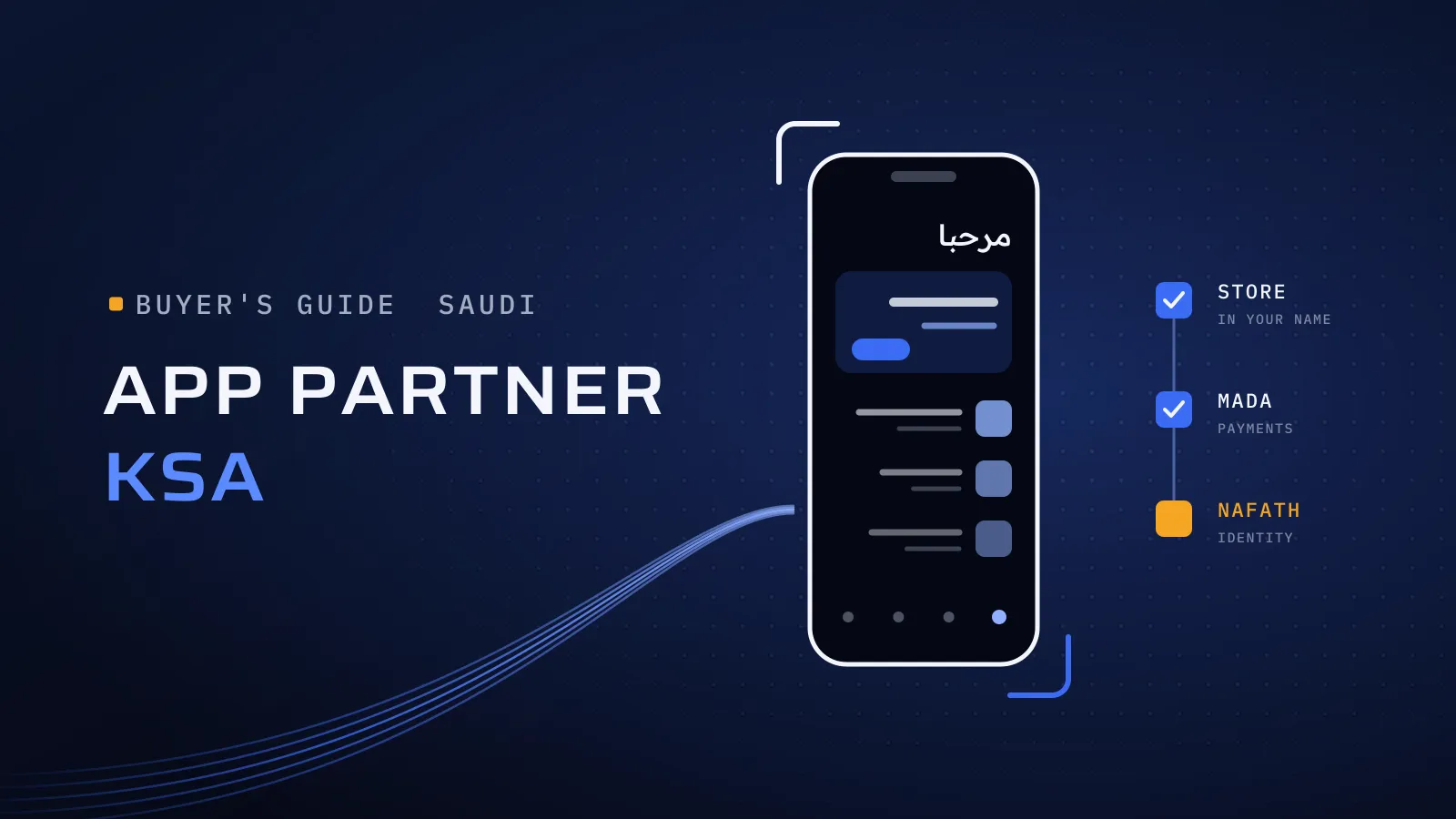
Search for app development companies in Saudi Arabia and page one is mostly ranked lists. None of them can tell you which company fits your app. Make one choice first: a studio in Riyadh or Jeddah, a GCC partner on the Saudi working week, or a remote team further away. Then check every company the same way: apps live in the stores, store accounts in your name, Arabic designed first, Saudi payments, Nafath where you need it, and where your users’ data lives under the PDPL.
How do you compare app development companies in Saudi Arabia?
Quick answer: Pick the kind of partner, then run the same checks on every name. A studio in Riyadh or Jeddah fits when you want the team in your office often, or your procurement asks for a company registered in the Kingdom. A GCC partner that works Sunday to Thursday gives you Arabic speakers on Saudi hours, with the contract signed elsewhere in the Gulf. A remote team further away can suit a clearly written build, if someone on your side manages the work across time zones. Then ask every company for apps live in the stores, store accounts in your company’s name, Arabic screens designed first, mada and Apple Pay through a gateway licensed by the Saudi Central Bank, Nafath sign-in where you need it, and a written answer on where your users’ personal data is stored.
Comparing app companies for a Saudi launch? Book a free consultation about your app → or send us the proposal you received →
What a wrong pick costs you
The problems show after signing. The app sits in the agency’s store account, so every update waits for them. Arabic was translated at the end, so labels overflow and screens still read left to right. Checkout takes international cards but not mada, the national payment network. The database sits in a region nobody chose, and your legal team asks about it just before launch. Each one means a rebuild or a delay, and each could have been caught with one question before the contract.
Riyadh studio, GCC partner or remote team: the decision table
Riyadh or Jeddah changes little for an app; the city matters only if you want people at your office.
| Studio in Riyadh or Jeddah | GCC partner on the Saudi week | Remote team further away | |
|---|---|---|---|
| Fits when | You want the team in your office often, or your procurement asks for a company registered in the Kingdom | You want Arabic speakers on Saudi hours, with video calls and visits when they matter | The scope is written and stable, and someone on your side manages the work |
| Working week | Sunday to Thursday | Sunday to Thursday, if the team works it: ask | Often Monday to Friday, so four shared working days |
| Meeting in person | Easy | Planned visits | Rare |
| Arabic-first design | Common, but see the Arabic screens | Ask who designs and tests the Arabic screens | Ask who designs and tests the Arabic screens |
| Who signs the contract | A company in the Kingdom | A company in another Gulf country: check which one, and under which law | A company abroad: check which one, and under which law |
| Ask about | Who builds: their own team, or work passed to others | Where the team sits, and whether you meet the people who build | Shared hours, who manages, and who signs off the Arabic |
How to read it: choose the column first, then score the companies inside it with the checks below, starting with the live app that already runs mada, Apple Pay or Nafath. A local studio isn’t Arabic-first by default, and a remote team isn’t wrong by default; the checks show which is which. If you buy for a government entity, your procurement rules decide who may bid, so read them before you build a shortlist. For a weighted way to score the names, our Dubai scorecard works for Saudi companies too, with the Saudi rows below added. If you are also weighing developers who join your own team, or a freelancer, see company, team or freelancer.
Six checks for every company on your list
| Check | What to ask | A good answer |
|---|---|---|
| Apps in the stores | Links to apps they built that are live on the App Store and Google Play, and which parts they built | Apps you can download today and use in Arabic, and a client who will take your call |
| Store accounts | Whose name the Apple and Google developer accounts will be in | Your company’s, enrolled as an organisation, with the developer invited as a user. Both stores ask organisations for a D-U-N-S number, so request yours early |
| Arabic first | Who designs the Arabic screens, and can you see some | Arabic designed first and right to left, checked by native speakers, with English alongside |
| Saudi payments | Which gateway they would use, and which live apps already run it | A gateway licensed by SAMA, with mada cards, Apple Pay and credit cards, plus the STC Bank wallet (formerly stc pay) if your customers ask; prices in riyals; a refund tested on each method |
| Nafath sign-in | Whether your app needs it, and how access is obtained | Used where the app must know who the user is; access requested through the official channel, in your organisation’s name; a fallback for users without Nafath |
| Testing and launch | Who tests, on which phones, and who handles store review | A tester who doesn’t write the code, real phones, and both store submissions in the quote |
Sources: SAMA licenses payment service providers (SAMA rulebook, Article 6); mada is owned by the Saudi Central Bank and works online and with Apple Pay (SAMA); stc pay is now STC Bank, licensed by SAMA (STC Bank); Nafath, the national sign-in that SDAIA develops and runs, verifies identities for government and private digital services (Saudi Press Agency); the D-U-N-S rule (Apple, Google Play).
Saudi data rules: the PDPL rows
Saudi Arabia’s Personal Data Protection Law (PDPL) came into force on 14 September 2023, and SDAIA, the Saudi Data and AI Authority, is the authority that supervises it. SDAIA’s guide makes two points that matter when you hire an app company: the law covers the personal data of people in the Kingdom even when a party outside the Kingdom processes it, and data stored on a cloud abroad is still covered (SDAIA’s guide for controllers and processors). Add these rows to your checklist, and let your legal team sign off.
| Row | What to settle with the company |
|---|---|
| Who is responsible | You decide what the app collects and why, so you are the controller. A developer that handles the data for you is a processor, and you must make sure it complies. Ask which users’ data their team will see, and from which country. |
| Where data lives | The region of the database, backups, files, logs, crash reports and analytics. Transfers outside the Kingdom carry extra requirements (SDAIA’s PDPL handbook), so decide hosting before the build. |
| The data list | Every personal-data field, why it is collected and how long it is kept. Your record of processing activities starts from this list. |
| Test data | Developers work on test data, and access to real users’ data is limited and logged. |
| Breaches | How they tell you about a breach, so you can notify SDAIA and the users affected where the PDPL requires it. |
| Your sector | Health and finance apps follow their sector’s data rules as well as the PDPL. |
Comparing proposals from Riyadh, Jeddah or abroad? Send us the one you received, with anything confidential removed. We reply with the questions to ask, starting with store accounts, payments and where the data lives, and what we would change before you sign. Send us the proposal →
How to compare app quotes line by line
Two quotes for “the same app” often price two different apps. Make them comparable:
- Send every company the same one-page brief: who uses the app, the main journeys, Arabic and English, payments, Nafath, the admin panel, the systems it connects to, and where data must live.
- Ask for each quote split by phase (discovery, design, build, testing, launch, support) and by role (delivery lead, designer, mobile and back-end developers, tester).
- Check each quote against these lines.
| Line | What it should say |
|---|---|
| Back end and admin panel | The server, the database and the dashboard your team uses, not only the app screens |
| Arabic | Arabic designed and tested, not “translation” as one line |
| Payments | The gateway named, each method listed, refunds included |
| Nafath | In or out, in writing, and who applies for access |
| Testing | A tester who isn’t the developer, and the phones named |
| Store launch | Both submissions, and fixes after store review |
| Running costs | Store memberships, hosting, gateway fees, SMS and maps, listed apart from the build, with who pays each supplier |
A quote that leaves a line out isn’t cheaper; it prices a smaller app. Our mobile app cost guide shows the roles and phases behind an app price, and a Saudi app is built from the same parts.
Contract and handover: the checklist
- The code sits in a repository in your company’s account from the first day, not handed over at the end.
- Store accounts, domain, cloud account, gateway merchant account, Apple Pay merchant ID and push-notification keys are in your company’s name.
- The contract says who owns the code and the designs, and from when.
- Design files and technical notes come with each release.
- Payments are tied to things you can test on a phone.
- You know which company signs, where it is registered and which law applies.
- Support after launch is in writing: what is fixed without charge, and how changes are priced.
Red flags
- A portfolio of screenshots with no store links.
- The store accounts would be “easier” in the agency’s name.
- Arabic is a later phase, or a file sent out for translation.
- “We support mada”, with no gateway named.
- No answer on where the data will be stored.
- A fixed price for a scope nobody has written down.
- Developers test their own work, and nobody else does.
- You can’t meet the people who will build your app before you sign.
Where Flojics fits
We are a GCC partner, not a Riyadh studio. Our headquarters at Dubai Digital Park, Dubai Silicon Oasis, holds the contract, and our delivery team works from Egypt, Sunday to Thursday like Saudi Arabia, within an hour of Riyadh time. We have no office in the Kingdom: if you need a team in your Riyadh office every week, a local studio fits better, and we will tell you so.
We build mobile apps in Flutter, React Native, Swift and Kotlin, and the custom software behind them. Native Arabic speakers on our core team check every Arabic screen, independent QA tests each release, and Nafath sign-in and mada checkout are planned in discovery. Our Saudi Arabia page shows what we build for Saudi organisations. Also comparing companies in the UAE? Our comparison of UAE app companies puts eleven side by side without ranking them.
Massart, from our work in Saudi Arabia, is a no-code app builder: businesses build and publish iOS and Android apps without writing code. Talk to the team that built it: book a meeting.
Send us the proposal you received, or your brief
Since 2014 we have worked with more than 100 clients across the UAE, Saudi Arabia, Qatar, Kuwait, the USA and Canada. Send us the app proposal you were given, or the brief you are about to send to companies in Riyadh, Jeddah or abroad.
Send us the proposal you received → or book a free consultation about your app → We reply with the questions to ask and what we would change. We reply by email first and set up a call only if you want one. Asking commits you to nothing.
Frequently asked questions
How do I choose an app development company in Saudi Arabia?
Decide first whether you need a studio in Riyadh or Jeddah, a GCC partner on the Sunday to Thursday week, or a remote team further away. Then ask every company the same six things: apps live in the stores, store accounts in your company's name, Arabic designed first, mada and Apple Pay through a gateway licensed by the Saudi Central Bank, Nafath where you need it, and who tests and launches. Add the PDPL rows on where your users' data lives.
Should I hire an app company in Riyadh or Jeddah, or a remote team?
A local studio fits when you want the team in your office often, or your procurement asks for a company registered in the Kingdom. A GCC partner gives you Arabic speakers on Saudi hours, with the contract signed in another Gulf country. A remote team further away suits a written, stable scope, often with four shared working days a week. Riyadh or Jeddah changes little for the app itself.
Who should own the App Store and Google Play accounts?
Your company, enrolled as an organisation, with the developer invited as a user. Apple and Google ask organisations for a D-U-N-S number, so request yours early. If the app sits in the agency's account, every update waits for them.
Which payment methods should a Saudi app support?
mada cards, Apple Pay and credit cards, plus the STC Bank wallet (formerly stc pay) if your customers ask for it, through a gateway licensed by the Saudi Central Bank (SAMA). Show prices in riyals and test a refund on each method before launch.
Does the Saudi PDPL apply if the app developer is outside Saudi Arabia?
Yes. SDAIA's guide says the PDPL covers the personal data of people in the Kingdom even when a party outside the Kingdom processes it, and data stored on a cloud abroad is still covered. You are the controller and must make sure the developer complies. Transfers outside the Kingdom carry extra requirements, so settle hosting before the build.
How do I compare app development quotes?
Send every company the same one-page brief, ask for each quote split by phase and role, and check that each one covers the back end and admin panel, Arabic, payments, Nafath, testing by someone other than the developer, both store launches and running costs. A quote that leaves a line out prices a smaller app. Send us a proposal you received and we reply with the questions to ask and what we would change.