Software Development Team Structure: The Roles, Who Leads Them, and Which to Keep In-House
Software development team structure for UAE and GCC companies: the roles, who leads the engineers, and which roles to keep in-house or add from outside.
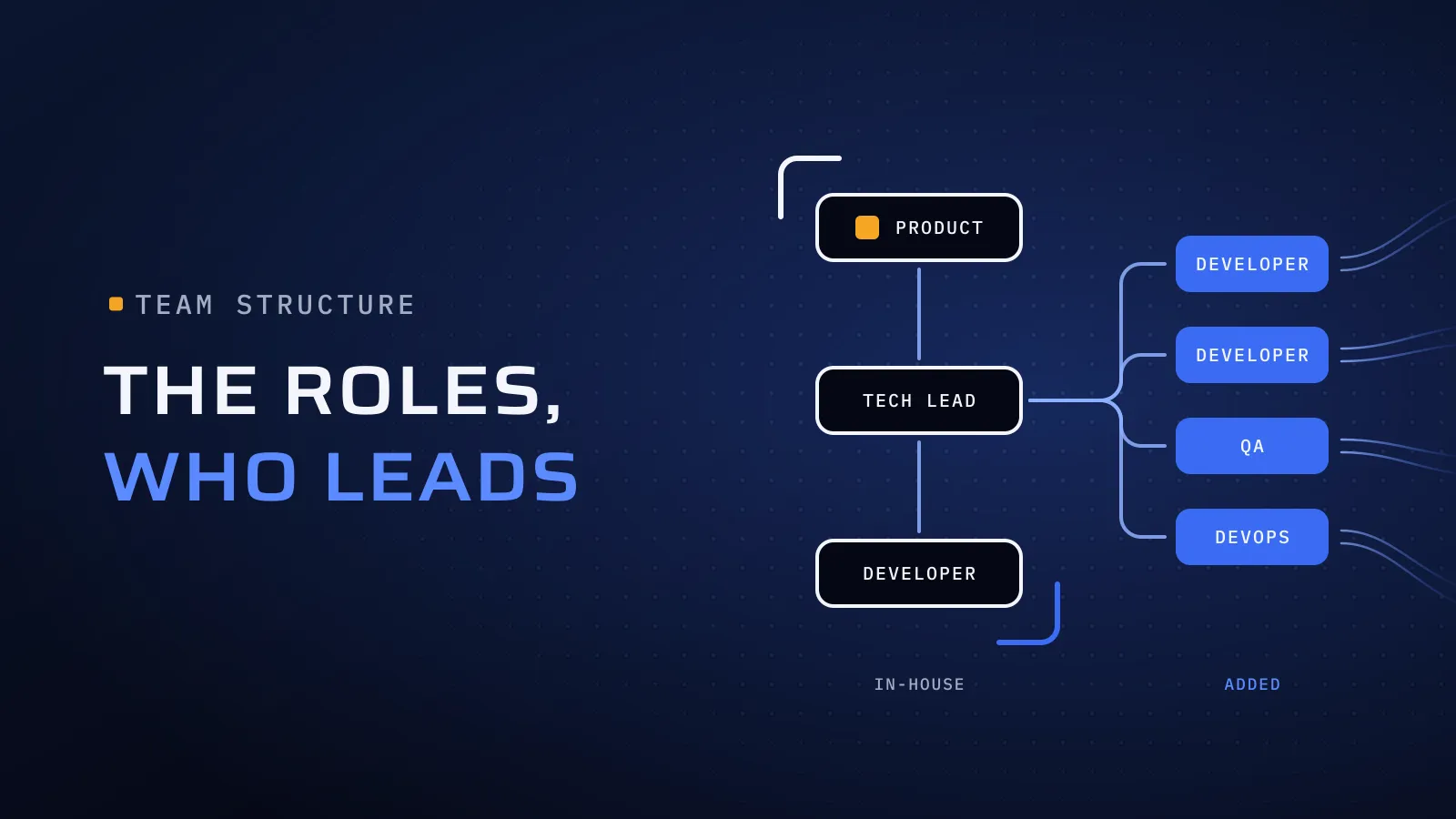
A software development team structure sets who decides what to build, who decides how it is built, and who builds and tests it. Keep the roles that hold your decisions and your business knowledge inside your company, and add delivery capacity and specialist skills from outside when the roadmap needs them.
How should you structure a software development team?
Quick answer: Start from decisions, not job titles. One product owner decides what gets built and in what order. A technical lead, backed by a CTO or CTO as a service, decides how it is built. A project manager or delivery lead owns the dates and raises risks early. Developers build, and QA tests their work as a separate role, so nobody signs off their own code. Keep product ownership, the final technical call, your domain knowledge and security in-house. Add developers, QA, DevOps, designers and phase-only roles from outside.
Know the roles you need? Plan your team in a minute → It turns your choices into a brief you can edit.
What does the wrong structure cost you?
It shows up as weekly friction, not one big failure:
- Nobody owns the decision. Your operations manager asks a developer for one thing, your sales lead for another, and both get built.
- Developers test their own code. The author shares the code’s blind spots, so the same bugs reach your users release after release.
- The lead becomes the bottleneck. Every review and release waits on one person.
- The knowledge sits in one head. When the one developer who understands billing leaves, nobody can change it safely.
Each of these is cheaper to fix in the structure than in the code.
Which roles does a software development team need?
We staff all of these roles, on our projects or in your team. On a small team one person can hold two, with two exceptions: developers are never the only testers of their own work, and the product owner and project manager should be two people, since scope and dates pull against each other.
| Role | What it owns | The sign it’s missing |
|---|---|---|
| Product owner | The vision and requirements: what gets built, in what order, and what “done” means | Features nobody approved |
| Project manager or delivery lead | The dates: planning, tracking, reporting and raising risks early | Dates slip without warning |
| CTO or CTO as a service | Technical direction: architecture, scalability and the calls that are expensive to reverse | Whoever started first chose the stack |
| Technical lead | Complex logic, code review and day-to-day architecture with the developers | Unreviewed code reaches users |
| Developers | Building the features, in iterations you can see and test | Plenty of activity, little working software |
| Independent QA | Testing every scenario and edge case, separate from development | The same bugs keep coming back |
| UI/UX designer | User journeys, wireframes and validated flows, including Arabic right-to-left screens | Screens fixed after launch |
| DevOps engineer | The release pipeline: CI/CD, Docker and Kubernetes | Releases depend on one person’s laptop |
| Business analyst | Turning business rules, often written in Arabic, into user stories | Requirements explained again every sprint |
The Scrum Guide reaches the same split: a Scrum team has three accountabilities, the Product Owner, the Scrum Master and the Developers, and the product owner is “one person, not a committee” (Scrum Guide). Titles differ; ownership shouldn’t.
Who leads the engineers?
Three kinds of decision need three owners. Mix them up, and the tech lead ends up writing the roadmap while a product manager chooses the database.
| Decision | Who leads it |
|---|---|
| What to build, and in what order | The product owner, with one named decision-maker on your side who gives the final yes |
| How it is built | The tech lead day to day; the CTO, or CTO as a service, for the calls that are expensive to reverse |
| People, process and dates | The engineering manager, project manager or delivery lead |
Add people from outside, and the model you choose decides who runs the day-to-day work:
| Model | Who runs the day-to-day work | What stays with you |
|---|---|---|
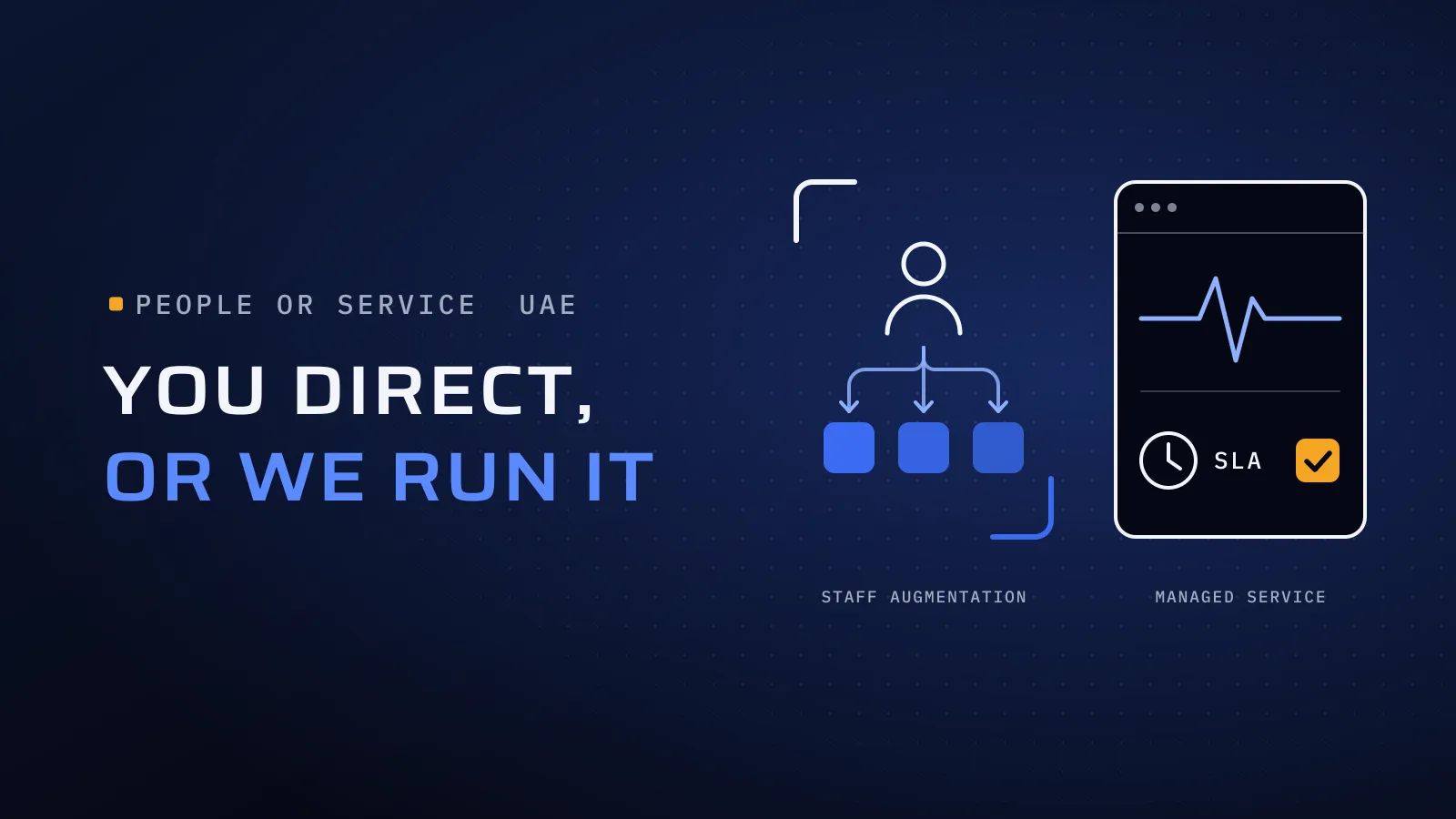
| Staff augmentation | Your own leads: the developers join your stand-ups, tracker and repositories | Every decision above. Our account manager handles contracts, HR, payroll and performance reviews |
| Dedicated team | Shared: our delivery lead runs the team’s process | The product owner, the priorities and accepting the work |
| Project delivery | Flojics: our project manager plans and runs the work | The goal, the scope and accepting each milestone |
| Time and materials | Shared: you set the tasks, we do the work and log the hours | The priorities |
Our engagement models page compares the four. For who decides what on an outsourced build, read product owner vs product manager when you outsource.
Which roles should you keep in-house?
Keep the roles that hold your decisions and your knowledge. Add from outside the roles that add hands, or a skill you need for one stretch of the roadmap:
| Role | Keep in-house when | Add from outside when |
|---|---|---|
| Product owner | Always keep the final say on scope and releases | On a project we deliver, our product owner builds the backlog from your goals and brings every trade-off to you |
| CTO | Software is what you sell, and technical decisions fill a full-time job | You need senior technical judgement before a full-time hire makes sense: CTO as a service |
| Tech lead | Your team is growing on a codebase you own | Your lead has become the bottleneck, or nobody on your side has led the new stack, such as a first Flutter app |
| Developers | They hold the business rules nobody wrote down | The roadmap needs more delivery than your team can give, or a stack you don’t have |
| QA | Your users run acceptance testing (UAT) | You need independent testers or test automation: a dedicated QA team |
| UI/UX design | Brand and product direction | Arabic right-to-left design, or a redesign phase |
| DevOps | Ownership of production access and your cloud accounts | Setting up CI/CD, containers and release pipelines |
| Security owner | Always. In Saudi government entities and critical national infrastructure, the NCA’s Essential Cybersecurity Controls reserve cybersecurity roles for qualified Saudi nationals (NCA) | Developers, QA and DevOps work to the controls your security owner sets |
| Odoo developer or functional consultant (UAE) | You run Odoo every day and change it often | An implementation, an upgrade or a busy stretch after go-live: hiring an Odoo developer in Dubai |
How to read it: if losing the person would take a decision or business knowledge with them, keep the role. If it would only cost you capacity, the role can come from outside, as long as the code and documentation live in your repositories. Hiring the role yourself? See staff augmentation vs in-house in the UAE.
Know which roles you’d add? Send us the roles, stack, seniority and working hours. We source candidates from the market and send profiles with our assessment notes; you interview them and choose who joins. Request developer profiles →
Not ready for a call? Ask for our company profile and we’ll send it to you.
What does the structure look like at each stage?
| Stage | Keep in-house | Add from outside | Who leads the engineers |
|---|---|---|---|
| A first release, with no CTO of your own | One named decision-maker for the product, the budget and the release you accept | The whole build team as a project, with CTO as a service as your technical voice | Our project manager and tech lead, with milestone reviews by you |
| A growing product with your own lead | The product owner, the tech lead or CTO, and the developers who know the domain | Developers, QA, designers or DevOps through staff augmentation, or a dedicated team for a new product line | Your tech lead, or our delivery lead on a dedicated team |
| A company IT team that also runs business systems | The IT lead, who owns systems, access and vendors, and each system’s key users | Developers for internal apps and integrations, QA and, for UAE companies on Odoo, Odoo specialists | Your IT lead |
Moving down the table as you grow is easier when the first stage left the code, the accounts and a written decision log with you.
What changes for a team in the UAE and the Gulf?
- The working week. Most UAE private companies work Monday to Friday; Saudi Arabia, Qatar, Kuwait and Oman work Sunday to Thursday, like our team in Egypt. That gives four shared weekdays with a Dubai office and the whole week with Riyadh, Doha, Kuwait City and Muscat. Plan sprints and demos on the shared days; the hours are in our guide to an offshore development team in Egypt.
- Arabic, by role. The business analyst, the QA engineer who tests right-to-left screens, the front-end developer who builds them and the project manager who reports to Arabic-speaking stakeholders need it. Our guide to Arabic-speaking developers shows how to test it for each role.
- Rules on roles and data. Saudi Arabia’s personal data law limits sending personal data outside the Kingdom, so agree which environments outside developers may reach before the first sprint. Our page for Saudi, Qatari, Kuwaiti and Omani teams covers each country.
How do you plan the team for the year, not just this month?
Plan around the dates you already know:
- A launch or a new product line. Add design and QA before the release, not after the first bug reports.
- The UAE e-invoicing go-live. UAE companies whose ERP must send e-invoices go live in 2027, on a date set by their revenue group; our e-invoicing deadline checker gives yours. Plan the integration and testing capacity before that date.
- Your own busy season. People you add for a sales peak or a tender deadline should join early enough to learn the codebase first.
- After launch. Decide who owns support, maintenance and updates: your team, ours, or both.
You can add or reduce people as your roadmap changes, on the terms in your proposal, and start with one developer before growing into a dedicated team. Plan your team in a minute →
A checklist before anyone joins
- One named decision-maker for the product, known to everyone.
- A written split of who decides what.
- A tech lead with time set aside for code review.
- QA separate from the developers, and testing inside your definition of done.
- Named accounts in your tools, and the code in your repositories from the first commit.
- Arabic written into the brief for the roles that use it.
- A named person to call when someone isn’t the right fit.
- The next role you will add, and the event that triggers it.
How we add people to your structure
Through team extension, we add people to the structure you already have: as a project, as developers who join your team, as hours, or as a dedicated team recruited for you. We source candidates for your roles from the market, and from our core team where one fits. You interview them, can set a technical task and decide who joins. They work in your tools and sprints, while HR, payroll and replacements stay with us.
We recruit developers, QA, DevOps, designers and delivery roles such as tech leads, mid-level to lead. Odoo roles are for UAE companies only. Our core team are native Arabic speakers who work in English.
ButlerFM is facility management software, and our engineers joined ButlerFM’s own team to fill gaps in it. Talk to the team that worked on it: book a meeting.
Plan the structure first, then the people
Write down who decides what, which roles you keep and which you would add, then send us the roles. You contract with Flojics Technology at Dubai Digital Park, and our core team works from Egypt. If your structure needs a hire of your own rather than one of ours, we will say so.
Plan your team in a minute → or request developer profiles → We ask about the roles you need, what your team uses today, your timing and who else should be involved. We reply by email first and set up a call only if you want one. Asking commits you to nothing, and we sign an NDA first if you ask.
Frequently asked questions
What is a typical software development team structure?
A product owner who decides what gets built and in what order, a project manager or delivery lead who owns the dates, a technical lead backed by a CTO or CTO as a service, developers, independent QA and a UI/UX designer. A DevOps engineer and a business analyst join when the release pipeline or the requirements need them. On a small team one person can hold two roles, but developers should never be the only testers of their own work.
Who leads a software development team?
Three kinds of decision need three owners. The product owner decides what to build and in what order. The tech lead, backed by the CTO or CTO as a service, decides how it is built. The engineering manager, project manager or delivery lead runs the people, the process and the dates. One named decision-maker on your side gives the final yes.
Which roles should a company keep in-house?
The roles that hold your decisions and your knowledge: product ownership, the final technical call, the developers who know business rules nobody wrote down, and the security owner. Extra delivery capacity, QA and test automation, DevOps, Arabic right-to-left design and roles needed for one phase can come from outside, as long as the code and documentation live in your repositories.
Who manages developers added from outside?
It depends on the model. With staff augmentation, your own leads do: the developers join your stand-ups, tracker and repositories, and our account manager handles contracts, HR, payroll and performance reviews. With a dedicated team, you set the priorities and accept the work, and our delivery lead runs the team's process. On a project, our project manager runs the work and you accept each milestone.
Should developers test their own code?
Not as the only check. The author of the code shares its blind spots, so the same bugs reach users release after release. Keep QA as a separate role that tests every scenario and edge case, and keep your own users for acceptance testing.
Which roles in a Gulf software team need Arabic?
The roles that use it: the business analyst who reads Arabic requirements, the QA engineer who tests right-to-left screens, the front-end developer who builds them, and the project manager who reports to Arabic-speaking stakeholders. Put Arabic in the brief for those roles, and test it the way each role will use it.