A Dedicated QA Team for Your Product: When Developers Should Stop Testing Their Own Code
A dedicated QA team for UAE and GCC products: when to stop self-testing, manual vs automation, Arabic and RTL checks, release gates and adding testers.
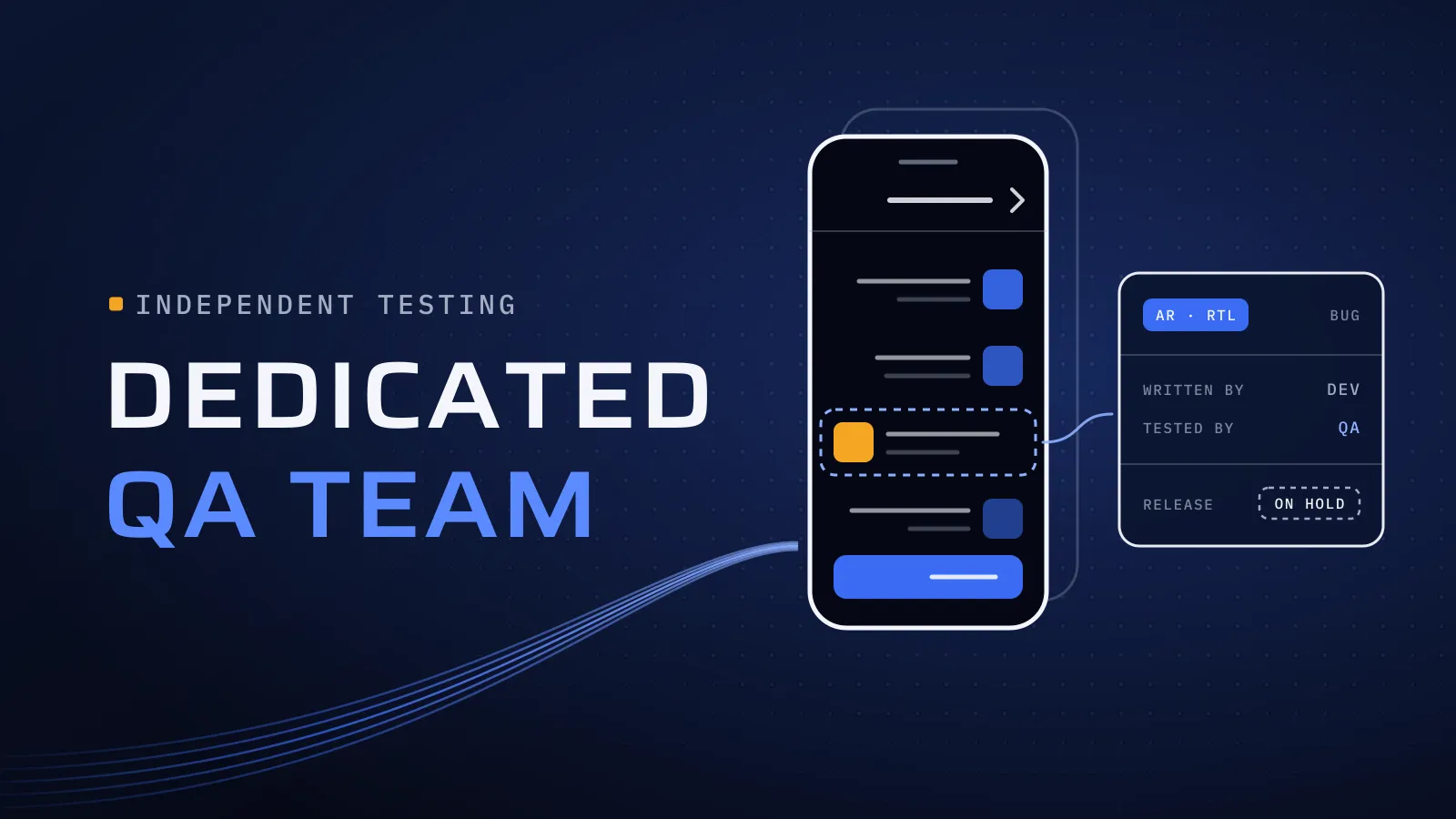
A dedicated QA team becomes urgent the week your customers start finding bugs your developers missed. Developers who test their own code check the path they built, on the phone on their desk, in the language they think in. Your users take every other path, on every other device, and many of them read the screen right to left.
When do you need a dedicated QA team?
Quick answer: When releases slip because developers test their own work, when the same kinds of bug reach UAT or customers release after release, or when your product runs in Arabic and English across many devices. A dedicated QA team tests code its members didn’t write, keeps the test cases up to date and holds the release gate.
Know what you ship and how often? See QA engineer profiles →
What self-testing costs you
Every hour a developer spends testing is an hour not spent on the roadmap, and it is weak testing, because the author of the code shares its blind spots. Regressions slip through: a fix in checkout breaks the Arabic invoice, and nobody looks at the invoice because nobody changed it. Each one comes back as a support ticket, a hotfix and a release your team has to explain. The longer a product runs this way, the more of each sprint goes on fixing last sprint’s bugs.
What a dedicated QA team adds
The principle is simple: the person testing the work did not write it. It is one of the pillars we work by, and it is what a QA team adds to a team of developers. In practice, a dedicated QA team:
- Writes test cases from the acceptance criteria, before or while the feature is built, and keeps them in your tracker as the product changes.
- Explores what the spec forgot: empty states, double taps, a lost connection halfway through a payment, a user with no permission for the screen they reached.
- Runs regression on every release, by hand at first and automated as the core flows settle, so old features keep working when new ones ship.
- Tests on the devices and languages your users have, not the ones the developers carry.
- Holds the release gate, so a release goes out because it meets agreed criteria, not because the sprint ended.
How QA fits into delivery from the first week, and the questions to score a vendor’s process, are in our guide to quality assurance in software development. This article is about adding the people.
Manual or automated: what to test which way
Take this to whoever writes the QA role brief. It shows which work needs a manual tester and which needs an automation engineer.
| Area | Test by hand | Automate | Role it needs |
|---|---|---|---|
| New features | Exploratory testing as each feature lands | Once the feature stops changing | Manual QA |
| Core flows: sign-up, login, checkout, calculations | The first time, and after a redesign | Every build, as a regression suite | Test automation |
| APIs and integrations | Odd cases a contract doesn’t describe | Every endpoint your apps depend on, on every build | Test automation |
| Arabic and right-to-left screens | Read by a native Arabic reader, on real screens | Screenshot comparisons once layouts settle | Manual QA who reads Arabic |
| Devices and OS versions | The key journeys on the devices your users own | Wider device and browser runs | Both |
| Payments and money | Each payment method, refund and failure case in test mode | Amount calculations and totals | Both |
How to read it: if most of your work is new features that change every sprint, start with a manual QA engineer. If regression takes longer with every release, add automation.
Arabic, right-to-left and the devices your users carry
Arabic testing is more than checking the translation. Layouts mirror, English names and numbers sit inside Arabic sentences, and Arabic has to come out right in PDFs, emails and text messages as well as on screen. A tester who reads Arabic as a native notices a label that is correct but reads badly, which no automated check will flag.
For devices, take the list from your own analytics, not from a guess: the phones, OS versions and browsers your users actually have, plus the smallest screen you support. Agree that list with QA once, and test every release against it.
Release gates: the rule that ships the release
A release gate is a short written rule the QA lead checks before anything goes live. A typical gate:
- Every test case for the new features has passed, or has a known issue you accepted in writing.
- The regression suite passes on the agreed devices and browsers.
- No open blocker or critical bug.
- Arabic and English checked end to end on the changed screens.
- The product owner signs the go or no-go.
The gate is yours to set; the dedicated QA team holds it, release after release, so the decision rests on evidence rather than on the sprint calendar.
Send us your release cycle. Tell us your stack (web, mobile, API), how often you release, the devices and languages you support and who tests today. We reply with the QA roles we would add and what each would own first. See QA engineer profiles →
Not ready for a call? Ask for our company profile and we’ll send it to you.
How to add QA engineers through team extension
- Your brief. Manual QA, test automation for web, mobile and API, or both. Add your tools, your devices, the languages you support and whether Arabic is needed.
- We source, you choose. We source candidates from the market, and from our core team where one fits. Each has a technical interview with a senior Flojics engineer, a practical assessment relevant to the role and an English check, plus Arabic where your product needs it. You interview the shortlist, can set your own task, such as a build with known bugs to find, and approve each person. Our checklist on how to vet dedicated developers works for testers too.
- Contract, then access. The NDA, master agreement and statement of work come first. Then access to your tools, repositories and channels.
- Into your sprints. Your QA engineers join your stand-ups and demos, write test cases in your tracker and hold the release gate you agree. You get monthly reporting, account manager check-ins and performance reviews, and you can add or reduce testers as your roadmap changes.
Proof: a product where testing carries weight
Sparx is a pharmacy app we built, where users upload prescriptions for a pharmacist to review. Talk to the team that built it: book a meeting.
On every project we run, independent QA is a dedicated testing and quality assurance process, separate from development. Transparent delivery sits beside it: clear milestones, reporting and communication, so you see what was tested, not only that it passed. When our QA engineers join your team instead, your leads run the process, and the same principle comes with them.
Give your releases a tester who didn’t write the code
Since 2014 we have worked with more than 100 clients across the UAE, Saudi Arabia, Qatar, Kuwait, the USA and Canada. See how staff augmentation in the UAE adds QA engineers to your team, or staff augmentation for Saudi Arabia, Qatar and Kuwait on the Sunday-to-Thursday week.
See QA engineer profiles → We ask about your goal, what you use today, your timing and who else should be involved. You leave with clear next steps. The call commits you to nothing, and we sign an NDA first if you want one.
Frequently asked questions
Manual QA or test automation: which do we need first?
Manual QA first if you have no written test cases yet, or the product changes every week. Automation once the core flows are stable, so they are checked on every build. Most teams need both in time, and the role brief can ask for a tester who starts manual and automates as the flows settle.
Do QA engineers from Flojics work in our tools and process?
Yes. On staff augmentation they join your stand-ups, tracker and priorities, and your leads direct the work. Test cases, bug reports and automation code live in your tools and repositories.
Can your QA engineers test Arabic screens?
Our core team are native Arabic speakers who work in English. When we recruit for your team, Arabic goes into the brief if your product needs it, our screening checks it, and you can test it again in your own interview.
Can we add QA for one release only?
Yes. For testing around a single release, time and materials from our core team works: you choose the tasks and pay for the hours used. Staff augmentation fits when you want testers inside your team month after month.
Who owns the test cases and automation code?
You do. They sit in your tools and repositories from the first day, and the code and IP pass to your company at the end of the contract term or project, once it is completed and paid.