Quality Assurance in Software Development: Few Issues in UAT, Almost None in Production
Quality assurance in software development from day one: what independent QA gives you, how it keeps issues out of production, and a QA scorecard for any team.
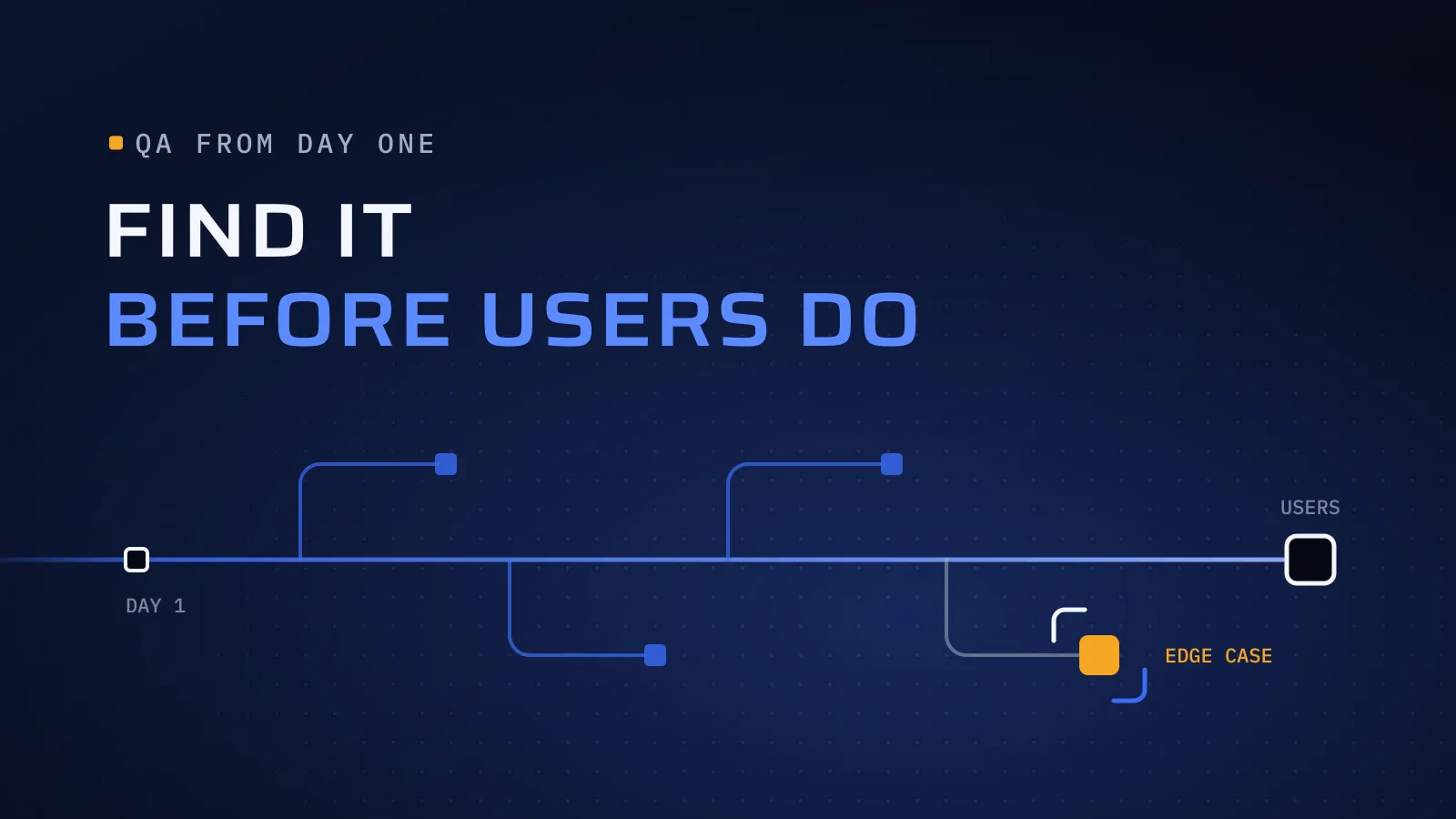
Quality assurance in software development decides how your go-live feels: a short UAT with few issues and a quiet first week, or weeks of defect lists and urgent fixes. Independent QA that starts on day one is how we aim for the first: very few issues in UAT, and almost none in production.
What does independent QA give you?
A tester who didn’t write the code, working from week one. They review your requirements, agree acceptance criteria with you, keep a list of what would hurt you most, and test each feature in the same cycle it is built. By UAT, your users confirm the product instead of hunting for bugs, and go-live is a decision you sign.
Planning a launch or a big release? Talk to us about QA for your project →
When testing waits for the end, issues are found where they cost most. In UAT, your business users log defects for weeks, and many turn out to be requirements nobody pinned down. After go-live, your customers find the rest, and each one costs a support call, an urgent fix and some trust. The same issue caught in a requirement costs a sentence.
How independent QA keeps issues out of production
- Week one: a requirements review. Before any code, the tester reads every feature and asks what is missing. Who is allowed to do this? What if they do it twice? What does the screen show before there is any data? Each answer goes into the spec, or to your Product Owner as a question.
- Acceptance criteria you sign. Every feature gets testable conditions. For example: when a customer cancels a paid booking before a provider accepts it, the full amount goes back to the original card and both sides are notified. Then the tester asks what happens if the provider accepts in the same second.
- A risk list. No team can test everything, so we list what would hurt you most, such as wrong amounts, one customer seeing another’s data, or an app store rejection in launch week. Each item gets a test and an owner, and the list decides where testing time goes.
- Testing in the same cycle. Each feature is tested as it is built. Repeated checks on core flows, such as sign-up, payments and calculations, are automated and run on every build. People handle exploratory testing, real devices and Arabic screens, read by an Arabic speaker.
- UAT and a signed release. UAT scripts are written with your users, so UAT confirms instead of discovers. A release checklist covers features, devices, payments, data migrations and a rollback plan, and you make the go or no-go call.
Independent doesn’t mean distant. Testers join the same planning sessions and demos as the developers, and developers still own their unit tests.
The cases that catch Gulf products out. Arabic right-to-left screens with English names and numbers inside them. Currencies with three decimal places, such as the Kuwaiti dinar. Customers in the US or Canada, whose clocks change twice a year while the UAE’s don’t. Field apps that lose signal halfway through a form. A good tester names the ones that apply to your app before you ask.
A QA scorecard for any team, including ours
Ask these before you sign. Each good answer means fewer issues waiting for you in UAT.
| Ask | A good answer | A warning sign |
|---|---|---|
| When does QA join? | In week one, reviewing requirements | “Once there’s something to test” |
| Is QA separate from development? | Yes: testers don’t test their own code | Developers test their own work |
| Who writes and signs the acceptance criteria? | QA and the Product Owner write them, and you sign | “The developers know what you mean” |
| Can we see the risk list? | Yes, with a test and an owner for each item | There isn’t one |
| What is automated? | Core flows, calculations and checks after every deploy | “Everything”, or “nothing” |
| Which devices and languages are tested? | An agreed list, with Arabic and English end to end | “The usual ones” |
| Who writes the UAT scripts? | QA, with your business users | Your users click around |
| What must be true before release? | A signed checklist and a rollback plan | “We’ll fix it after launch” |
Talk to us about QA for your project
Tell us what you are building, or what went wrong in your last UAT. We reply with how we would test it and what we would check first.
Talk to us about QA for your project → · Not ready for a call? Ask for our company profile and we’ll send it to you.
Where the testing time goes on a real app
Zidly, a tipping and donations app we built for Kuwait, shows where a tester spends the time. Customers scan a code and choose who gets the money: one employee, a whole team or a community case, and money sent to a team is shared among its members. Amounts are in Kuwaiti dinars, with three decimal places. So the rounding rule for a team split belongs in the acceptance criteria before anyone codes it, and the tester checks that every share adds back up to the total. Money flows like this go first on the risk list.
Independent QA is one of the principles we work by: a dedicated testing and quality assurance process, from the first week through launch and support. It sits alongside transparent delivery, with clear milestones, reporting and communication, so you see the test plan and the release checklist, not just the result. For the contract side of UAT, such as change control and sign-off, see software delivery governance.
Testers work with anonymised or made-up data. We design for UAE PDPL, Saudi PDPL and PIPEDA, and agree data rules with you before access.
Since 2014 we have delivered software for more than 100 clients in the UAE, Saudi Arabia, Qatar, Kuwait, the USA and Canada, from our headquarters at Dubai Digital Park in Dubai Silicon Oasis and our offices in Houston and Alexandria. Already have developers and need testers? Team extension adds QA engineers to your own team.
Want few issues in UAT and almost none in production? Talk to us about QA for your project. We ask about your goal, what you use today, your timing and who else should be involved. You leave with clear next steps. The call commits you to nothing, and we sign an NDA first if you want one.
Frequently asked questions
Does independent QA add cost?
It adds tester time from the first sprint, agreed in your proposal. That time goes where fixes are cheapest, into requirements and builds still in progress, so less of your budget, and less of your users' patience, goes on long UAT rounds and urgent fixes after launch.
Will QA slow my project down?
No. Testers work in the same cycle as the developers, so each feature is tested as it is built, not in a separate phase at the end. The release checklist adds a short go or no-go step, and that step is what keeps launch week quiet.
Can you promise zero bugs in production?
No honest team can, because real users and live data always find something new. Our aim is very few issues in UAT and almost none in production. When one gets through, it is fixed under the support plan, the rollback plan is ready if it is needed, and a test is added so the same issue is caught next time.
Do testers work with our real customer data?
Not by default. Testers work with anonymised or made-up test data, and production personal data stays in your environment. We design for UAE PDPL, Saudi PDPL and PIPEDA, and agree data rules with you before anyone has access.
We already have developers. Can you add QA only?
Yes. With staff augmentation, QA engineers you choose from our shortlist join your team for manual testing and test automation on web, mobile and API, inside your own process. For QA around a single release, time and materials works too.
Who decides when we release?
You do. QA brings a release checklist with every feature checked against its acceptance criteria and every high risk tested or accepted by you in writing. You make the go or no-go call with the full picture in front of you.