Software, App and Website Projects in Oman: A Buyer's Guide for Muscat Companies
Choosing a software company in Oman for an app, website or online store: scope it, compare a Muscat studio, a Dubai partner or a freelancer, and what to check.
Choosing a software company in Oman goes faster when the project is written down before the first call. A one-page brief makes the quotes comparable, whether they come from a studio in Muscat, a partner in Dubai or a freelancer. It also puts Arabic, payments and the e-commerce licence on the plan from the start, instead of at launch.
How do you choose a software company in Oman?
Quick answer: Write a one-page brief first: the goal, the users, the platforms, Arabic and English, payments and the systems it must connect to. Send the same brief to a Muscat studio, a Dubai partner and, for a small job, a freelancer. Compare who builds it, the hours you share and how each one splits the work into phases, and ask each to show live work in Arabic. For an online store, apply for the e-commerce licence and open the payment gateway account while the store is being built, not after.
Ready to compare? Send us your brief → or send us the proposal you received →
What a vague brief costs you
Three companies read a vague brief three ways: one prices a template website, another a custom platform, the third a guess. The quotes can’t be compared, and the gaps come back as change requests. Arabic added after the English version means revisiting every screen. And a store whose licence and gateway wait until the build is done can’t take its first payment.
Scope the project before you ask for quotes
You don’t need a technical specification, only answers to the questions every company will ask, written once and sent to all of them.
| Write down | Example | Why it matters |
|---|---|---|
| The goal | Take orders online across Oman, instead of on WhatsApp | Sets what the first release must do, and what can wait |
| Who uses it | Customers, your staff, drivers, an admin | Each user role adds its own screens and permissions |
| Platforms | A website, iPhone and Android apps, an admin panel | Decides the team, and whether one codebase can serve both apps |
| Languages | Arabic and English, and which one leads | Right-to-left layout is planned in the design, not added later |
| Payments | Cards, wallets, cash on delivery, refunds | Decides the gateway and the tests for failed payments |
| Connections | Your accounting system, a courier, SMS, maps | Each connection is its own piece of work and its own test |
| Content | Who writes the Arabic and English text, who loads the products | Late content is a common reason a finished site waits |
| Accounts | Domain, hosting, store and gateway accounts | In your company’s name from day one; slow to move after launch |
| After launch | Who fixes, updates and adds features | Support is its own agreement; price it with the build |
No answers yet? A short discovery phase produces them; our guide to software product discovery shows what it covers.
A Muscat studio, a Dubai partner or a freelancer: how they compare
Each fits a different project. This table compares them; it doesn’t rank them.
| Studio in Muscat | Partner in Dubai, working remotely | Freelancer | |
|---|---|---|---|
| Meetings | In person, at your office | Online; travel only if agreed | Online, usually |
| Clock and week | Yours | The same clock as Muscat (UTC+4). Ask which week its team works: a team in Egypt works Sunday to Thursday, like you | Depends on where they live |
| Who builds it | Ask: their own team, or passed to another one | Ask: where each person works and who leads | One person |
| Roles you get | Depends on size: check design, testing and project management are covered | Usually a full team: design, developers, QA and a delivery lead | One or two skills; you add the rest |
| Local know-how | Omani gateways, licences and suppliers, first hand | Ask what it has connected for Omani clients, and how it checks the rest | Varies |
| Fits when | You want face-to-face meetings, or the work needs someone on site | You want a full team on your clock and are happy with video calls | A small, well-defined job you can check yourself |
| Watch for | A team too small for an app plus a back end | Who answers for the team in your hours | The work stops if they become unavailable |
How to read it: start from the “Fits when” row, then check the rows you can’t compromise on. Arabic belongs in every column: ask all three for live work in Arabic. Our guide to hiring app developers compares a company, added developers and freelancers in more depth.
Comparing partners now? Send us the brief; we reply with the phases, the team and the price. Send us your brief →
Not ready for a call? Ask for our company profile and we’ll send it to you.
Questions to ask every company on your shortlist
- Who will build it, and where does each person work? Names and roles, not only a sales contact.
- Can you show two live projects in Arabic? Switch them to Arabic yourself: the layout should mirror and forms should accept Arabic.
- Which payment gateways have you connected? And how do you test a failed payment and a refund?
- How do you split the work into phases, and what does each phase deliver? A quote that lists phases, roles and assumptions can be compared; a single figure can’t.
- Who tests, and when? Someone other than the developer, before each release.
- Whose name are the accounts in? The domain, hosting, store and gateway accounts should be your company’s.
- What happens after launch? Who fixes a bug on a Thursday evening, and how support is priced.
- What do you need from us, and when? A good partner asks for decisions, content and testing time, with dates.
Our weighted scorecard for choosing a software company turns the answers into a score you can compare.
Already holding a proposal? Send it to us with anything confidential removed. We reply with the questions to ask and what we would change before you sign. Send us the proposal →
What drives the cost of a project in Oman
Price follows scope, so the same brief to every company is the only fair comparison. These make a project bigger:
- User roles: a customer app alone is smaller than a customer app, a driver app and an admin panel.
- Platforms: the website, the apps and the admin panel each add work; one cross-platform codebase for both apps keeps it down.
- Two languages: two sets of content, mirrored layouts and testing in both.
- Payments: each method, refunds, partial payments and failed payments add tests.
- Connections: accounting, couriers, SMS, maps and any bank or government service.
- Design: a template adapted to your brand, or custom design for every screen.
- Content and data: writing, translating, loading products and moving old records.
- After launch: support, updates and new features.
Our guides to mobile app cost, website design cost and custom software cost set out the team and phases behind each type.
Arabic and right to left: plan it on day one
A website or app for customers in Oman usually needs Arabic and English. Decide these before design starts:
- What mirrors: menus, back arrows and progress steps flip; logos and phone numbers don’t.
- Content: Arabic written for Arabic readers and checked by a native speaker, not machine translation.
- Mixed text: product names, emails and codes in Latin letters must read in the right order inside an Arabic sentence.
- Numbers and prices: choose Western or Arabic-Indic digits, and show prices in rials with three decimals, since a rial has 1,000 baisa.
- Search: Arabic search that matches spelling variants, such as أ and ا, or ة and ه.
- Google: each language on its own URL, linked with hreflang, so an Arabic search finds the Arabic page.
Our guide to Arabic app development and right-to-left layouts goes screen by screen.
Online stores in Oman: licence, payments and invoices
Three items sit with you, not the developer, and a finished store can wait on any of them:
- The e-commerce licence. The Ministry of Commerce, Industry and Investment Promotion licenses e-commerce. The Oman government portal lists the online application for commercial companies and for freelancers. Apply while the store is being built, and check the current conditions on the portal.
- The payment gateway. Choose it early: it decides which cards and wallets customers can use. Open the merchant account in your company’s name, and before launch test a failed payment, a refund and a cancelled order.
- Invoices. The Oman Tax Authority is introducing e-invoicing (Fawtara) in phases: selected large taxpayers first, then more medium and large companies, then SMEs, then every VAT-registered business. Invoices go out in approved formats through an approved service provider or a compatible ERP. The page lists no dates yet: check it for your phase, and make sure store orders reach your accounting system.
Customer data matters too. Oman’s Personal Data Protection Law, issued by Royal Decree 6/2022, and its executive regulations are overseen by the Ministry of Transport, Communications and Information Technology, which asks for a breach that threatens people’s rights to be reported within 72 hours. Ask your partner where the data is stored, who can reach it and how fast they would tell you about a breach.
What this means for you: put the licence, the gateway account and the Arabic content on the project plan as your own tasks, with dates, next to the developers’ tasks. A developer can’t do them for you, and a finished store can wait on each one.
Working with a Dubai partner from Muscat: hours and week
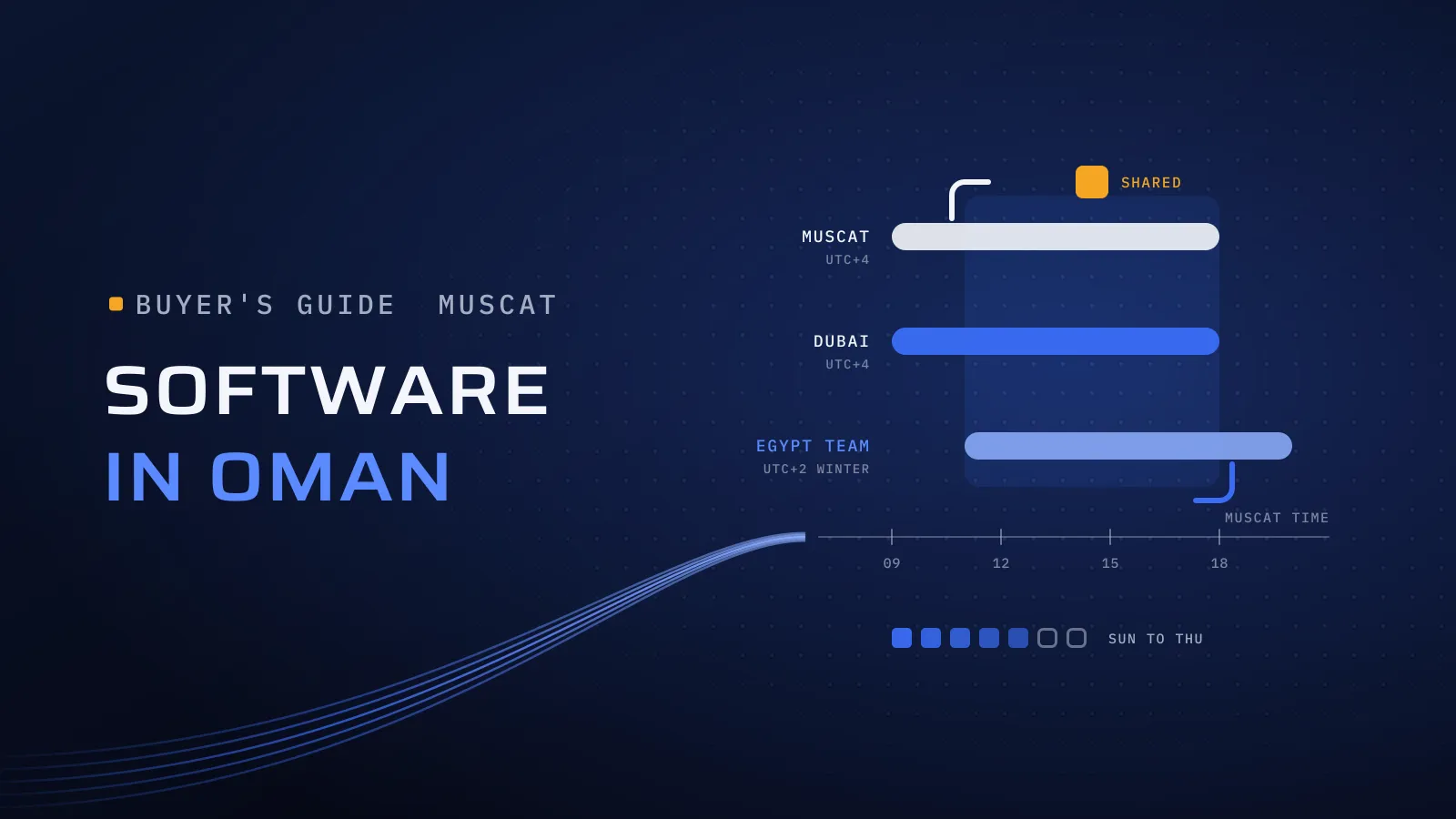
Muscat and Dubai share a clock, UTC+4 all year, and Oman works Sunday to Thursday. A Dubai partner whose team is in Egypt works the same Sunday-to-Thursday week, but Egypt’s clock is behind Muscat’s:
| Season in Egypt | Egypt’s clock | 09:00 to 18:00 in Egypt, in Muscat time | Shared hours in a 09:00 to 18:00 day |
|---|---|---|---|
| Winter (end of October to end of April) | UTC+2, 2 hours behind Muscat | 11:00 to 20:00 | 7, from 11:00 to 18:00 |
| Summer (end of April to end of October) | UTC+3, 1 hour behind Muscat | 10:00 to 19:00 | 8, from 10:00 to 18:00 |
Agree three things in writing before the first sprint: the daily window for questions, the day of the weekly demo, and one named contact who answers in your hours. More on the hours in our guide to an offshore development team in Egypt.
Where Flojics fits
We are headquartered at Dubai Digital Park and serve companies in Oman remotely from there; we have no office in Oman. Our core team works from Egypt, on the same Sunday-to-Thursday week as Oman, and speaks Arabic as a first language. We build mobile apps, websites, online stores and custom software in Arabic and English. Quality built into every step: CTO oversight, independent QA before each release and a dated plan in FloPlan, our own delivery software.
- Qargo is a car rental and ride-hailing platform in Qatar, with apps and dashboards. Talk to the team that built it: book a meeting.
- Abdulhameed Aljasmi Advocates is a law firm with a multilingual website. Talk to the team that built it: book a meeting.
- Mowein is a marketplace app where home-based sellers and small startups sell food, crafts and clothing. Talk to the team that built it: book a meeting.
Send us your one-page brief
Since 2014 we have worked with more than 100 clients across the UAE, Saudi Arabia, Qatar, Kuwait, the USA and Canada. Send the brief from this guide, even half finished: the goal, the users, the platforms, the languages and the payments. We reply with the phases, the team and the price for your project.
Send us your brief → or send us the proposal you received → We reply by email first and set up a call only if you want one. Asking commits you to nothing, and we sign an NDA first if you ask.
Frequently asked questions
Can a Dubai company build our app or website if we are in Oman?
Yes. Muscat and Dubai share a clock (UTC+4), and a team in Egypt works your Sunday-to-Thursday week, with seven to eight shared office hours a day depending on the season. Meetings are online. If you need someone in the room every week, a studio in Muscat fits better; compare both on the same brief.
Do I need a licence to sell online in Oman?
Yes. The Ministry of Commerce, Industry and Investment Promotion licenses e-commerce, and the Oman government portal lists the online application for commercial companies and for freelancers. Apply while the store is being built, and check the current conditions on the portal.
How much does a website or app cost in Oman?
It follows the scope: the user roles, the platforms, Arabic and English, payments, connections to your other systems, the design and the support after launch. Send the same one-page brief to every company so the quotes compare, and ask for the phases and roles behind each figure. Send it to us and we reply with the phases, the team and the price.
Should our website be in Arabic and English?
For customers in Oman, usually yes. Plan both from the first design: the layout mirrors for Arabic, each language has its own written content and its own URL, and prices in rials show three decimals. Arabic added after launch means revisiting every screen.
Does Oman's data protection law affect our app or online store?
If it collects personal data, yes. The Personal Data Protection Law (Royal Decree 6/2022) and its executive regulations are overseen by the Ministry of Transport, Communications and Information Technology, which asks for a breach that threatens people's rights to be reported within 72 hours. Ask your partner where the data is stored and how they would tell you about a breach.
Who should own the domain, hosting and app store accounts?
Your company. Register the domain, the hosting, the App Store and Google Play accounts and the payment gateway in your company's name, and invite the developers as users. Moving an account after launch needs the other side's cooperation.
Does Flojics have an office in Oman?
No. We serve companies in Oman remotely from our headquarters at Dubai Digital Park, and our core team works from Egypt on the Sunday-to-Thursday week. Meetings are online, and we reply by email first.