Software Companies in Kuwait: How to Compare a Local Software House, a Gulf Partner and a Remote Team
Software companies in Kuwait compared: a local software house, a Gulf partner or a remote team, with a decision table, KNET and Arabic checks, and red flags.
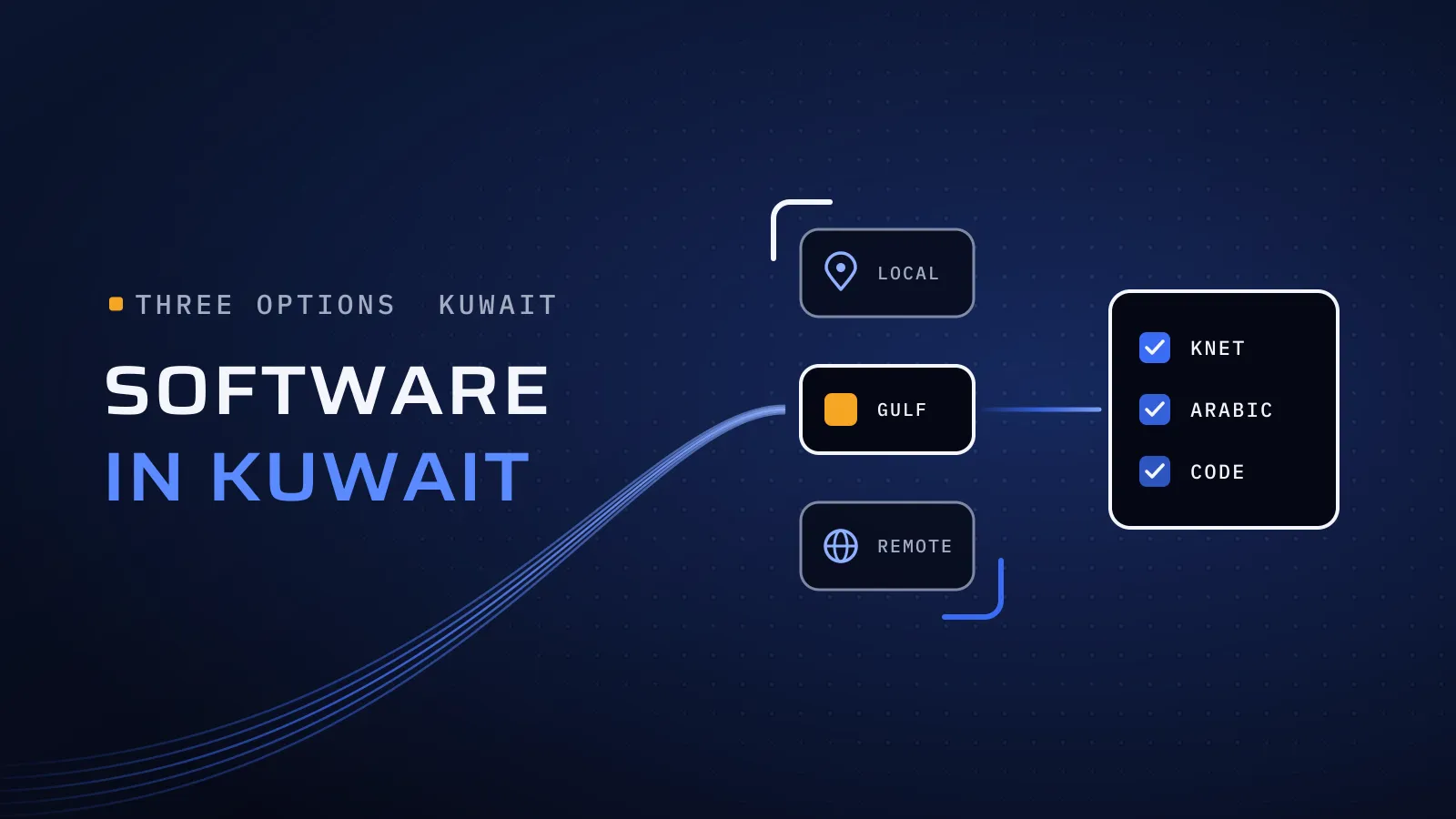
Most searches for software companies in Kuwait, or for a software house or web development company, end on ranked lists, and a list can’t tell you which kind of company fits your project. Decide that first: a local software house you can visit, a Gulf partner that works with you remotely, or a remote team you manage yourself. Then hold every firm on your shortlist to the same evidence: work you can try, code and accounts in your company’s name, Arabic designed from the start, and a KNET checkout tested before launch.
How do you choose between software companies in Kuwait?
Quick answer: Pick the type of company before the name. A local software house suits you when you want meetings in person. A Gulf partner suits you when you want a full team (design, development, independent QA and a delivery lead) on your Sunday to Thursday week, and video calls are enough. A remote team you manage suits a small, clearly defined job that someone on your side can lead. Then ask every firm for live work you can open, the people who will build yours, accounts in your company’s name and a tested KNET checkout.
Planning software for Kuwait? Book a free consultation for an app →, for a web app or system →, or send us the proposal you received →
What a pick from a ranked list costs you
A list doesn’t tell you who will write your code, whether customers can pay with KNET on launch day, or whose account your app sits in. The gaps show later: a checkout that works with a test card and fails on a real KNET payment; an Arabic version that is the English layout with the words swapped; an App Store, repository or gateway account in the agency’s name, so every change goes through them. Each costs a delay, a rebuild or a negotiation, and each could have been checked before you signed.
A local software house, a Gulf partner or a remote team: the decision table
Each fits a different kind of project, from a web app to an online store. The table compares them; it doesn’t rank them.
| Local software house in Kuwait | Gulf partner working remotely | Remote team you manage | |
|---|---|---|---|
| Where the people work | In Kuwait; ask whether the whole build stays there | A head office elsewhere in the Gulf, often with a delivery team in a nearby country | Abroad: an agency, or freelancers you bring together |
| Your week and clock | Yours | Ask: a team that works Sunday to Thursday shares your week | Depends on the country; a Monday to Friday team works your Friday, not your Sunday |
| Contract | With a company registered in Kuwait | With the partner’s company in its own country; ask which entity signs | With an agency abroad, or one agreement per freelancer |
| Roles you get | Depends on its size; check that design, independent QA and project management are covered | Usually a full team: delivery lead, designer, developers, QA and a technical lead | The skills you hire; you add the rest and lead it |
| Kuwait know-how | KNET, three-decimal dinars and local suppliers, first hand | Ask what it has shipped for clients in Kuwait, and try it | Often none: write KNET, dinar amounts and Arabic into the brief |
| Fits when | You want meetings in person, or the work needs someone on site | You want a full team on your week, and video calls are enough | A small, clearly defined job, and someone on your side can lead it |
| Watch for | Work passed to another team without telling you | Who answers for the team during your working day | The work stops when one person leaves |
How to read it: start from the “Fits when” row, then mark the rows you can’t compromise on. Many firms mix columns, such as a local office that sends the build abroad. That is fine if they tell you. We sit in the middle column, so score us on the same rows. Weighing developers inside your own team instead? Our guide to hiring app developers compares a company, your own team and freelancers.
What to check before you sign: the Kuwait checklist
Ask every company on your shortlist the same questions, in writing.
| Check | What a good answer looks like |
|---|---|
| Shipped work you can try | Live apps or web apps you open yourself, with the client named; one already taking payments in Kuwait is the strongest proof |
| Who builds it | Named people and roles, where each one works, and any subcontractor disclosed |
| Code and accounts | The repository, domain, hosting, cloud, app store and payment gateway accounts registered to your company from day one; the developers get access, not ownership |
| Who owns the code | The contract says when the code and IP pass to your company |
| Arabic first | Arabic designed from the first wireframe, right to left, written for Arabic readers and checked by a native speaker. Switch a live product to Arabic yourself |
| KNET through your bank or a licensed provider | KNET takes debit cards issued by banks in Kuwait and doesn’t contract with merchants directly: your company signs up through a local member bank or a payment provider licensed by the Central Bank of Kuwait. The partner builds the checkout on that gateway, verifies every payment on the server, and tests a declined card, a closed page and a refund |
| Three-decimal dinars | Prices, discounts, splits and refunds calculated in fils (1 KWD is 1,000 fils), with a rounding rule agreed |
| Data rules | CITRA has issued a Data Privacy Protection Regulation (Decision No. 26 of 2024); ask your lawyer whether it applies to you. Either way, expect consent screens, access logs, a breach record and a clear answer on where the data is hosted |
| Independent QA | Someone who didn’t write the code tests each release, on real phones, in both languages |
| After launch | Who fixes a bug on a Thursday evening, with support priced as its own line |
Sources, checked on 5 November 2026: KNET’s payment gateway page and its merchant portal; the Central Bank of Kuwait’s e-payment services page; CITRA’s Decision No. 26 of 2024 (in Arabic).
Want a number to compare? Our weighted scorecard for choosing a software company turns these answers into a score.
How to compare quotes from software companies in Kuwait
Two quotes for the same idea often price different projects. A price is a team’s effort across phases, so ask every company for the same breakdown:
| Ask each company | Why it matters |
|---|---|
| Which roles work in each phase (delivery lead, designer, developers, independent QA, technical lead)? | A single total hides the missing role, most often QA or design |
| What does discovery produce? | A written scope, screens and a dated plan protect the rest of the budget |
| Is Arabic designed, written and tested in the quote, or translated at the end? | Arabic added later means revisiting every screen |
| Which gateway is the KNET checkout built on, and are failed payments and refunds tested? | “Payment integration” can mean a button, or a checkout your accountant can reconcile |
| What sits outside the quote? | Hosting, store and gateway fees, paid plugins and content, with who pays each supplier |
| How are changes sized and approved? | Every project changes; this rule matters more than the first total |
What makes a project bigger: more user roles (customer app, provider app, admin dashboard), more platforms (web, iOS, Android), two languages from the first release, payouts as well as payments, each integration, data moved from an old system, and custom design for every screen. The phases stay the same: discovery, design in both languages, build, independent QA, then launch and support.
Our guides to custom software development cost and mobile app development cost show the team and phases behind each type of project. They were written for the UAE, and a quote is built the same way in Kuwait.
Holding two or three quotes? Send them to us with anything confidential removed. We reply with the questions to ask each company and what we would change before you sign. Send us the proposal you received →
Not ready for a call? Ask for our company profile and we’ll send it to you.
Red flags when comparing software houses in Kuwait
- A fixed price after one call, with no questions about your users, payments or Arabic.
- Accounts “set up for you” in the agency’s name: the repository, the app store, the hosting or the gateway.
- Arabic described as “translation”, or planned for after the English version is finished.
- KNET “supported”, with no live example and no plan for testing a failed payment.
- The only people you meet are sellers, and the team is “to be assigned”.
- Pressure to sign before you have read who owns the code.
One flag is a question to ask. Three together are an answer.
What a good start looks like after you sign
A good partner shows how it works before most of the budget is spent. Expect these steps, in this order:
- Accounts in your name. The repository, cloud, app store and gateway test accounts are your company’s, with the team invited as users.
- Discovery you can read. Workshops with your users, the KNET checkout and any payouts mapped step by step, and an owner named for the Arabic content. You get a written scope and a dated plan.
- Designs you try on your phone. Clickable screens in Arabic and English that you approve before the build starts.
- A first working slice. A real feature in a test environment you can open, with a test payment through your gateway.
- A fixed rhythm. A demo on a set day in each sprint, written progress, and a named contact who answers during your working day.
- QA from the first build. Test reports from someone who didn’t write the code, not only at the end.
If one of these is missing, ask why before the next invoice.
Where Flojics fits
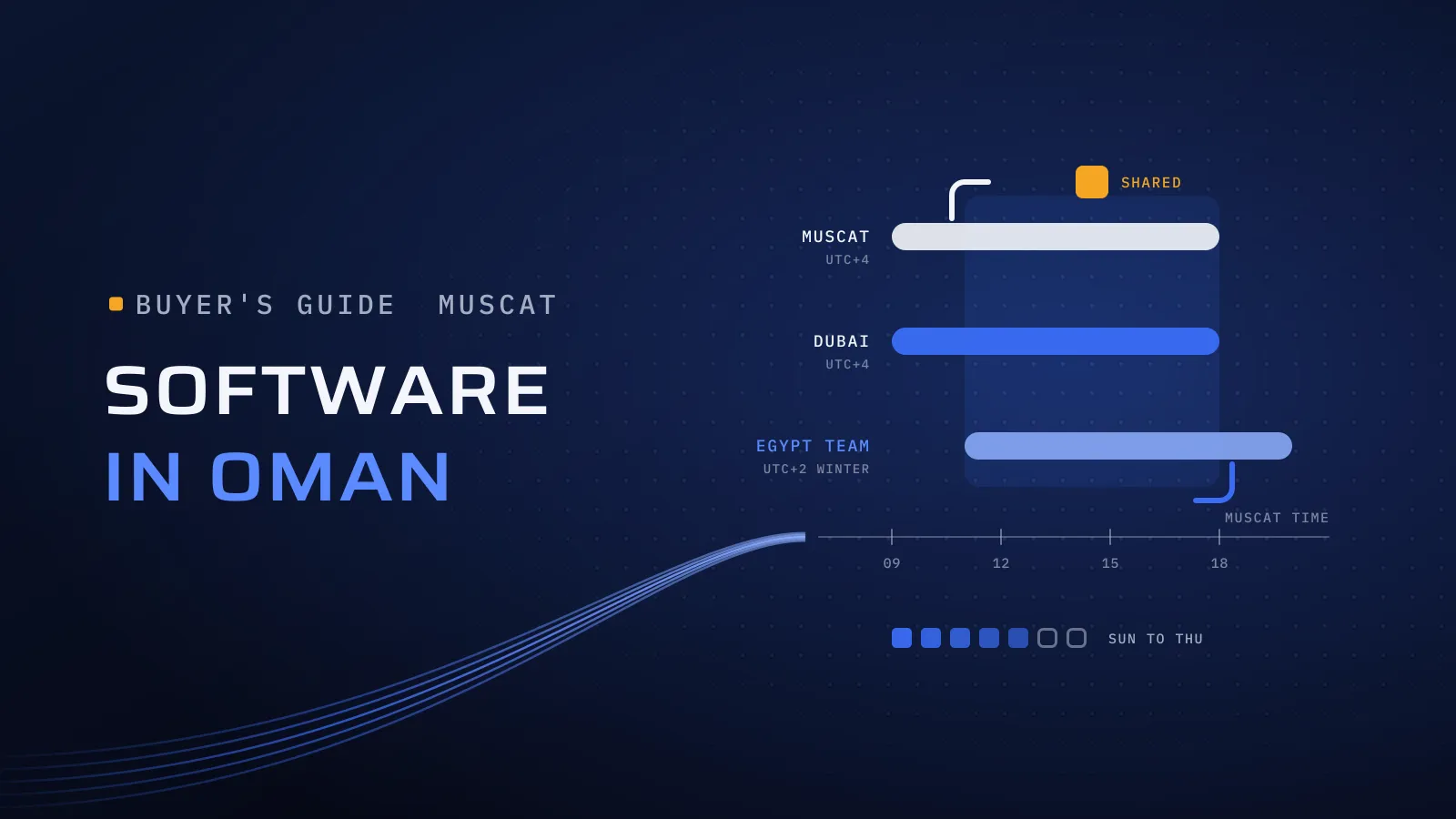
In the table’s terms, we are a Gulf partner. Our headquarters is at Dubai Digital Park, Dubai Silicon Oasis, and our delivery team works from Egypt on the same Sunday to Thursday week as Kuwait City, with no time difference in Egyptian summer time and one hour in winter. We have no office in Kuwait, so meetings are online. We build mobile apps and web apps, dashboards and custom software in Arabic and English, and websites on WordPress or custom code, whichever fits. Native Arabic speakers on our core team check every Arabic screen, and independent QA tests each release. Our page on software and app development for Kuwait covers KNET and dinar amounts; for developers inside your own team, see staff augmentation for Kuwait.
- Zidly is a QR code tipping and donations app: customers scan a code at the venue and choose who gets their tip or donation. Talk to the team that built it: book a meeting.
- Spoiled lets clients book trained beauty specialists to their home and shop for beauty products; we built the app and the admin dashboard that runs it. Talk to the team that built it: book a meeting.
Send us your shortlist question, or the proposal you received
Since 2014 we have worked with more than 100 clients across the UAE, Saudi Arabia, Qatar, Kuwait, the USA and Canada. Tell us what you are building and how your customers will pay, and we reply with the effort, the team and the price. Or send the proposal you are weighing.
Book a free consultation for an app →, for a web app or system →, or send us the proposal you received → For a proposal or a question, we reply by email first and set up a call only if you want one. Asking commits you to nothing, and we sign an NDA first if you ask.
Frequently asked questions
How do I choose a software company in Kuwait?
Decide the type first: a local software house if you want meetings in person, a Gulf partner if you want a full team on your Sunday to Thursday week over video calls, or a remote team you manage for a small, clearly defined job. Then ask every firm for the same evidence: live work you can open, the named people who will build yours, accounts in your company's name, Arabic you can switch to and a KNET checkout tested before launch.
Is a local software house in Kuwait safer than a remote team?
Not by default. A local house gives you meetings in person and a contract with a company registered in Kuwait. What matters more is who actually builds your product, whether their week matches yours, and whether you own the code and the accounts. Ask where each person works, and whether any of the work is passed to another team.
How do KNET payments work in an app or website?
KNET's payment gateway takes debit cards issued by banks in Kuwait. KNET doesn't contract with merchants directly: your company signs up through a local member bank, or through a payment provider licensed by the Central Bank of Kuwait that offers KNET. The developer builds the checkout on that gateway, checks every payment result on the server, and tests a declined card, a page the customer closes and a refund.
How much does software development cost in Kuwait?
It follows the effort of the team: a delivery lead, a UI/UX designer, developers, independent QA and a technical lead, across discovery, design, build, QA and launch. More user roles, more platforms, two languages, payouts, integrations and data migration make it bigger. Send every company the same brief and ask for roles and phases, not one total. Send it to us and we reply with the effort, the team and the price.
Who should own the code and the accounts?
Your company. Keep the repository, the domain, the hosting, the app store accounts and the payment gateway account in your company's name from day one, with the developers invited as users, and make sure the contract says when the code and IP pass to you.
Should our software be in Arabic and English?
For customers in Kuwait, usually yes. Design both from the first wireframe: the layout mirrors for Arabic, the Arabic is written for Arabic readers and checked by a native speaker, and dinar amounts show three decimals. Arabic added after launch means revisiting every screen.
Does Flojics have an office in Kuwait?
No. Our headquarters is at Dubai Digital Park, and our delivery team works from Egypt on the same Sunday to Thursday week as Kuwait City. We work with clients in Kuwait online, and we built Zidly and Spoiled for clients there.