Custom Software Development Cost in the UAE: The Team, the Phases and What Moves Them
Custom software development cost in the UAE: who works in each phase, three sizes of first release, what moves the effort, build vs Odoo, and comparing quotes.
Custom software development cost in the UAE is easiest to control when you measure it the way software is built: which roles work on it, in which phases, and what makes each phase bigger. Know that before you compare quotes, and you can fit the first phase to your budget; skip it, and you end up choosing between quotes that priced different systems.
How much does custom software development cost in the UAE?
Quick answer: The cost follows the effort: the roles on the team and the phases they work through, from discovery to launch. A first release for one workflow needs a small team: a delivery lead, an analyst, a designer, developers and QA. A portal or a core system adds roles, integrations and phases. Rules, integrations, Arabic and data migration move the effort most.
Know what the system must do? Get an estimate for your project →
What a guessed budget costs you
A budget approved before anyone sizes the work usually breaks halfway: the must-haves don’t fit, features are cut mid-build, and you launch half a process that your team still finishes in a spreadsheet. Meanwhile, the manual work carries on every week. A short discovery phase costs far less than approving the wrong number.
Who works on a custom system, phase by phase
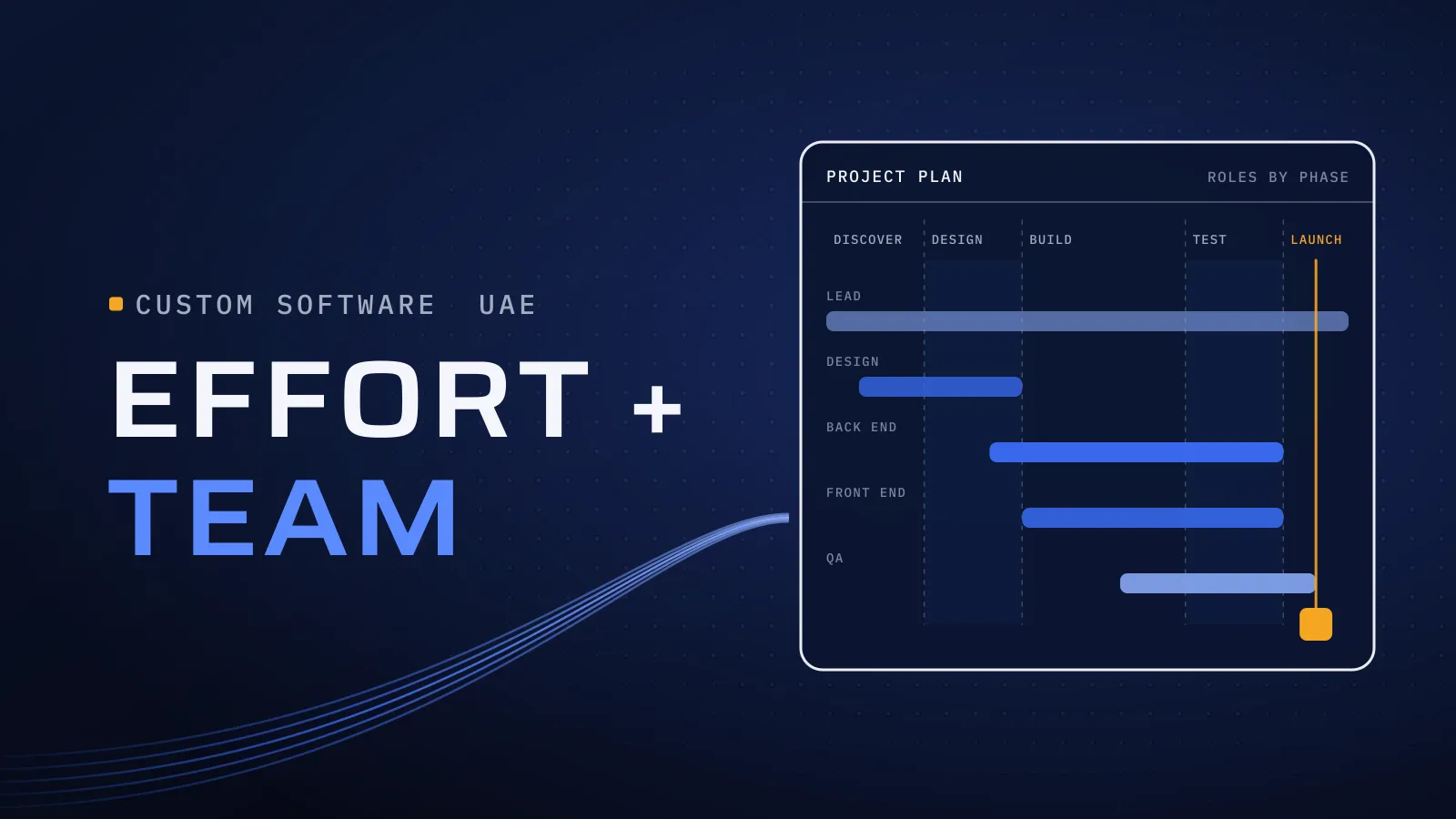
A delivery lead runs the project throughout: the plan, the risks and a weekly report. The other roles join when their phase needs them.
- Discovery. A business analyst maps the process with the people who run it: its rules, roles, reports and connected systems. You get a written scope, a dated phase plan and an estimate that lists its assumptions. Each extra department or connected system adds to what is mapped.
- Design, overlapping the build. Designers turn each role’s main journey into clickable screens, in Arabic and English where users need both, and a technical lead signs off the data model. A change here is quick; after the build, it means rework. Every user role brings its own journeys to design.
- Build in two-week cycles. Back-end developers build the data, rules and integrations; front-end or mobile developers build the screens. Each cycle ends with working software you can try. Rules, exceptions and integrations decide how many cycles it takes.
- Testing in every cycle, then acceptance. A QA engineer, separate from the developers, turns the rules found in discovery into tests. Your team accepts each release on real cases. Every permission and every integration adds tests.
- Launch and run. A DevOps engineer, usually part-time, sets up hosting, backups and monitoring, and the data from the old system is moved in a rehearsed switch-over. After launch, a smaller team handles fixes and changes.
Three sizes of first release, in team and scope
Typical shapes for planning a business system; your team, phases and dates are agreed in your proposal.
| One workflow | A portal or several workflows | A core business system | |
|---|---|---|---|
| Example | Approvals or scheduling now kept in a spreadsheet | Customers or suppliers log in to request, track and download | Several departments or branches, with money and compliance rules |
| Scope | 2 or 3 user roles, web only, one integration at most | 4 to 6 user roles, web and mobile, 2 to 4 integrations | Many user roles, 5 or more integrations, data moved from an old system |
| Team | Developers, with the delivery lead, analyst, designer and QA part-time | Delivery lead, analyst, designer, back-end and front-end or mobile developers, QA; DevOps part-time | Delivery lead, analysts and designers by area, back-end and front-end teams, dedicated QA, DevOps |
| How it ships | One release, then changes as your team uses it | The main journeys first, then the next roles or workflows | In phases, each with its own scope, dates and acceptance |
How to read it: each step to the right adds roles, integrations and phases, not just screens, so it takes longer and needs a larger team. When you compare quotes, check that each one names the same roles for the same phases. A quote far below the others usually leaves a role or a phase out; the checklist below shows where to look.
Mainly one of these? Each has its own guide:
- a consumer app: mobile app development cost in Dubai;
- a first version to test an idea: MVP development cost in Dubai;
- a company website: website design cost in Dubai;
- accounts, stock and HR on Odoo: Odoo implementation cost in the UAE.
What moves the effort up or down
These drivers move the effort more than the number of screens does:
- Rules and exceptions. Every approval, calculation and “unless” in your process is built and tested, so a process with a dozen exceptions takes longer than one with three.
- Roles. Each role sees different data and screens, and each permission needs a test. Customer or supplier logins add a second set of journeys.
- Integrations. Each link to your ERP, a payment gateway, UAE PASS or a partner’s system is built and tested against their test environment. Merchant accounts and government sign-in need approvals that take weeks, so start them in discovery.
- Arabic and English. Every screen is designed and tested in both directions, and Arabic invoices, PDFs and reports need their own templates. Planned from the first screen, it adds design and testing time; added after launch, it touches every screen again.
- Data migration. Old records need cleaning, mapping, test imports and a rehearsed switch-over. The state of the data decides the effort more than its size.
- Invoices. If the system issues B2B invoices itself, plan for UAE e-invoicing in 2027: invoices travel as structured data through an Accredited Service Provider. Design for it now, or let your ERP handle invoicing.
- Field work and reports. An app that works offline for staff on site takes more effort than a web screen. Each report is a query, a layout and a test, so list only the ones someone reads.
Build, buy or Odoo: where the effort goes
Custom software is not always the answer: the cheapest effort is the one you don’t need.
| A ready-made product | Odoo, implemented | Custom software | |
|---|---|---|---|
| Fits when | A standard process: accounting, payroll, a helpdesk | Accounts, VAT, stock and HR in one system | The process is how you win customers, and no product fits it |
| Where the effort goes | Setup, importing your data, training | Configuration, data migration, training and custom modules for the gaps | Discovery, design, the build, testing and data migration |
| What you pay every year | A subscription per user | Odoo licences per user, hosting and support | Hosting, support and changes |
Many UAE companies combine them: a product for the standard records, and a custom portal or app for the process it can’t cover. Custom software vs off-the-shelf compares each route’s cost over several years.
Send us four things: what the system must do, who uses it, which systems it connects to and whether you need Arabic. We reply with the effort, the team and the price. Get an estimate for your project →
Not ready for a call? Ask for our company profile and we’ll send it to you.
How to scope custom software to a budget
Fix the budget and the date, and let the scope move:
- Give vendors both up front. A useful proposal then shows what fits in phase one and what waits for phase two.
- Build one process from start to finish. One complete workflow in daily use is worth more than half of five. Our guide to replacing Excel with custom software shows how to choose it.
- Handle rare cases by hand from an admin screen, and automate them once the volume justifies it.
- Never cut the foundations. Testing, access rules, backups and a data model built for later phases take little effort now and a lot to add later.
- Choose how you pay. A fixed scope per phase once discovery has settled it; time and materials while it is still moving. Our four ways to work compare the options.
Why quotes for the same brief differ
Most of the gap comes from assumptions, not rates: one vendor priced discovery, testing and data migration, and another left them out. Ask every vendor the same questions:
| Ask each vendor | Why it matters |
|---|---|
| Which roles work in each phase, and what does each deliver? | A single total hides the missing role, often QA or the analyst |
| Is discovery included, and what does it produce? | A scope, screens and a dated plan protect the rest of the budget |
| Are screens designed for each role, in Arabic and English? | Adapting a template later takes more effort than designing once |
| Who tests, and when? | An independent tester finds what developers miss in their own code |
| Which integrations are included, one by one? | “Integration with your systems” can mean one link or five |
| How much data moves, and who cleans it? | Migration left out comes back as a change request |
| What happens after launch? | Fixes, support, hosting and licences as separate lines; see our app maintenance cost guide |
| How are changes sized and approved? | Every project changes; this rule matters more than the first total |
| Is VAT shown, and who owns the code? | UAE VAT is 5%, so compare like with like; the code should pass to your company |
A custom ERP we built: Al-Mawared
Al-Mawared ERP is a web-based ERP we built for exchange companies across the MENA region. Talk to the team that built it: book a meeting.
Every project we deliver has quality built into every step: CTO oversight on the architecture, independent QA before each release, and a dated plan in FloPlan, our own delivery software, which replaced our own planning spreadsheets. We build in Flutter, Laravel/PHP, Java, .NET, Go and Python.
Our core team in Alexandria are native Arabic speakers who work in English, so Arabic screens and reports are checked by native readers. Our page on custom software development in Dubai covers the portals, internal systems and integrations we build.
Send us the process, and we’ll size the work
Since 2014 we have worked with more than 100 clients across the UAE, Saudi Arabia, Qatar, Kuwait, the USA and Canada, from our headquarters at Dubai Digital Park. Tell us what the system must do, who uses it, which systems it connects to and whether you need Arabic. We reply with the effort, the team and the price for each phase. If a ready-made product or Odoo fits better, we will say so.
Get an estimate for your project → It commits you to nothing, and we sign an NDA first if you want one.
Frequently asked questions
How much does custom software development cost in the UAE?
It follows the effort: the roles the work needs and the phases they carry it through. A first release for one workflow needs a small team; a portal or a core system needs more roles and more phases. We don't publish a price list. Send us the process, and we reply with an estimate of effort, team and price; the final price is agreed in your proposal, phase by phase, after discovery.
How long does it take to build a custom system?
Discovery comes first and ends with a dated plan, so you know your dates before the build starts. One workflow ships sooner than a portal with several user roles, and larger systems ship in phases, each with its own dates. Fixing the date and letting the must-have list flex is the surest way to hold it.
Fixed price or time and materials?
A fixed scope per phase once discovery has settled what the phase covers, so you know each phase's price before it starts. Time and materials while the scope is still moving, or for a long list of changes after launch. Many companies use both: a fixed first phase, then time and materials.
Who owns the code?
Your company. The code passes to you at the end of the project, once it is completed and paid, and the hosting and outside-service accounts can be in your company's name from the start.
What does a custom system cost to run after launch?
Hosting, outside services such as SMS, maps or payment fees, licences for any product it connects to, and support for fixes and changes. Ask for each one as a separate line in every quote, so the first year holds no surprises and you can plan it with the build.
What if our budget is smaller than the scope?
Then the scope shrinks, not the quality. Keep one process working from start to finish, handle rare cases by hand from an admin screen, and move the rest to phase two. Testing, access rules and backups stay in every phase, because adding them later takes more effort than building them in.