E-commerce App or Website First? A Guide for Dubai Retailers
E-commerce app development in Dubai: when a website should launch first, when an app pays off, where marketplaces fit, and the payments and stock links to plan.
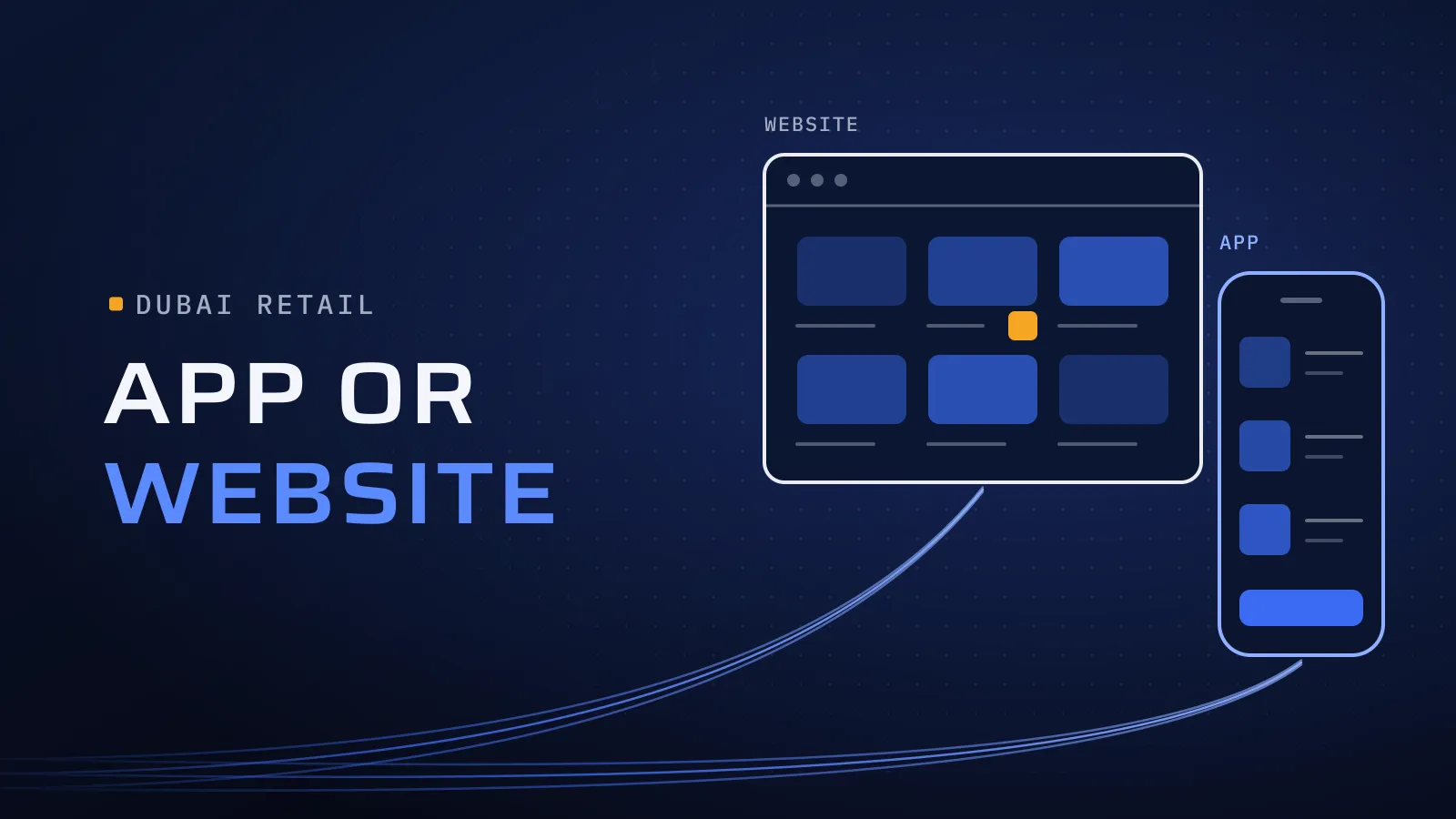
E-commerce app development in Dubai starts with a decision that shapes the whole budget: where your customers will buy first, and where they will come back. Get it right and you take orders sooner and keep the customers you paid to win; get it wrong and the money goes on an app few people install, or a website nobody revisits.
Should you launch an e-commerce app or a website first?
Quick answer: Launch a mobile-first website when you are proving demand, when most customers buy once or twice a year, or when search brings them to you. Add an app when repeat buyers drive your revenue, because saved baskets, loyalty points and push messages bring them back. A marketplace listing adds reach, but the customer stays with the marketplace.
What does selling only on marketplaces and WhatsApp cost you?
Every marketplace order pays a commission, and the customer’s next order pays it again, because the marketplace keeps the relationship. Orders on Instagram and WhatsApp live in one person’s phone, stock is counted by hand, and the last unit sold twice becomes a refund and a poor review. Your own store turns one-off buyers into customers you can reach again.
When a website should come first
In the UAE edition of the 2025 Global Digital Shopping Index by Visa Acceptance Solutions and PYMNTS Intelligence (a market survey from late 2024), 67% of UAE consumers used their phones as part of their latest retail purchase. That says mobile, not app. Start with a mobile-first website when:
- You are still testing products, prices or a new emirate. A website change goes live the same day; an app update waits for store review.
- Search and ads bring your customers. Search engines rank product pages, not the screens inside an app.
- Customers buy once or a few times a year, as with furniture, electronics or gifts. Few people install an app for one purchase.
- You sell to trade buyers with their own accounts and price lists.
Built well, the website’s back end (products, prices, stock and customers) is what an app plugs into later, without a rebuild. Our e-commerce website development in Dubai work starts there.
When an e-commerce app is worth it
An app pays when the same customer comes back often. If you can’t say why a customer would open it twice a month, start with the website.
- Repeat buying. Groceries, pharmacy, pet food, water and beauty refills: last week’s basket reordered in one tap, with the address and Apple Pay saved.
- Loyalty. Points, tiers and member prices, plus a card on the phone that your branches scan, so online and in-store buying count together.
- Push messages. Back in stock, a price drop, order on the way: they reach your customers without paying for the click again. Send too many and they get switched off.
Where a marketplace listing fits
A listing on a regional marketplace gives you reach and delivery from the first week, with no build. You pay a commission on every order, follow its rules on pricing and returns, and the customer data stays with the marketplace. Use it to test demand and clear stock, and build repeat custom in a channel you own.
Hosting other sellers on your own marketplace is a bigger project: a buyer app, seller tools, an admin to approve sellers, and payouts. That is marketplace app development, with the same question of what to launch first.
Website, app or both? A decision table by business type
Take this to your commercial and operations leads. The last column says when the next channel has earned its place.
| Your business | Launch first | Add next | Add it when |
|---|---|---|---|
| New brand or new market | Mobile-first website and a marketplace listing | An app | Repeat orders become a steady share of sales |
| Fashion, gifts, electronics, furniture | Website with strong product pages | An app for loyal buyers | Customers buy several times a year |
| Grocery, pharmacy, pet supplies, water | App and website on one back end | Subscriptions, delivery slots | Customers reorder the same basket |
| Retail chain with a loyalty scheme | Both, with loyalty in the app | Click and collect, branch stock | Customers call to ask if a branch has an item |
| Wholesale and trade buyers | Website with trade accounts and price lists | A reorder app for buyers or reps | Reps take orders on visits or by phone |
| A platform for other sellers | Buyer app, seller tools, admin | Automatic payouts, more categories | Paying sellers by hand takes hours each week |
If a hosted store builder covers most of how you sell, start there; we say so, even though it means we build less. Custom work pays off when your checkout, stock or customer experience sets you apart.
Tell us what you sell, where you sell today and what runs your stock. We reply with the channel we would launch first and what a first release could cover.
Not ready for a call? Ask for our company profile and we’ll send it to you.
What every store needs at launch
Payments: cards, Apple Pay and cash on delivery
Take cards, Apple Pay and Google Pay through a gateway that settles in dirhams, and add mada for Saudi Arabia or KNET for Kuwait if you ship there. Under Apple’s App Store Review Guidelines (3.1.3(e)), physical goods sold in an iPhone app are paid by card or Apple Pay, not in-app purchase, so the app and the website share one gateway account.
Many UAE shoppers still ask for cash on delivery, especially on a first order. Keep it, with controls: confirm each cash order before dispatch, cap the order value and let the courier take a card at the door.
Delivery: connected to your courier
A confirmed order creates the courier shipment and label, the customer gets tracking in their language, and the cash collected is recorded against the order. Take each address as a map pin plus building, area and landmark, set zones and slots per emirate, and let customers start a return from their order page.
Arabic and English from day one
Every screen in both languages, right to left for Arabic, with product titles, sizes and filters translated and search that works in either language. Adding Arabic to a finished store means revisiting every screen and every product.
Stock connected to your ERP
Keep one stock figure for the website, the app, the branches and any marketplace listing: when an item sells anywhere, the count drops everywhere. Orders flow into the ERP for picking, invoicing and VAT, and prices are set once.
In the UAE we implement Odoo. If Odoo already runs your stock and accounts, its own e-commerce module covers a simple web store, and we tell you when that is enough. A custom storefront or app connects to Odoo, so stock, prices, orders and invoices stay in one place (see our Odoo implementation guide). Outside the UAE, we connect to the system you already run.
How an e-commerce project runs
- Pick the first channel and market, such as a web store delivering across the UAE with one courier.
- Map one order from browse to return, including a refused cash order and a refund.
- Connect the gateway, the courier and your ERP, and decide which system owns stock, prices and customers.
- Test in Arabic and English on real phones, including an item selling out mid-checkout and a partial refund.
- Launch, measure, then add. Conversion, repeat purchases and cash refusals decide whether the app comes next.
A store usually runs as project delivery, with a fixed scope per phase. Market price bands for apps are in our mobile app development cost guide; our price is agreed in your proposal.
Marketplace apps we have built: Mowein and G&D
Mowein is a marketplace app where home-based sellers and small startups sell food, crafts and clothing. Talk to the team that built it: book a meeting.
G&D is a marketplace app for trading gold and diamonds. Talk to the team that built it: book a meeting.
Two of the ways we work matter most here. Product thinking: choosing the first channel, and what waits, decides how soon you take orders. Scalable architecture: one back end for the website, the app and your listings, so the app arrives later as a new front end, not a new store.
Talk to us about your store
Since 2014 we have built software, websites and mobile apps for more than 100 clients across the UAE, Saudi Arabia, Qatar, Kuwait, the USA and Canada, from offices in Dubai, Houston and Alexandria.
We ask about your goal, what you use today, your timing and who else should be involved. You leave with clear next steps. The call commits you to nothing, and we sign an NDA first if you want one.
Frequently asked questions
How much does an e-commerce app or website cost in Dubai?
The price follows the scope: the size of the catalogue, the languages, the payment methods, the courier and ERP connections, and whether the app ships on both iPhone and Android. We scope a first release with you and price it phase by phase, so the cost is agreed in your proposal and you see each phase's price before you commit to it. Market price bands for full apps are in our mobile app development cost guide.
How long until we can take our first online order?
The timeline is agreed in your proposal, because it follows the scope. The quickest route is a mobile-first website with cards, Apple Pay and cash on delivery, one courier, and Arabic and English. You get a dated release plan before the build starts, so you know when the store opens.
Can we start with a website and add an app later without rebuilding?
Yes, if the website is built on a back end the app can share: products, prices, stock, customers and orders, served through an API. The app is then a new front end on the same store, and customers keep their accounts and order history. We plan for that from the first release.
Should we keep selling on marketplaces once our own store is live?
Usually, yes. A listing keeps bringing in new buyers and helps clear stock. Keep every channel on one stock count, so a marketplace order never sells an item your website has already sold, and give repeat buyers a reason to come to your own store, such as loyalty points or member prices.
Do we have to offer cash on delivery?
If your customers ask for it, offering it at launch wins orders you would otherwise lose. You stay in control: confirm cash orders before dispatch, set a maximum order value, take cards at the door and reward prepaid orders. The dashboard shows refusals by area, so you tighten the rules only where they are needed.
Who owns the store, the code and the customer data?
Your company does. The app store, payment gateway and courier accounts can all be in your company's name, and the code passes to you as agreed in your contract. We sign an NDA first if you want one.