SaaS Product Development in the UAE: Tenants, Subscriptions, VAT and Arabic
SaaS product development in the UAE: seven decisions to make before you build, from tenant data and recurring card billing to VAT invoices, hosting and Arabic.
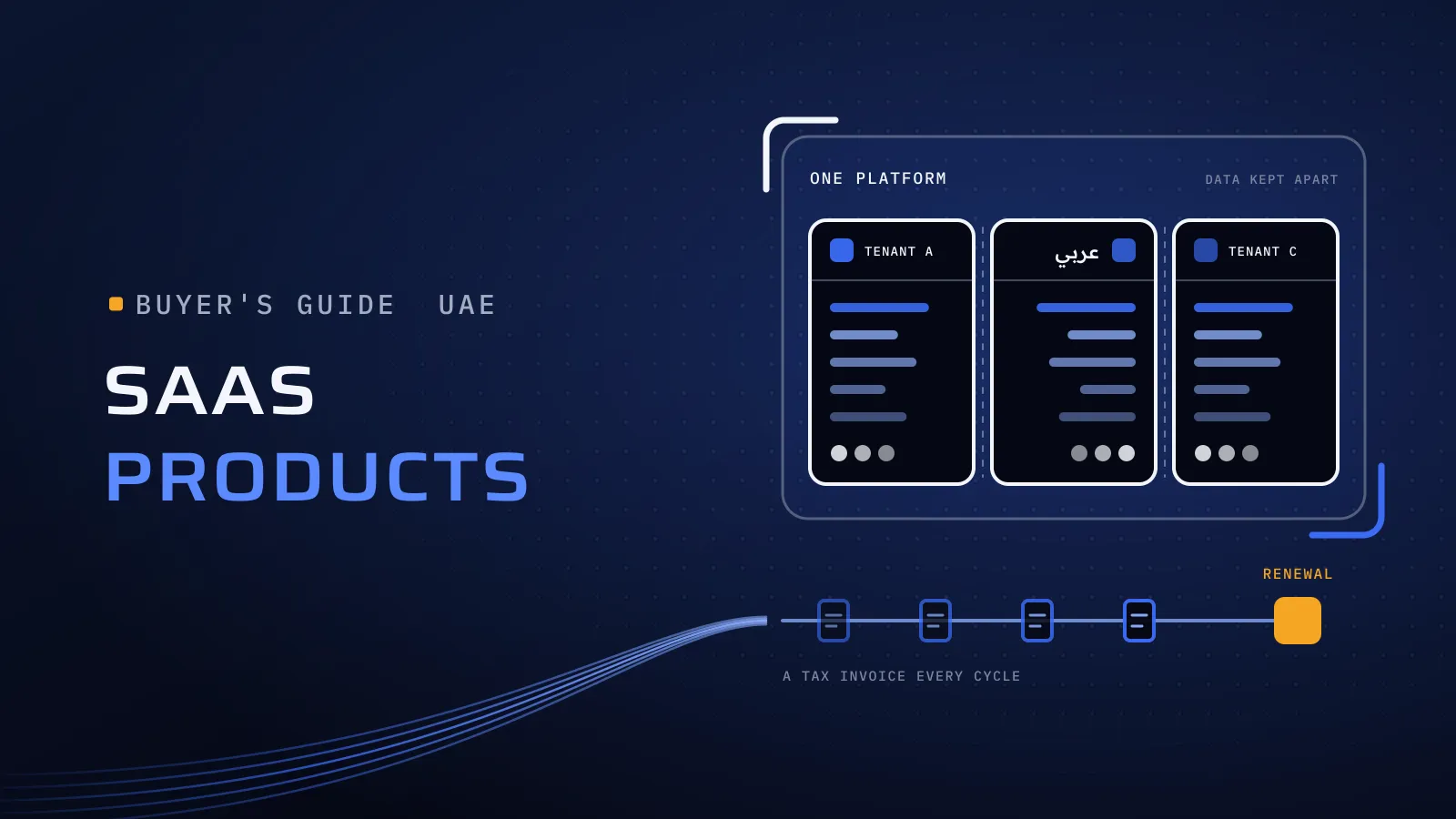
SaaS product development in the UAE means building one platform that many customer companies rent, so a few early decisions shape everything after: how each tenant’s data is kept apart, how subscriptions are charged, how VAT reaches every invoice, where the data lives and how Arabic works. Each one is quick to settle in the plan and expensive to change once customers are paying.
What does SaaS product development in the UAE involve?
Quick answer: Build the one workflow your customers pay for, and settle seven decisions before the first screen: how each tenant’s data is kept apart, whether customers sign up alone or buy through sales, how saved cards are charged on renewal, how VAT and tax invoices work, where the data is stored, how Arabic works for each tenant and user, and whether a mobile app changes who takes the payment. Write them into the plan, because each is hard to change once tenants are live.
Planning a SaaS product? Get the phases, team and price for your first release → We work as a SaaS development company in Dubai, from the plan to launch and the modules after it.
What a wrong early decision costs a SaaS business
A SaaS product sells the same code to every customer, so an early mistake repeats for each one. A tenant filter missed in one report shows a customer another company’s data, and that customer rarely stays. Billing that can’t prorate an upgrade leaves someone in finance writing credit notes by hand every month. Invoices built without a TRN field or an AED tax line get reworked the week you register for VAT. Arabic added after launch means reworking every screen, email and PDF. And the first large customer who asks where its data is stored can turn into a migration. None of this is hard to plan in discovery. All of it is slow to fix with paying tenants on the platform.
Seven SaaS build decisions, side by side
| Decision | Your options | Choose by | Hard to change later? |
|---|---|---|---|
| 1. Tenant model | A shared database with a tenant ID on every record, a schema per tenant, or a database per tenant | How many customers you expect, how large they are, and what their contracts ask for | Yes |
| 2. How customers buy | Self-serve sign-up with a card, contracts paid against invoices, or both | Your price point and who signs the purchase | Partly: both routes need the same plans and invoice data |
| 3. Recurring payments | A gateway that saves the card as a token and charges each renewal; bank transfer for annual contracts | Self-serve volume, your currencies and where you settle | Partly: moving saved cards to a new gateway needs both gateways’ help, or customers re-enter them |
| 4. VAT and invoices | Tax invoices issued by the platform, or by your accounting system with the platform feeding it | When you register for VAT, and whether you invoice UAE businesses | Yes: invoice numbers and history must stay intact |
| 5. Data location | A UAE cloud region, another region, or a separate deployment for customers who require it | Your customers’ sector and contracts | Yes: moving live data is a project of its own |
| 6. Arabic | A default language per tenant, a choice per user, and the language of each document | Who your users are and what they send to their own customers | Yes, if screens and PDFs were built for one direction |
| 7. Mobile apps | Web only, apps for business customers’ staff, or apps sold to consumers | Who uses the product on a phone, and who pays | Partly: it decides whether app store billing applies |
How to read it: settle every row marked Yes in discovery, before design starts. Our guide to software product discovery shows how that phase runs and what you leave it with.
How do you keep each tenant’s data apart?
Multi-tenant means one platform serves many customer companies, each in its own workspace with its own users, roles and settings. There are three common ways to keep their data apart.
| Model | Fits | Watch for |
|---|---|---|
| Shared database, tenant ID on every record | Many small and mid-sized customers on the same plans | Every query must filter by tenant. Enforce it in one place in the code, not by hand in each report |
| Schema per tenant | Fewer, larger customers who want clearer separation | Every database change runs once per tenant, so releases need tooling |
| Database per tenant | Customers whose contracts ask for their own database or region | More to run, back up and upgrade, so it is usually sold as a higher plan |
Many products mix them: a shared database for most customers, and a separate one for the few who pay for it. Whichever you choose, ask for four things in the first release:
- A test that tries to cross tenants. On every release, QA signs in as one tenant and tries to reach another’s records, files and exports.
- Tenant settings in one place: name, logo, language, VAT number, time zone, and the modules each plan includes.
- Export and deletion per tenant, so a customer who leaves gets their data and nothing of theirs remains.
- Support access with a trail. Your team can open a tenant’s account to help, and every visit is logged.
Start with one well-structured application rather than many services. Our guide to monolith vs microservices for a SaaS product explains when splitting pays off.
Subscriptions and recurring card payments in the UAE
A SaaS billing engine does more than take a payment. It holds your plans and prices, trials, upgrades and downgrades with proration, seat or usage counts, renewals, retries of failed payments with a grace period before access stops, cancellations, refunds and credit notes. Business customers on annual contracts often pay by bank transfer against an invoice, so the same engine has to run invoiced accounts beside card subscriptions.
Before you build around a payment gateway, ask it these questions:
- Can it save a card as a token and charge renewals without the customer present, after a first payment authenticated with 3-D Secure?
- Which currencies can you charge, and does it settle in AED to your UAE bank account?
- Does it send webhooks for successful, failed and refunded payments and for chargebacks? The platform, not the browser, should confirm each payment.
- Can customers update their card on a page the gateway hosts, so card numbers never touch your servers?
- Does it offer Apple Pay and Google Pay for self-serve sign-ups?
- Will it approve recurring charges for your business activity? Gateways onboard a merchant against its trade licence and website, so ask before the build starts.
Price in AED for UAE buyers. If you also price in US dollars, the tax invoice still shows the tax in AED, as the next section explains.
VAT on SaaS subscriptions: what the platform must record
VAT is run by the Federal Tax Authority (FTA), and how it applies depends on your company and your customers, so have a tax adviser approve your tax rules once. What the platform must record follows from a few published rules:
- The rate and the threshold. The standard rate is 5%. A UAE business must register once its taxable supplies and imports pass AED 375,000 in 12 months. For a supplier based outside the UAE, the threshold is in effect nil, although business customers registered for VAT account for it themselves under the reverse charge (FTA E-Commerce VAT Guide).
- Where the service is used. The same guide lists the supply and updating of software, delivered automatically over the internet, as an electronic service, taxed where it is used and enjoyed. It names the billing address, the IP address and the bank details among the signs of where that is. Store them with each subscription, with each business customer’s TRN.
- What a tax invoice shows. The words “Tax Invoice”, your name, address and TRN, the customer’s TRN if they are registered, a sequential number, the date, and the tax in AED, with the exchange rate when you price in another currency. A simplified tax invoice is allowed for customers who aren’t registered, and for registered ones buying up to AED 10,000. Invoices may be electronic if you store them securely and can show they weren’t changed (VAT Executive Regulation, Article 59).
- Customers abroad. The guide’s summary shows no UAE VAT where the service is used outside the UAE, but the treatment turns on the facts. Confirm it with your tax adviser before you set the tax rules.
- E-invoicing. From your e-invoicing date, invoices to UAE businesses travel as structured data through an Accredited Service Provider. Our UAE e-invoicing 2027 guide has the dates for each group, so plan the invoice data for it in the first release.
What this means for you: before launch, ask your developers for a test invoice and a credit note from the platform. Check the TRN fields, the sequential number, the AED tax line and the exchange rate, then have your tax adviser sign off the tax rules once.
Already holding a SaaS proposal? Send us the proposal you received, with anything confidential removed. We reply with the questions to ask about tenants, billing, VAT and Arabic, and what we would change. Send us the proposal →
Still planning? Send the idea, who your customers are and whether they pay by card or by invoice. We reply with the phases, the team and the price for your first release. Plan your first SaaS release → Not ready for a call? Ask for our company profile and we’ll send it to you.
Where should a UAE SaaS keep its data?
Your customers decide this as much as you do. Government entities, banks, healthcare providers and large companies often ask in their procurement questions where data is stored, and some sectors have their own rules. Ask two or three target customers early, and ask your legal adviser which rules apply to your sector.
Several major cloud providers run regions inside the UAE, so the choice is about your customers, not about what’s available. Three habits keep it simple:
- Open the cloud account in your company’s name, and pick the region before the first customer goes live. We don’t sell hosting; we set the platform up in your account.
- Keep a data map: every outside service that receives customer data, such as email delivery, error tracking, analytics, file storage or an AI model, and the country where it processes that data. Large customers’ security questionnaires ask for exactly this list.
- Back up and restore per tenant, in the same region, and test a restore before launch.
If one large customer needs its own database or region, the database-per-tenant model lets you sell that as a separate plan without moving everyone else.
Arabic for each tenant and each user
Arabic in a SaaS product works at three levels, and each needs its own setting.
| Level | What to build | What goes wrong without it |
|---|---|---|
| The tenant | A default language for each customer company, its name and address in Arabic and English, and its own field labels in both | A company’s documents carry only its English name |
| The user | Each person chooses Arabic or English, and the layout mirrors right to left, including tables, charts and direction icons | Arabic text squeezed into a left-to-right layout |
| The documents | Invoices, reports, emails and SMS in the recipient’s language, with Arabic letters joined correctly in PDFs | Arabic PDFs with disconnected letters or words in reverse order |
Two details catch teams late. Search should match Arabic spelling variants, so a search with one form of alef or taa marbuta finds the other. And digits need a decision: Western digits or Arabic-Indic digits, set per tenant or per user. Our guide to Arabic app development and right-to-left design covers the screens in more depth.
When a mobile app changes who takes the payment
Many SaaS products add a mobile app, for field staff or for end users. That app can change your billing. Apple’s App Review Guidelines (3.1.3(c)) let an app sold only to organisations, for their employees or students, give access to subscriptions bought elsewhere. Sales to consumers, single users or families must use in-app purchase, and the United States storefront has its own rules. Decide early whether your app is a tool for business customers’ staff or a product that consumers buy, and check the current text before you set plans.
What goes into the first release, and who builds it
A first SaaS release usually holds the core workflow, tenant accounts and roles, billing, the admin panel you run the service from, and Arabic and English. The team behind it:
- Product owner: turns the idea into the first-release list and keeps the backlog in order.
- Project manager: owns the dates and raises risks early.
- CTO-level lead: decides the tenant model, the billing design and the architecture, the rows marked Yes above.
- UI/UX designer: draws the Arabic and English screens together.
- Back-end, front-end and, if needed, mobile developers: build it, with a technical lead reviewing the code.
- QA engineer, apart from the developers: tests every release, the cross-tenant test included.
What makes the first release bigger: usage or per-seat pricing, more user roles, integrations with accounting software, an ERP or an e-invoicing provider, mobile apps, and separate deployments for large customers. Our MVP development cost guide shows how to trim a first release, and our QA guide explains why testing is a separate role from day one.
Where Flojics fits
As a SaaS development company in Dubai, we plan and build SaaS products from the first release to the modules after launch. Quality built into every step: CTO oversight on the architecture, independent QA before each release, and a dated plan in FloPlan, the delivery software we built and use ourselves.
Massart is a no-code app builder from our work in Saudi Arabia: businesses build and publish their own iOS and Android apps from one platform. Talk to the team that built it: book a meeting. On ButlerFM, facility management software for cleaning businesses, our engineers joined ButlerFM’s own team. Talk to the team that worked on it: book a meeting.
Bring your SaaS idea and who it’s for
Since 2014 we have worked with more than 100 clients across the UAE, Saudi Arabia, Qatar, Kuwait, the USA and Canada. Our headquarters is at Dubai Digital Park, and our core team works from Egypt. Bring the idea, who your customers are and how they will pay.
Get the phases, team and price for your first release → or send us a proposal you received → We ask about your goal, what you use today, your timing and who else should be involved. You leave with clear next steps. We reply by email first and set up a call only if you want one. Asking commits you to nothing, and we sign an NDA first if you ask.
VAT rules checked on 29 October 2026 against the FTA guide and regulation linked above. Confirm how they apply to your company with your tax adviser.
Frequently asked questions
What is multi-tenant SaaS, and which model should we use?
Multi-tenant means one platform serves many customer companies, each in its own workspace with its own users, roles and settings. Most products start with a shared database and a tenant ID on every record, enforced in one place in the code. A schema or a database for each tenant suits fewer, larger customers, or contracts that ask for separation. Choose in discovery, because the model is hard to change once tenants are live.
Which payment gateway do we need for a SaaS product in the UAE?
One that saves cards as tokens and charges renewals without the customer present, settles in AED to your UAE bank account, sends webhooks for every payment event and hosts the page where customers update their card. Ask early whether it approves recurring charges for your business activity. Business customers on annual contracts often pay by bank transfer, so the platform should handle invoiced accounts too.
Do we charge VAT on SaaS subscriptions in the UAE?
Once you are registered, the standard rate is 5% where the service is used and enjoyed in the UAE. The FTA makes registration mandatory once taxable supplies and imports pass AED 375,000 in 12 months, and for a supplier based outside the UAE the threshold is in effect nil. Each tax invoice then needs your TRN and the tax in AED. How VAT applies to customers abroad depends on the facts, so ask your tax adviser.
Does our SaaS data have to stay in the UAE?
It depends on your customers and your sector. Government entities, banks, healthcare providers and large companies often ask where data is stored, and some sectors have their own rules, so ask your target customers and your legal adviser early. Several major cloud providers run regions in the UAE, and the cloud account should be in your company's name.
Should Arabic be in the first release of a SaaS product?
If your customers or their staff work in Arabic, yes. Plan it at three levels: a default language for each tenant, a choice for each user, and documents such as invoices and emails in the recipient's language. Adding right-to-left layouts and Arabic PDFs after launch means reworking every screen and template.
Can customers pay for our SaaS inside the iPhone app?
If the app is sold only to organisations for their staff, Apple's guideline 3.1.3(c) lets users sign in with a subscription bought elsewhere. Sales to consumers, single users or families must use in-app purchase, and the United States storefront has its own rules. Check the current guidelines before you set your plans.
How much does SaaS product development cost?
It follows the scope of the first release and the team it needs: a product owner, a project manager, a CTO-level lead, a designer, developers and a QA engineer who works apart from them. Usage or per-seat pricing, more user roles, integrations, mobile apps and separate deployments make it bigger. Send us your idea and how customers will pay, and we reply with the phases, the team and the price.