Software Product Discovery Services in Dubai: What Discovery Covers, Who Runs It and What You Leave With
Software product discovery services in Dubai: what discovery covers, who runs it, what you leave with, if you need it, and a checklist to prepare.
Software product discovery services in Dubai give you written answers before you sign for a build: what the first release must do, what could go wrong, and how the system should be built. Settle them on paper and you compare quotes for the same product and launch on a plan you approved; skip them, and the same answers arrive later as change requests, after the budget is committed.
What do software product discovery services in Dubai cover?
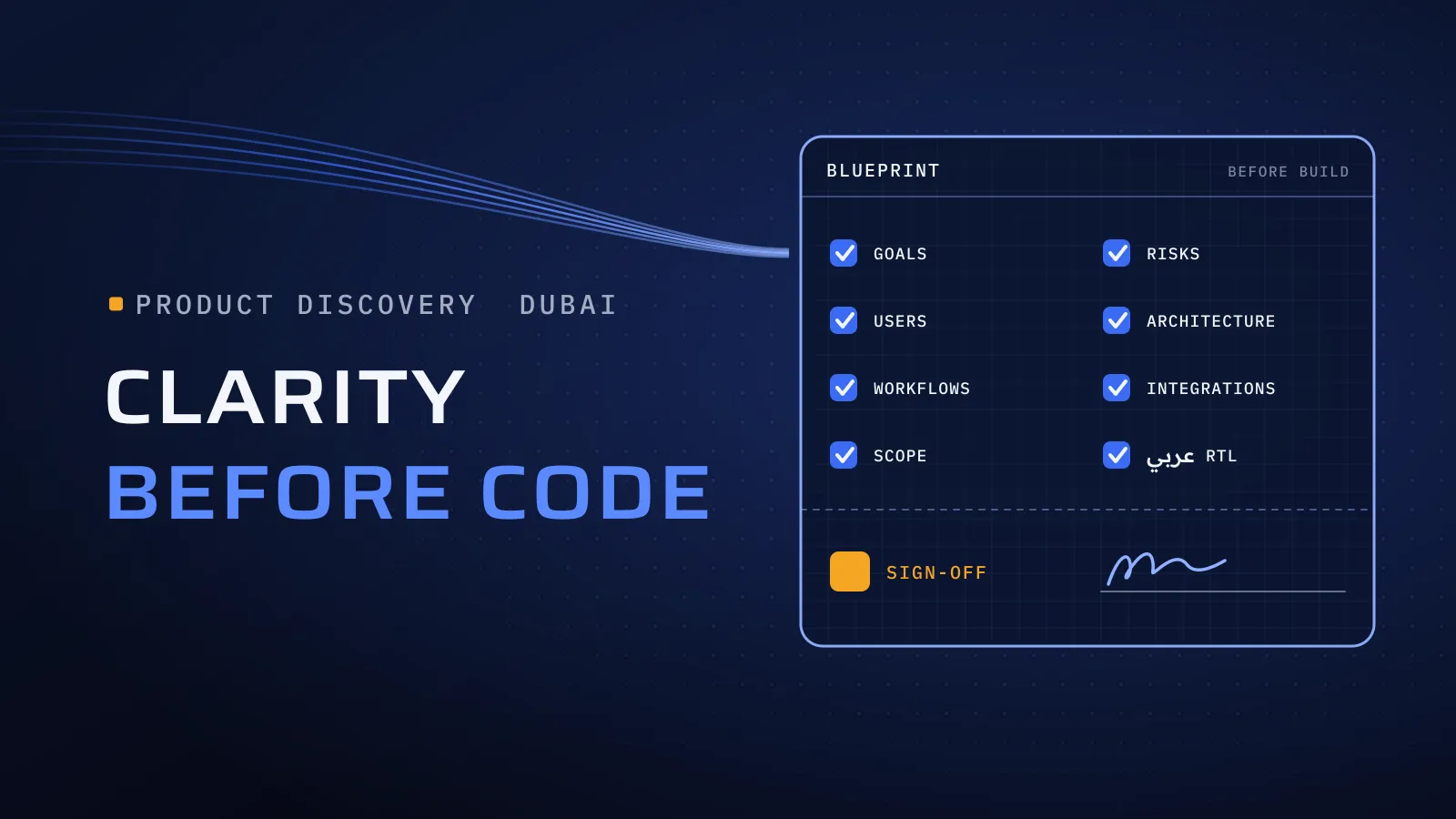
Quick answer: Discovery is the phase before the build. With the people who will use and run the product, we settle the goals, the users and their workflows, the scope of a first release, the risks, the architecture direction, the integrations and the Arabic right-to-left screens. You leave with a written scope, wireframes, the architecture, a dated plan and an estimate.
About to build a product or replace a system? Tell us what you plan to build →
What starting without discovery costs you
A quote written before discovery prices a guess. Each vendor fills the gaps with its own assumptions, so three quotes for one brief can describe three different systems. The gaps come back mid-build: an approval rule only the finance team knew, an Arabic invoice nobody listed, an ERP connection that needs a test environment nobody asked for. Found on paper, each costs a conversation. Found in code, it costs rework and a later launch, while the old system or spreadsheet keeps costing you until the new one takes over.
How discovery runs, step by step
Discovery is the first stage of our software delivery process, and it works the same way for a new product or a system you are replacing.
- Goals and the numbers that prove them. What must change for your business, and the one or two numbers that will show it after launch, such as bookings taken or invoices sent on time.
- Users, roles and today’s workflows. Every group that will use it, and how each one does the job today: an app, a spreadsheet, a WhatsApp group or an old system. The rules, approvals and exceptions are mapped with the people who run the process, because the rules that matter most are often the ones nobody wrote down.
- The scope of a first release. Every feature goes into one of three lists, first release, later or not doing, and the first release covers one job or process from start to finish. Our guide to deciding what to build first shows how we pick the features that give users a reason to switch.
- Integrations, data and Arabic. Each system it must talk to, such as your ERP, a payment gateway or UAE PASS; the records to move from the old system and how clean they are; and which screens and documents need Arabic, designed right to left beside the English from the first wireframe. Adding Arabic later means reworking every screen.
- Risks and the architecture direction. The riskiest parts are worked out first: an untested integration, a rule with many exceptions, data in poor shape. A CTO-level lead sets the architecture direction, the stack and the data model, so the decisions that are expensive to reverse are made on purpose and explained in plain terms.
What you leave with
In our process, discovery produces written outputs that you sign off before any code is written:
- A scope in three lists: first release, later and not doing. The last list keeps extra requests from moving your launch.
- Success measures: the numbers from step 1, agreed before launch.
- Wireframes of the main journeys for each role, in Arabic and English where your users need both, from our UI/UX and product design team.
- The architecture, the stack and the data model, with the reasons written down.
- The integrations and the data to move, one by one, with what each depends on.
- A risk list, including the awkward cases independent QA raises while the scope is still on paper.
- A dated plan in FloPlan, the delivery software we built and use ourselves.
- An estimate of the effort, the team and the price that lists its assumptions, ready for your board or investors.
Who is involved: CTO oversight and our team
Each role on our side owns part of the result:
| Role | What it does in discovery |
|---|---|
| Product Owner | Holds the vision and the requirements, and ranks what goes into the first release |
| Project Manager | Owns the plan and the dates, and raises risks early |
| Business analyst | Maps the process with the people who run it: rules, roles, reports and connected systems |
| UI/UX designer | Wireframes each role’s main journeys, in Arabic and English where needed |
| CTO oversight | Sets the architecture direction and the stack, and signs off the data model |
| Independent QA | Lists the awkward cases while the scope is still on paper |
| Your side | A decision-maker, the people who run the process today and, if you have one, your IT lead |
When several apps and dashboards share one set of records, how those records connect is settled once, in discovery, before the screens are designed, or every new feature fights the last one. Two of our principles carry it. CTO oversight: senior technical leadership supervises the architecture, so the big calls are made once, deliberately. Product thinking: we solve business problems, not only deliver features, so everything in the first release earns its place.
Our core team are native Arabic speakers who work in English, which helps when your requirements, documents or people work in Arabic. No technical leader of your own? CTO as a service keeps that judgement with you through the build.
Do you need discovery? A quick check
| Your situation | What discovery does for you |
|---|---|
| An idea and a launch date, but no written scope | Full discovery: users, first-release scope and architecture before you compare quotes |
| Replacing a spreadsheet or an old system | Maps the rules people carry in their heads, the reports they rely on and the data to move |
| Quotes for the same brief that differ widely | Settles one scope, so the next quotes price the same system |
| A written scope from your own team | Checks it for gaps, and spends the time only on what is still open |
| No technical leader, with an investor or board review coming | Puts the architecture and its reasons in writing, under CTO oversight |
| A small change to a product you already run | Probably not needed: a clear change request with acceptance criteria is usually enough |
In the last row? Say so when you write, and we will tell you if discovery is more than you need.
Not sure how much discovery your project needs? Send us five things:
- the goal, in a line or two;
- who will use it;
- what they use today;
- the systems it must connect to;
- whether you need Arabic.
We reply by email with what discovery would cover first and who would join it. Tell us what you plan to build →
Not ready for a call? Ask for our company profile.
Checklist: what to prepare before discovery
Bring what you have; the workshops fill in the rest.
| Bring | Why it helps |
|---|---|
| The goal, and one or two numbers that would prove it | Every scope decision is tested against them |
| The people who run the process today, and a few real users | They know the exceptions no document lists |
| How the job is done today: the spreadsheet, the forms, screenshots of the old system | Shows what the new product has to beat or replace |
| Sample invoices, reports and approvals, in Arabic and English if you use both | Templates and right-to-left layouts are designed from real examples |
| The systems to connect, and who holds each account | Access and test environments are requested early |
| Where your data lives today, and how complete it is | The data move is sized on facts |
| Your budget and the dates that matter: a launch, a funding round, an old system’s renewal | The first release is cut to fit, instead of the plan being cut later |
| Outside approvals, such as a merchant account or UAE PASS access | They run outside the build, so they start during discovery |
After discovery: the build and the price
The estimate becomes your proposal, and the dated plan becomes the build’s starting point. For a first release to test an idea, MVP development cost in Dubai sets out the scope tiers and roles. For a business system or a replacement, custom software development cost in the UAE shows who works in each phase.
Sometimes building is not the answer. If a ready-made product fits the process, or Odoo fits your accounts, stock and HR (we implement Odoo in the UAE), we say so. When custom is the right call, see our custom software development in Dubai page.
Tell us what you plan to build
Since 2014 we have worked with more than 100 clients across the UAE, Saudi Arabia, Qatar, Kuwait, the USA and Canada. We are headquartered at Dubai Digital Park in Dubai Silicon Oasis, with offices in Houston and Alexandria. Qargo is a car rental and ride-hailing platform in Qatar whose technical direction and architecture we led. Talk to the team that built it: book a meeting.
Quality is built into every step: CTO oversight on the architecture, independent QA before each release, and a dated plan in FloPlan.
Tell us what you plan to build → Send the goal, the users, what they use today, the systems to connect and whether you need Arabic. We reply by email first with what discovery would cover, and set up a call only if you want one. Asking commits you to nothing, and we sign an NDA first if you ask.
Frequently asked questions
How long does discovery take, and what does it cost?
Both are agreed in your proposal before discovery starts. They follow mainly from how much is still open: how many user groups and workflows, how many systems to connect, how much data to move and whether you need Arabic. Whatever you decide next, the outputs are written down and in your hands.
Is discovery only for new products, or also for replacing a system?
Both. For a new product, it settles the users, the first-release scope and the architecture. For a replacement, it also maps the rules people follow today, the reports they rely on and the data to move, so nothing the business depends on is missing from the scope.
How much of our time does discovery need?
A person who can make decisions in the workshops, the people who run the process today and, if you have them, a few real users. We prepare the questions, run the sessions and write everything up for you to sign off.
What if discovery shows we shouldn't build custom software?
Then we tell you. A ready-made product suits a standard process, and for UAE companies we implement Odoo for accounts, stock and HR. Many companies combine them: a product for the standard records, and custom software for the process that sets them apart.
Do we have to build with you after discovery?
No. The scope, wireframes, architecture and plan are written for your team, so you have them in hand whatever you decide. If you build with us, the release plan from discovery is where the build starts.
Is our idea safe if we share it in discovery?
Yes. We sign an NDA before you share the details, if you want one, and ownership of the work is written into your contract.