Booking Platform Development in Dubai: What a Booking App Needs, What It Costs and What to Launch First
Booking platform development in Dubai: what a booking app needs, what drives the cost and what to launch first, for home services, beauty, tours and tutoring.
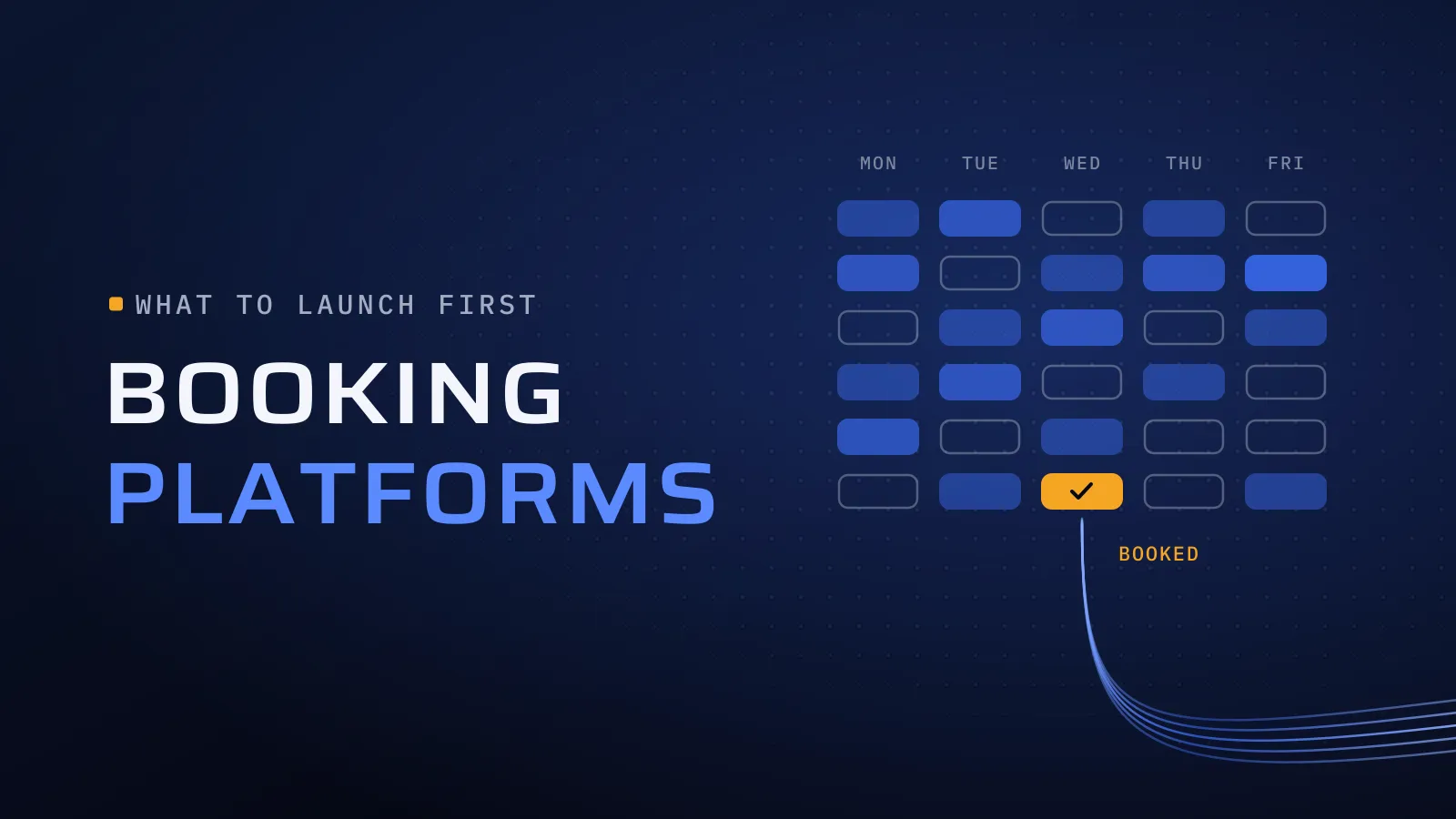
Booking platform development in Dubai comes down to one outcome: a customer books and pays in a few taps, and the provider turns up knowing where and when. Launch the right first release and you take paid bookings sooner, on a base that grows with you; launch the wrong one and the budget goes on features nobody has asked for yet.
What does a booking platform need, and what does it cost?
Quick answer: A booking platform is three parts sharing one calendar: a customer app to book and pay, a provider app for availability and jobs, and an admin dashboard to run it. Launch with one booking model, payments, reminders, and Arabic and English. Loyalty, live tracking and promotions can wait. Your price follows that scope and is agreed in your proposal.
What do WhatsApp bookings cost you?
Many booking businesses start on WhatsApp and Instagram, or on a marketplace that takes a cut of every booking and keeps the customer. As you grow, it leaks: one slot promised twice, a no-show with no deposit, and every customer’s history in someone’s phone. Each lost booking is revenue you already paid to win. Your own platform turns chats into paid bookings and gives you the repeat-customer data a chat never will.
Choose your booking model first
How a booking happens sets when the customer pays, what the provider sees and how the calendar works. Most platforms use one of four models:
- Instant slot. The customer picks a free time and it is confirmed at once, paid in full or by deposit. Salons, home beauty, tutors, cleaners.
- Request and approve. The customer asks for dates, the provider accepts, then the customer pays, so a declined request never needs a refund. Car, yacht and holiday-home rentals.
- Quote and choose. The customer describes the job, providers send prices and the customer picks one. Home repairs and moving.
- Scheduled session. A fixed date with a set number of places. Group trips, classes, workshops.
Launch with one, unless the business cannot run without a second.
The three parts of a booking platform
Availability sits underneath everything: each provider’s hours and days off, how long each service takes, and the gap between bookings, which for home services in Dubai includes the drive across town. A slot is held for a few minutes while the customer pays, so nobody books it twice. Three parts share that calendar:
- The customer app. Browse, see real prices and free times, book, pay, and rebook in one tap.
- The provider app. Set availability, accept or decline, see each job’s address, mark it done and see earnings. Independent providers need it from launch; your own staff can start with a simple staff view.
- The admin dashboard. Approve providers and their documents, manage services and prices, and handle refunds, complaints and reports. Founders often plan it last, yet your operations team works in it daily.
The features that win or lose a booking
- Payments and deposits. Cards and Apple Pay through a gateway that also takes local cards, such as mada in Saudi Arabia or KNET in Kuwait. Decide early between full payment, a deposit or paying after the visit, and how your commission is recorded. Under Apple’s App Store Review Guidelines (3.1.3(e)), services used outside the app, such as a home visit or a car rental, are paid by card or Apple Pay, not Apple’s in-app purchase. One-to-one live online lessons can be paid the same way (3.1.3(d)); live online group classes must use in-app purchase.
- Cancellations and no-shows. One simple rule, shown before payment and applied by the app, such as free cancellation up to a set time. Cover the provider who doesn’t turn up too, with an automatic refund and an admin override.
- Reviews. Only after a completed booking, so every rating comes from a real customer.
- Notifications. Confirmed, reminder, on the way, done. Reminders are your first defence against no-shows; the deposit is the second.
- Arabic and English. Both from day one, with a right-to-left layout. Adding right-to-left to a finished app means revisiting every screen.
- Maps. A pin plus notes for the building and landmark, since many Gulf addresses are a building name and an area. Service areas decide which providers see which jobs.
What does a booking platform cost?
Market price bands for full apps in Dubai are in our mobile app development cost guide. For a booking platform, the price moves most with the number of sides, the booking model, the money flow (a marketplace that holds deposits and pays providers costs more than one business taking cards) and integrations such as your accounting system. Our price is agreed in your proposal, phase by phase, so you see each release’s scope and price before you commit.
How a booking platform project runs
- Pick one booking model and one launch market, such as one service category or one area of Dubai.
- Map one booking from search to review, including cancellations, no-shows and refunds, where the rules and the money sit.
- Design both sides in Arabic and English, and test a clickable prototype with real customers and providers.
- Build release one, testing the moments that cost money: two customers on one slot, a late cancellation, a refund.
- Launch, measure, then add. Completed bookings, no-shows and repeat bookings decide what moves into release two.
An MVP usually runs as project delivery, with a fixed scope per phase, or as time and materials for a small or changing scope.
Launch first or add later?
Take this to your co-founders: the last column says when a feature has earned its place.
| Area | Launch first | Add later | Add it when |
|---|---|---|---|
| Booking | One model, provider hours, slot holds | Recurring bookings, waitlists | Customers ask for the same slot every week |
| Customer app | Guest browsing, book, pay, rebook | Packages, gift bookings, referral codes | Repeat customers are a large share of bookings |
| Provider side | Availability, accept or decline, job address, earnings | In-app chat, performance reports | You have more providers than you can manage by phone |
| Admin dashboard | Provider approval, services and prices, refunds, basic reports | Promo codes, admin roles, detailed analytics | A second person joins to run operations |
| Payments | Cards and Apple Pay, deposits, commission per booking | Wallets, automatic split payouts | Paying providers by hand takes hours each week |
| Cancellations | One rule, applied by the app, admin override | Rules per service or provider | Disputes take admin time every week |
| Notifications | Confirmed, reminder, on the way | WhatsApp messages, offers | Customers start bookings and don’t finish them |
| Maps | Address pin with notes, service areas | Live tracking, route planning | Customers call to ask where the provider is |
Tell us what people will book, who provides it and how bookings run today. We come back with the booking model we would start with and what your first release could cover.
Not ready for a call? Ask for our company profile and we’ll send it to you.
A booking platform in practice: Spoiled
Spoiled brings salon services to the client’s home in Kuwait: clients book beauty and self-care services at the place and time they choose. We built the client app, which covers booking and a beauty product shop, and the admin dashboard that tracks customers, service providers, bookings and earnings.
Bookings, a shop and an admin view only hold together on one set of records, settled before the screens are built. That is scalable architecture. Choosing what goes into the first release, and what waits, is product thinking. Talk to the team that built it: book a meeting.
We also built AlloPro, which connects people with technicians for home repairs through offers, ratings and chat, and Inck, where students book private lessons by subject and teacher availability, online or in person.
Plan your first release with us
Since 2014 we have built software and mobile apps for more than 100 clients across the UAE, Saudi Arabia, Qatar, Kuwait, the USA and Canada, from our headquarters at Dubai Digital Park in Dubai Silicon Oasis.
Talk to us about your MVP → We ask about your goal, what you use today, your timing and who else should be involved. You leave with clear next steps. The call commits you to nothing, and we sign an NDA first if you want one.
Frequently asked questions
How much does a booking app cost in Dubai?
The price follows the scope: how many sides the platform has, the booking model, how payments and payouts work, and the languages. We scope a first release with you and price it phase by phase, so the cost is agreed in your proposal and you see each phase's price before you commit to it. Market price bands for full apps are in our mobile app development cost guide.
How long until we can take our first booking?
The timeline is agreed in your proposal, because it follows the scope. The quickest route to live bookings is a small first release: one booking model, one service category or area, and payments that work. You get a dated release plan before the build starts, so you know when customers can book.
Do our providers need their own app at launch?
If they are independent providers, such as freelance stylists, technicians or car owners, yes: they need to set their hours, accept jobs and see addresses on their phone. If they are your own staff, a simple staff view or the admin dashboard can cover the first release, and a full provider app follows as the team grows.
How do payments, deposits and payouts to providers work?
Customers pay by card or Apple Pay through a payment gateway, in full or as a deposit, and the platform records your commission on every booking. At launch, providers can be paid from the dashboard's earnings report, and automatic split payouts can follow once volumes justify them. Apple's App Store rules require services used outside the app, such as a home visit or a rental, to be paid this way rather than through Apple's in-app purchase, so booking payments run through your own gateway account.
Who owns the app, the code and the customer data?
Your company does. The App Store and Google Play accounts can be in your company's name, and the code and IP pass to you at the end of the project, once it is completed and paid. We sign an NDA first if you want one.
What if bookings are slow after launch?
Then the numbers show you why. The admin dashboard shows where customers stop, which services sell and which providers get rebooked, so the next release fixes the real problem rather than a guess. Because release one was kept small, budget is left for what your customers ask for next.