ERP for Small Business in the UAE: The Signs You've Outgrown Spreadsheets, and What Kind of System Fits
ERP for small business in the UAE: nine signs you've outgrown spreadsheets and separate tools, and whether Odoo, a custom ERP or neither fits you yet.
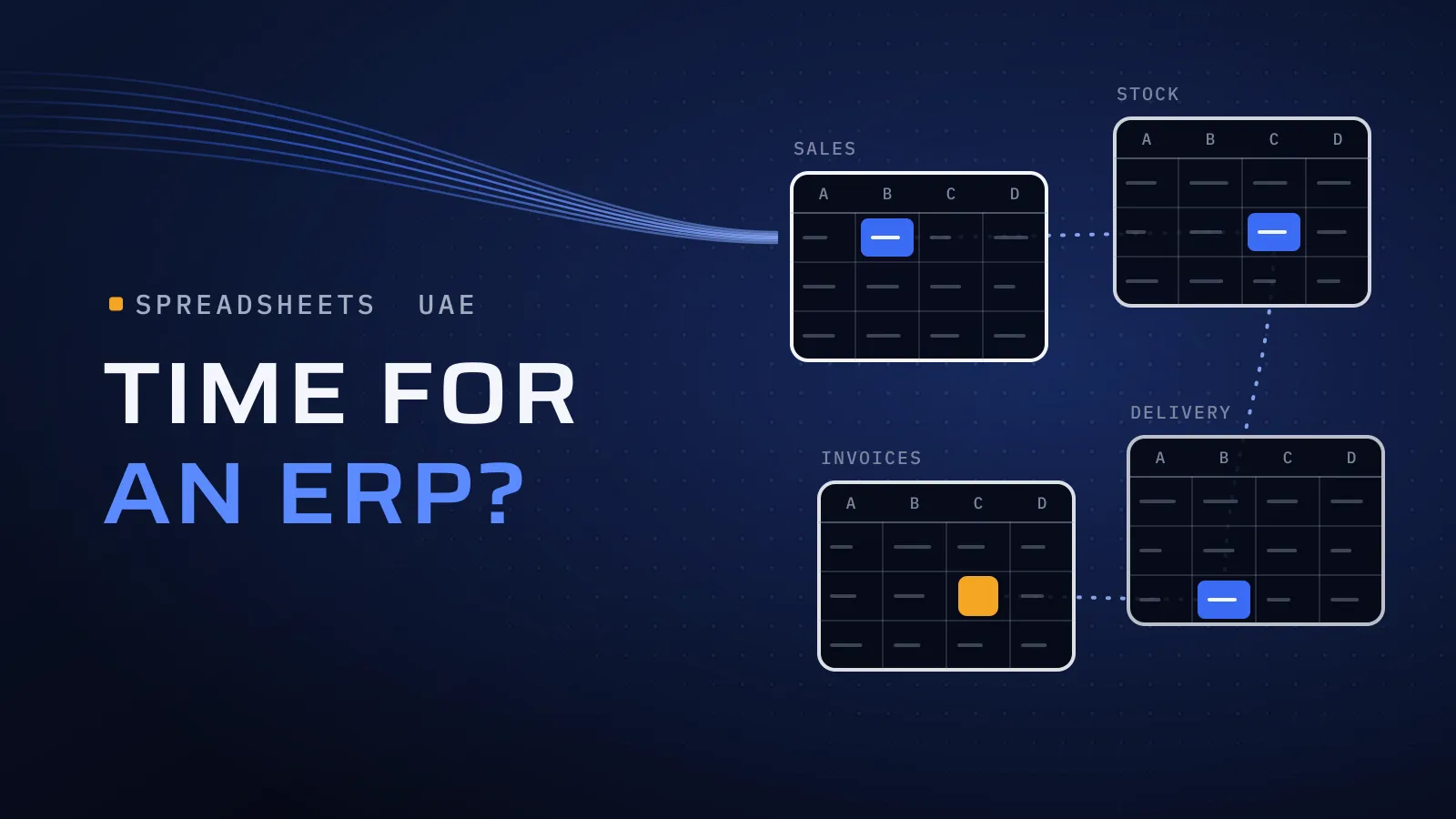
ERP for small business in the UAE is worth paying for at one point: when the spreadsheets and separate tools that got you here start costing more time than they save. Spot that point early and you move to one system on your own timetable; miss it and you make the switch under pressure, in the middle of a VAT quarter or close to an e-invoicing deadline.
When does a UAE business need an ERP?
Quick answer: A UAE business needs an ERP when the same order, invoice or stock item is typed into more than one tool, month-end waits on someone merging spreadsheets, and the VAT return is built by hand. One sign can usually be fixed in the tool you have. Three or more, across finance, sales and stock, mean it is time to scope an ERP.
Ticked three or more already? Talk to us about where an ERP would start.
What another year on spreadsheets costs you
Every month on separate tools is another month-end rebuilt by hand, another VAT return assembled from exports and another stock count that doesn’t match the file. The cost hides in the time of the people you can least spare: the finance lead who merges sheets instead of checking them, the sales manager who calls the warehouse before quoting.
The calendar adds pressure. Businesses with revenue below AED 50 million must appoint an accredited service provider by 31 March 2027 and send B2B invoices as structured data from 1 July 2027 (Ministerial Decision No. 244 of 2025). A Word or spreadsheet invoice can’t do that. Our guide to UAE e-invoicing in 2027 sets out who is in scope and when.
Nine signs you’ve outgrown spreadsheets and separate tools
Go through this with your finance lead and whoever runs sales or the warehouse. Tick a sign only if it happened in the last quarter.
| Sign | What it costs you | Usually fixed by |
|---|---|---|
| The same order or invoice is typed into two or more tools | Hours of re-keying, and errors that surface at month-end | One system where the quote becomes the order and then the invoice |
| Month-end waits on one person merging spreadsheets | A late close, and numbers nobody can check | Accounting tied to sales and purchasing |
| The VAT return is built by hand from exports | Time every quarter, and corrections when exports disagree | Accounting with UAE VAT set up and tested |
| Stock on the shelf doesn’t match stock on file | Sales of items you don’t have, and cash tied up in items you do | Inventory updated by every sale and purchase |
| Purchases are approved on WhatsApp or by email | Spending nobody can trace later | Approval rules inside purchasing |
| A second branch, warehouse, entity or currency is coming | Each one adds another set of spreadsheets | Multi-company and multi-currency in one database |
| Managers wait days for a simple answer, such as margin by product | Decisions made on last month’s numbers | Reports read from the records your team works in |
| Only one person knows how the main spreadsheet works | The business stalls when they are away | The process held in the system, not in a file |
| Invoices are made in Word or a spreadsheet | No route to e-invoicing in 2027 | A system that produces structured invoice data |
How to read it: one or two ticks in one department can usually be fixed in the tool you already use. Three or more, spread across finance, sales and stock, mean the cost now sits in the gaps between your tools rather than in any one of them. That is the point at which an ERP is worth scoping.
What this means for you: if your ticks sit in one department, you may not need an ERP yet. Fix that tool, then run the list again next quarter. If they cross departments, the question is no longer whether you need one, but which kind and where it starts. The rest of this article answers both.
What an ERP for small business in the UAE should cover first
A first phase doesn’t need every module. For most UAE SMEs it covers the money path, from quote to cash:
- Accounting with UAE VAT: 5% VAT, zero-rated and exempt items, the VAT return, and accounts tagged the way your corporate tax report needs.
- Sales and invoicing: quotations that become orders and then invoices, in Arabic and English, typed once.
- Purchasing and stock: if you hold stock, purchase orders, receipts and stock levels that change as you buy and sell.
- E-invoicing readiness: customer and supplier records, tax codes and invoice formats clean enough to pass your provider’s checks.
Payroll, projects, manufacturing, a customer portal or a field sales app come in later phases, once the first one runs and your team trusts it.
Custom ERP vs Odoo: which kind of system fits?
Needing an ERP doesn’t settle which one. Four routes cover most UAE SMEs, and the first is not an ERP at all.
| Option | Accounting software plus a few tools | Odoo, configured | Odoo with custom modules | A custom ERP |
|---|---|---|---|---|
| Fits when | One entity, little or no stock, ticks in one department | Your processes are close to standard: sales, purchasing, stock, accounting, HR | Odoo covers most of the work, but one process, approval or integration is yours alone | Your core process is so specific that no standard module covers it |
| Trade-off | Cheapest now; the gaps between tools grow as you do | Your team adapts some habits to the way Odoo works | Each custom module is code to test and carry through every upgrade | More work up front and more to maintain; in return it follows your process exactly |
| E-invoicing in 2027 | Only if the package produces structured invoice data | Odoo connects to an accredited provider; we set up and test the connection | As for Odoo | Built to your provider’s format |
| Our advice | Run the nine signs again next quarter | The usual starting point for an SME | Add a module only where a process earns it | Choose it only after Odoo has been ruled out |
A test for the two middle columns: is the process that doesn’t fit one your customers would notice? If not, adapt the process to Odoo. If it is, build that one piece. For the last column, our own FloERP is an ERP shaped around each business: the modules it needs, the approvals it uses and the reports it reads.
Ticked three or more signs? Send us your list and a line on how one order runs today, from quote to cash. We reply with the route we would take, what a first phase covers and what can wait.
Comparing suppliers first? Ask for our company profile and we’ll send it to you.
How to decide, in four steps
- Run the nine signs with your team. Finance, sales and whoever runs stock each tick the list separately. Where you disagree is often where the gap is.
- Follow one order from quote to cash. Write down every tool it passes through and every time someone retypes it. That list is the scope of your first phase.
- Pick the route from the table. If you are between Odoo and custom, apply the customer test above before anyone writes code.
- Scope a first phase, then price it. Our Odoo implementation guide for the UAE sets out the phases and what you get from each. The Odoo implementation cost guide lists Odoo’s published licence prices, with a licence calculator.
A Flojics price is agreed in your proposal after discovery. It follows the modules and users in the first phase, how much data moves across and how clean it is, the custom modules and the integrations, such as your bank, online store or e-invoicing provider.
Start with the signs you ticked
We implement Odoo for companies in the UAE, and we take on custom software development in Dubai where a standard module falls short. Since 2014 we have worked with more than 100 clients across the UAE, Saudi Arabia, Qatar, Kuwait, the USA and Canada. We are headquartered at Dubai Digital Park in Dubai Silicon Oasis. Al-Mawared ERP is a web-based ERP we built for exchange companies across the MENA region. Talk to the team that built it: book a meeting.
Most SMEs belong in the second column of the table, and we will tell you if you do. Two of our pillars keep that choice honest. Product thinking: each feature has to answer a business problem, so a custom module has to earn its place. Custom development: built around your business’s requirements, where the standard route falls short. Our Odoo implementation services in the UAE page sets out what a rollout includes.
Bring your ticked list. Talk to us about your ERP → We ask about your goal, what you use today, your timing and who else should be involved. You leave with clear next steps. We reply by email first and set up a call only if you want one. Asking commits you to nothing, and we sign an NDA first if you ask.
Frequently asked questions
How can ERP software help my business, and what are the main benefits?
It puts sales, purchasing, stock, accounting and HR on one system, so each figure is entered once. For a UAE business, the main benefits are a faster month-end, accurate stock, VAT returns from the same records and invoices ready to connect to e-invoicing. We implement Odoo in the UAE; send us the tools you use and we reply by email.
Is my business too small for an ERP?
Headcount isn't the test; the signs are. A business with one entity, a small team and little or no stock usually does well on accounting software for now. Once three or more of the signs show up across finance, sales and stock, an ERP is worth scoping, whatever your size. If you are not there yet, we will say so.
Odoo or a custom ERP: which suits a UAE SME?
Odoo, configured, when your processes are close to standard: accounting with UAE VAT, sales, purchasing, stock and HR. Odoo with a few custom modules when one process or integration is yours alone. A custom ERP only when your core process is so specific that no standard module covers it. For most SMEs we start with Odoo as configured and add custom pieces only where they earn their place.
How much does an ERP cost a small business in the UAE?
The budget has four parts: licences, implementation, customisation and integrations, and hosting and support. Our Odoo implementation cost guide lists Odoo's published licence prices in AED. A Flojics price is agreed in your proposal after discovery, and it follows the modules, users, data and integrations in your first phase.
Do we need an ERP for UAE e-invoicing in 2027?
You need an accredited service provider and invoice data in the structured format it accepts. Spreadsheets and Word templates can't produce that, and some accounting packages can. If you are moving to an ERP anyway, set it up for e-invoicing from the start, so you don't reopen the system a few months after go-live.
What if my team keeps using spreadsheets after go-live?
Then the first phase was too wide or the old file was never switched off. Start with the process that hurts most, train people on your own data rather than demo data, and stop updating the old spreadsheet on cut-over day. Close support in the first weeks after go-live fixes the gaps people find, so they have no reason to go back.