Online Store in Saudi Arabia: Salla, Zid, Shopify or a Custom Build?
E-commerce website in Saudi Arabia: Salla, Zid, Shopify or a custom build compared on mada, BNPL, ZATCA e-invoices and store rules, with a launch checklist.
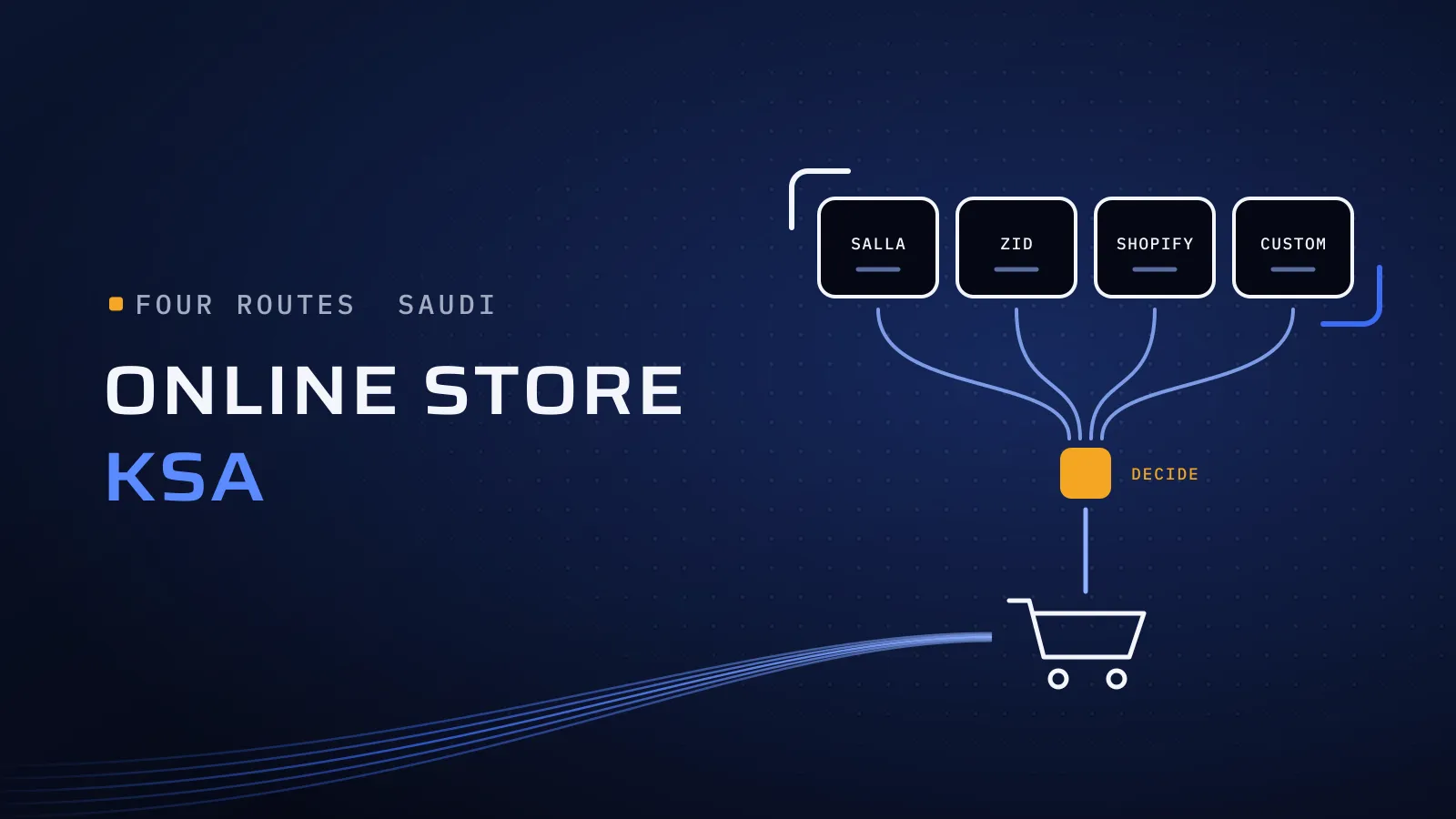
An e-commerce website in Saudi Arabia is mostly a choice between renting a store and owning one: Salla, Zid and Shopify rent you a store, and a custom build is yours. Whichever you choose, the same Saudi rules apply: an authenticated store, prices with VAT, e-invoices and a licensed payment provider.
Salla, Zid, Shopify or custom: which fits a Saudi store?
Quick answer: Start on Salla or Zid if you sell standard products in the Kingdom: both are Arabic first, take mada, Apple Pay and pay-later through their own payment service, connect couriers and issue e-invoices. Choose Shopify if you sell in several countries from one store; without Shopify Payments in Saudi Arabia, you add a local payment provider and pay Shopify’s third-party fee. Build custom when trade prices, offers, bookings, other sellers or ERP stock rules don’t fit a template.
Planning a Saudi store? Book a free consultation → or send us the proposal you received →
The Saudi rules every online store follows
The platform doesn’t change the law. We checked these official pages on 5 November 2026:
| Rule | What the official source says | What your store needs |
|---|---|---|
| Authentication | Since March 2023, the Ministry of Commerce authenticates online stores on the Saudi Business Center’s Business Platform instead of Maroof, its only approved platform, with a valid commercial registration or freelance document and a commercial bank account (Ministry of Commerce). | Apply at business.sa once the store is live on its domain; show the badge on the store. |
| E-Commerce Law | The seller shows who it is and how to reach it, states the total with taxes and delivery before the order, issues an invoice and protects customer data. Consumers may cancel within 7 days of receiving unused goods, with exceptions, or if delivery is over 15 days late. Fines reach SAR 1 million (E-Commerce Law). | A store information page, the full total at checkout, return, privacy and terms pages, refund statuses. |
| VAT | 15%, mandatory registration above SAR 375,000 of taxable supplies in 12 months. Prices shown to consumers online include VAT, and a registered business displays its VAT certificate on its store (ZATCA e-commerce guideline). | Prices with VAT, and the VAT number and certificate on the store. |
| E-invoicing (FATOORA) | Phase 1, invoices from a compliant electronic system, has applied since 4 December 2021; Phase 2 connects that system to ZATCA in waves (ZATCA). Wave 25 covers VAT revenue above SAR 187,500 in any year from 2022 to 2025, by 1 February 2027 (ZATCA). | A simplified tax invoice per order; in Phase 2 it carries a QR code and reaches ZATCA within 24 hours (ZATCA guideline). |
| Payments | mada, a national payment system owned by the Saudi Central Bank (SAMA), works online and in Apple Pay (SAMA). SAMA licenses pay-later (BNPL) companies, including Tabby and Tamara. | mada, Apple Pay and cards through a SAMA-licensed provider; STC Pay and pay-later if customers ask. |
Selling from outside the Kingdom? ZATCA’s guideline says a non-resident selling to consumers there may have to register for VAT, whatever the value of its sales. Rules change: confirm with the Ministry of Commerce and ZATCA before launch.
The decision table: Salla, Zid, Shopify or a custom store
Checked on each platform’s own pages on 5 November 2026.
| Salla | Zid | Shopify | Custom store | |
|---|---|---|---|---|
| Fits when | You sell standard products in the Kingdom and want to start soon | The same; both include an app for selling in your shops | You sell in several countries from one store, or need apps only Shopify has | Your pricing, checkout or stock rules don’t fit a template, or a website and an app share one back end |
| mada, Apple Pay, STC Pay, pay-later | Salla Payments lists mada, cards, Apple Pay, STC Pay, Tabby and Tamara, with no third-party contract | Zid Pay, with Tamara, Tabby, MisPay, Emkan and Madfu for pay-later | No Shopify Payments in Saudi Arabia: add a provider that takes mada; Shopify’s third-party fee applies | Your SAMA-licensed provider’s API |
| ZATCA e-invoice | Salla says its e-invoices meet ZATCA’s requirements and connect to ZATCA directly | Invoice and tax settings from the Growth plan | Through an app; check it covers Phase 2 | Built into the order flow |
| Couriers | Salla says it connects 300+ local and international carriers without contracts | Zid Ship: one contract, 35 carriers, every region of the Kingdom | A courier app or connector; check yours has one | Your couriers’ APIs |
| Arabic | Arabic first | Arabic first | Storefront translation on every plan; test the theme and checkout in Arabic | Arabic first, English beside it |
| If you leave | Your data exported; the design and apps stay | The same | The same | The code and data, per your contract |
Sources: Salla plans, payments; Zid pricing, payments, shipping; Shopify Saudi pricing, payment countries.
How to read it: Salla and Zid are closer than their marketing suggests. Choose on the plan that includes what you need, payment fees, the couriers covering your cities and the apps you need; load the same ten products on both and try checkout on your phone. If either covers how you sell, start there. We say so, even though we build less.
Which plan you actually need
Plan prices as each platform published them on 5 November 2026. These are the platforms’ fees, not ours:
| Platform | Plans as published | Watch for |
|---|---|---|
| Salla | Basic free; Plus SAR 990 a year or SAR 99 a month; Pro SAR 2,990 a year or SAR 299 a month; Special on request | Online payment and your own domain start at Plus; Pro adds instant VAT activation, staff accounts, CSS and JavaScript. |
| Zid | Starter free; Rise SAR 99 a month; Growth SAR 299 a month; Professional on request | Starter takes bank transfer and cash on delivery only; your own domain starts at Rise; invoice and tax settings and five team members at Growth. |
| Shopify | Basic USD 19 a month paid yearly or USD 27 monthly; Grow USD 54 or 72; Advanced USD 299 or 399; Plus from USD 2,300 | A third-party transaction fee on each order: 2% on Basic, 1% on Grow, 0.6% on Advanced, 0.2% on Plus. |
Payment fees come on top: Zid publishes its Zid Pay rates by plan, and every provider will quote yours for your mix of mada, cards and pay-later. Check any plan against the launch checklist below.
When to move from Salla or Zid to a custom store
Move when several of these are true:
- Your team does by hand what the platform can’t: trade prices, approvals, offers, bookings sold with products.
- Paid apps pile up to cover one process, and they don’t share data.
- Stock lives in your ERP or across branches, and the sync can’t keep up.
- Other sellers want to sell on your store: that is a marketplace, its own project.
- Your website, app and shops need one customer account and order history.
To move without losing sales, keep the platform live until the new store passes QA, export products, customers and orders, and redirect every old link so your Google traffic follows. Keep the domain, and any DNS record that verifies it for the Business Platform. Weighing an app too? Read e-commerce app or website first?
Planning a Saudi store, or outgrowing one? Tell us what you sell, whether you are VAT-registered, the payment methods and couriers you need, and what runs your stock. We reply with the route we would take (Salla, Zid, Shopify or custom) and the phases, team and price behind it. Book a free consultation →
Not ready for a call? Ask for our company profile and we’ll send it to you.
What an online store in Saudi Arabia costs: the team and the phases
On a platform you pay the plan, apps and payment fees above, plus the set-up work. A custom store follows the effort of the team that builds it: a product owner who decides what launches first, a UI/UX designer working in Arabic first, developers, an independent QA engineer who tests payments, refunds and invoices on real phones, and a CTO-level lead when the store connects to your ERP, couriers and payment provider.
The phases: discovery (one order mapped from browse to refund), design in both languages, build and connect, independent QA, then launch. What makes it bigger: extra payment methods, invoices to business buyers, several couriers, stock across branches, two-way ERP sync, an app, and rules only your business has. Our store cost guide details these drivers for the UAE; here, mada, ZATCA and the Business Platform replace the UAE rows. Send us your scope and we reply with the effort, the team and the price.
Launch checklist for a Saudi online store
- Identity: a commercial registration or freelance document, a commercial bank account, and your national address (Zid asks for it to activate payments for individuals).
- Authentication on the Business Platform, with the badge on the store.
- Store information: name, address, contact details, registration number, VAT number and certificate.
- Prices with VAT, and the total with delivery shown before payment.
- E-invoices for every order, with your Phase 2 wave covered.
- Payments: mada, Apple Pay and cards through a SAMA-licensed provider; STC Pay and pay-later if customers ask.
- Policies: return, privacy and terms pages matching the 7-day and 15-day rules.
- Delivery: the cities each courier covers, cash on delivery rules, how a return starts.
- Arabic first: product data, checkout, messages and the invoice.
- Accounts for the domain, platform, payment provider and couriers in your company’s name.
- Test orders: a full and a partial refund, a refused cash order, a pay-later order, an invoice checked field by field.
Where Flojics fits
We build online stores and the systems behind them, on WordPress or custom code, and recommend what fits; if Salla, Zid or Shopify covers how you sell, we tell you so. When you outgrow it, we build the custom store, connected to your ERP, couriers and payment provider. See our e-commerce solutions and how we work with companies in Saudi Arabia.
Our core team are native Arabic speakers who check the Arabic checkout, independent QA tests payments, invoices and both languages, and our team in Egypt works Sunday to Thursday, like Saudi Arabia. Comparing builders? Read how to choose a website design company in Saudi Arabia.
G&D is a gold and diamond marketplace app where trusted sellers showcase jewellery and customers make offers to vendors. Talk to the team that built it: book a meeting.
Send us your store plan, or the quote you received
Since 2014 we have worked with more than 100 clients across the UAE, Saudi Arabia, Qatar, Kuwait, the USA and Canada. Our headquarters is at Dubai Digital Park, and our core team works from Egypt. Send us a store proposal you were given, with anything confidential removed, and we reply with the questions to ask and what we would change before you sign.
Book a free consultation → or send us the proposal you received → We reply by email first and set up a call only if you want one. Asking commits you to nothing, and we sign an NDA first if you ask.
Frequently asked questions
How much does it cost to build an online store in Saudi Arabia?
On Salla, Zid or Shopify you pay the plan, paid apps and a fee on each payment, plus the work of setting the store up. A custom store follows the effort of the team that builds it: a product owner, a designer, developers, independent QA and a technical lead when the store connects to your systems. Extra payment methods, invoices to business buyers, several couriers, stock across branches and ERP sync make it bigger. Send us your scope; we reply with the effort, the team and the price.
Salla or Zid: which is better for a Saudi store?
They are closer than their marketing suggests. Both are Arabic first, take mada, Apple Pay and pay-later through their own payment service, connect couriers and publish a merchant API. Compare the plan that includes what you need, the payment fees for your mix of cards, the couriers that cover your cities and the apps you need. Neither free plan takes online card payments.
Can I use Shopify in Saudi Arabia?
Yes, but Shopify Payments isn't available in Saudi Arabia, so you add a payment provider that takes mada and pay Shopify's third-party transaction fee on each order: 2% on Basic, 1% on Grow, 0.6% on Advanced and 0.2% on Plus, as Shopify's Saudi pricing page showed on 5 November 2026. Test the theme and checkout in Arabic, and use an app for ZATCA e-invoices.
Do I still need Maroof for my online store?
No. Since March 2023 the Ministry of Commerce has authenticated online stores on the Business Platform of the Saudi Business Center (business.sa) instead of Maroof, and calls it the only approved platform. You need a valid commercial registration or freelance document and a commercial bank account.
Does my online store need ZATCA e-invoicing?
If you are VAT-registered, yes. Phase 1, invoices issued by a compliant electronic system, has applied since 4 December 2021. Phase 2 connects that system to ZATCA wave by wave; Wave 25 covers VAT revenue above SAR 187,500 in any year from 2022 to 2025, integrated by 1 February 2027. In Phase 2, each simplified invoice carries a QR code and reaches ZATCA within 24 hours.
When should we move from Salla or Zid to a custom store?
When your team does by hand what the platform can't (trade prices, offers, bookings), paid apps pile up to cover one process, stock in your ERP or branches won't stay in step, other sellers want to sell on your store, or your website, app and shops need one order history.