How to Choose a Website Design Company in Saudi Arabia: A Guide for Riyadh and Jeddah
Website design company in Saudi Arabia: what a Riyadh or Jeddah site needs, Arabic-first design, Saudi rules, questions to ask and how to compare quotes.
Choosing a website design company in Saudi Arabia comes down to what happens after launch, not the demo. Your buyers read the site in Arabic first, usually on a phone, and many message you on WhatsApp instead of using a form. Pick the company that designs Arabic first, gets you found in Arabic searches, sends every enquiry to sales, and shows your business details the way Saudi rules ask. Then compare quotes by roles and phases, not the total.
How do you choose a website design company in Saudi Arabia?
Quick answer: Shortlist companies that can open a live Arabic site they designed, then test five things: Arabic designed first, not mirrored; a separate URL per language, so Google finds you in both; forms and WhatsApp that reach your sales team and CRM; your legal name and commercial registration in the footer, plus the store details Saudi rules ask for if you sell online; and the domain, hosting and editor in your company’s name. Compare quotes by roles and phases. A company in Riyadh or Jeddah, or a remote team on the same Sunday to Thursday week, can pass this test.
Comparing website design companies? Book a free website consultation → or send us the proposal you received →
What an English-first website costs a Saudi business
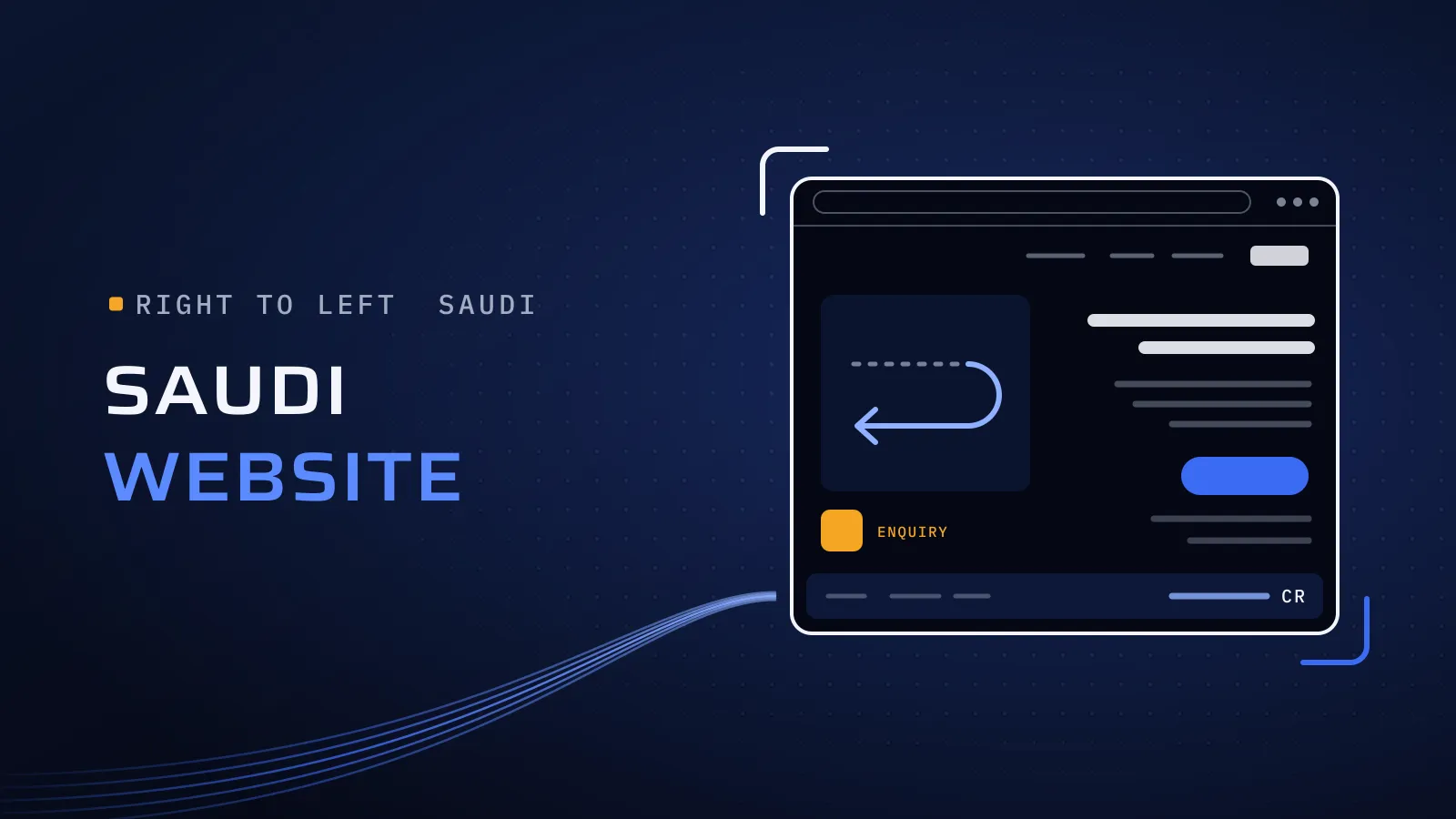
Many Saudi company sites are designed in English and flipped into Arabic at the end. It shows on day one: arrows point the wrong way, a Latin font stands in for Arabic headings, phone numbers break, and buttons cut off Arabic labels. The Arabic pages share the English URLs, so Google rarely shows them to Arabic searchers, and enquiries sit in a mailbox nobody reads on Thursday evening. Each loses buyers quietly, and the fix is reopening every page.
Arabic first: what to check in the design
Ask for the Arabic designs in the first design round, not after the English is approved:
- Layouts designed for Arabic, not mirrored. Menus, steps and “next” arrows run right to left; logos, play buttons, ticks, phone numbers and Latin brand names don’t flip.
- An Arabic typeface chosen on purpose, with sizes and line spacing set for Arabic. No letter-spacing: it breaks the joined letters.
- Real Arabic text in every template. Arabic headlines and buttons rarely match the English length, and a Latin name inside an Arabic sentence can push punctuation to the wrong end.
- One choice for digits, Western (0-9) or Arabic-Indic (٠-٩), used everywhere, with forms that accept both, because visitors type phone numbers on Arabic keyboards.
- Saudi formats: mobile numbers typed with 05 or the 966 country code, and Hijri dates where your audience expects them.
- English copy written for English readers, not translated word for word.
- A check by someone who reads Arabic, on a real phone, before launch.
Found in Arabic on Google
Google’s guidance for multilingual sites sets out the basics:
- A separate URL for each language, not a language switched by cookie or browser setting, with hreflang tags so each searcher gets the right version.
- No automatic redirects by language: they can hide one version from visitors and search engines.
- The whole page translated. Google reads a page’s language from its visible content, so an Arabic menu on an English page still makes an English page.
Then write the way Saudis search. Many drop the hamza: Google suggests «تكلفة تصميم موقع الكتروني في السعودية», not «إلكتروني». Write titles and headings in Arabic from the phrases your buyers type, with a page per service, and a city page only when you have something real to say about Riyadh or Jeddah.
Enquiries that reach sales: forms, WhatsApp and your CRM
Ask the company where each enquiry ends up:
- Short forms, routed by service, that create a lead in your CRM or reach the right inbox, with spam protection that works for Arabic visitors.
- A WhatsApp button that opens a chat with a ready message naming the page or service.
- The source recorded for each form and WhatsApp click: the page, campaign or search that brought it.
- An automatic reply in the visitor’s language, saying when your team will answer, Friday and Saturday included.
- A test before launch: every form sent in both languages and traced to where it lands.
Saudi business details your website should show
Saudi rules ask more of a site that sells than of one that presents a company. The official texts, checked on 5 November 2026:
| Your site | What the official text says | What to put on the site |
|---|---|---|
| Any company website | The E-Commerce Law (Royal Decree M/126, 2019) counts selling products, providing services or advertising them by electronic means as e-commerce. Article 6 asks a service provider to show its name, address (unless registered with an e-store authentication body), contact details, and commercial registration name and number. | Legal name, commercial registration number, address, phone and email in the footer of both languages. Ask your legal adviser whether Article 6 covers your site; the line costs nothing either way. |
| A site that sells online | The same law asks for the terms and the total price with all charges, taxes and delivery fees (Article 7), an itemised invoice (Article 8), and the merchant’s online store entered in the Commercial Register (Article 15). | Price, VAT and delivery before payment, terms in both languages, an invoice per order. Our guide to online stores in Saudi Arabia compares the platforms. |
| A VAT-registered seller | ZATCA’s e-commerce guideline (Issue 2, May 2026): a resident taxable person displays its VAT registration certificate at its main place of business, branches and electronic stores, and final prices announced to consumers on websites, platforms or apps include VAT. | The VAT certificate on the store, and prices shown with VAT at 15%. |
| A government entity | The National Cybersecurity Authority’s Essential Cybersecurity Controls (ECC 2-2024) apply to government entities. | Give every bidder the controls you follow, and ask how hosting, updates and access will meet them. |
Texts change, so check the current version before launch.
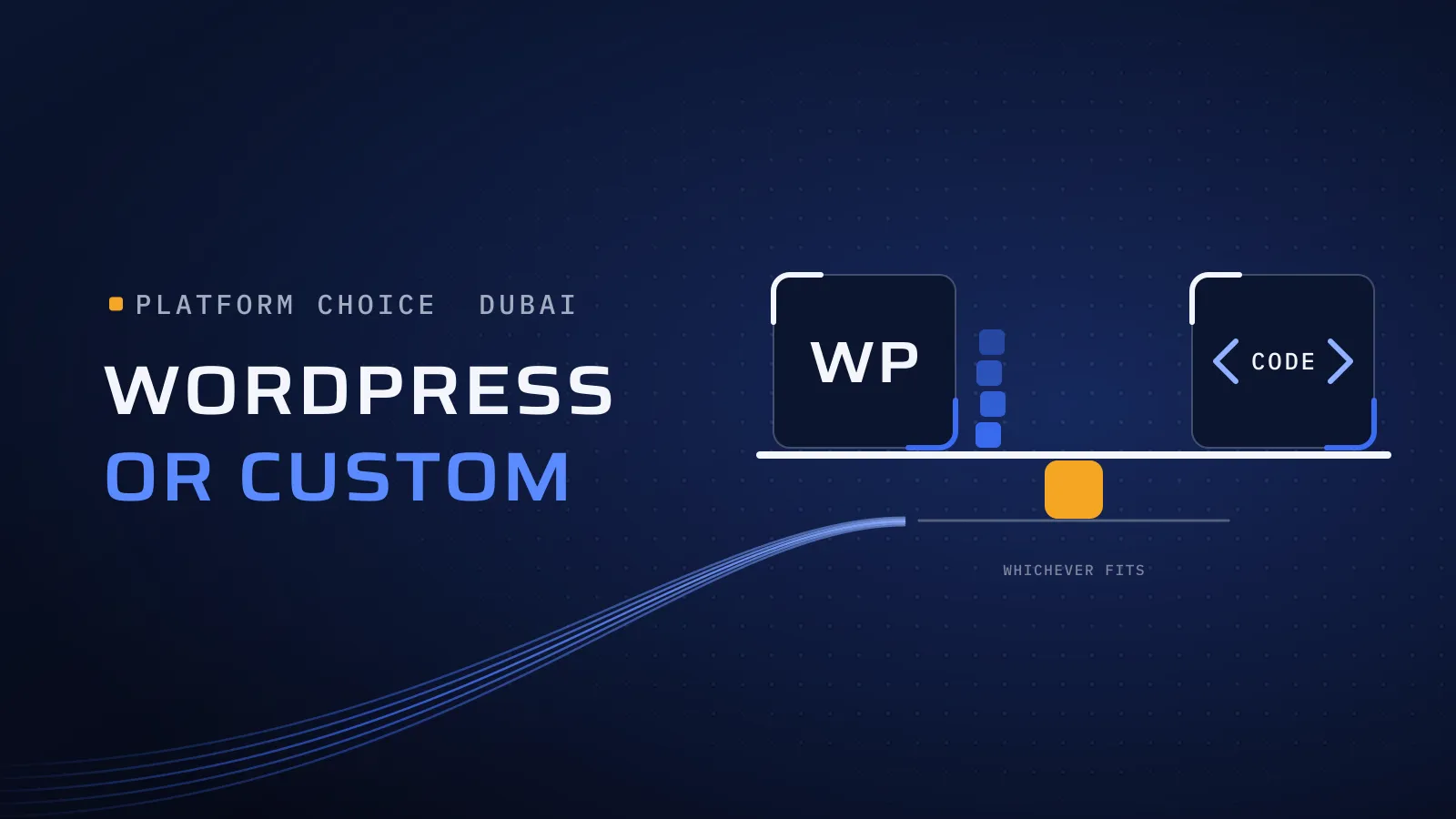
WordPress or a custom build?
We build both; the answer depends on what the site has to do:
| WordPress | Custom build | |
|---|---|---|
| Fits when | A company site with services, projects and articles your team updates often | The site is part of a system: accounts, bookings, calculators or a portal linked to your systems |
| Arabic | A right-to-left theme and a multilingual plugin; check both, and every plugin, in Arabic | Designed in both languages from the first screen |
| Editing | A familiar editor, with an Arabic admin | An admin with exactly the fields your team needs |
| After launch | Regular updates to WordPress, the theme and each plugin | Fewer third-party parts; most changes need a developer |
| Ask about | Paid themes and plugins, their licences, and who pays | Who maintains the code, and the documentation you get |
How to read it: most company sites fit WordPress; choose custom when a feature doesn’t fit a plugin, not because it sounds more serious. Our guide to WordPress or a custom-built website covers the decision in detail.
Questions to ask every website design company
Send these, in writing, to every company on your shortlist:
- Can we open a live Arabic site you designed on our own phones?
- Who writes the Arabic copy, and who reviews the Arabic screens?
- Will each language have its own URLs, and how will Google tell them apart?
- Where do form enquiries and WhatsApp clicks go, and how do we see which page brought them?
- What can our team edit in Arabic without you?
- WordPress or custom for us, and why? Which paid themes, plugins or licences does it need?
- Which business details will the footer show, and does the quote cover the store rules if we sell?
- Who designs, builds and tests, and who is our contact? Does someone other than the developers test?
- What are the phases, and what do we approve at the end of each?
- Whose name are the domain, hosting, analytics and editor accounts in, and what happens after launch?
Already holding a website proposal? Send it to us with anything confidential removed. We reply with the questions to ask that company and what we would change before you sign. Send us the proposal → Planning from scratch? Book a free website consultation →
Comparing companies with your team first? Ask for our company profile and we’ll send it to you.
Red flags in a website proposal
| Red flag | Why it matters | Ask for instead |
|---|---|---|
| “We translate once the English is approved” | Mirrored layouts, and every page reopened later | Arabic designs in the first design round |
| One total with no breakdown | You can’t see what is missing or compare quotes | Roles, phases and what is out of scope |
| The domain or hosting in the agency’s name | You can’t change provider without their help | Accounts in your company’s name, the agency invited as a user |
| Unlicensed copies of paid themes or plugins | No security updates, and a risk of hidden malicious code | Every paid theme and plugin listed with its licence |
| A promised first-page Google ranking by a set date | Nobody controls Google’s results | How the pages are built to be found in Arabic and English |
Website design cost in Saudi Arabia: what moves the price
A price is the effort of the people who build the site. A company website usually needs:
- a delivery lead for the plan, the approvals and your questions;
- a UI/UX designer for every template in Arabic and English;
- a copywriter or translator, if the quote includes the content;
- developers on WordPress or custom code, for templates, the editor and the CRM and WhatsApp links;
- a QA engineer, separate from the developers, who tests both languages and every form on real phones.
The phases: discovery (pages, languages, where enquiries go, the details to show), design in both languages, build and connect, independent testing, then launch and care.
It gets bigger with more page templates (not more pages reusing them), both languages designed rather than one translated, copy and photos made for you, links to a CRM or booking system, features no plugin covers, and selling online, a store project of its own.
Our guide to website design cost explains each driver; they work the same way in Riyadh or Jeddah. Redesigning? Our website redesign guide shows how to keep your Google traffic. Send us your page list and languages; we reply with the phases, the team and the price.
Where Flojics fits
We are a website design company for businesses in Saudi Arabia, working with companies in Riyadh, Jeddah, Dammam and across the Kingdom without an office there. Our headquarters is at Dubai Digital Park in Dubai Silicon Oasis, and our delivery team works from Egypt on the Saudi week, Sunday to Thursday: no time difference from late April to late October, one hour in winter. We build on WordPress and custom code and tell you which fits. Native Arabic speakers on our core team check every Arabic screen; independent QA tests both languages and every form. We don’t sell hosting, so it stays in your accounts.
- Massart is a no-code app generator from our work in Saudi Arabia: businesses build and publish iOS and Android apps with drag-and-drop tools. Talk to the team that built it: book a meeting.
- Abdulhameed Aljasmi Advocates is a law firm with offices in Dubai and Cairo whose multilingual website we designed. Talk to the team that built it: book a meeting.
Send us your current site, or the proposal you received
Since 2014 we have worked with more than 100 clients across the UAE, Saudi Arabia, Qatar, Kuwait, the USA and Canada. Send us your current site, page list or another company’s proposal.
Book a free website consultation → or send us the proposal you received → We reply by email first and set up a call only if you want one. Asking commits you to nothing, and we sign an NDA first if you ask.
Frequently asked questions
How do I choose a website design company in Saudi Arabia?
Shortlist companies that can open a live Arabic site they designed, then check five things: Arabic designed first rather than mirrored, a separate URL for each language so Google finds you in Arabic, forms and WhatsApp that reach your sales team and CRM, your business details in the footer, and the domain and hosting in your company's name. Send every company the same questions and compare quotes by roles and phases.
How much does website design cost in Saudi Arabia?
It follows the effort of the team that builds the site: a delivery lead, a UI/UX designer, developers, independent QA and, if the content is in the quote, a copywriter or translator. It grows with the number of page templates, both languages designed, copy and photos made for you, links to a CRM or booking system, features no plugin covers, and selling online. Send us your page list and languages; we reply with the phases, the team and the price.
What business details should a Saudi company website show?
Your legal name, commercial registration number, address and contact details, in both languages. Article 6 of the E-Commerce Law asks a service provider to show them, and the law counts advertising products or services by electronic means as e-commerce, so ask your legal adviser whether it covers your site. Under ZATCA's e-commerce guideline, a VAT-registered online store also displays its VAT registration certificate, and prices announced to consumers include VAT.
Should our Saudi website be WordPress or custom-built?
WordPress fits most company sites with services, projects and articles the team updates often, as long as the theme and every plugin work properly in Arabic. A custom build fits when the site is part of a system, such as accounts, bookings, calculators or a portal linked to your own systems. We build both and recommend what fits.
Can the Arabic site be a mirror of the English one?
Not if you want it to work. Flipping an English design leaves arrows pointing the wrong way, Latin fonts in Arabic headings, broken phone numbers and buttons that cut off Arabic labels. Design the Arabic templates in the first design round, give each language its own URLs, and have someone who reads Arabic check every screen on a phone.
Do you work with companies in Riyadh and Jeddah?
Yes, remotely. We have no office in Saudi Arabia: our headquarters is at Dubai Digital Park, and our delivery team works from Egypt on the Saudi week, Sunday to Thursday, with no time difference from late April to late October and one hour in winter.