Pharmacy App Development in the UAE: Prescriptions, Delivery and the Licences to Check
Pharmacy app development in the UAE: prescription upload and pharmacist review, insurance, what can't be delivered, and the DHA, DoH and MOHAP approvals.
A pharmacy app in the UAE is a licensed pharmacy working through a phone, not a shop with medicines in its catalogue. A pharmacist checks every prescription order, the regulator approves how the pharmacy delivers, and some medicines can’t leave the counter at all. Put those rules into the scope before the first screen, and the app gets approved and used; leave them out, and the order flow is rebuilt after launch.
What does a pharmacy app in the UAE need?
Quick answer: Three parts that share one order: a patient app (catalogue, prescription upload, insurance card, checkout, tracking and refills), a pharmacist console where every prescription is checked before it is dispensed, and delivery that proves who received the medicine. Three rules shape all of it. The pharmacy, not the app, holds the approval to dispense online and deliver: from DHA in Dubai, DoH in Abu Dhabi, or MOHAP’s online and home delivery permits. Prescription-only medicines wait for a pharmacist’s check. Narcotic, controlled and semi-controlled medicines may not be delivered in Dubai, and need DoH’s special authorisation in Abu Dhabi. Confirm your approvals with your regulator, then scope the app around them.
Planning a pharmacy app? Get an estimate for your pharmacy app → or send us the proposal you received →
What a pharmacy app built like a shop costs you
Many pharmacy apps start as an online store template with a prescription field added. The gaps show on real orders. A prescription item reaches the cart with nobody to check it. A patient with insurance is asked for the full price and closes the app. A fridge item leaves in an ordinary bag. A driver is sent with a controlled medicine that can’t be handed over. Each one becomes a refund, a complaint or a question from the inspector, and the fix is a rebuilt order flow, not a new screen.
Which approvals does a UAE pharmacy app depend on?
The app runs on the pharmacy’s licence. Each emirate’s health regulator decides how a licensed pharmacy may dispense online and deliver, and federal law sets rules for every pharmacy. Here is what the official documents say, checked on 29 October 2026:
| Who | What the official document says | What it means for the app |
|---|---|---|
| Dubai Health Authority (DHA) | Its Pharmacy Guidelines require DHA approval to dispense through a delivery system: telepharmacy approval for prescription-only medicines, with licensing requirements that cover electronic platforms, websites and mobile apps, and a home delivery add-on for over-the-counter medicines and general products. A courier company is named in the application, and the pharmacy and its pharmacist in charge stay fully responsible. Narcotic, controlled and semi-controlled medicines may not be delivered. | The app is part of the approval, so plan it with your pharmacist in charge before the build. Keep prescription and over-the-counter orders as separate flows. |
| DHA, for online dispensing | Its Standards for Telehealth Services (version 4, in effect from 26 November 2025) say the online prescription system must verify the DHA-licensed doctor and the prescription, the patient and the pharmacist. The pharmacy must stop one prescription being filled twice, track medicines and recalls, show its licensed name, its pharmacist in charge, its pharmacists, its address and phone, and tell patients all costs, delivery included, in advance. | These are features, not paperwork: verification in the review queue, a lock on filled prescriptions, recall tracking, a pharmacy information page and the full price before payment. |
| Abu Dhabi Department of Health (DoH) | Its Standard on Delivery of Pharmacy Medication (the February 2020 version) requires DoH approval after an audit, and written or electronic consent before delivery, recording the Emirates ID, insurance details where the medicine is covered, the address and anyone authorised to receive it. It asks for an Emirates ID check at the door and delivery within 2 working days of the agreed date. Narcotic, controlled and semi-controlled medicines need DoH’s special authorisation, and complex regimens prescribed for the first time are not delivered; refills are. | A consent step at sign-up, an authorised-receiver field, an ID check in the driver app and delivery dates the system watches. |
| Ministry of Health and Prevention (MOHAP) | MOHAP issues an online community pharmacy permit and a home delivery permit for community pharmacies. | Ask MOHAP which permit your pharmacy needs, and what it asks of the app, before you fix the scope. |
| Federal law | Federal Decree-Law No. 38 of 2024, in force since 2 January 2025, lets pharmacies and pharmacy chains provide their services electronically under a system set by the Minister or the emirate’s health authority (Article 90). It bars dispensing prescription medicines without a prescription (Article 75), and advertising or promoting medical products by any means, social media included, without the Emirates Drug Establishment’s approval (Article 44). | Hold prescription items at checkout until the pharmacist approves the prescription. Banners and push offers for medical products need an approval route. |
Documents change. Before you fix the scope, confirm with your regulator (DHA, DoH or MOHAP) which approval your pharmacy holds or needs, and what it asks of the app.
What this means for you: bring your pharmacist in charge into the first workshop, not the launch week. They carry the responsibility for every delivery under the approval, and many of the app’s rules come from it.
The prescription flow, from upload to the pharmacist’s check
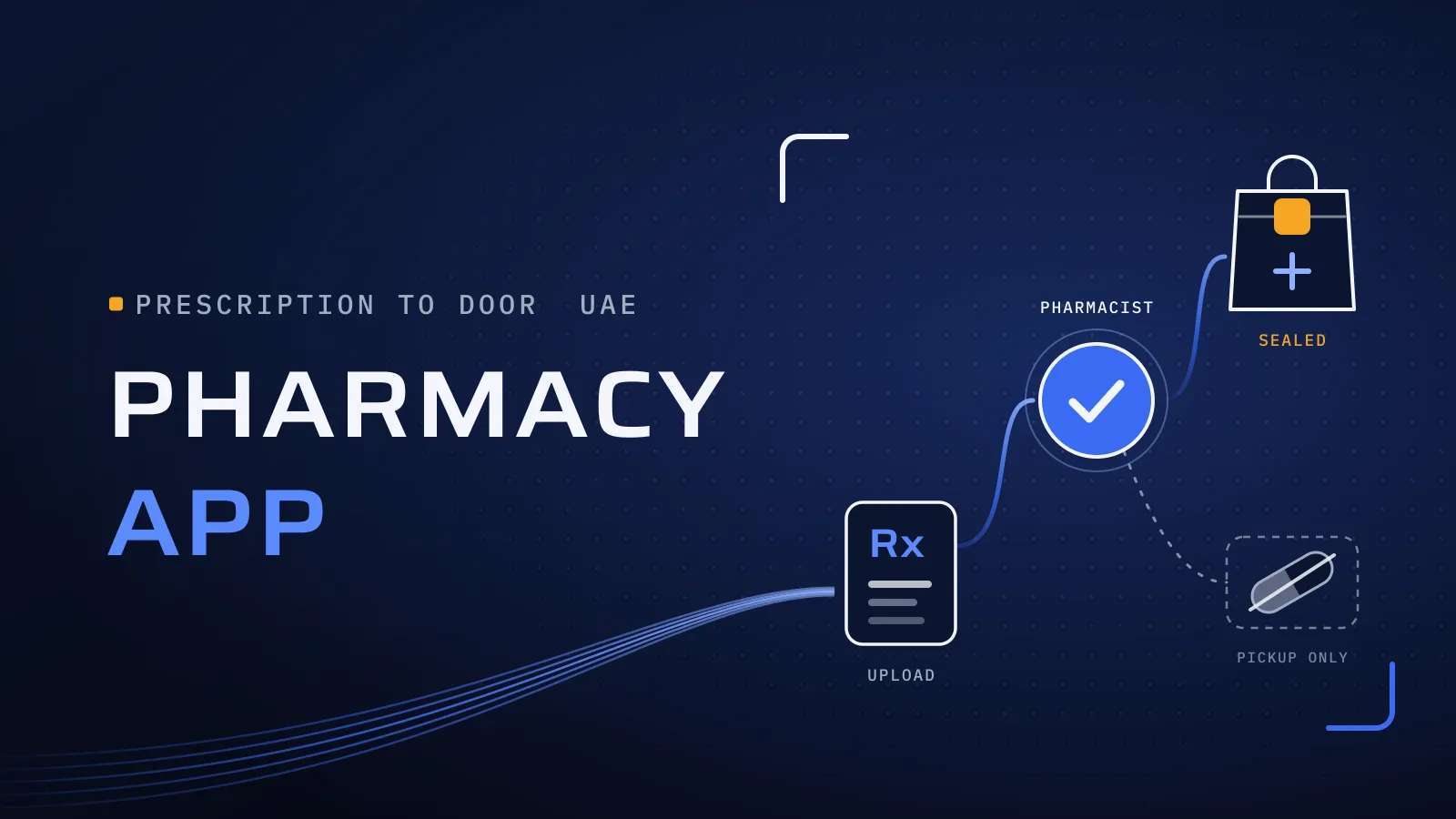
The prescription flow is where a pharmacy app differs from every other delivery app. A workable flow has six steps:
- Upload or receive. The patient photographs every page of the prescription, or it reaches the pharmacy electronically from the doctor. The app checks that the photo is sharp and complete before it is sent, so the pharmacist doesn’t have to ask twice.
- Verify. In a review queue, the pharmacist confirms the prescriber, the prescription and the patient: the three checks DHA’s telehealth standards name for an online prescription system.
- Review. The pharmacist checks doses, interactions and allergies, calls the doctor if something is unclear, and approves, approves in part or declines with a reason the patient can read.
- Counsel. The pharmacist explains how to take the medicine by chat or call from the console, and the note stays with the order. DHA’s guidelines expect counselling records in the delivery audit trail.
- Lock. Once dispensed, the prescription is marked as filled, so it can’t be sent to a second pharmacist.
- Refill. Patients on monthly medicine reorder from their history. The federal law leaves the conditions for repeat dispensing to its executive regulations, so ask your regulator before you build automatic reminders.
One Abu Dhabi detail changes the design. In the 2020 version of DoH’s standard, the pharmacist prepares a delivery only once the original or electronic prescription is at the pharmacy, and the driver collects a paper prescription at the door unless it is electronic. The photo then serves the review, and the original still comes back. Ask DoH how its current version treats an uploaded image.
Where prescription photos and patient records are stored matters as much as the screens. Our page on healthcare app development in Dubai sets out where health data may be kept in each market.
Insurance: the step that decides whether patients finish the order
Many patients ask about their share of the price, not the price. If the app can’t answer, they call or walk in, and the app becomes a catalogue.
- Capture once. The insurance card and the Emirates ID are added with the first prescription and saved to the profile.
- Request approvals the way your counter does. Your pharmacy team requests any approval the insurer requires. DHA’s telehealth standards list contacting insurers for required approvals among the electronic pharmacy services a pharmacist may provide.
- Show the share before checkout. The patient sees what the insurer covers and what they pay, and pays only that.
- Handle a partial approval or a rejection. A clear message and a choice: pay for the item, take an alternative the pharmacist proposes, or remove it.
- Make waiting visible. “Waiting for insurer approval” is a status with a notification, not silence.
Whether your pharmacy system already talks to insurers decides whether the app reads approvals automatically or your team updates them from the console. Find out in discovery: it moves the effort more than any screen.
What a pharmacy app can’t sell or deliver
| Item | The rule | How the app handles it |
|---|---|---|
| Narcotic, controlled and semi-controlled medicines | DHA: may not be delivered, and can’t be prescribed or dispensed through telehealth services. DoH: excluded unless DoH grants special authorisation. | Flagged from your pharmacy system and never offered for delivery; the app tells the patient to collect them at the pharmacy. |
| Prescription-only medicines | No dispensing without a prescription (federal law, Article 75). | Held at checkout until the pharmacist approves the prescription. |
| Complex regimens prescribed for the first time (Abu Dhabi) | Not delivered under DoH’s standard; refills are. The pharmacist may also refuse to deliver a high-risk medicine and ask the patient to collect it. | The pharmacist switches the order to collection from the console, with a message to the patient. |
| Fridge items | DHA: kept within +2 to +8 °C in transport, with evidence that the limits weren’t exceeded. | Flagged as cold chain, assigned only to drivers carrying cool boxes, and logged at dispatch and at handover. |
| Promotions for medical products | Advertising or promoting medical products needs the Emirates Drug Establishment’s approval (federal law, Article 44). | Banners and push offers on medical products pass an approval step in the admin panel. |
Planning your pharmacy app? Send us:
- your pharmacy: one branch, a chain, or a platform for several pharmacies;
- your emirate, and the approvals you hold or have applied for;
- how prescriptions and insurance approvals run at your counter today;
- your own drivers, a courier company, or both;
- your pharmacy system, and whether you need Arabic at launch.
We reply with the scope we would build first, and the effort, the team and the price behind it. Get an estimate for your pharmacy app →
Not ready for a call? Ask for our company profile and we’ll send it to you.
Delivery: what the driver app has to prove
Dispatch, zones and live tracking work as in any delivery app, and our delivery app guide covers them. A pharmacy adds proof at every step:
- Who received it. An Emirates ID check at the door before the driver can close the order: DoH asks for it, and DHA asks for an Emirates or patient ID on prescription deliveries. The order records who else may receive it; under DHA’s delivery rules for over-the-counter items, another adult receives it only with the customer’s approval.
- Sealed, labelled and receipted. Medicines go in their original packs and leaflets, inside a sealed container that hides what is in it, labelled to match the prescription. DHA asks for a receipt naming the dispensing pharmacist and the pharmacy, and accepts an emailed acknowledgement, so the app can send it.
- The pharmacist talks about medicine, not the driver. DHA’s guidelines say the person delivering should avoid discussing medication with the patient, so questions go to the pharmacist chat, one tap from the tracking screen.
- An audit trail. The patient, the address, items needing special storage, counselling notes and the person who received the order, kept for every delivery.
- Nothing stays in the car overnight. Under DoH’s standard, undelivered items go back to the pharmacy, so “returned to pharmacy” is a status, not a note.
- Couriers keep the same proof. A courier company works under your approval and your pharmacist in charge’s responsibility, so its app or integration must send back the same ID check and handover record.
- Recalls and delays. DHA expects a way to tell patients about delays and known recalls. With batch numbers recorded at dispensing, the app can message everyone who received a recalled batch.
One pharmacy, a chain or a platform for many?
| One pharmacy | A pharmacy chain | A platform for several pharmacies | |
|---|---|---|---|
| Who dispenses | Your pharmacist in charge | Each branch’s pharmacists | Each partner pharmacy, under its own licence |
| What the app adds | Prescriptions, insurance and delivery for one stock | Routing by area and stock, reports per branch | Pharmacy sign-up, routing between pharmacies, payouts, each pharmacy’s licence details on its page |
| Ask your regulator | Which approval covers the app and your couriers | Whether one approval covers every branch | Whether the platform itself needs a licence, and how the partners’ approvals apply |
How to read it: move right only when the business needs it. Each column adds approvals to check as well as features to build.
What drives the cost of a pharmacy app?
The cost is the effort of the team that builds it. A first release usually involves:
- A delivery lead, who runs the plan and the risks and works through the approval requirements with your pharmacist in charge.
- A UI/UX designer for the patient app, the pharmacist console and the driver app, in Arabic and English.
- Mobile developers, often in Flutter, for iOS and Android from one codebase.
- A back-end developer for orders, prescriptions, insurance status, delivery and the admin panel.
- A QA engineer, separate from the developers, who tests the paths that carry risk: a declined prescription, a partial insurance approval, a controlled item in the cart, a failed ID check.
The effort moves most with:
- The model: one pharmacy, a chain or a platform, as in the table above.
- Your pharmacy system. Stock, prices, restricted-item flags and batch numbers should come from it, not be typed twice. DHA’s telehealth standards tie medicine prices to the MOHAP and DHA price list, so the app shows the prices your system holds.
- Insurance: approvals updated from the console, or read from the systems your pharmacy already uses.
- Delivery: your own drivers with cool boxes, a courier company, or both.
- Consultation: a pharmacist chat is small; video consultations with prescribing doctors are a telehealth service with their own rules.
- Arabic and English from the first release: product names, instructions, notifications and the pharmacist chat.
Send us your scope and we reply with the effort, the team and the price, phase by phase. For how app cost works in general, see our mobile app development cost guide.
Already holding a quote for a pharmacy app? Send it to us with anything confidential removed. We reply with the questions to ask, starting with prescriptions, insurance and restricted items, and what we would change before you sign. Send us the quote →
Release one: what to launch and what to add later
| Area | Launch with | Add later | Add it when |
|---|---|---|---|
| Patient app | Catalogue, search, prescription upload, insurance card, checkout, tracking | Family profiles, saved baskets | Patients order for parents and children |
| Pharmacist console | Review queue with verification, approve or decline with reasons, counselling notes, the filled-prescription lock | Workload by pharmacist, review-time reports | More than one pharmacist reviews at a time |
| Insurance | Card capture, status messages, the patient’s share before payment | Approvals read from your systems | Your team keys in approvals by hand every day |
| Delivery | ID check, authorised receiver, sealed-bag checklist, receipt, returns to pharmacy | Courier integration, delivery slots | Your drivers can’t cover peak hours |
| Cold chain | Fridge flag, driver assignment, logs at dispatch and handover | Readings from temperature loggers in the cool boxes | Fridge items become a regular share of orders |
| Refills | Reorder from history, reminders where your regulator allows | Refill requests sent to the patient’s doctor | Many patients are on long-term medicine |
Where Flojics fits
We are a mobile app development company in Dubai, building patient apps, staff consoles and admin panels in Flutter, React Native and native Swift and Kotlin. Quality built into every step: CTO oversight settles how prescriptions, insurance and delivery share one order record before the screens are drawn, and independent QA tests the paths where a mistake reaches a patient.
We built Sparx, a pharmacy app where users upload prescriptions for pharmacist review, get medication delivered and request monthly refills. Talk to the team that built it: book a meeting.
Bring your approvals and your order flow
Since 2014 we have worked with more than 100 clients across the UAE, Saudi Arabia, Qatar, Kuwait, the USA and Canada. Our headquarters is at Dubai Digital Park, and our core team works from Egypt. Send us your emirate, the approvals you hold and how an order runs at your counter today.
Get an estimate for your pharmacy app → or send us the proposal you received → We ask about your goal, what you use today, your timing and who else should be involved. You leave with clear next steps. We reply by email first and set up a call only if you want one. Asking commits you to nothing, and we sign an NDA first if you ask.
Frequently asked questions
How much does it cost to develop a pharmacy app in the UAE?
It follows the effort of the team that builds it: a delivery lead, a designer, mobile and back-end developers and independent QA. The model moves it most (one pharmacy, a chain or a platform for several pharmacies), then the link to your pharmacy system, insurance approvals, delivery and Arabic. Send us your scope; we reply with the effort, the team and the price.
Do I need a licence to launch a pharmacy app in the UAE?
The pharmacy that dispenses needs its regulator's approval to dispense online and deliver. In Dubai, DHA approves telepharmacy for prescription medicines and a delivery add-on for over-the-counter items. In Abu Dhabi, DoH approves delivery after an audit. MOHAP issues online and home delivery permits for community pharmacies. If you run a platform for other pharmacies, ask your regulator whether the platform itself needs a licence.
Can a pharmacy app in the UAE deliver prescription medicines?
Yes, with the regulator's approval, once a pharmacist has checked the prescription, and with an Emirates ID check at the door. Narcotic, controlled and semi-controlled medicines may not be delivered in Dubai, and need DoH's special authorisation in Abu Dhabi.
Can patients just upload a photo of their prescription?
A photo works for the pharmacist's review. In Dubai, the online prescription system must verify the doctor, the prescription and the patient. In the 2020 version of Abu Dhabi's delivery standard, the original or electronic prescription must be at the pharmacy, and the driver collects a paper prescription at the door, so ask DoH how its current version treats photos.
How do insurance approvals work in a pharmacy app?
The patient adds the insurance card and Emirates ID once. Your pharmacy team requests any approval the insurer needs, the app shows the patient's share before payment, and a partial approval or a rejection comes with a clear choice: pay for the item, take an alternative the pharmacist proposes, or remove it.
Can we promote medicines with banners and push notifications?
Under the federal law, advertising or promoting medical products by any means, social media included, needs the Emirates Drug Establishment's approval (Article 44). Build an approval step for banners and push offers on medical products, and keep them switched off until your approval route works.