Online Course Platform Development in the UAE: What It Needs and What to Launch First
Online course platform development in the UAE: when an LMS is enough, live or recorded classes, payments, certificates, two languages and what to launch first.
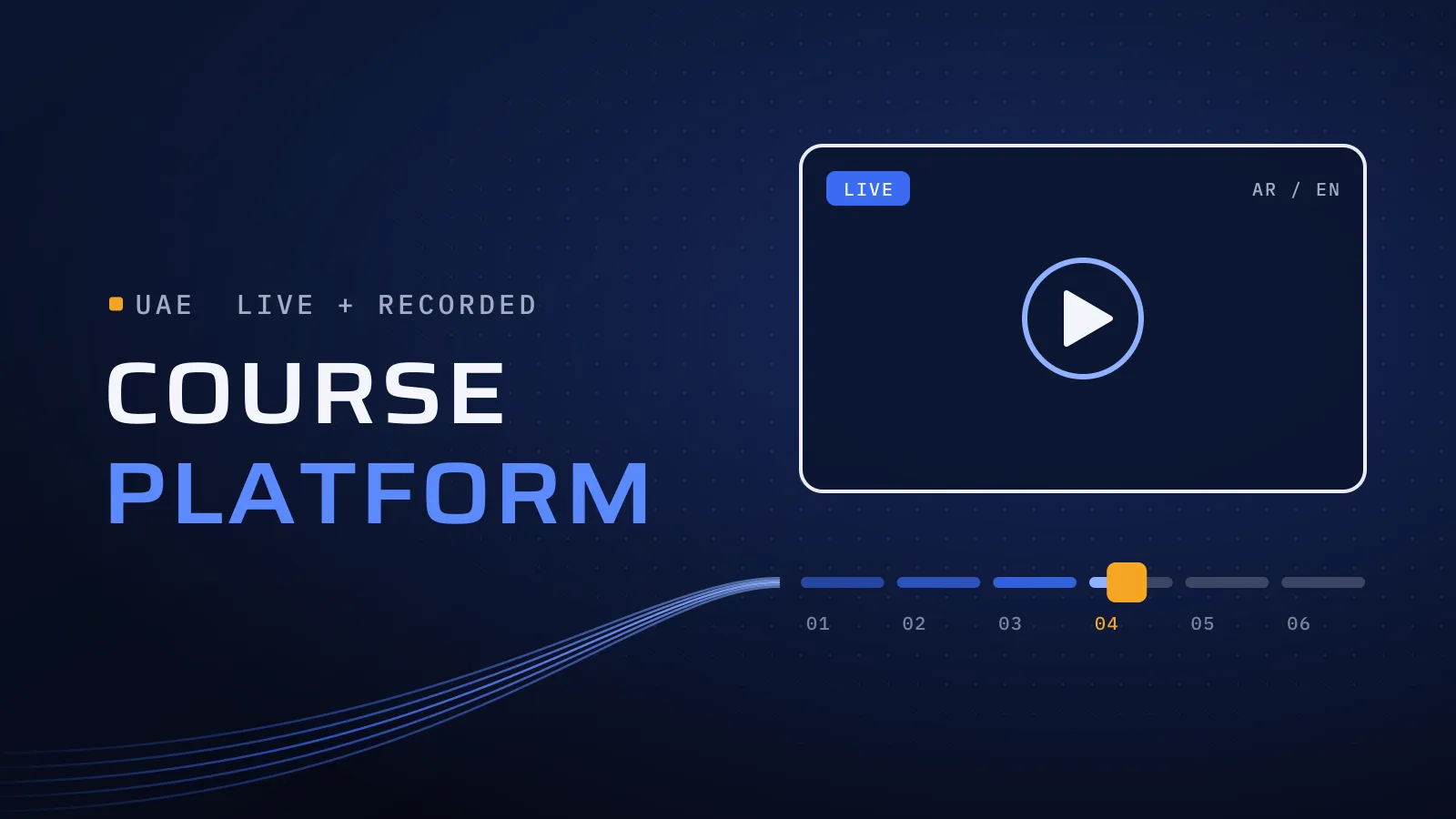
An online course platform is where a training company, tutoring business or school group keeps its learners, or loses them to the next link in a WhatsApp group. Online course platform development in the UAE starts with one decision that saves or wastes most of the budget: whether you need your own platform at all and, if you do, what to launch first.
What does an online course platform need, and should you build one?
Quick answer: An online course or tutoring platform needs four parts: live or recorded lessons, payments, progress records that end in a certificate, and Arabic and English. If you sell recorded courses at one price, an off-the-shelf LMS often does the job. Build your own when tutors, live classes, session packages or your brand are what learners pay for.
What do video links and WhatsApp groups cost you?
Most tutoring and training businesses start with video-call links, a WhatsApp group and bank transfers. It works for the first few dozen learners. Then a teacher is booked twice, a parent asks how their child is doing and the answer sits in three chats, a recorded class is forwarded to people who never paid, and someone spends hours each week matching transfers to names. Each of those moments puts a renewal in doubt. Your own platform puts classes, payments and progress in one place, and shows you who comes back.
Off-the-shelf LMS or a custom platform?
A learning management system (LMS) is ready-made software for hosting courses, enrolling learners and tracking completion, usually paid monthly. Most e-learning platform development in the UAE should start by asking whether one would do. Take this table to your team and, row by row, mark the column that sounds like you.
| Question for your team | Leans to an off-the-shelf LMS | Leans to a custom platform |
|---|---|---|
| What do you sell? | Recorded courses, or training for your own staff | Tutoring, live classes, packages, or a mix of all three |
| How does a learner start? | Enrols in a course | Chooses a teacher by subject, level and free times |
| How do people pay? | One price per course, or a subscription | Per session, session packages, family accounts, company invoices, teacher payouts |
| Who logs in? | Learners and one admin | Learners, parents, teachers, branch managers and your operations team |
| What must it connect to? | A payment link | Your CRM, accounting, school system or HR system |
| Is the platform the product? | No, the courses are | Yes, the experience is what customers pay for |
Mostly left: start with an LMS. If it covers most of what you need, we will tell you so, even though it means we build less. Mostly right: a custom platform pays off, because the parts an LMS can’t do are the parts your customers choose you for. A split is common: an LMS for recorded courses now, and a custom tutoring or live-class platform once the model is proven. Before you sign up for any LMS, check three things: Arabic with a right-to-left layout, the fee it takes on each sale, and a full export of your learners and their progress.
When the answer is custom, it is custom software development in Dubai like any other project: scoped, priced and built in phases.
Live classes, recorded courses, or both?
- Live classes bring learners back, because there is a teacher and a time. They need a timetable, teacher availability, seat limits for groups, a video call that opens from the class page (most platforms connect an existing video service rather than build one), attendance and a recording afterwards. Every class costs a teacher’s hour.
- Recorded courses scale: one recording serves every learner. They need streaming video that isn’t easy to download, lessons in order, quizzes, and progress that resumes where the learner stopped. Their weak point is completion, so short lessons and reminders matter more than more content.
- Both is where most training companies end up: recorded lessons for the theory, live sessions for questions and practice. If that is your plan, design the records for both from day one, even if you launch with one.
Booking and payments: decide before the design
How learners pay shapes the screens, your margin and your admin work.
- Ways to charge: per course, per session, packages of sessions used over a term, monthly subscriptions, and invoices to companies training their staff. Launch with the one or two your customers already use.
- One-to-one lessons are a booking problem. For tutoring app development in Dubai or anywhere in the Gulf, the hard parts are teacher free times, travel time for home lessons and a cancellation rule. Our booking platform guide covers that side in detail.
- The app store rule that moves your margin. Under Apple’s App Store Review Guidelines, recorded courses and other digital content sold inside an iPhone app go through Apple’s in-app purchase (3.1.1). Live one-to-one tutoring can be paid through your own gateway (3.1.3(d)); live classes for groups cannot. Courses sold only to organisations, for their employees or students, follow a separate enterprise rule (3.1.3(c)). Decide where each product is sold before the app is designed: it is easy to plan and slow to change.
Certificates, progress and two languages
- Certificates are issued automatically when a learner meets your rule: every lesson done, a quiz passed or enough classes attended. Add a QR code or link an employer can check, and print the learner’s name in Arabic and English.
- Progress goes to whoever pays. Parents want attendance and teacher notes; companies buying staff training want a report of who enrolled and who finished, by department.
- Arabic and English from the first screen, with a right-to-left layout, Arabic search and subtitles on recorded lessons. Decide early whether each course runs in both languages or the learner picks one, because it changes how courses and certificates are stored.
What should you launch first?
- Choose one way of teaching for one audience, such as one-to-one maths tutoring for secondary students, or one live course for corporate teams.
- Map one learner from sign-up to certificate, including a missed class, a refund and a teacher who cancels, because that is where the rules and the money sit.
- Design for three people: the learner or parent, the teacher and your admin team. Test a clickable prototype with real teachers and learners.
- Build release one, then measure sign-ups, attendance, completion and renewals. Those numbers decide release two.
Release one usually carries the teaching model, one or two ways to pay, progress tracking, certificates if your learners need them, an admin view of teachers, learners and refunds, and Arabic and English. A mobile app can wait if your learners study at a desk, since the web platform works on phones. So can discussion forums, leaderboards, referral codes and automatic teacher payouts.
An MVP like this usually runs as project delivery, with a fixed scope per phase, or as time and materials while the scope is still moving. What drives the price of a first release is in our MVP development cost guide.
Tell us what you teach, who learns and how classes run today. We come back with whether an LMS would do the job and, if not, what your first release could cover.
Not ready for a call? Ask for our company profile and we’ll send it to you.
A tutoring platform in practice: Inck
Inck is the mobile app and web platform we built where students book private lessons with teachers. Talk to the team that built it: book a meeting.
Two of the ways we work matter most on a course platform. UI/UX focus, because a learner, a parent and a teacher each open it for a different reason, and each should finish in a few taps. Scalable architecture, because learners, teachers, sessions, courses and payments share one set of records, so a second branch or a new way of teaching is added, not rebuilt.
Plan your course platform with us
Since 2014 we have built web platforms and mobile apps for more than 100 clients across the UAE, Saudi Arabia, Qatar, Kuwait, the USA and Canada, as a mobile app development company in Dubai with offices in Dubai, Houston and Alexandria.
Talk to us about your MVP → We ask about your goal, what you use today, your timing and who else should be involved. You leave with clear next steps. The call commits you to nothing, and we sign an NDA first if you want one.
Frequently asked questions
How much does an online course platform cost to build?
The price follows the scope: the way of teaching (live, recorded or both), how many kinds of users log in, how payments work and what the platform connects to. We scope a first release with you and price it phase by phase, so the cost is agreed in your proposal and you see each phase's price before you commit to it. If an off-the-shelf LMS would do the job, we tell you before you spend anything on a build.
How long until we can sell our first course or lesson?
The timeline is agreed in your proposal, because it follows the scope. The quickest route is a small first release: one way of teaching, one audience and payments that work. You get a dated release plan before the build starts, so you know when learners can sign up.
Can we move our courses and learners from the LMS we use today?
In most cases, yes. Videos, course outlines, learner accounts and completion records come across through your current system's export, and we check that export before the build is planned. Learners keep their history, and you can run both systems side by side until the move is done.
Do we need a mobile app at launch, or is a website enough?
A web platform that works well on phones is often enough for the first release, especially for recorded courses and staff training. An app earns its place when learners study on their phones every day or need reminders before live lessons. When you add one, decide which courses are sold inside it, because Apple's in-app purchase rules apply to digital content sold in an iPhone app.
Who owns the platform, the code and our course content?
Your company does. Your courses and learner data stay yours, the App Store and Google Play accounts can be in your company's name, and the code passes to you once the project is completed and paid. We sign an NDA first if you want one.
What if learners sign up but don't finish?
Then the platform shows you where they stop: which lesson, which week, which teacher. The next release can answer that with shorter lessons, reminders or more live sessions, based on real data rather than a guess. Because the first release stays small, budget is left for what your learners ask for next.