Egypt vs India Software Developers for GCC Companies, with Eastern Europe Compared
Egypt vs India software developers, plus Eastern Europe, for GCC teams: shared hours, working week, Arabic, English, talent pool and what drives cost.
Egypt vs India software developers is usually the first comparison a GCC company makes when it extends its team abroad, and Eastern Europe is the third option that comes up. Choose on the wrong factor and you pay for it every week: stand-ups squeezed into a narrow window, a working day nobody on the other side covers, or Arabic requirements waiting for a translator.
Disclosure: our core team works in Alexandria, Egypt, so we are not a neutral party. We have kept to facts you can check, and given each region the case where it is the better choice, including the cases where that isn’t Egypt.
Egypt vs India software developers: which fits a GCC team?
Quick answer: Egypt fits when Arabic is part of the work, or when your company runs Sunday to Thursday, as in Saudi Arabia, Qatar and Kuwait. India fits when you need scale or a rare stack and the work happens in English. Eastern Europe fits English-only work, especially if you also serve Europe. Count the hours you share before you compare rates.
Know your week and your roles? See developer profiles →
What choosing on rate alone costs you
A lower rate in a poorly matched location is paid back in time. A question asked late in your afternoon waits for tomorrow if the team’s day has already ended. A Sunday-to-Thursday company working with a Monday-to-Friday team loses a shared day at each end of the week. Every Arabic requirement handed to a team that doesn’t read Arabic goes through a translator first. None of it shows on the invoice; all of it shows in your release dates.
The clocks behind the numbers
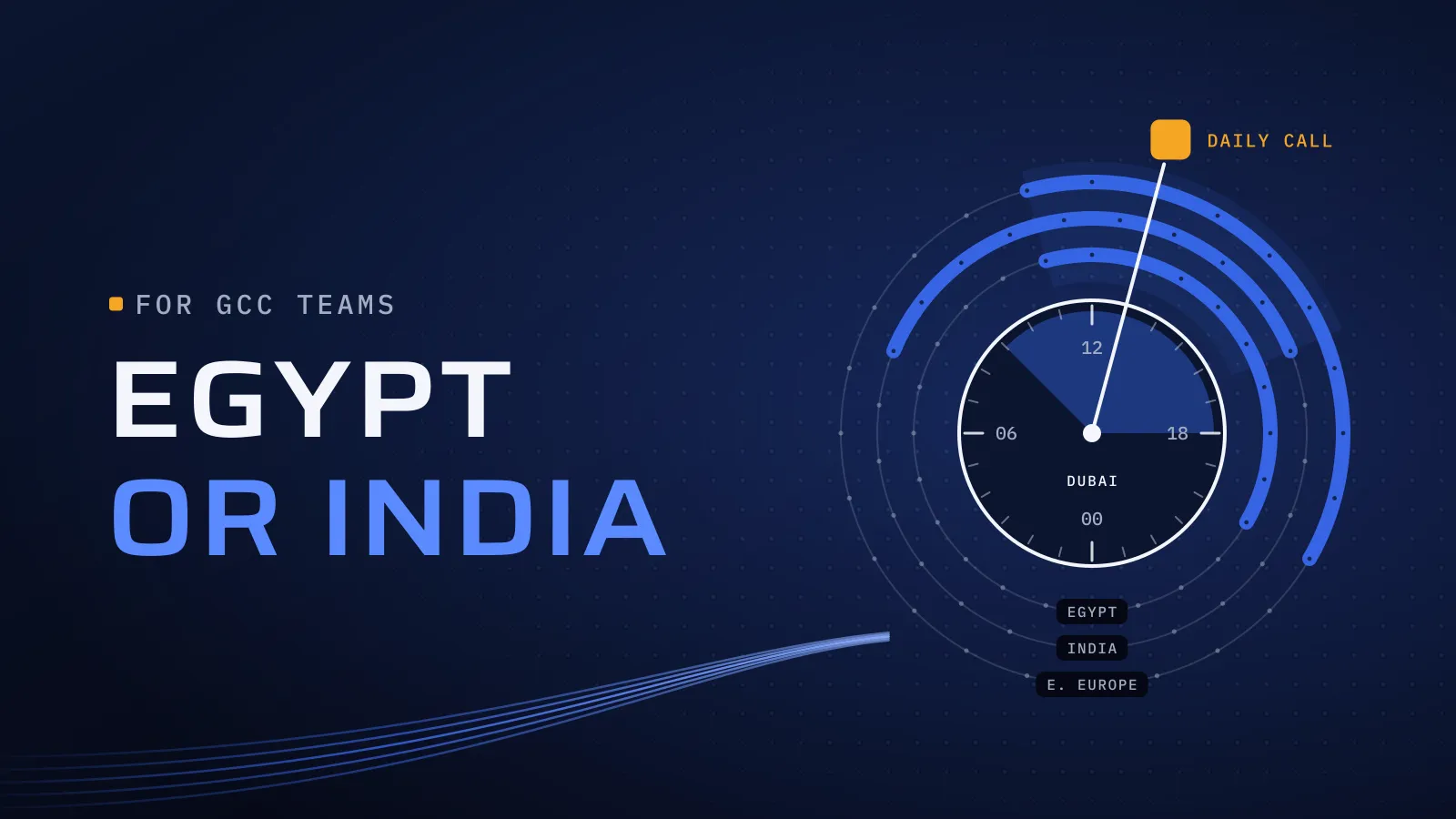
The table below assumes a 09:00 to 18:00 working day in each place. The Gulf states don’t change their clocks.
- Egypt is on UTC+2, and on UTC+3 from the last Friday of April to the last Thursday of October. This year, summer time ends on 29 October 2026.
- India stays on UTC+5:30 all year, an hour and a half ahead of Dubai.
- Eastern Europe changes its clocks on the last Sundays of March and October. Poland is on UTC+1 (UTC+2 in summer); Romania and Bulgaria are on UTC+2 (UTC+3 in summer).
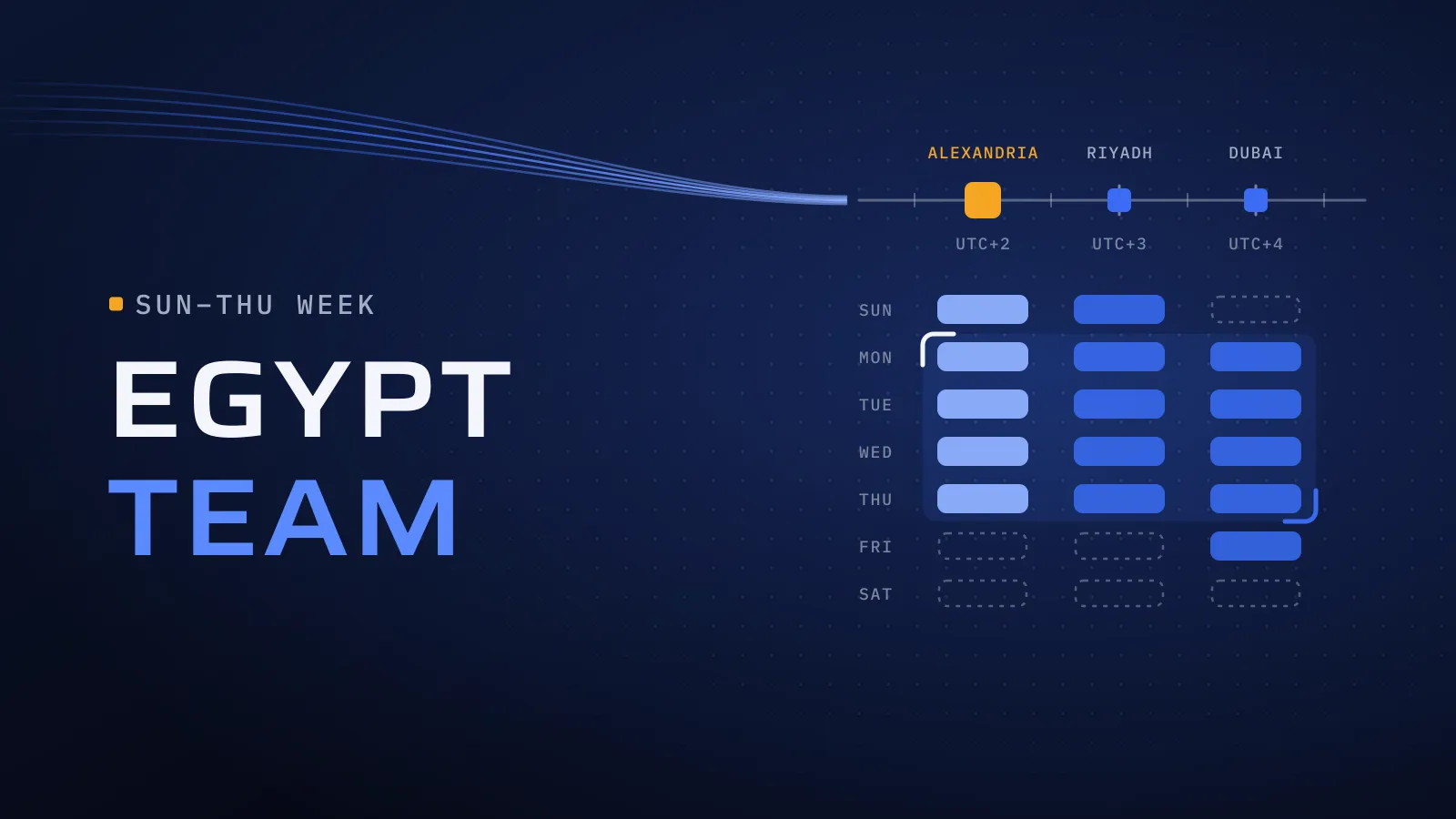
Then multiply by the days you share. Egypt works Sunday to Thursday. India’s IT firms mostly work Monday to Friday, as does Eastern Europe. Most UAE companies now work Monday to Friday too, while Saudi Arabia, Qatar and Kuwait keep Sunday to Thursday.
Egypt, India and Eastern Europe compared
Take this table to whoever decides where the team sits. The hours are per week, because a shared day lost every week matters more than an hour gained each day.
| Egypt | India | Eastern Europe | |
|---|---|---|---|
| Clock against Dubai | 1 to 2 hours behind | 1.5 hours ahead | 1 to 3 hours behind, by country and season |
| Working week | Sunday to Thursday | Monday to Friday at most IT firms | Monday to Friday |
| Shared hours a week with a Monday-to-Friday Dubai office | 28 to 32 (4 days) | About 37.5 (5 days) | 30 to 40 (5 days) |
| Shared hours a week with a Sunday-to-Thursday office in Riyadh, Doha or Kuwait City | 40 to 45 (5 days) | About 26 (4 days) | 28 to 36 (4 days) |
| Arabic | The native language | Rarely spoken | Rarely spoken |
| Talent pool | Smaller: about 50,000 ICT graduates a year | The largest of the three by far | Spread across several countries |
| Best when | Arabic is part of the work, or you run Sunday to Thursday | You need scale or a rare stack, in English | The work is in English and you also serve Europe |
The honest reading: for a Monday-to-Friday Dubai company that works only in English, India and Eastern Europe share more of your week than Egypt does. For a company on the Sunday-to-Thursday week, Egypt shares the most, and the gap is a full working day.
Arabic and English
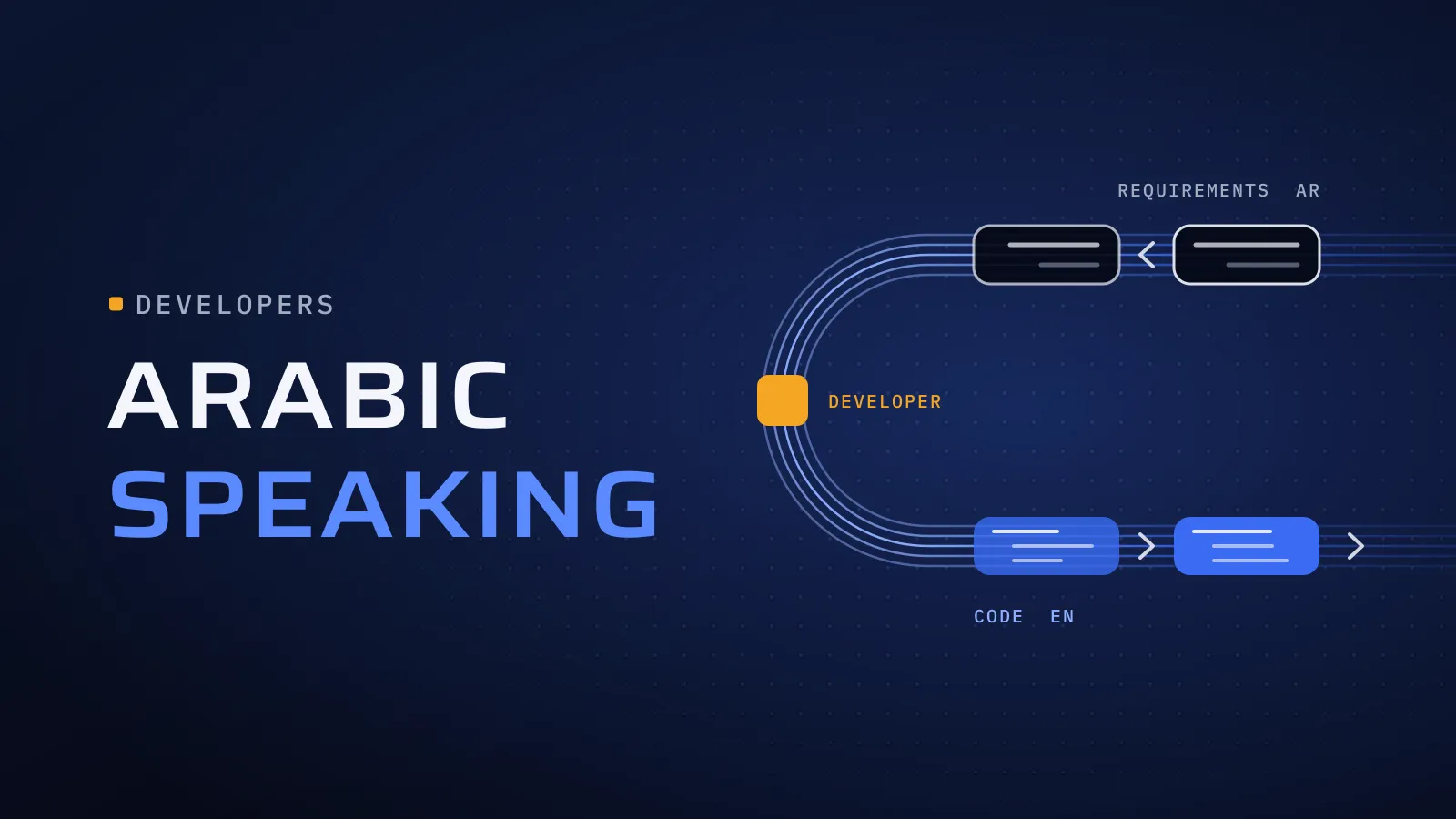
Arabic. In Egypt it is the native language, so developers read Arabic specifications and talk with Arabic-speaking stakeholders without a translator. In India and Eastern Europe, Arabic speakers are rare in software teams. That matters only where Arabic touches the work: requirements, stakeholder meetings, or Arabic screens and documents. If it doesn’t, leave it out of the brief. Our guide to Arabic-speaking developers for hire shows which roles need it.
English. All three regions run their software industries in English: code, tickets and documentation are written in it. In India, English is also widely used in business and higher education. Level varies from person to person in every country, so test it the same way everywhere: a written ticket and a spoken explanation of a technical choice.
How big is each talent pool?
India’s is far larger. NASSCOM’s Strategic Review 2026 projects direct employment in India’s tech sector at about 6 million in FY2026. Egypt’s pool is smaller: ITIDA, Egypt’s IT industry development agency, counts about 50,000 ICT graduates a year. Eastern Europe’s pool is spread across several countries, each with its own language, labour law and salary market.
In practice, ten engineers in a rare stack by next quarter is where India’s depth helps most. For two or three roles that also need Arabic, the pool that counts is the one meeting both requirements, and of these three it is deepest in Egypt.
What drives the cost
We don’t publish rates; yours is agreed in your proposal. Wherever the team sits, the same things move a quote:
- Seniority and stack. A senior engineer in a scarce stack costs more in every country.
- The local salary market, which differs between the three regions and between cities inside each.
- What the fee covers. A freelancer’s rate covers hours. A provider’s fee can also cover recruitment, HR, payroll, equipment and replacements, so compare like for like.
- Hours outside the local day. Asking a team to work outside its own day or week, such as Sundays for a Gulf client, adds shift allowances or turnover.
- Language requirements. Asking for Arabic narrows the pool far more in India and Eastern Europe than in Egypt.
How to choose, in four steps
- Write down your week and your core hours, and where the people the team will talk to sit: your office, your clients, your stakeholders.
- Mark where Arabic touches the work, role by role. If it touches none of them, take it off the list of factors.
- Count the roles, the stacks and the dates. Many people or a rare stack quickly points one way; two or three roles with Arabic points another.
- Vet candidates the same way wherever they are. The same task, the same code review and the same written English check, whichever country the shortlist comes from.
Send us your week and your roles. Tell us where your team sits, the days and hours it works, and the roles and stacks you need. We reply with the overlap you would get with our team and how we would source each role. See developer profiles →
Not ready for a call? Ask for our company profile and we’ll send it to you.
Where each one is the better choice
- Egypt is the better choice when Arabic is part of the requirements, the screens or the conversations, or when your company works Sunday to Thursday, as in Saudi Arabia, Qatar and Kuwait. The hours, contract and set-up are covered in our guide to a dedicated development team in Egypt.
- India is the better choice when you need many engineers or a rare stack, the work happens in English, and your office works Monday to Friday, the week India’s IT firms share.
- Eastern Europe is the better choice when the work is in English and your company also serves European customers or has a European office, so one team shares both working days.
Same week as our team: Spoiled
Spoiled is a home beauty services app we built for Kuwait. Talk to the team that built it: book a meeting.
Kuwait works the same Sunday-to-Thursday week as our team in Alexandria. Whatever the country, one of our pillars matters more the further apart two offices are: transparent delivery, with clear milestones, reporting and communication, so progress is visible from across the border.
Decide on the week, then the country
Since 2014 we have worked with more than 100 clients across the UAE, Saudi Arabia, Qatar, Kuwait, the USA and Canada, from Dubai Digital Park, Houston and Alexandria. For the Sunday-to-Thursday markets, see staff augmentation for Saudi Arabia, Qatar and Kuwait; for a UAE team, see staff augmentation in the UAE.
See developer profiles → We ask about your goal, what you use today, your timing and who else should be involved. You leave with clear next steps. The call commits you to nothing, and we sign an NDA first if you want one.
Frequently asked questions
Is Egypt in the same time zone as Saudi Arabia?
For half the year, yes. From the last Friday of April to the last Thursday of October, Egypt is on UTC+3, the same clock as Riyadh, Doha and Kuwait City. The rest of the year it is on UTC+2, one hour behind. The Gulf states don't change their clocks, so a 10:00 stand-up in Gulf time works all year.
Which is cheaper: Egypt, India or Eastern Europe?
Rates differ by country, and also by seniority, stack, what the fee covers and how far the hours stretch beyond the local day, so compare quotes like for like. We don't publish prices: your rate is agreed in your proposal, as one monthly fee per developer.
Can one team mix developers from different countries?
Yes. Hold the stand-up and reviews inside the window everyone shares, write decisions down in your tracker and give each person the same onboarding. Count the shared hours for the furthest member of the team, not the nearest.
Do you recruit developers outside Egypt?
Our core team works from Alexandria. For developers we recruit for your contract, location is part of the brief, and you interview and approve every candidate wherever they are.
Who do we sign the contract with?
With Flojics Technology at Dubai Digital Park, Dubai Silicon Oasis. The NDA, master agreement and statement of work come first, before anyone gets access to your systems.