AI Chatbot for Business in the UAE: Answer Customers on Your Website and WhatsApp, in Arabic and English
AI chatbot for business in the UAE: answer customers on your website and WhatsApp in Arabic and English, look up orders and hand over to your team.
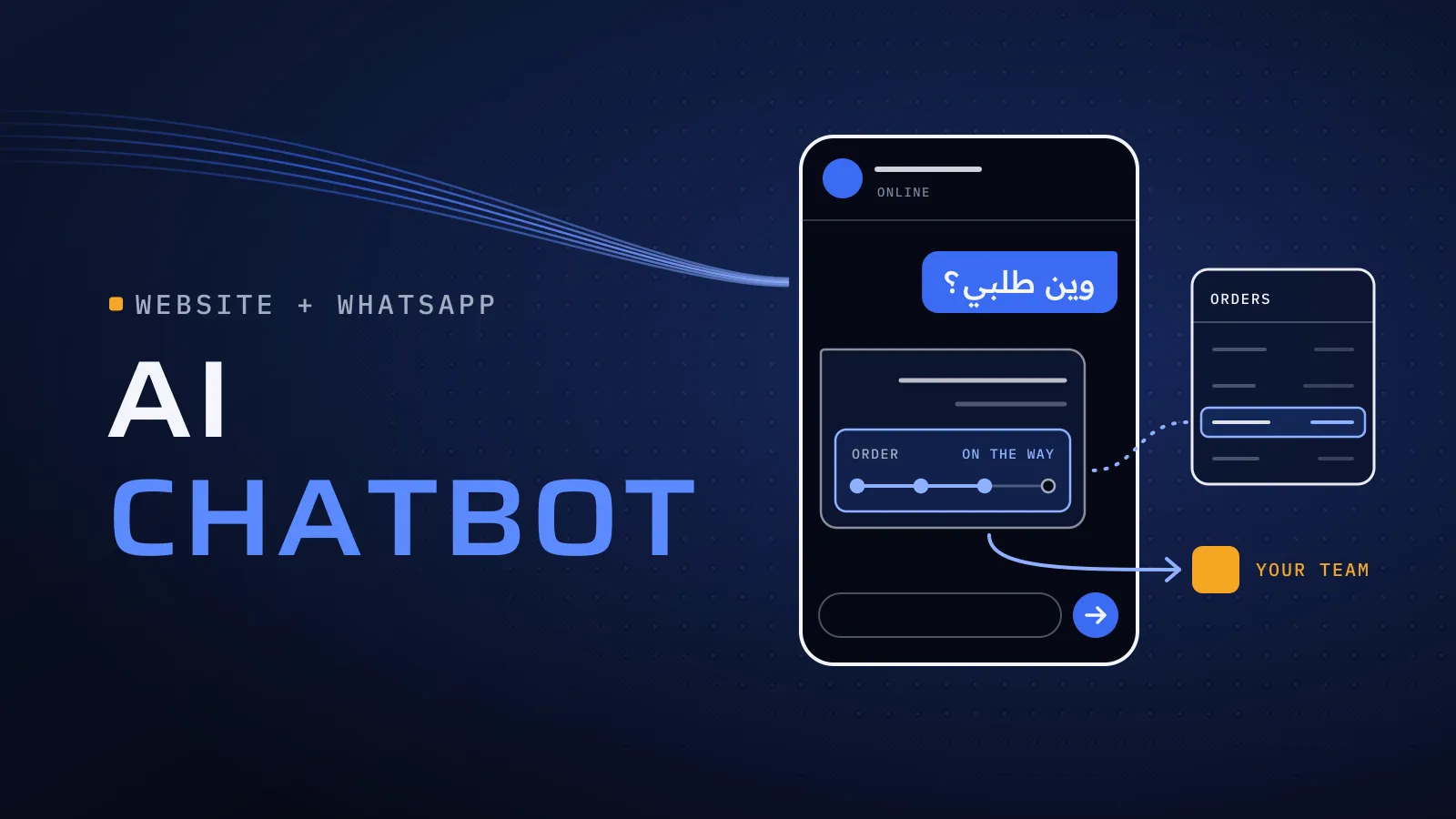
A customer messages you on WhatsApp at ten at night: وين طلبي؟ (“where’s my order?”). Nobody replies until morning, and by then they have asked twice or bought somewhere else. An AI chatbot for business in the UAE answers that message in seconds, in the customer’s Arabic or English, checks the order in your system and passes the chat to a person when it should, so your team spends its day on the cases that need them.
What should an AI chatbot for business in the UAE do?
Quick answer: It answers your customers’ common questions on your website and WhatsApp, in Arabic, English and Gulf dialect, only from content you approve. It looks up live details, such as an order or booking, in your CRM or Odoo. It hands the chat to a person, with the history, for complaints, refunds and anything it isn’t sure of.
Have a channel in mind? Plan your customer chatbot →
What slow replies cost you
Most customer messages repeat: opening hours, delivery areas, prices, “where is my order”. Messages sent in the evening or at the weekend wait until someone is back, and customers who wait ask again elsewhere or buy from whoever answered first. Meanwhile your staff type the same answers all day, and two of them can quote two different prices for the same thing.
A customer chatbot, a knowledge assistant or ChatGPT?
Each solves a different problem:
- An AI chatbot, this guide’s subject, talks to your customers. It answers from content you approve for the public and reads a few records, such as an order’s status.
- An AI Knowledge Assistant talks to your staff, answering from internal documents with sources and access rights. See our guide to the Arabic AI chatbot for company documents.
- ChatGPT for business helps staff draft, summarise and translate. Our guide to ChatGPT for business in the UAE shows where a plan is enough.
- An AI agent acts in your systems, such as turning a WhatsApp order into a draft quotation. See our guide to an AI agent for Odoo.
How to launch a chatbot on your website and WhatsApp
- Read three months of real messages. Export chats from WhatsApp, your website and the contact inbox. List the most common questions in the customers’ own words, and mark each one: the chatbot answers, the chatbot looks it up, or a person handles it.
- Write the answers it may give. Hours, delivery areas, return terms, the current price list, product details. Each answer has an owner who keeps it current, because the chatbot repeats whatever it is given, including last month’s offer.
- Connect lookups, read-only. Order status from Odoo, a booking from your booking system, a new lead into your CRM, through the chatbot’s own account with the narrowest rights. Before showing an order, it checks the WhatsApp number against the customer record, or asks for the order number and phone number. The AI model and cloud region are agreed with you before the build.
- Set the handover. Decide who receives a chat, in which inbox and during which hours. After hours, the chatbot says when a person will reply and puts the chat first in the morning queue. Customers can ask for a person at any time, in either language.
- Test on your messages, then launch on one channel. Run your real questions through it, including the hard rows in the table below. Start on the channel with the most repeat questions, and add the second once the weekly numbers hold up.
Arabic, Gulf dialect and messages that switch language
A chatbot that does well in a formal-Arabic demo can still miss what your customers type. Test it on:
- Gulf dialect: توصلون العين اليوم؟ (“do you deliver to Al Ain today?”).
- Arabic and English in one line: أبي أسوي return للطلب (“I want to return the order”).
- Arabic in Latin letters: “3indkum delivery el youm?” (“do you deliver today?”).
- Arabic-Indic digits: order ٤٥١٢ has to find order 4512.
- Your product names, spelled the way customers spell them in both languages.
It should reply in the language the customer wrote in, and stay in it unless the customer switches. Our core team are native Arabic speakers, so the people checking the Arabic replies read them the way your customers do.
WhatsApp: three things to settle first
- The account. A chatbot connects through the WhatsApp Business Platform. A number on the WhatsApp Business app on a staff phone doesn’t connect as it is, so plan the number and display name, with the account in your company’s name.
- The 24-hour window. A customer’s message opens a 24-hour customer service window. Inside it you can reply freely; outside it, only with templates Meta has approved, such as “your order is ready”. Meta bills messages by type, and since 1 October 2026 it also charges for replies beyond a monthly free allowance per number (Meta).
- Keep it about your business. Meta’s terms bar AI providers from offering an AI assistant as the main service on the platform; AI that supports a business’s own customer service is outside that ban, as Meta judges it (Meta). A chatbot that answers about your products and orders, and politely declines the rest, is also the one customers trust.
What your chatbot answers, looks up and hands over
Fill this in with your customer-service lead. Every common question goes into one row.
| The customer asks about | Example | The chatbot | A person takes over |
|---|---|---|---|
| Hours, branches, delivery areas | “Are you open on Saturday?” | Answers from approved content | When the answer isn’t there |
| Products or services | “Does this come in a larger size?” | Answers from your catalogue | For technical or custom questions |
| Price | “How much is the annual service?” | Quotes the current price list only | For bulk, custom or discount requests |
| Order or booking status | وين طلبي؟ | Looks it up after checking the number | When it’s late or not found |
| A new enquiry | “We need this for 30 staff” | Takes the details and creates a CRM lead | At once, above the size you set |
| Moving an appointment | “Can I move my visit to Thursday?” | Offers open slots | Your team confirms, at first |
| A complaint | “The order is wrong again” | Apologises and takes details, never argues | Always, at once, with the history |
| Refund, discount or payment | “I was charged twice” | Promises nothing | Always |
| Medical, legal or financial advice | “Can I take this with my other medicine?” | Doesn’t answer | Always |
| Off-topic | Politics, other companies, general questions | Declines politely | Not needed |
| Asking for a person | أبي أكلم موظف (“I want to talk to someone”) | Hands over | Always, at once |
How to read it: the last five rows protect your business, and they matter as much as the first five. A chatbot that answers everything but promises a refund nobody approved is not ready.
Send us 20 real customer messages, names and numbers removed, and the channels and systems you use. We reply with the rows a chatbot could take, the ones that stay with your team and what a first version would cover.
Not ready for a call? Ask for our company profile and we’ll send it to you.
How to measure it every week
Before launch, write down how long customers wait for a first reply today, and how many messages arrive after hours. Then read these each week:
- Answered without a person, checked against customers who asked the same question again within a day. A customer who gave up is not a resolved chat.
- Handed to a person, and how long the customer then waited.
- Wrong answers in a sample. Someone on your team reads chats in each language and marks every reply right or wrong.
- Questions it couldn’t answer. Each is a missing answer or a new table row.
- Leads and bookings passed on, and how many your team closed.
Set targets from your own starting numbers, not a vendor’s brochure.
What drives the effort, and when a ready-made tool is enough
The effort sits in four phases, each with its own people:
- Discovery. Your customer-service lead and our product owner sort the messages and agree the answers and rules. Tidy existing answers make this shorter.
- Build. Developers connect the channels, the lookups and the handover inbox. Each system it reads, such as Odoo, a CRM or a booking system, is its own piece of work.
- Testing. An independent tester and Arabic reviewers run your messages in each language.
- Running. AI usage billed by volume, WhatsApp messages billed by Meta, and hosting, while someone on your side keeps the answers current.
A ready-made chatbot platform on a monthly plan can be enough for common questions on one channel, with no lookups in your systems. A build pays off when the chatbot must read your Odoo or CRM, follow your handover rules and pass your Arabic test. Your estimate is agreed in your proposal, and if a subscription does the job, we’ll say so.
How we build a customer chatbot
We have built AI chatbots and assistants that answer from company documents; those clients are under NDA, so we don’t name them. Our AI agent development in Dubai work starts with your real messages, and for UAE companies on Odoo, our Odoo implementation in the UAE team plans the lookups knowing where your orders and customer records live.
For a public example of our customer-facing app work, HUQOUQ is a UAE legal services app that connects clients with qualified lawyers. Talk to the team that built it: book a meeting.
Quality is built into every step: CTO oversight of how the chatbot connects to your systems, independent QA before each release by testers who didn’t build it, and a dated plan in FloPlan, our own delivery software. If your staff also need answers from internal documents, see our guide to a private ChatGPT for your company.
Bring 20 customer messages
Since 2014 we have built software for more than 100 clients across the UAE, Saudi Arabia, Qatar, Kuwait, the USA and Canada, from our headquarters at Dubai Digital Park in Dubai Silicon Oasis and our offices in Houston and Alexandria. Bring a sample of real messages, the channels you use and the system that holds your orders or bookings.
Plan your customer chatbot → We ask about your goal, what you use today, your timing and who else should be involved. You leave with clear next steps. The call commits you to nothing, and we sign an NDA first if you want one.
Frequently asked questions
What does an AI chatbot cost for a UAE business?
There are two parts. The build covers sorting your messages, connecting the channels and the systems it reads, setting the handover and testing in Arabic and English. The running cost is AI usage billed by volume, WhatsApp messages billed by Meta, and hosting. Your estimate is agreed in your proposal, and it follows the channels, the systems and the languages.
How long does it take to launch?
A first version covers one channel and your most common questions, and goes live once it passes a test on your own messages. The timeline is agreed in your proposal. What moves it most is how many systems the chatbot reads, such as Odoo or a CRM, and how current your answers are when we start.
Can it understand Gulf Arabic and mixed Arabic and English?
Yes, once it passes a test built from your customers' real messages: Gulf dialect, Arabic and English in one line, Arabic typed in Latin letters, Arabic-Indic digits and your product names. It replies in the language the customer used. Anything it can't understand goes to a person instead of getting a guess.
Will it invent prices or promise refunds?
Not if it is set up and tested properly, and that is checked before launch. It answers only from the content you approve, quotes only the current price list and passes every refund, discount and complaint to a person. A weekly sample of chats, read by your team, catches any wrong answer, and the fix goes into the content or the rules.
Do we need the WhatsApp Business API?
Yes. A chatbot connects through the WhatsApp Business Platform, which is the API, not the WhatsApp Business app on a staff phone. Outside the 24-hour window after a customer's last message, you can only send templates Meta has approved, and Meta bills messages by type. The account and the number stay in your company's name.
Where does our customers' data go?
That is agreed with you before the build: which AI model, which cloud and region, and where chat history is kept. OpenAI's API and Azure OpenAI don't use your data to train their models by default. The chatbot reads only what a chat needs, through its own account, after checking who it is talking to.