Arabic AI Chatbot for Company Documents: An AI Knowledge Assistant That Shows Its Sources
An Arabic AI chatbot for company documents: an AI knowledge assistant that answers in Arabic and English, shows its sources and is tested on Gulf dialect.
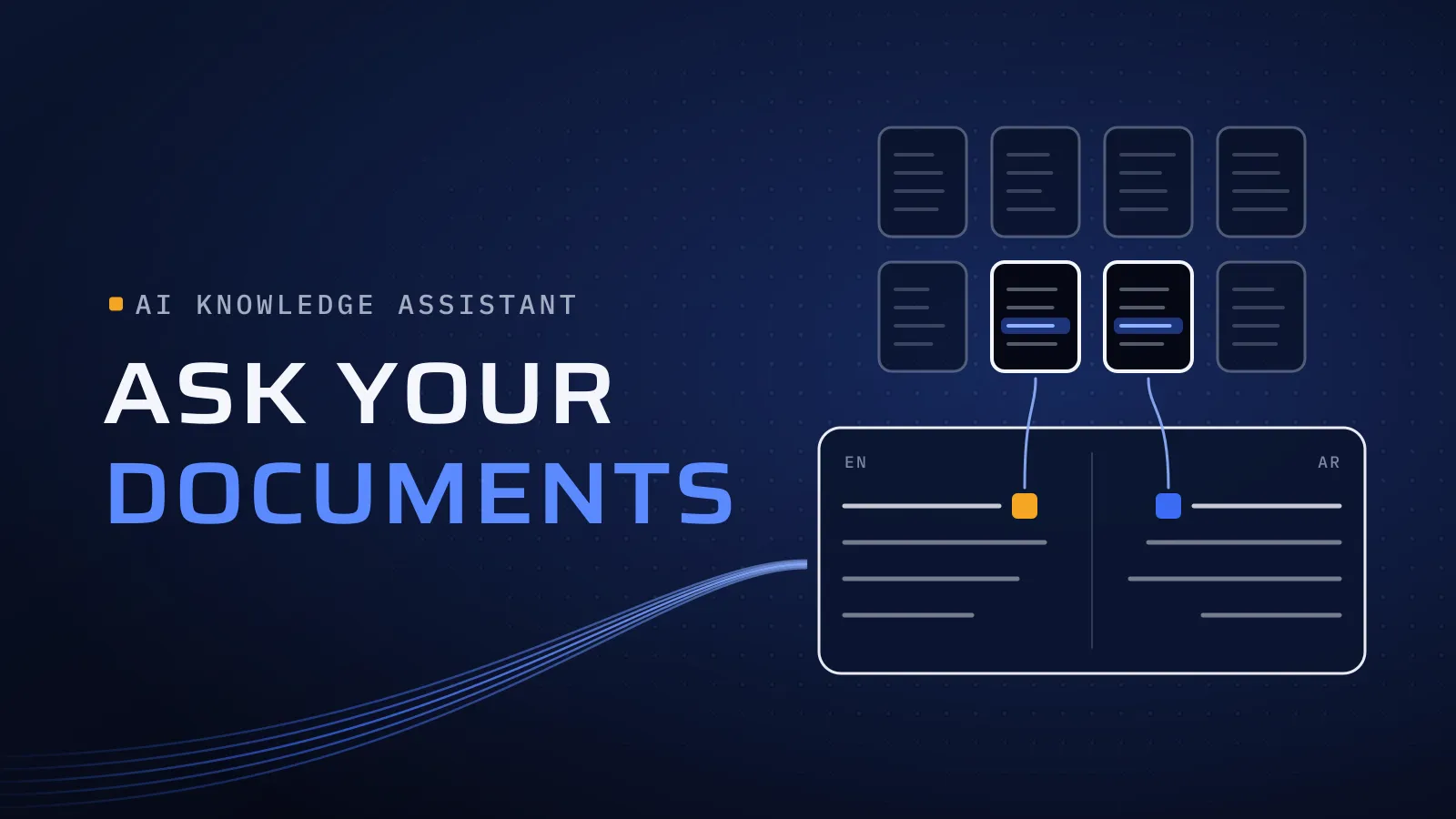
Your staff ask the same questions every day, about leave, approval limits, contract terms or a procedure from a circular issued years ago, and the answers sit in hundreds of Arabic and English documents nobody can search properly. An Arabic AI chatbot for company documents, which we call an AI Knowledge Assistant, answers those questions from your own files in Arabic or English and shows the passage each answer came from, so people stop waiting on HR, legal and IT for things that are already written down.
What is an Arabic AI chatbot for company documents?
Quick answer: It is an AI Knowledge Assistant. Staff ask in Arabic, English or Gulf dialect, and it answers only from your company’s documents and systems, showing the source passage for each answer. It searches only what the person asking may open, says when the documents don’t hold the answer, and is tested on your own questions before launch.
Have a set of documents in mind? Plan your AI knowledge assistant →
What the search for answers costs you
Every unanswered question becomes an email to HR, a call to legal or a message to the one colleague who remembers where the policy is. Your experts lose hours to repeat questions, new joiners wait days for answers that already exist, and people act on an old version of a policy because it was the one they found. In a bilingual company the gap is wider: the circular is in Arabic and the person asking reads English, or the other way round. And when staff paste company documents into a personal chatbot to get a quick answer, nobody knows where those documents went.
How an AI knowledge assistant is built, in plain words
The technical name is retrieval-augmented generation, or RAG. You don’t need the term, but you should know the three parts, because each one can fail on its own:
- The library. Your documents are collected from where they live (shared drives, SharePoint, an intranet, your ERP), read, scans included, and split into short passages. Each passage keeps its source, its date and who may see it.
- The search. When someone asks a question, the system finds the passages that match its meaning, not only its exact words. This is the part called vector search: a question about “sick leave” finds a passage on “medical leave”, or the Arabic إجازة مرضية.
- The answer. The AI model writes the answer from those passages only, in the language of the question, and lists its sources. If the passages don’t contain the answer, it says so.
Most wrong answers start in the first two parts, not in the AI model: a missing or outdated document, a scan read badly, or a search that brought back the wrong passage. That is why the testing covers all three.
Why Arabic needs its own testing
An assistant that shines in an English demo can still fail your staff. Four things make Arabic harder:
- Dialect against formal Arabic. Policies are written in formal Arabic; staff ask in Gulf, Egyptian or Levantine dialect, in a hurry.
- Mixed language. وين ألقى الـ policy حق الـ overtime؟ (“where do I find the overtime policy?”) is a normal question in a UAE office. So is Arabic typed in Latin letters.
- Cross-language search. Researchers who tested RAG on real Arabic and English company documents found that the search step is the main weakness: results drop sharply when the question and the document are in different languages. Two simple fixes helped: searching both languages equally, or translating the question before searching (ArabicNLP 2025).
- Scans and numbers. Stamped letters, scanned circulars, Arabic-Indic digits and Hijri dates all have to be read correctly before anything in them can be found.
Our core team are native Arabic speakers, so the people judging the Arabic answers read them the way your staff will.
How to launch an AI knowledge assistant in the UAE
- Pick one department and its documents. HR policies, a procedures manual or contract templates: one set with an owner who can say which version is current.
- Collect the questions people really ask. Take them from emails, help-desk tickets and messages to the department, in the words and languages staff used. They become your test set, together with the cases in the table below.
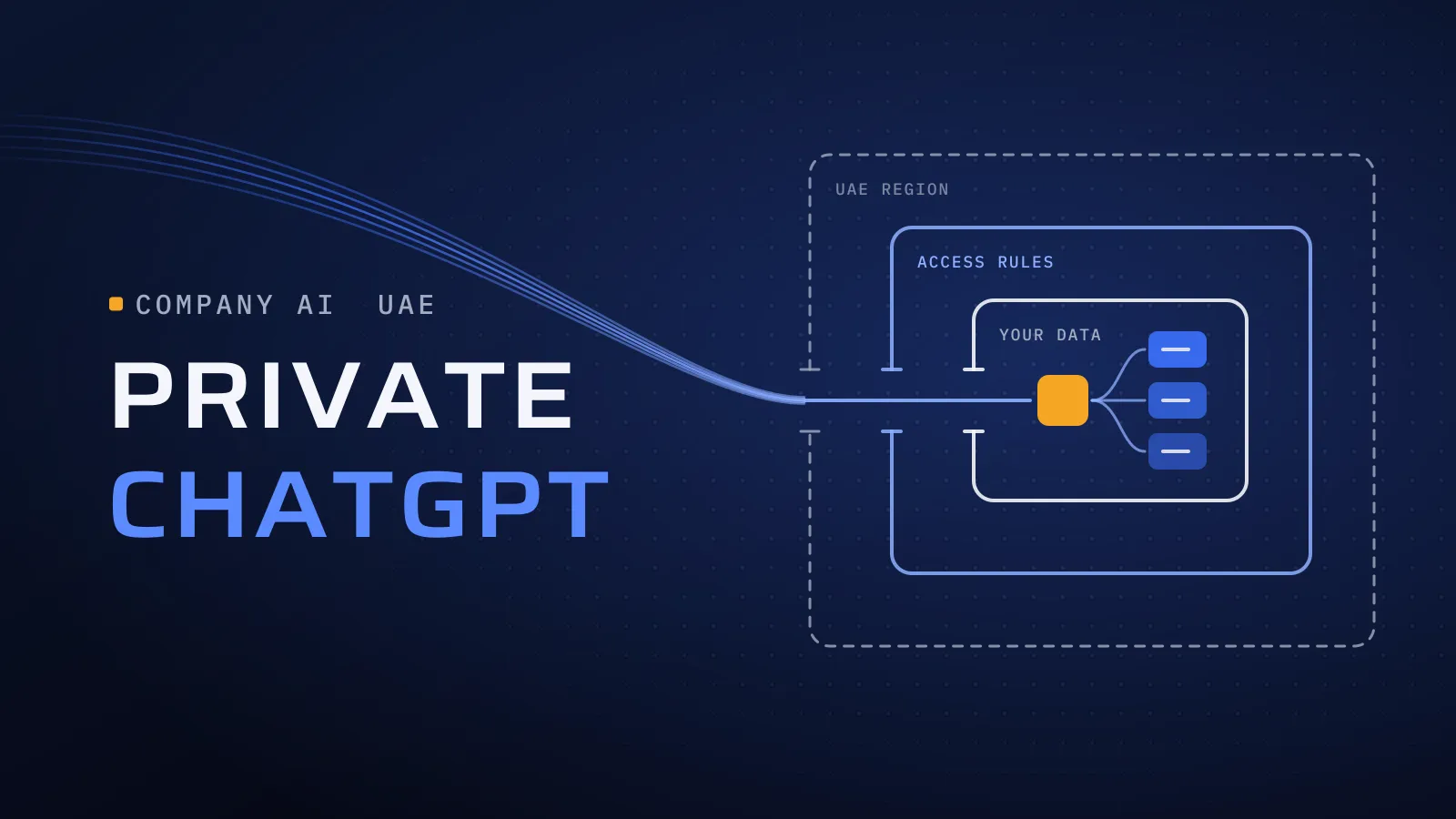
- Agree access and where it runs. Decide who may see which documents, and how that is carried over from the source system. Agree which AI model is used and where it runs: which cloud and region, or your own cloud account. Our guide to private ChatGPT for companies in the UAE sets out the current UAE options.
- Test before anyone relies on it. Run every test question and score each answer: right, wrong, or “I don’t know” where that is the honest reply. Check that each answer cites the right source. Fix the cause of every failure, whether the document, the scan or the search, and run the set again.
- Launch to one team, then widen. Watch which questions go unanswered: each one points to a missing document or a gap in a policy. Add the next department when the first one holds up.
The Arabic test set: what to check before launch
Build this with the department head, using your own documents. The assistant is ready when every row passes on your questions, not on a vendor’s demo.
| What to test | Example | A pass looks like |
|---|---|---|
| Gulf dialect | شلون أطلب إجازة مرضية؟ (“how do I ask for sick leave?”) | Finds the leave policy written in formal Arabic and answers from it |
| Formal Arabic | ما مدة الإشعار عند الاستقالة؟ (“what is the notice period on resignation?”) | Quotes the right clause and cites it |
| Arabic and English mixed | وين ألقى الـ policy حق الـ overtime؟ | Finds the English overtime policy |
| Arabic in Latin letters | “shlon atlob shahadat ratib?” (“how do I request a salary certificate?”) | Understands it, or asks the person to rephrase |
| Across languages | An English question whose answer exists only in an Arabic circular | Answers in English and cites the Arabic source |
| Scanned Arabic PDF | A stamped, scanned circular | Text read correctly; a person checks a sample of scans first |
| Numbers and dates | ٣٠ يوم against “30 days”; Hijri against Gregorian dates | The same answer either way |
| No answer in the documents | A question your policies don’t cover | Says it doesn’t know and names who to ask |
| Restricted document | A question about salary bands from someone outside HR | No answer from documents that person can’t open |
| Two versions of one policy | The old and new travel policy both on the drive | Answers from the current version, or flags the clash |
How to read it: the last four rows matter as much as the language rows. An assistant that answers every Arabic question but quotes the old policy, or a file the person shouldn’t see, is not ready.
Send us ten real questions and a few of the documents behind them. We reply with how we would test them, what a first version could cover and what would need fixing in the documents first.
Plan your AI knowledge assistant →
Not ready for a call? Ask for our company profile and we’ll send it to you.
When not to build one
- The documents aren’t current. If nobody can say which version of a policy is valid, the assistant will quote the wrong one with confidence. Fix the source first; that work pays off on its own.
- A short FAQ page would do. If staff ask twenty different questions a year, publish the answers.
- The question needs live records or an action. “How many leave days do I have left?” is a question for your HR system, not your documents. Reading records and acting in your systems is an AI agent’s job, set out in our guide to AI agents for enterprises.
- A ready-made tool already passes the test. If your documents sit in one tool that offers AI search, and it passes the table above on your questions, use it. We’ll tell you.
How Flojics builds an AI knowledge assistant
We have built AI chatbots and assistants that answer from company documents. Our AI agent development in Dubai work starts the same way each time: one set of documents, the questions people really ask, and a test before launch. Where it runs is agreed with you before any document is loaded.
Two of the ways we work matter most here:
- Independent QA. A dedicated testing and quality assurance process: the people who test the assistant on your Arabic, mixed-language and restricted questions are not the people who built it.
- Product thinking. Each feature has to answer a business problem, so the assistant is judged by the questions it takes off your experts’ desks, not by how it looks in a demo.
Bring ten questions your staff ask
Since 2014 we have built software for more than 100 clients across the UAE, Saudi Arabia, Qatar, Kuwait, the USA and Canada, from our headquarters at Dubai Digital Park in Dubai Silicon Oasis and our offices in Houston and Alexandria, where our native-Arabic core team works the Sunday to Thursday week. Bring the questions in the words your staff use, and tell us where the documents live.
Plan your AI knowledge assistant → We ask about your goal, what you use today, your timing and who else should be involved. You leave with clear next steps. The call commits you to nothing, and we sign an NDA first if you want one.
Frequently asked questions
What does an AI knowledge assistant cost?
There are two parts. The build covers preparing your documents, connecting the places they live, setting the access rules and testing on your questions. The running cost is AI usage, billed by the number of questions, plus hosting. Our price is agreed in your proposal. What moves it: how many sources, how many scans, how many languages and how detailed the access rules are.
How long until our staff can use it?
A first version covers one department's documents and goes live once it passes your test questions. The timeline is agreed in your proposal, and the main factors are how tidy the documents are and how easily the source systems can be connected. Starting with one department gives you real answers to measure before you add the next.
What happens when it gives a wrong answer?
Every answer shows the passages it came from, so staff can open the source and check. When a wrong answer is reported, we trace it to its cause, such as a missing document, an old version or a search miss, and fix that. When your documents don't hold the answer, it says so and names who to ask, instead of guessing.
Can it read scanned Arabic PDFs and stamped letters?
Yes, once the text has been read from the scan, and that step is tested on its own. We check a sample of your scans for misread letters and numbers before they are searched, because a misread scan gives a wrong answer with a correct-looking source. Scans too poor to read reliably are flagged for a person to replace.
Will staff see documents they shouldn't?
That is tested before launch. The assistant searches only the documents the person asking may open, and how access is carried over from SharePoint, a shared drive or your ERP is agreed with you during the build. Restricted questions are part of the test set, so a gap shows up before staff rely on it.
Where does it run, and is our data used to train the AI?
Where it runs is a decision we agree with you before the build: which AI model, which cloud and region, or your own cloud account. OpenAI's business plans and API, and Azure OpenAI, don't use your data to train their models by default. You know where your documents go before the first one is loaded.