RAG Development in Dubai: Building Retrieval-Augmented Generation on Your Company Documents
RAG development in Dubai: how a retrieval-augmented generation system is built on your documents, tested in Arabic, secured and kept in the UAE.
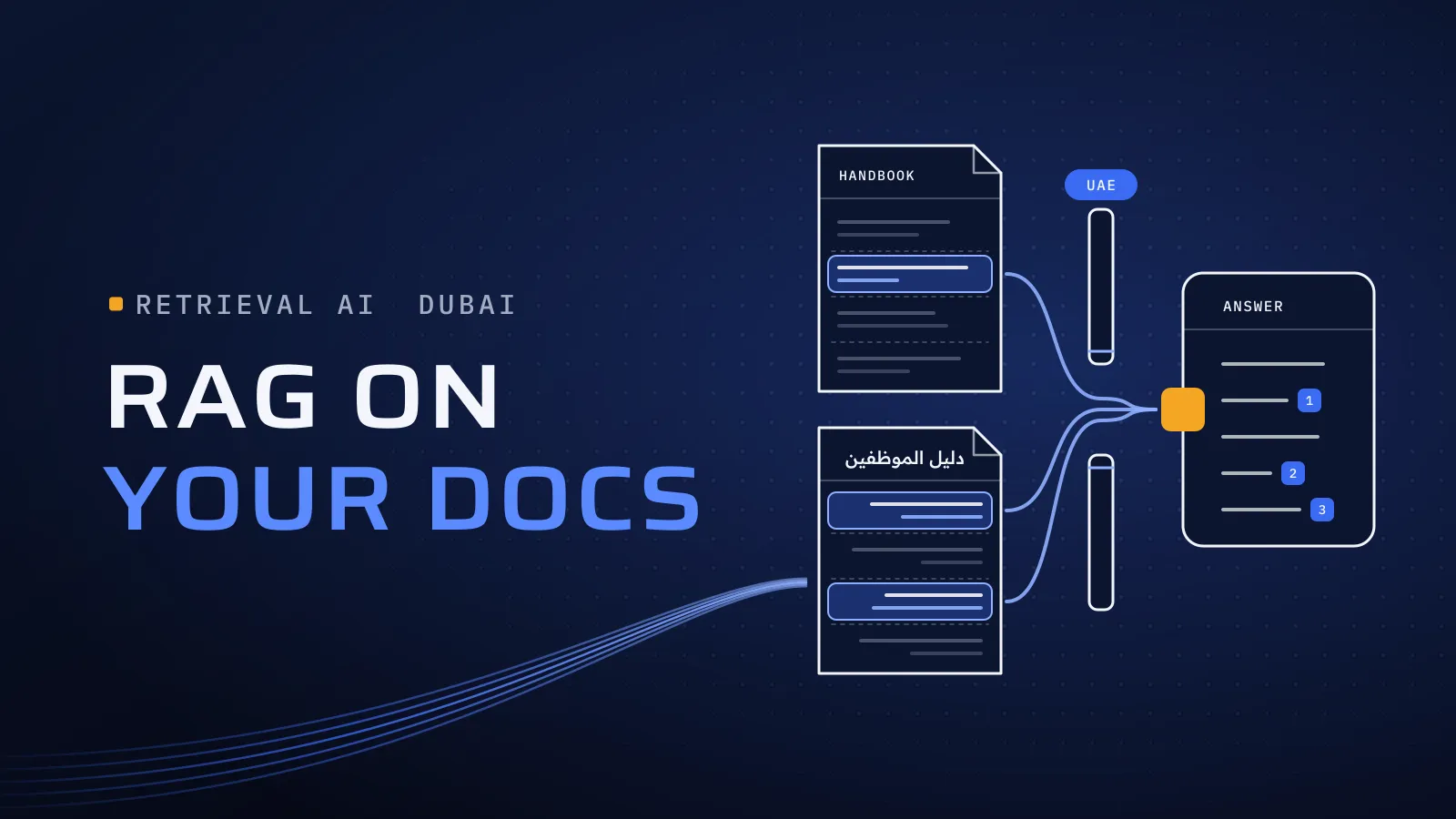
RAG (retrieval-augmented generation) is how an AI model answers from your company’s own documents instead of from memory: it searches your files first, then writes the answer from the passages it found and cites them. If you are looking for RAG development in Dubai, the model is the easy part. Whether staff trust the system depends on the rest: Arabic search, access rights, where the data is processed, and proof that the answers are right.
What does RAG development in Dubai involve?
Quick answer: A RAG build has five parts: loading and splitting your documents, a search index, a search step that respects each user’s access, an AI model that answers only from what was found, and a test set of your real questions. In Dubai, two more decisions shape it: Arabic retrieval, and where each part runs.
Have documents and questions in mind? Scope your RAG build →
What a demo-only RAG build costs you
Most RAG projects look good in a demo on a few clean English PDFs. Real documents break them: a scanned Arabic circular the search can’t read, last year’s policy, a file the asker should never see. After a few wrong answers, staff go back to emailing the expert.
How a RAG system works, part by part
Our guide to an Arabic AI chatbot for company documents explains the idea for business readers; we call that product an AI Knowledge Assistant. This page is for the people who will own the system.
| Part | What it does | What your IT team decides with us | Where it can run |
|---|---|---|---|
| Loading | Reads files from SharePoint, shared drives or your ERP, scans included, keeping each file’s source, date and access list | Which sources, how often they sync, who owns each set | A UAE cloud region or your own servers |
| Splitting | Cuts documents into passages along their structure: articles, clauses, table rows | How your policies are laid out, so no clause is cut in half | With loading |
| Search index | Stores each passage as words, for keyword search, and as a vector (numbers that capture meaning), for meaning search | Which index, and which embedding model makes the vectors | A UAE cloud region or your own servers |
| Search | Finds the passages that answer the question, only from documents the asker may open | How access is carried over from each source | With the index |
| Answer | Writes the answer from those passages only, in the question’s language, with citations | Which model, and where it processes questions | The hardest part to keep in the UAE |
How to read it: only the answer step is an AI model; most wrong answers start in the ordinary software above it.
Arabic documents and Arabic answers
Arabic changes the search step before the model writes a word:
- Normalising. One word can be typed several ways: أ إ آ against ا, ة against ه, ى against ي, with or without short vowels. Documents and questions are normalised the same way, or keyword search misses obvious matches.
- Two kinds of search. Arabic joins prefixes and suffixes to words (و, ال, ها), so keyword search needs a light stemmer and meaning search needs an embedding model tested on Arabic. We run both and merge the results: keywords catch policy numbers and names, meaning catches reworded questions.
- Across languages. An English question answered only by an Arabic circular is where Arabic RAG most often breaks, so it gets its own rows in the Arabic test set.
- Clauses, tables and scans. Splitting follows numbered clauses (المادة ٥). Tables in Arabic PDFs often extract in the wrong order, and scans go through text recognition (OCR), so a person checks a sample of both before indexing.
- The answer’s language. Answers follow the question’s language and show the source in its own, so an English answer from an Arabic policy still shows the Arabic clause.
Our core team are native Arabic speakers who work in English, so the people judging Arabic retrieval read it the way your staff do.
Where the data stays: UAE options
A RAG system holds your data in four places: the copied documents, the search index, the logs, and the passages sent to the AI model with each question. The first three can sit in a UAE cloud region or on your own servers. The fourth is the real decision, because those passages are your document text. Checked on 27 Oct 2026:
- Azure, UAE North. Microsoft’s region table lists embedding models as pay-per-use deployments processed in UAE North; chat models processed there come only on reserved (provisioned) capacity. Pay-per-use “Global” deployments may process a question in any Azure region (Microsoft Learn).
- AWS, UAE region (me-central-1). Amazon Bedrock’s table shows some models answering in the UAE region, and others, including some of the newest, only through global cross-Region inference, which can route the request to another country (AWS documentation).
- OpenAI. OpenAI lists a UAE region for its API, with extra approval and a short model list. Our guide to a private ChatGPT for your company in the UAE sets out the limits.
- Your own servers. An open-weight model on your hardware keeps every step inside; you run the hardware, and its Arabic must pass the same tests.
One workable pattern: documents, index, embeddings and logs in the UAE, and a written decision on the answer step: reserved capacity in the region, or a global deployment your compliance team has approved. We recheck these tables on the day you sign.
Send us twenty real questions, where the documents live and what must stay in the UAE. We reply with how we would test them, where each part would run and what to fix in the documents first.
Not ready for a call? Ask for our company profile and we’ll send it to you.
Security and access rights
An IT head’s first question is rarely “is it accurate?” It is “can it leak?”
- Access is checked at search time. Each passage carries its source file’s access list, and the search only looks at passages the signed-in person may open. Filtering the answer afterwards is too late: the model has already read the passage.
- Access stays in sync. When someone loses access in SharePoint or the ERP, the index follows on the next sync, and a deleted document leaves the index.
- Read-only, and documents can’t give orders. The assistant answers; it doesn’t send, change or approve anything. A file that says “ignore your instructions” is text to quote, and that case is in the test set.
- Logs are protected like documents. A question about salaries is sensitive in itself, so who may read the logs is agreed with your IT team.
How to test RAG answers before launch
- Build the test set from real questions. Take them from emails and help-desk tickets, in staff’s own words and languages, with the document owner marking the passage behind each answer. Add questions the documents can’t answer, and restricted ones.
- Score the search on its own. Check that the right passage is among the first few results. If it isn’t, fix loading, splitting or search; a better prompt won’t help.
- Score the answers. Right, wrong, or an honest “I don’t know”, citing the passage used and adding nothing from outside it. Native Arabic speakers score the Arabic answers.
- Test access and attacks. Ask restricted questions as users without access, and load documents with hidden instructions. Both must fail safely.
- Re-run the whole set after every change. A new model version or splitting rule can fix one answer and break another. After launch, unanswered and down-voted questions join the set.
What makes a RAG project bigger
Your price is agreed in your proposal. It follows the effort, and the effort follows these drivers:
- Sources. One shared drive is one connector. SharePoint, a document system and an ERP are three, each with its own access model.
- The state of the documents. Current, typed files load quickly. Scans, complex tables and three versions of every policy need work first.
- Languages. Arabic, English, dialect and mixed questions mean more test rows and more rounds of fixing.
- Access detail. Access by department is simpler than per-record rules that change daily.
- Where it runs. An answer step processed in the UAE can mean reserved capacity; your own servers mean hardware to run.
- Where staff use it. A web page is one front end; Teams, your intranet and a mobile app each add one.
The team follows the phases. Discovery: a delivery lead and a CTO-level architect agree sources, access and regions with your IT team. Build: back-end engineers make the connectors and index; an AI engineer, the answer step. Testing: independent QA, with native Arabic speakers, so the people scoring answers did not build the search. Launch: DevOps sets up hosting and monitoring.
How we build RAG systems
We have built AI assistants that answer from company documents; those clients are under NDA, so we don’t name them here. This work is part of our AI agent development in Dubai service.
Retrieval often reads business records as well as files, and we build those systems too. Al-Mawared ERP is a web-based ERP we built for exchange companies across the MENA region. Talk to the team that built it: book a meeting.
Quality is built into every step: CTO oversight of the architecture and regions, independent QA before each release, and a dated plan in FloPlan, our own delivery software.
Bring twenty questions and the documents behind them
Since 2014 we have built software for more than 100 clients. Our headquarters is at Dubai Digital Park in Dubai Silicon Oasis. Bring the questions your staff ask, a few of the documents behind them, and your rules on where data may go.
Scope your RAG build → We ask about your goal, what you use today, your timing and who else should be involved. You leave with clear next steps. We reply by email first and set up a call only if you want one. Asking commits you to nothing, and we sign an NDA first if you ask.
Frequently asked questions
What is RAG (retrieval-augmented generation)?
RAG is a way of building an AI assistant so that it answers from your own documents instead of from what the model learned in training. It first searches your files for the passages that match the question, then the AI model writes the answer from those passages only and cites them. If nothing matches, it says it doesn't know.
Is RAG better than fine-tuning a model on our documents?
For answers from company documents, RAG is the usual starting point. Documents change, and RAG picks up a new policy on the next sync, while a fine-tuned model has to be trained again. RAG also cites its sources and respects each person's access, which fine-tuning can't do. Fine-tuning suits tone and format, not facts that change.
Can a RAG system keep our data in the UAE?
The documents, the search index and the logs can sit in a UAE cloud region or on your own servers. The step to check is the AI model: on Azure UAE North, chat models processed in the region come on reserved capacity, and in AWS's UAE region some models run locally while others are routed globally. We agree where each part runs before any document is loaded.
How do you stop staff from seeing documents they can't open?
Each passage keeps the access list of its source file, and the search only looks at passages the signed-in person may open, so the AI model never reads a restricted passage. Access is synced from SharePoint, shared drives or your ERP, and restricted questions are part of the test set, so a gap shows up before launch.
Does RAG work with Arabic and scanned documents?
Yes, with work in the search step. Arabic text is normalised, keyword and meaning search run together, and English questions are tested against Arabic documents. Scans go through text recognition first, and a person checks a sample, because a misread number gives a wrong answer with a correct-looking source.
What does a RAG project cost?
Your price is agreed in your proposal, once we have seen the documents and the questions. It follows the effort, and the effort follows the number of sources, the state of the documents, the languages, how detailed the access rules are, where each part runs and where staff use it. AI usage and hosting are a separate running cost.