Car Rental App Development in the GCC: App Types, Features and Rules
Car rental app development, or an app like Careem, in the UAE and GCC: the apps you need, the RTA step, deposits, fines, payouts and what to launch first.
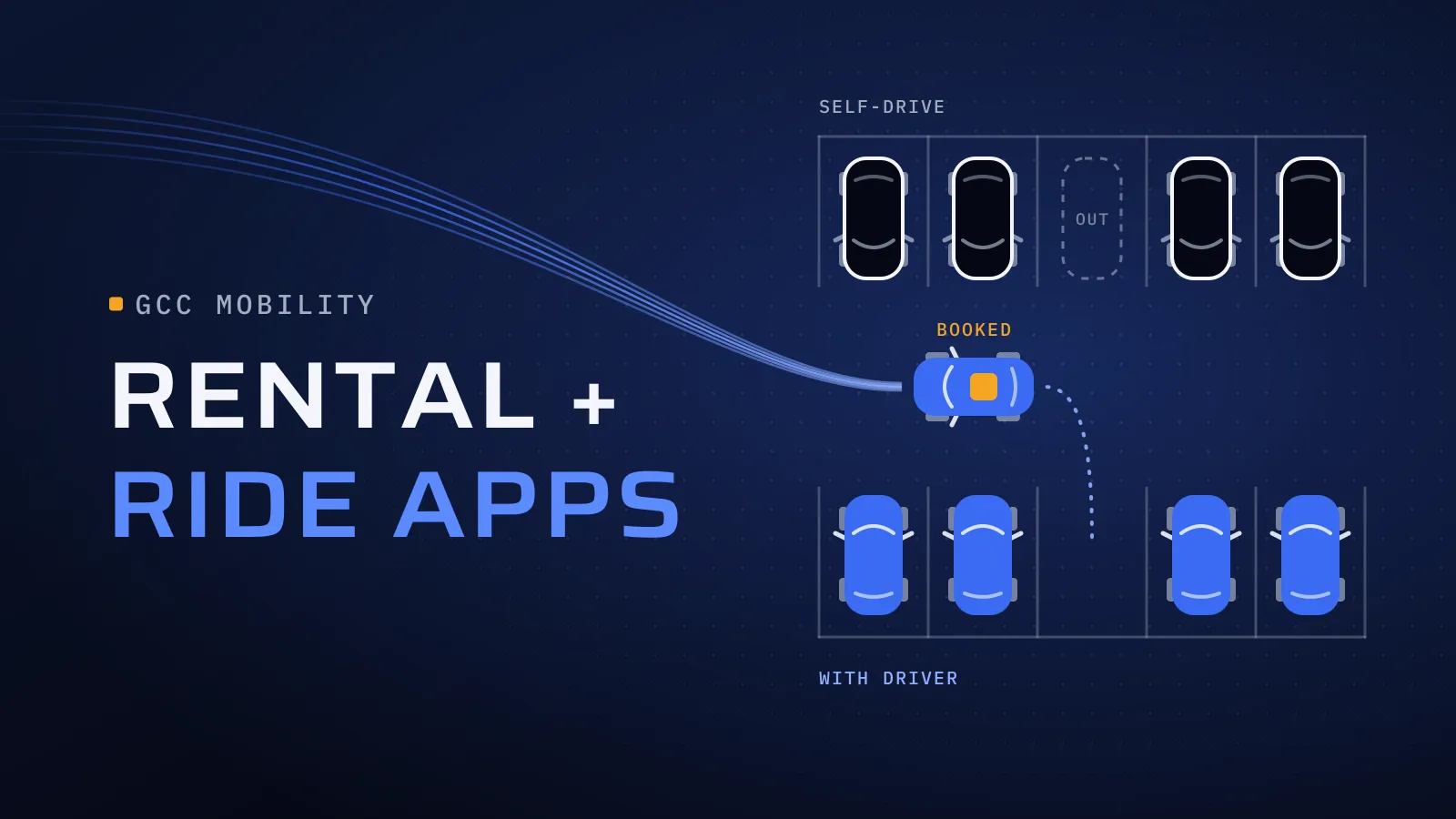
Car rental app development decides whether every car in your fleet has its day, its condition and its money on record. Run bookings on WhatsApp, check-outs on paper and deposits by hand, and each scratch becomes an argument, late fines come out of your margin and partners wait for their payouts; put them in one platform, and you rent more cars with fewer disputes.
What does car rental app development involve?
Quick answer: Every car rental app needs a customer app and an admin dashboard. A driver app joins when you deliver cars or offer rides, and an owner or partner dashboard joins when others list cars with you. Most of the work sits behind the screens: bookings, deposits, handover photos, fines and payouts. Self-drive in one city is the smallest first release; ride-hailing, partners and devices in the cars add to it, and in Dubai ride-hailing also needs the RTA’s authorisation. Tell us your fleet and model, and we reply with the effort, the team and the price.
Know your fleet and your first city? Talk to us about your rental platform →
What paper check-outs and WhatsApp bookings cost you
Each manual step leaks money. A scratch nobody photographed at pick-up becomes a repair you pay for. A traffic fine that reaches you weeks after the car came back stays with you if no booking record shows who had the car. Deposits refunded by hand take staff time and bring complaints, and partners who can’t see their own bookings ask for a statement every month. An app won’t run your operation for you, but it puts the evidence and the money of every booking in one place.
Types of car rental apps, and what each one needs
Most mobility apps in the GCC start as one of these types. Sort yours before you ask for a quote:
| App type | What it must do well | Watch out for |
|---|---|---|
| Rental company (self-drive) | Search by place and dates, the full price with deposit and insurance, licence and ID upload, extensions | Damage and fines that surface after the car is back |
| Monthly rental or car subscription | Plans, recurring payments, car swaps, servicing reminders | Mileage limits and early cancellation rules |
| Car sharing between owners | Owner listings, owner and renter checks, payouts to owners | Insurance cover, and who pays for damage |
| Chauffeur and limousine | Bookings by the hour or trip, airport pick-ups, corporate accounts | Driver schedules and transport permits |
| Ride-hailing (an app like Careem) | Requests, the nearest free driver, live tracking, the fare before booking | The transport regulator’s authorisation and fare rules |
| Corporate fleet booking | Staff booking pool cars, approvals, cost centres | Links to HR and accounting systems |
The apps and dashboards behind them
- The customer app. Search, see the full price before paying, upload documents once, book, pay and follow the booking. Residents and visitors carry different documents, so sign-up asks each for the right set.
- The admin dashboard. Your team runs the fleet, prices, bookings, document approvals, damage cases, refunds and reports from the web.
- A driver app, when staff deliver and collect cars or you offer rides: go online, accept a job, navigate, start and end it, and see earnings. Drivers use it for whole shifts, so large buttons and low battery use come first.
- An owner or partner dashboard, when other companies or owners list cars with you: their own cars, bookings and statements, without calling your team.
Settle one question before design: can the same car be booked for more than one service, such as self-drive and a monthly plan? If it can, every service must read one availability calendar, or a car gets booked twice for the same hour.
Deposits, damage photos, fines and payouts
This is where a rental platform makes or loses money, so design it before the screens.
- Deposits. Most rental firms place a hold on the customer’s card rather than charge it. On most card networks an online hold lasts 7 days by default, and vehicle rental is one of the categories where some networks allow up to 30 days (Stripe’s documentation sets out the rules by card network). If you keep deposits longer to cover late fines, ask your gateway what it supports, and show the customer the release date in the app.
- Damage photos. At pick-up and at return, the app takes the customer or your staff through the same set of angles, with the time and place stamped on each photo. A dispute is then settled from the record, not from memory.
- Fines and tolls. These are recorded against the car’s plate, so they reach your company, often after the car is back. The dashboard matches each one to a booking by plate and time, and charges the renter with the notice attached.
- Payouts. For partners, each booking splits into the platform’s share and theirs, less refunds and agreed charges. A statement partners open themselves saves your finance team the monthly calls.
Arabic, documents and payments in each GCC market
- Arabic and English across the apps, notifications, invoices and rental agreements, with right-to-left layouts from the first design. Check which language your drivers read most easily, too.
- Payments through a licensed local gateway: AED prices in the UAE, QAR through a QCB-licensed provider in Qatar, mada cards in Saudi Arabia and KNET in Kuwait. Apple Pay and Google Pay shorten checkout.
- Documents and rules differ by country and by service: which licences you accept, your minimum driver age, and whether ride-hailing needs its own transport licence. Keep them in settings your team can change, not in the app’s code.
Building an app like Careem or Hala in the UAE: what you build, and what the RTA decides
Careem and Hala are the ride apps Dubai riders already know, so “an app like Careem” is a clear brief. It covers two jobs: the apps and dashboards, which a development team builds, and the right to take rides, which the RTA grants. Plan them together, because the RTA’s conditions change what the software must do.
What you build. Ride-hailing needs these parts, with these jobs:
- Customer app: pick-up and drop-off by search or pin, the car category and fare before booking, the driver’s live position, card, Apple Pay or Google Pay, then a rating and a receipt.
- Driver app: go online, accept a request, navigate, start and end the trip, and see earnings. A trip must keep running when the signal drops.
- Dispatch and fares, behind the screens: offer each request to the nearest free driver, pass it on when a driver declines, and handle cancellations and no-shows. This decides whether the service holds up at rush hour.
- Admin dashboard: a live map of drivers and trips, driver documents with their permit expiry dates, complaints, refunds and fares.
- Partner or fleet dashboard: each taxi or limousine company sees its own cars, drivers, trips and payouts.
- Arabic: riders search places and read notifications and receipts in Arabic or English, with right-to-left layouts; drivers get the language they read best.
What makes it bigger: several car categories, each with its own fare; scheduled and airport rides; corporate accounts billed on one invoice; a wallet and promo codes; more emirates or countries; and more services in one app. Careem grew into food, groceries and payments, and each of those is a product of its own, so launch with rides.
What the RTA decides in Dubai. The RTA’s implementing bylaw for passenger transport by cars (Administrative Resolution No. 516 of 2022) sets conditions that reach into the software:
- An authorisation for the service. A company that takes on-demand rides through an app, a call or a website needs an authorisation from the RTA’s Public Transport Agency.
- Authorised partners and drivers. The operator undertakes to contract only with taxi and limousine companies the agency has authorised, and taxi and limousine drivers need the agency’s permit. If the cars are yours, check what your own company needs, too.
- A link to the RTA’s platform. The operator undertakes to connect its apps and systems to the electronic platform the RTA approves, as the agency specifies.
- The RTA’s fares. Fares follow the RTA’s tariff, with limousine fares above taxi fares, so the fare engine reads rates your team sets in the dashboard.
The agency publishes its detailed instructions on the RTA website and can update them, so confirm the current conditions with it before the build starts. Other emirates and GCC countries have their own regulators. You hold the authorisation; we build the platform around its conditions.
Talk to us about your ride-hailing app → Tell us your model (your own fleet, partner companies or both), your car categories and your first emirate. We reply with what release one covers, the effort, the team and the price.
How a car rental app project runs
- Map one booking from search to final payout, including the awkward cases: a car returned late, damage found at return, a fine that arrives after the deposit is released, a ride cancelled on the way. This discovery step ends with a written scope and the estimate to budget on.
- Choose your launch model: self-drive or chauffeur first, your own cars or partners’ cars, one city or several.
- Design the apps and dashboards in Arabic and English, overlapping the start of the build, and test a clickable prototype with a few customers, drivers and your counter staff. One cross-platform codebase usually covers iOS and Android; our guide to Flutter vs React Native helps you pick.
- Build release one in short cycles and test the money paths: a deposit hold that expires, a split payout, a refund after a damage claim. QA tests each cycle, and you try a working version at the end of each.
- Launch in one city, then add what your numbers ask for: bookings per car, cancellations and the share of bookings that end in a dispute. Apple and Google review the apps before they go live, so their reviews sit inside the launch plan.
Launch first or add later?
Take this to your operations lead. The last column says when a feature has earned its place.
| Area | Launch first | Add later | Add it when |
|---|---|---|---|
| Customer app | Search, full price with deposit, documents, book, pay, extend | Loyalty, subscriptions, monthly rentals | Repeat renters are a large share of bookings |
| Handover | Guided photos at pick-up and return, signed in the app by both sides | Keyless entry and a telematics device in each car | Cars are handed over without staff |
| Ride-hailing | Request, nearest driver, live tracking, fare shown before booking | Scheduled rides, airport pick-ups, peak pricing | Peak-hour requests outgrow your drivers |
| Deposits | Card hold, with the release date shown in the app | No deposit for verified repeat customers | Your booking history shows who is low-risk |
| Fines and tolls | Matched by plate and time, charged with the notice attached | Automatic import, where your providers offer a feed | Matching takes your team hours each week |
| Partners | Their cars, bookings, revenue and payout statements | Partner pricing rules, self-service car listing | You run more than a handful of partners |
| Admin | Fleet, prices, bookings, document checks, refunds, a daily report | Staff roles, maintenance schedules, detailed analytics | A second branch or city goes live |
Tell us your fleet, your cities and your model. Self-drive, chauffeur or both; your own cars or partners’. A few lines are enough. We reply with what a first release should cover, the effort, the team and the price, and what can wait.
Talk to us about your rental platform →
Not ready for a call? Ask for our company profile and we’ll send it to you.
What drives the cost of a car rental app
The cost follows the effort: which roles work on the platform, and how much each one has to build, the same way app development cost in Dubai is set for any app. A self-drive first release for one city typically involves:
- A delivery lead runs the plan, the risks and your weekly report.
- A UI/UX designer designs the app and dashboards in Arabic and English.
- Flutter developers build the customer app for iOS and Android from one codebase.
- A back-end developer builds bookings, deposits, fines, payments and the admin dashboard.
- A QA engineer tests every build cycle. DevOps joins part-time for hosting, backups and releases.
The effort moves most with:
- One service or two. Self-drive alone needs no driver app or dispatch. Ride-hailing adds both, with more mobile development and testing of live trips.
- Your cars or partners’ cars. Partners add a dashboard, split payments and payout statements: more back-end and QA work.
- Hardware in the cars. Telematics and keyless entry add an integration with the device maker, testing on real cars and a device for each car.
- Markets. Each country adds its currency, gateway, documents and Arabic content checks.
- Your other systems. Accounting, ERP or insurance links, so nobody retypes bookings. Each one means building and testing against that system.
For an estimate, send us:
- the service: self-drive, chauffeur or both, with your own cars or partners’;
- your fleet size and your first city;
- the platforms: iOS, Android and web dashboards;
- your main features, from the “launch first” column above;
- whether you need Arabic at launch;
- the systems it connects to, such as your accounting software or insurer.
We reply with the effort, the team and the price, phase by phase, so you see each release’s scope and price before you commit.
Plan your rental platform with us
We have built software and apps since 2014 for more than 100 clients across the UAE, Saudi Arabia, Qatar, Kuwait, the USA and Canada. We are a mobile app development company in Dubai, headquartered at Dubai Digital Park, with offices in Houston and Alexandria. Qargo is a car rental and ride-hailing platform we built in Qatar. Talk to the team that built it: book a meeting.
Two of the ways we work matter most on a rental platform. Scalable architecture: built for long-term growth, so every app and dashboard reads one fleet and booking record, and a second city or service adds to it instead of copying it. Independent QA: the person testing the deposit, refund and payout paths is not the person who wrote them. Planning a platform for Doha? See our software and app development company for Qatar page. Send us the list above, even half filled in.
Talk to us about your rental platform → We ask about your goal, what you use today, your timing and who else should be involved. You leave with clear next steps. We reply by email first and set up a call only if you want one. Asking commits you to nothing, and we sign an NDA first if you ask.
Frequently asked questions
How much does car rental app development cost?
It follows the effort: the roles on the team and how much each one has to build. A self-drive first release for one city needs a delivery lead, a UI/UX designer, Flutter developers, a back-end developer and a QA engineer. Ride-hailing, partner payouts and devices in the cars each add work for several of those roles. Send us your fleet and model, and we reply with the effort, the team and the price, phase by phase, before you commit to each phase.
How long does it take to launch a car rental app?
Self-drive in one city is the quickest route. Ride-hailing adds a driver app, dispatch and live tracking, and with them more mobile, back-end and testing work, so many operators launch self-drive first. The store reviews, your payment gateway's merchant checks and any transport licence go into the plan, so you get a dated release plan before the build starts.
Which type of car rental app should we start with?
The one that matches the cars and customers you have today. A rental company with its own fleet usually starts with self-drive bookings, a limousine company with chauffeur bookings, and a platform for other people's cars with listings, owner approval and payouts. Each service prices differently and needs different checks, so plan the fleet and booking record for all of them, then switch services on one at a time.
Do we need a tracking device in every car?
Not for a first release. Bookings, document checks, deposits and handover photos all work without one. A telematics device adds live location, mileage readings and keyless entry; add it when cars are handed over without staff, or when your fleet is large enough to justify the cost per car.
Should we build our own app or use ready-made rental software?
Ready-made rental software suits one branch with a standard fleet and simple rules, and we will tell you if it is enough. Build your own when partners list cars on your platform, when you combine rental and ride-hailing, or when your deposit, damage and pricing rules are how you compete. Either way, check that you can export your customer and booking data.
Who owns the app and its code?
You do. The code passes to your company once the project is completed and paid, and the App Store, Google Play and payment gateway accounts can be in your company's name from the start.
Do we need an RTA permit to launch an app like Careem in Dubai?
Yes, if the app takes ride requests in Dubai. Under the RTA's implementing bylaw (Administrative Resolution No. 516 of 2022), on-demand passenger transport booked through an app needs an authorisation from the RTA's Public Transport Agency. The operator also undertakes to link its apps to the RTA's electronic platform, follow the RTA's fares and work only with authorised taxi and limousine companies. Confirm the current conditions with the agency early; we then build the dispatch, fares and partner features around them from the first release.