ERP for Exchange Companies in the UAE: Branches, Currencies and Compliance in One System
ERP for exchange companies in the UAE: branch tills, rates and currency positions, remittances, KYC and AML checks, and when to buy or build the system.
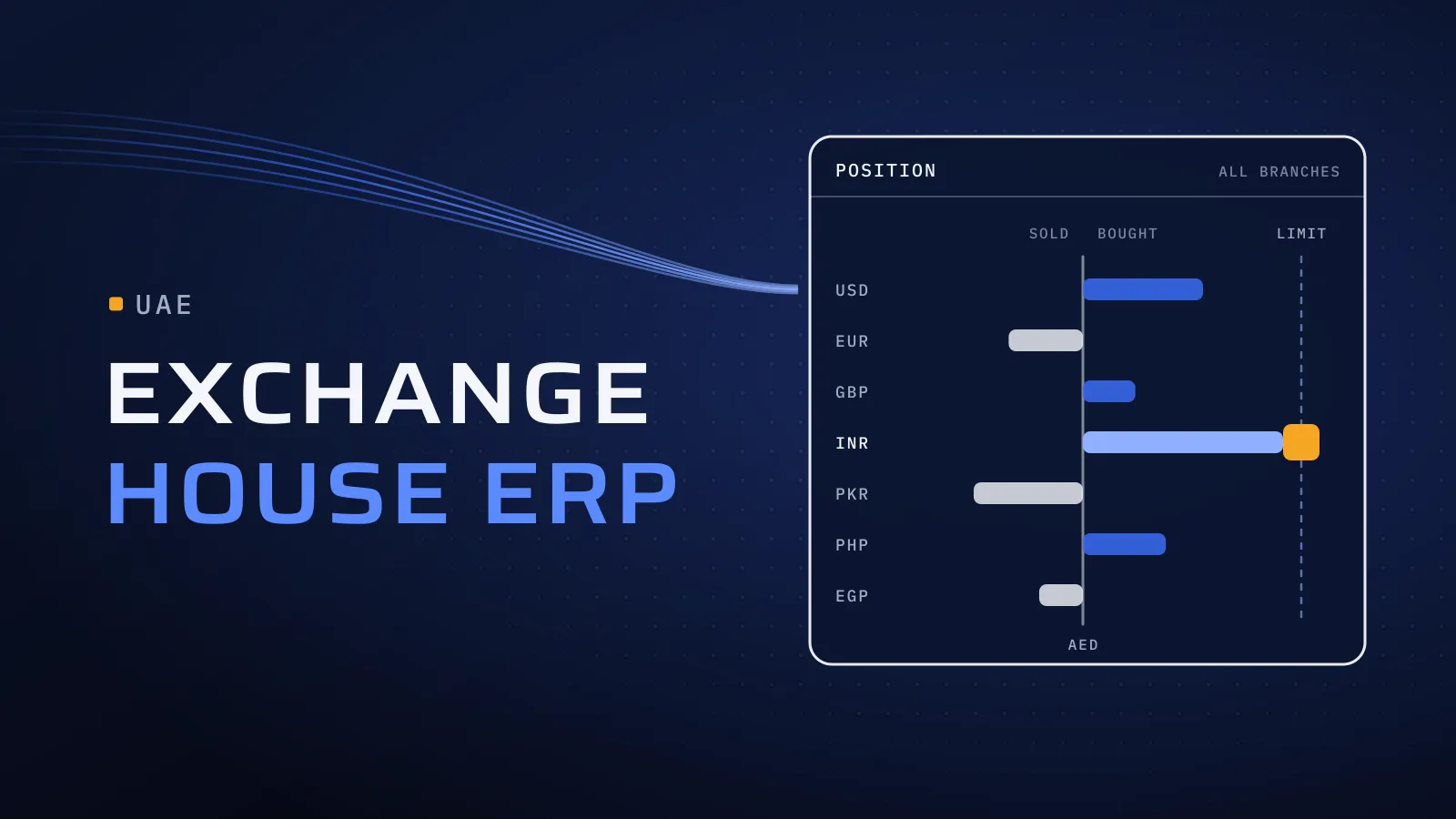
ERP for exchange companies in the UAE has to do work a general ERP was never built for: price each deal at the branch’s current rate, know the cash in every till by currency, and keep the customer checks behind every transaction ready for your compliance officer. When those sit in one system, the day closes on time; when they sit in separate tools and spreadsheets, someone rebuilds them every evening.
What should an ERP for exchange companies in the UAE cover?
Quick answer: Five things, in one set of records: branches and tills, rates and currency positions, remittances and their partners, customer checks built into each deal, and accounts that post themselves. General ERPs handle the accounts well and little of the rest, so exchange houses usually run a specialist package or a custom ERP connected to their accounting.
Running branches on separate tools? Tell us how a deal runs today →
What separate tools cost an exchange house
Each evening, branch totals are added up by hand, currency positions are rebuilt in a spreadsheet, and customer IDs sit in one system while the deals sit in another. Head office sees yesterday’s position, and the compliance team copies data between screens before it can review a single alert.
The regulator’s attention makes that gap expensive. The Central Bank of the UAE’s AML/CFT guidance for licensed exchange houses, issued in November 2021, weights the sector as highly important in risk terms because of its exposure to cash and cross-border transactions. It expects strong customer due diligence and continuous transaction monitoring, and both are hard to show when the records live in four places.
The checklist: what an exchange-house ERP must do
Take this to your operations head, finance lead and compliance officer. The last column is the question to put to any vendor, or to your own IT team.
| Area | What it must do | Ask any vendor |
|---|---|---|
| Branches and tills | Each teller’s drawer by currency and denomination, cash moved between branches and the vault, and an end-of-day close per branch | Can head office see every branch’s cash now, not tonight? |
| Rates and margins | Buy and sell rates set by head office per currency and branch, limits on how far a teller can move them, and the margin recorded on every deal | Who can change a rate, and where is the change logged? |
| Currency positions | A position per currency that moves with each deal and is revalued at the current rate | What is our US dollar position right now? |
| Remittances | Send and receive, partner and correspondent settlement, transfer status, and fees kept apart from exchange margin | How is each partner settled and reconciled? |
| Customer checks | The customer’s ID captured once and reused, expiry dates tracked, screening against the lists your compliance team sets before the deal completes, and thresholds that call for extra checks or a manager’s approval | What stops a deal, and who can release it? |
| Compliance queue | Alerts in one queue, with the deal, the customer and their history attached, and case notes kept on the record | Can a case be reviewed without copying data between screens? |
| Accounts and reports | Every deal posted to the ledger by branch and currency, with management reports and the data for your regulatory returns drawn from the same records | Do month-end and the returns come from one set of numbers? |
| Arabic and English | Screens, receipts and customer documents in both languages | Is the Arabic receipt designed, or translated at the end? |
How to read it: every question answered with “a spreadsheet” or “we export it” is a gap. One or two gaps can be closed with an add-on or an integration. Gaps in tills, positions and customer checks together mean the counter and the compliance work need a system built for them.
One line the system should never cross: it gathers the facts, and people decide. Your compliance officer reviews the alerts and files suspicious transaction reports with the UAE Financial Intelligence Unit through goAML. The ERP’s job is to have the customer, the deal and the history ready when they do.
Specialist package, general ERP or custom ERP?
Three routes cover most exchange houses. If a package already covers your checklist, buy it, and we will say so.
| A specialist exchange package | A general ERP with add-ons | A custom ERP | |
|---|---|---|---|
| Fits when | Your products and processes match what the package was built for | The back office matters most: accounts, HR, payroll and purchasing, with the counter run elsewhere | Your branches, products or approvals work differently, or you want counter, remittances, compliance and accounts in one system |
| Trade-off | Your process follows the vendor’s roadmap, and changes wait for their release | Tills, rates, positions and customer checks become add-ons or custom modules, each to test at every upgrade | More work up front and a system to maintain; in return it follows your process and your compliance rules |
| Arabic | Check receipts and customer documents, not only the menus | Depends on each add-on | Designed in from the first screen |
| Connections | Through the vendor’s own interfaces | Through the ERP’s API | Built to your partners, banks and screening provider |
| Our advice | Buy it if it answers your checklist | Use it for the back office, connected to the counter | Build when the checklist shows gaps no package closes |
The routes also combine. We implement Odoo in the UAE, and a counter system can post into it, so payroll and purchasing stay standard while the exchange work follows your rules. For that wider choice, see the signs a UAE business needs an ERP, and for the links between systems, our guide to API integration services in the UAE.
How an exchange-house ERP project runs
- Follow two deals from counter to ledger. One cash exchange and one remittance: every screen, paper form, spreadsheet and approval each one touches, at a branch and at head office.
- Agree the rules with compliance first. Thresholds, approvals, what stops a deal and who can release it are written down with your compliance officer before design starts. Each rule becomes a test.
- Build the first phase around one branch’s day. Tills, rates, deals, customer checks and the end-of-day close, posting to the accounts. Remittance partners and corporate clients follow in later phases.
- Run a pilot branch beside the old process. Compare the new close and positions with the old figures for an agreed period, then move the other branches one at a time.
- Give head office one view. Positions, margins by branch and currency, and the compliance queue, read from the records the branches work in.
Bring the checklist with your answers. Tell us how many branches you run, the currencies you hold and the systems you use today. We reply with the route we would take, what a first phase covers and what can wait. Talk to us about your exchange-house system →
Not ready for a call? Ask for our company profile and we’ll send it to you.
A custom ERP for exchange companies: Al-Mawared
Al-Mawared ERP is a custom, web-based ERP we built for exchange companies across the MENA region. Talk to the team that built it: book a meeting.
It belongs in the last column of the table above: a sector whose core work no standard module covers. Two of our pillars matter most for a system like this. Custom development: built around your business’s requirements, so the counter follows your process, not a package’s. Independent QA: a dedicated testing and quality assurance process, so the rules your compliance officer agreed are tested by someone who didn’t build them. Every project also runs under CTO oversight, with a dated plan in FloPlan, the delivery software we built and use ourselves.
Our page on fintech software development in the UAE covers the trading, payment and back-office systems we build for financial firms.
Start with one deal, from counter to ledger
Since 2014 we have worked with more than 100 clients across the UAE, Saudi Arabia, Qatar, Kuwait, the USA and Canada, from our headquarters at Dubai Digital Park in Dubai Silicon Oasis. Our custom software development in Dubai covers systems like this from first phase to support. Bring the checklist, even half answered, and one deal you would like to see run in one system.
Talk to us about your exchange-house system → We ask about your goal, what you use today, your timing and who else should be involved. You leave with clear next steps. The call commits you to nothing, and we sign an NDA first if you want one.
Frequently asked questions
How much does an ERP for an exchange company cost?
We don't publish a price list, because the cost follows your scope: the number of branches, the products you run, such as cash exchange, remittances and corporate services, the partners and providers the system connects to, and how much history moves across. Your price is agreed in your proposal, phase by phase, so you see each phase's cost before it starts.
How long does it take to go live?
Your dates are agreed in your proposal. The usual order is a pilot branch first, running beside the old process for an agreed period, then the other branches one at a time. That keeps every branch trading while the new system proves its numbers.
Can it connect to our remittance partners and screening provider?
Usually, through their APIs or the file formats they accept. Each connection is scoped in discovery and tested against the partner's test environment before any live transaction goes through it. If a link stops, the system holds the record, retries and alerts your team.
Does the system replace our compliance officer?
No. It gathers what the compliance officer needs: the customer's ID, the screening result, the deal and its history, in one queue. Decisions, and the reports filed with the UAE Financial Intelligence Unit, stay with your compliance team.
Can we move our history from the old system?
Yes. Customers, their ID records and open balances move first, tested on a sample and reconciled with your finance team before the full import. Older transaction history can move too, or stay in the old system as read-only for look-ups.