Digital Transformation in the UAE: Where a Mid-Size Company Should Start
Digital transformation in the UAE for mid-size companies: pick the first process, choose ERP, a portal, an app or AI automation, and order the steps.
Digital transformation in the UAE usually stalls at the start, not the end: a company buys a platform before it has chosen a process, and pays for software that nobody’s daily work depends on. Start with one process that costs you every week, give it the right kind of system, and the first result makes the case for the next step.
Where should a mid-size UAE company start its digital transformation?
Quick answer: Start with one process, not a platform: the one that costs you most each week, such as retyped orders, status calls or approvals by email. Then match it to a system: an ERP when departments retype each other’s data, a portal when customers or suppliers email you, an app for staff in the field, and AI automation when people copy fields from documents.
Know which process costs you most? Talk to us about where to start.
What a scattered start costs you
A programme that starts five systems at once spends its budget before a single process changes. Staff learn new tools while the old ones keep running, every department waits on the same integration, and the board sees cost long before it sees a result. One process at a time is slower to announce and quicker to prove: a before-and-after number your management can check.
How to pick your first process
- Ask each department head for the work they repeat, chase or retype. Five to ten candidates are enough. Spreadsheets passed around by email, approvals on WhatsApp and customers calling for status are the usual ones.
- Put four questions to each. How often does it happen? How many people touch it? What does one mistake cost? Does a customer or supplier feel it?
- Ask the golden question. Picture the new system for that process running, then ask: if this system disappeared tomorrow, would you lose revenue, lose efficiency, or stop operating? Revenue and operations come first; efficiency alone can wait a round.
- Check that it has an owner. Choose a process with one person who runs it every day and can decide quickly. Without one, the project waits on meetings.
Which system fits the process?
Take your two strongest candidates to this table. It covers the fixes a mid-size company reaches for most, from records to reports.
| If the problem is… | It is usually fixed by | A first release covers | Watch out for |
|---|---|---|---|
| Departments retype each other’s data; month-end and the VAT return are built by hand | An ERP; in the UAE, we implement Odoo | Accounting, sales, purchasing and stock on one database | Moving every department at once |
| Customers or suppliers email for status, documents and invoices | A customer or vendor portal on top of your ERP | One user group, one process, one ERP link | A portal with no system of record behind it |
| Staff in the field work from paper, calls and WhatsApp | A field or technician app | One job type, from dispatch to sign-off | Building screens before the office side is settled |
| Customers phone you for a service they could book or track | A customer app or web platform | The one journey customers repeat most | Features copied from a competitor |
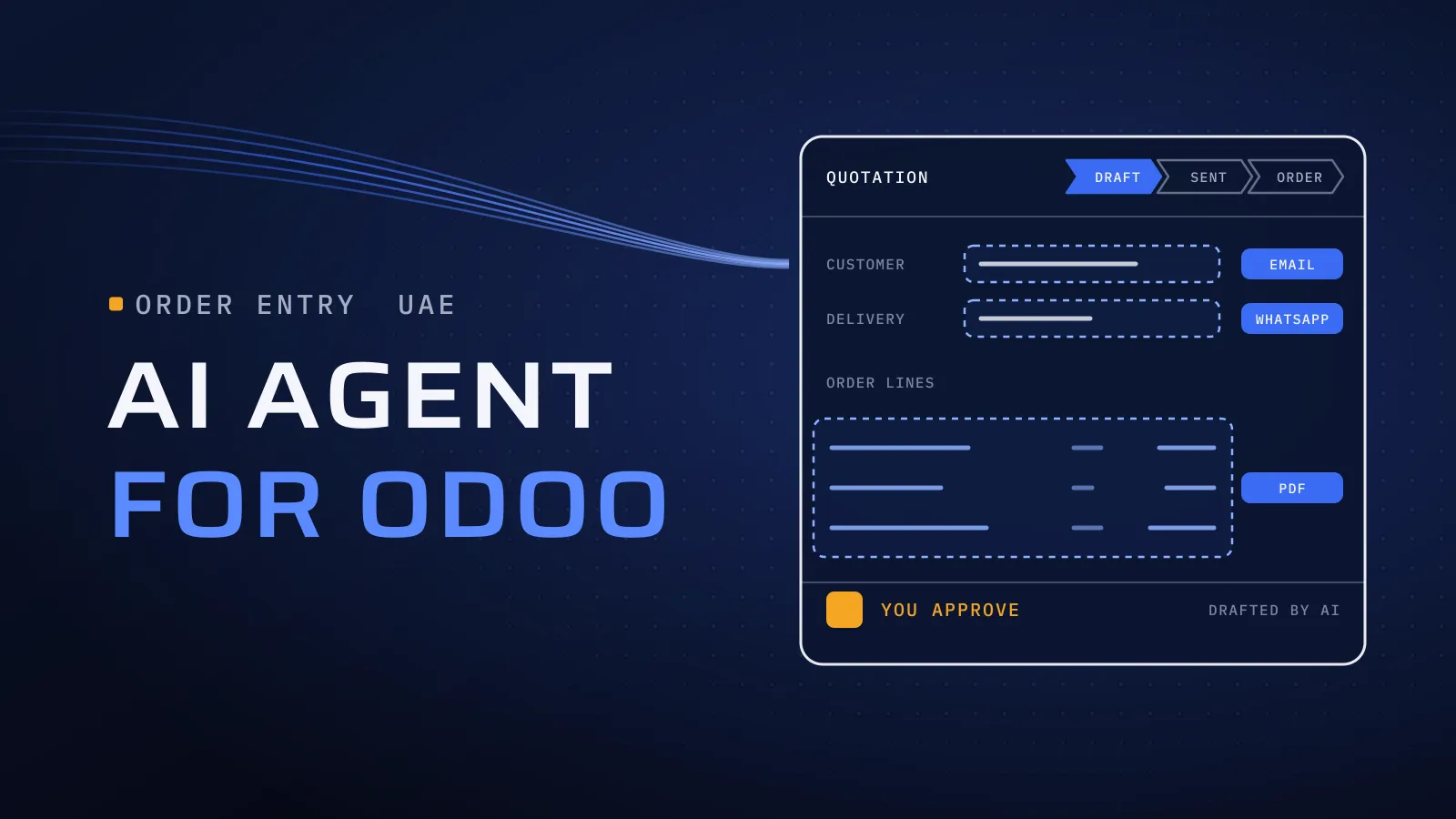
| People read documents and copy fields into a system | AI automation, with a person approving | One document type, such as supplier invoices | Starting AI on records nobody trusts |
| Managers wait days for numbers | Reports on the system where the work is recorded | The few figures someone acts on each week | A dashboard on top of spreadsheets |
How to read it: find your first process in the left column. If it fits two rows, start with the higher one, because the rows near the top hold the records the rows below them read.
Two rows have their own guides: customer and vendor portal development in Dubai, and a one-page AI readiness check that scores one process for a first AI agent.
What this means for you: if you are the COO or GM, your job this month is to choose one process, name its owner and count how often it happens. If you are the IT head, check whether your system of record is clean enough for what comes next, because a portal or an AI agent is only as good as the records under it. Neither step needs a budget yet.
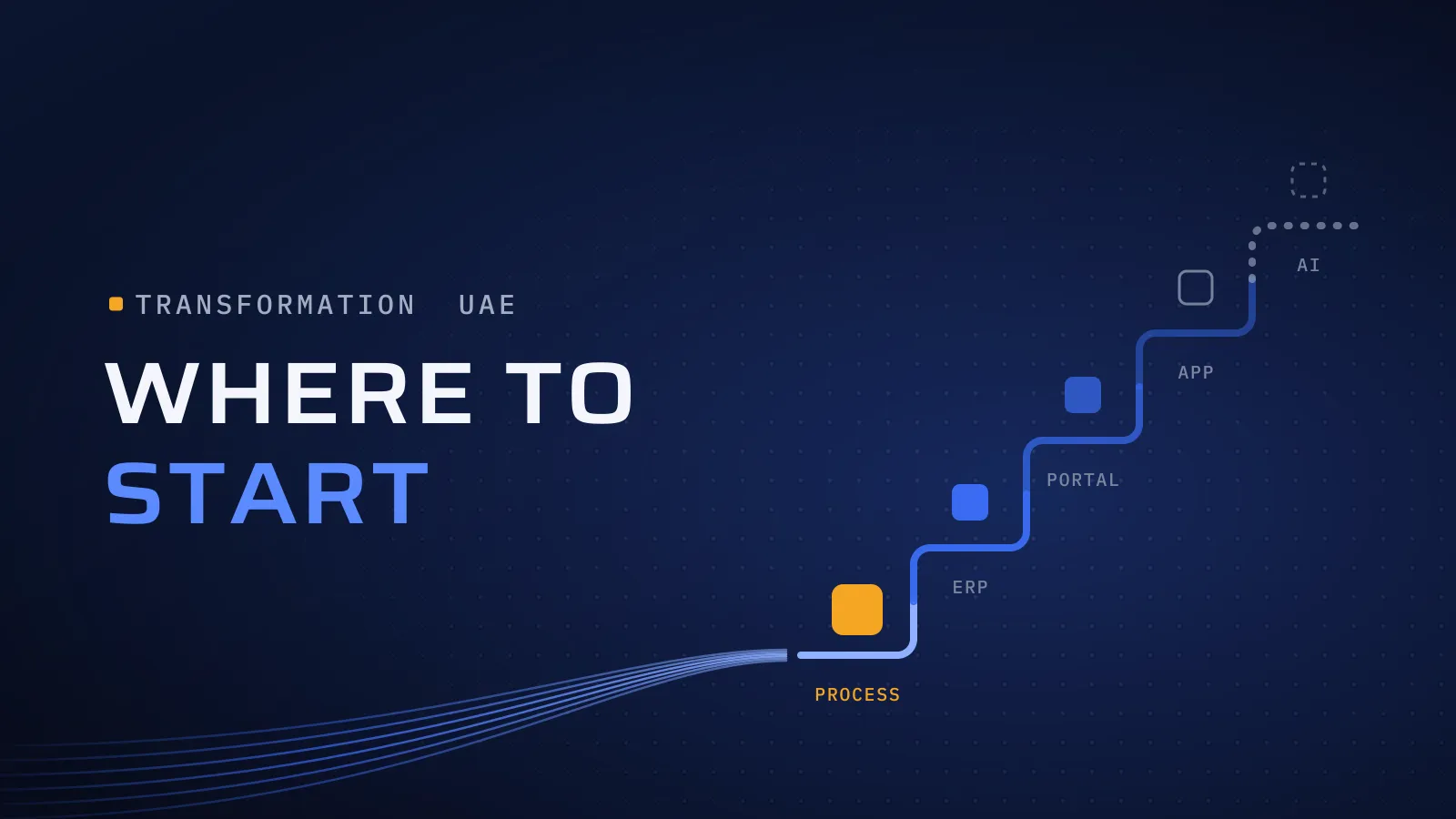
The order of steps for digital transformation in the UAE
A typical order for a mid-size company. Skip any step you already have.
- Records first. One system of record for the money path: an ERP, or your own platform if it already holds orders and customers. Everything after this reads from it. Our Odoo implementation in the UAE covers this step.
- Then the people outside. A portal for customers or suppliers, or an app for staff in the field, writing into the same records so nobody retypes.
- Then automation and AI. Approvals, reminders and document reading, once the records they act on are clean. Our AI automation in the UAE starts with one process and keeps a person on the cases where the stakes are high.
- Reports at every step. Each release adds records a report can read, so reporting improves as you go instead of waiting for the end.
Most first steps extend what you run rather than replace it: a portal on your ERP, an app that writes to it, an AI agent working through the apps your team already uses. Replace a system only when it blocks the process you chose.
Each step is a release with its own before-and-after number: calls per week, hours of retyping, days from order to invoice. The next step is scoped only after you accept the current one.
Send us your shortlist of processes, even two or three lines. We reply with the one we would start with, the kind of system that fits it and what a first release could cover.
Talk to us about where to start →
Need something for your board or procurement first? Ask for our company profile and we’ll send it to you.
Who should own it on your side
- A process owner from the business, not from IT: the person who runs the work every day and signs off each release. A weekly slot with them keeps the build moving.
- IT, for access, integrations and the systems that stay. They decide how the new release reaches the old systems, and who can see what.
- A build team with its own leadership. Ours puts a Product Owner, a Project Manager, CTO-level technical direction and an independent QA role around the developers. If your IT team would rather build it themselves, staff augmentation in the UAE adds developers to that team, and you choose who joins from our shortlist.
What keeps a programme on track
Two of our pillars matter most when the work runs in steps. Transparent delivery: clear milestones, reporting and communication, so management sees each release’s number rather than a status colour. CTO oversight: every project is supervised by senior technical leadership, so the system you choose in step one doesn’t block step three.
Start with one process
Since 2014 we have worked with more than 100 clients across the UAE, Saudi Arabia, Qatar, Kuwait, the USA and Canada. Our headquarters is at Dubai Digital Park in Dubai Silicon Oasis, with offices in Houston and Alexandria. We build custom software, portals and mobile apps, implement Odoo for UAE companies and automate work with AI, one process at a time.
Bring your shortlist. Talk to us about where to start → We ask about your goal, what you use today, your timing and who else should be involved. You leave with clear next steps. We reply by email first and set up a call only if you want one. Asking commits you to nothing, and we sign an NDA first if you ask.
Frequently asked questions
How much does digital transformation cost a mid-size UAE company?
The cost follows the first process, not the programme. Each release is priced in your proposal, and what drives the price is the number of user groups, the systems it connects to, how much data moves across and the languages it needs. You commit to one release at a time and see its price before work starts.
How soon do we see a result?
From the first release, because it is scoped to one process. Dates are agreed in your proposal. Before the build starts, you agree the number that should move, such as calls per week or hours of retyping, and you count it before and after.
Should we start with AI?
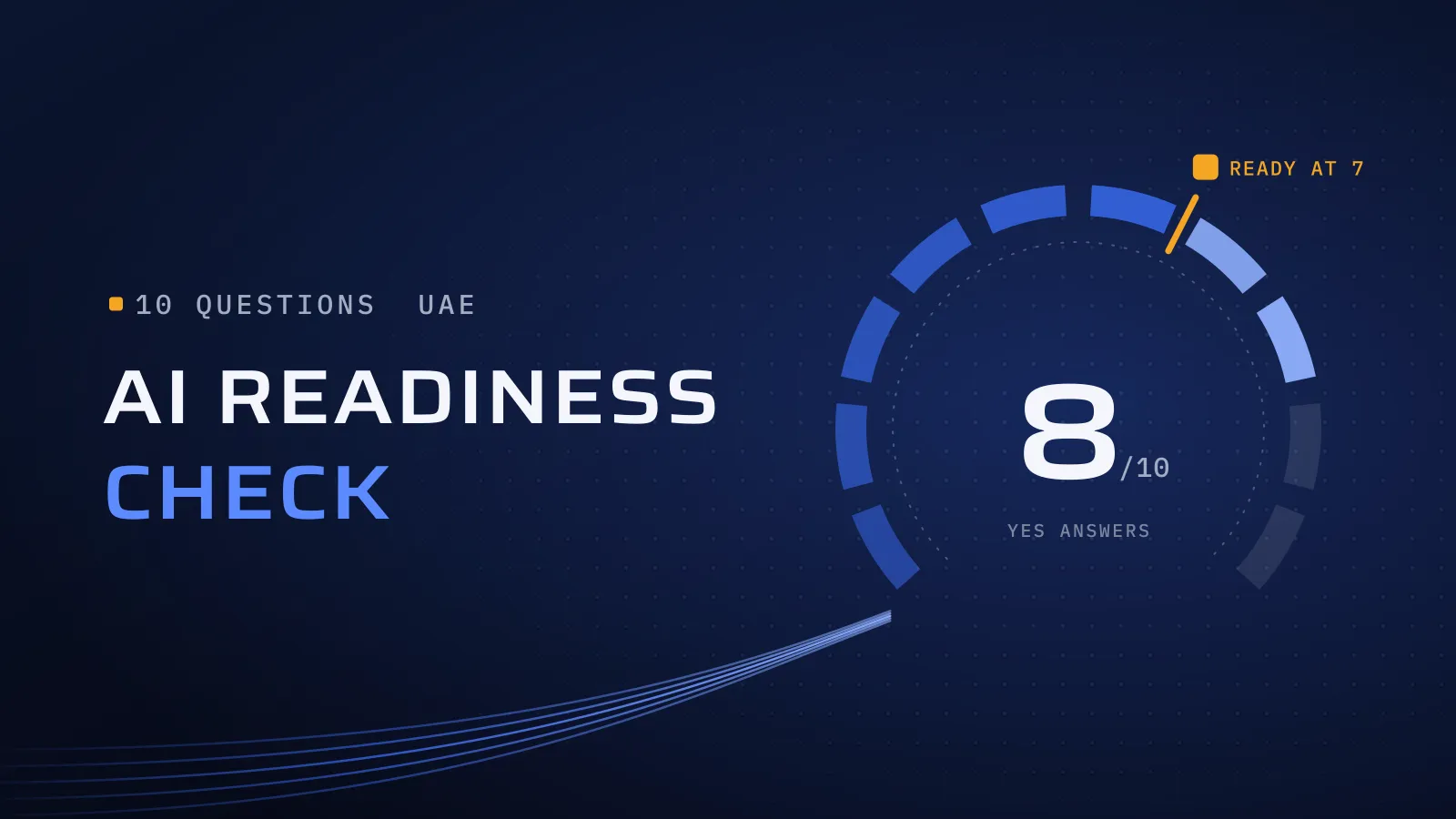
Only if your first process is one where people read documents or answer from records, and the data the AI needs is clean and within reach. Otherwise, fix the records first and add AI as the next step. Our one-page AI readiness check scores a process with ten yes/no questions.
Do we have to replace the systems we already use?
Usually not. Most first steps extend what you run: a portal on your ERP, an app that writes to it, or an AI agent working through the apps your team already uses. Replace a system only when it blocks the process you chose.
Who should lead it on our side?
The person who runs the process every day, with IT for access and integrations. A weekly slot with that person keeps decisions moving, and management sees one before-and-after number per release, so progress is visible without a committee for every step.
What if the first release doesn't change much?
Then you learn it on the smallest budget. The before-and-after number shows which step still costs time, and that step is fixed first. The next phase is scoped only after you accept the current one, so you never fund a programme that isn't working.